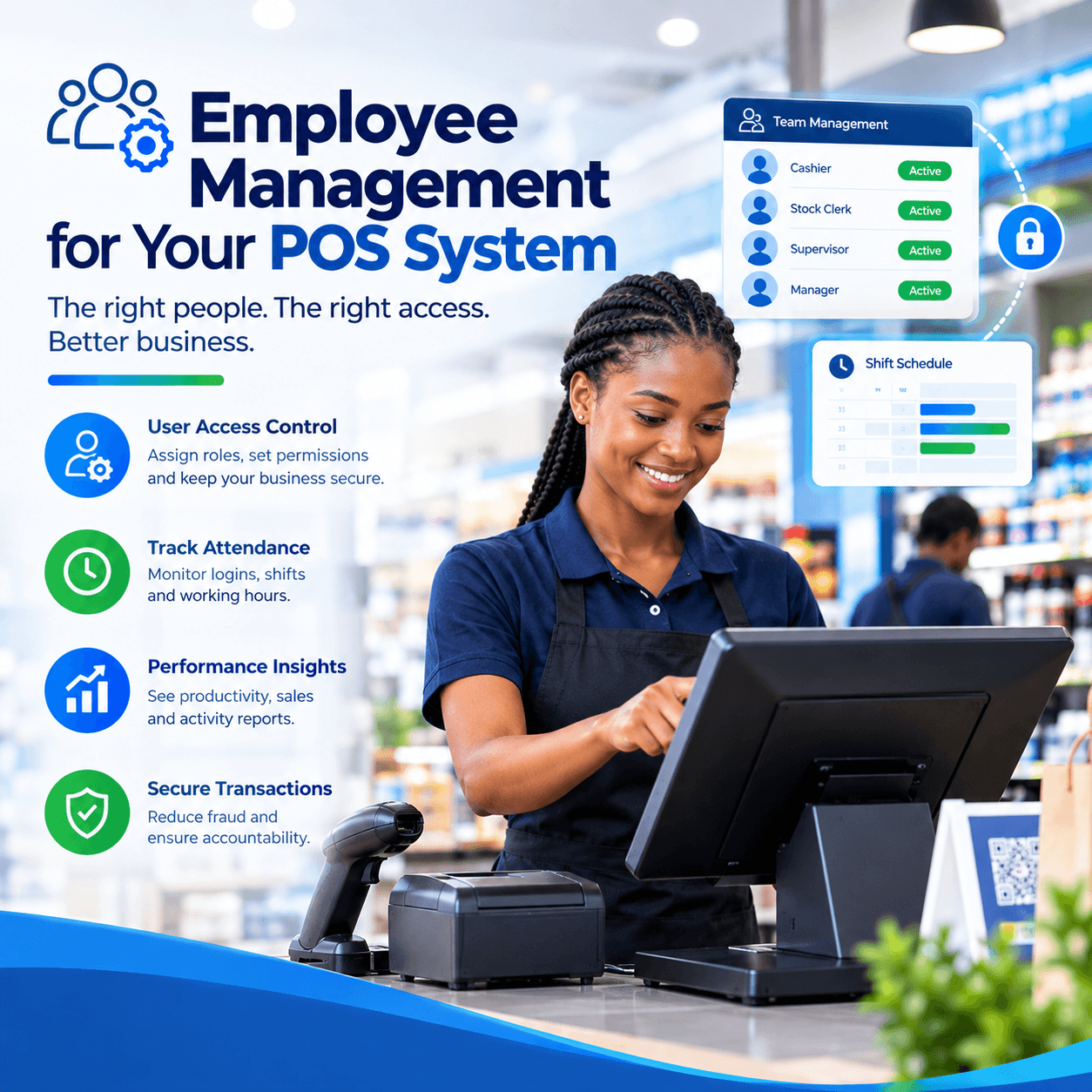
Employee management in a shop is decided less by policy documents and more by the machine on the counter — because the counter is where your staff actually work.
The till sees who rang what, when, at what price, and who approved the exceptions.
It knows who opened, who closed, who discounted, who refunded, and whose drawer came up short.
No HR file, no policy manual, and no Friday speech sees half of what a POS sees by Tuesday.
That is why serious employee management for retail lives inside the point-of-sale system — logins, permissions, time tracking, exception reports, and performance data, all drawn from the transactions your shop records anyway.
This article walks through that connection end to end: what weak employee management actually costs, the controls that work without poisoning the room, the reports that turn supervision into evidence, what everything costs, and how to choose a POS that does the job properly.
By the end, you will be able to judge any system against the only standard that matters: does it make the honest shift easy and the dishonest one impossible?
Employee Management and the POS Connection
Strip away the HR theory and employee management in a shop is four practical questions asked daily.
Who worked, and for how long? Who did what at the counter? Who performed, and who coasted? Who needs a conversation, and when?
A modern POS answers all four with data the business already generates — which is why employee management and the point-of-sale system belong in the same conversation.
Every sale, void, refund, discount, and stock adjustment is an action by a person, at a time, on a till.
Recorded properly, those actions become a work log no supervisor could ever keep by hand.
Ignored, they become noise — and the shop manages people by mood, memory, and whichever cashier was nearest when something went wrong.
In shops we configure, the moment logins and permissions go live is the moment supervision changes character: from watching to reading.
The owner of a shop running proper employee management controls spends the same half hour each evening — but reads a report instead of replaying the day from memory.
That shift — from presence to evidence — is the entire value proposition, and it is why employee management is now a core POS feature rather than an add-on.
The next sections build the system piece by piece, starting with the control everything else stands on.
The Cost of Managing Blind
Weak employee management does not announce itself; it leaks, in four currencies owners eventually count.
Shrinkage first: the discount to nobody, the refund without a return, the drawer that comes up short — all invisible where actions carry no names.
Hours second: attendance kept by memory, shifts stretched quietly, and month-end payroll built on arguments instead of records.
Performance third: your best cashier and your slowest one are paid identically and managed identically, because nothing distinguishes their work but anecdote.
And turnover fourth — the expensive one: good staff leave shops where the rules are vague and accountability is selective, and replacing a trained cashier costs real money.
Run those four lines monthly and the total usually dwarfs the cost of the employee management tools that would close them
There is a quieter cost too: the honest majority absorbs the suspicion that blindness creates.
When something goes missing and nobody can be excluded, everyone is under a cloud — and good people resent it precisely because they are innocent.
Proper employee management protects them first: a record that clears the honest is worth as much as the one that flags the rest.
That dual protection — catching the leak and ending the doubt — is why owners who install employee management controls rarely go back.
Logins and Permissions: The Foundation of Employee Management
Everything in this article stands on one rule: one login per person, everywhere, always.
Personal logins turn every counter action into a signed act — the sale, the void, the refund, the discount, the stock edit, each stamped with a name, a till, and a time.
Without that foundation, employee management is a poster on the wall: nothing downstream can be trusted because nothing can be attributed.
Permissions come next, and they encode your policy into the machine.
The cashier rings sales; the supervisor approves refunds; the manager adjusts prices; only you touch costs and user rights.
Roles defined once, applied across the whole team — and new staff arrive with the right rights on day one instead of inheriting whoever logged in before them.
Approval flows are the quiet hero here: sensitive actions route to a second person before they complete.
A void without approval is blocked and logged; a discount beyond policy asks for a PIN; a refund without a matching sale does not exist.
This is employee management enforcement that never tires, never looks away, and never plays favourites.
And the audit trail underneath it all is searchable history: every action by every user, on every till, forever.
When a question surfaces in March about a Tuesday in October, the answer is a lookup, not an argument.
In shops we configure, owners describe the same surprise: the logins change behaviour before anyone is ever accused, because ambiguity — the accomplice of every counter abuse — is simply gone.
Hygiene completes the foundation: leavers deactivated the same day, shared PINs banned — including yours — and logins reviewed monthly.
A surprising share of unexplained variances traces to a login three ex-employees once shared — the exact hole employee management hygiene closes for free.
Set the permissions tight from day one and loosen deliberately, never the reverse — tightening after an incident reads as accusation, while starting strict reads as standard.
That sequencing advice is worth as much as the employee management software itself, because rollout tone decides whether controls land as infrastructure or insult.
And when the foundation is in place, every other tool in this article becomes trustworthy — because every record in your employee management system has an author.
Time and Attendance
Hours are money, and attendance kept by memory pays memory’s rates — which are terrible.
A POS with time tracking turns the same logins into a clock: staff sign in at the till they will work, and the record of hours builds itself shift by shift.
No timesheets to fudge, no memory to argue with, and a payroll export that matches reality instead of somebody’s recollection of it.
For a small team this alone ends the month-end negotiation over who worked which Saturday.
The deeper value is operational: attendance data shows your real coverage against your real traffic.
Shops discover their busiest hour is understaffed and their quietest overstaffed — a mismatch invisible until the employee management data puts the two side by side.
Late starts surface too, not as accusations but as patterns: the shift that begins twelve minutes late three Fridays running is a conversation with evidence attached.
Overtime, leave, and shift swaps gain the same clarity — every change recorded, approved, and payable without reconstruction.
And because the clock lives in the till, there is no separate system to buy, feed, or ignore — the employee management data accumulates as a by-product of trading.
Ask any vendor how attendance connects to payroll: the confident answer is a clean export that the accountant confirms in minutes.
For teams paid hourly, this section pays for the entire POS by itself — attendance disputes are among the most expensive conversations in retail, and employee management time data ends them before they start.
The clock-in rule worth enforcing: staff sign in at the till they will actually work — a employee management record tied to the counter is the one nobody argues with.
Exception Reports: Accountability Without Policing
If logins are the foundation, the exception report is the daily reading — and it is where employee management becomes a five-minute habit.
The report lists departures from normal: unusual voids, discounts beyond policy, refunds without matching returns, price overrides, tills silent mid-morning.
Configured well, it is short by design — the system knows what normal looks like and speaks only when something departs.
Owners of a well-tuned employee management setup read it in five minutes each evening with three questions: is there a pattern, is there a person, is there a time?
One odd refund is noise. One cashier with twelve voids this week is a conversation.
Discounts clustered at closing time say something different from discounts spread evenly — patterns are the signal, single events are the static.
The discipline that keeps the report valuable is process: patterns earn questions and conversations, never ambushes.
Data used as a weapon destroys teams; data used as a process builds them — and the difference is entirely in how the owner behaves.
Read daily, the report also compounds in the other direction: weeks of clean lists are evidence your shop is tight, worth as much to your sleep as to your insurer.
The exception report is the highest-yield five minutes in employee management — and it exists only where actions carry names.
That daily reading habit is the difference between employee management software you own and software you merely pay for.
Every serious employee management defence runs on it the way a shop runs on its opening checklist: routinely, quickly, without drama.
Performance You Can Coach
Beyond catching problems, the same data identifies excellence — and that is the half of employee management most owners never get to.
Sales per cashier per shift, baskets by hour, speed at the counter during peak, returns handled cleanly — all of it already recorded, all of it fair.
Fair is the operative word: because every cashier works the same system, comparisons start from shared numbers instead of competing stories.
The best staff become visible — and visibility is the cheapest retention tool in retail, because nothing retains a good cashier like being recognised with evidence.
Training becomes targeted: coach the slowest counter path, not a generic service day, and measure the change in the same data next month.
Scheduling follows performance: put your strongest pair on the peak hours your reports name, and watch the basket averages move.
Promotion decisions stop being affection and start being arithmetic — the shift supervisor you promote from evidence manages better from day one.
And underperformance gains the same honesty: conversations that begin with a chart end in improvement far more often than conversations that begin with a feeling.
In shops we configure, the performance reports become the quiet favourite of good staff — because for the first time, effort has a scoreboard.
That scoreboard is what turns employee management from surveillance into sport: everyone can see the game, so everyone can play it.
The coaching loop worth installing: name one metric per cashier each month, review it in five minutes, and let the employee management data track the change — small, fair, and relentless.
Fair comparisons need fair context, which is why a serious employee management platform lets you weight for hours worked and section difficulty before anyone is ranked.
Scheduling That Follows the Data
Staffing is where employee management meets the revenue line, and the data makes the meeting honest.
Hourly sales reports name your true peaks — not the peaks habit assumes — and coverage should follow them, shift by shift.
Shops that align rosters to traffic see the same two results: faster queues at rush hour and a payroll that stops paying for empty hours.
The data also resolves the scheduling arguments that consume owners: who covers Saturday, who closes late, who trades shifts — all recorded, all fair, all visible.
Month-end peaks, pay-week surges, and holiday patterns repeat, and your employee management history makes them plannable instead of surprising.
Time-tracking feeds the same loop: attendance history shows who is reliable at opening and who is not, which is scheduling information no interview ever reveals.
And labour cost per hour sold becomes a number you can manage — the ratio that turns staffing from a feel into a lever.
The pattern is consistent across trades: the shops with the calmest operations are not the ones with the fewest staff, but the ones whose employee management data put the right people at the right hours.
Scheduling is also where multi-branch owners feel the gap most: two shops on paper systems schedule by phone, and both are wrong somewhere every week.
A shared platform ends that — coverage, attendance, and performance visible across locations from one screen, which is the group-level promise of employee management done well.
For a single shop, one honest hour with the hourly report redesigns the rota for good — that hour is the cheapest employee management investment on this page.
Choosing a POS With Employee Management: The Demo Test
Bring this script to every vendor; it converts claims into evidence in fifteen minutes.
Create two users and break a rule. Attempt a void without approval, a refund without a matching sale, and a discount beyond policy — a serious employee management platform blocks all three and logs the attempts.
Read the exception report live. Ask to see it populated with realistic events, not an empty screen — the difference between a real tool and a checkbox.
Pull one cashier’s day. Every action, one person, one afternoon — the speed and depth of that answer reveals how deep the logging really goes, and it is the employee management question that ends pretenders fastest.
Clock in and out. Watch attendance build from the same logins, then ask how it exports to payroll.
Compare two cashiers fairly. Performance side by side, weighted for hours and sections — if the demo cannot rank two users sensibly, your team will not trust it either.
Deactivate a user. Watch the access disappear everywhere at once — that single flow is where employee management security lives or dies.
Test the offline path. Unplug the router and confirm logins, approvals, and the audit trail all continue locally — controls that die with the connection protect nobody on the day of the fibre cut.
A employee management platform that passes all of this fluently is built by people who have run counters; one that improvises is selling a feature list.
Then ask the two background questions: can reports reach my phone daily, and can I revoke a login the moment someone leaves?
Finally, request one reference from a business your size and ask a single question: what changed in your team after three months?
The answer from an owner running real employee management controls — usually fewer surprises, delivered with some relief — is worth more than the entire demonstration.
Rolling Out Employee Management Without Poisoning the Room
Controls introduced badly damage morale; introduced well, they are welcomed — and the difference is communication.
Announce the system as what it is: protection for the shop and for the people in it, because a record that clears the honest is worth as much as the one that flags the rest.
Involve the team early — let cashiers test the logins, see the approval flows, and ask questions before go-live rather than whisper them after it.
Say plainly what the data will and will not be used for: patterns earn conversations and process, never ambushes — that single sentence, kept, buys a team that works with the system instead of around it.
Do not retro-accuse anyone from a year of reconstructed memory, because the whole point of employee management controls is that the guessing era ends at go-live.
Set the baseline cleanly — first accurate logins day, first clean week — and let every variance after that be judged on the new, shared record.
Nominate no one and suspect no one in week one; let the reports speak in their own time, and answer only what they actually say.
And train yourself too: the owner who cannot read the exception report or pull an audit trail has bought the staff a very expensive clock.
Most teams settle within a fortnight, and the pattern across the market is consistent: the staff who resist hardest on day one are often the first to say the till arguments ended.
The teams that thrive on employee management data share one habit: they celebrate what the reports reveal as often as they correct it.
A guided employee management rollout — logins, whole-team training, week-one review — typically runs one to two weeks with the doors open throughout.
Done this way, the system lands as infrastructure, not surveillance — and infrastructure is the version of employee management that lasts.
Mistakes Owners Make
Five patterns catch owners first; learn them here without paying for them.
Keeping shared logins for convenience. One shared PIN erases the name from every action and the entire system goes slack — one login per person is the cheapest, most important rule in employee management.
Buying the system and never reading the exceptions. The most common failure in this category — controls exist, reports generate, nobody opens either, and the leak continues with better documentation.
Using data as a weapon instead of a process. Ambushes built on reports end teams and trust at once; data earns conversations, and conversations follow process.
Measuring nothing but sales. A cashier who handles refunds gracefully and keeps the queue calm creates value the sales column never shows — a serious employee management view weighs several metrics before ranking anyone.
Skipping the owner’s own training. The owner who cannot read the reports or revoke a login has bought the staff a very expensive clock — finish your own training first.
Two quieter mistakes complete the set: announcing employee management the week after a shortfall turns protection into accusation, and forgetting the positive half — the same data that flags patterns should crown your best performers monthly.
Owners who avoid these five get what every employee management platform promises and few deliver completely: an honest shift made easy, a dishonest one made impossible, and a team that knows the difference.
What Employee Management Is Worth
Price the return honestly, in the four currencies it pays.
Recovered leakage first: named actions, approvals, and exception reviews typically shrink counter losses within the first quarter — in shops we configure, the exception report pays for the software before the first stock cycle ends.
Hours second: attendance data and aligned scheduling return the payroll arguments, the ghost hours, and the overstaffed quiet shifts to the budget.
Retention third: recognition with evidence keeps good staff, and every avoided replacement saves recruiting, training, and the mistakes a new hire makes on the way to competence.
Decision quality fourth: promotion, correction, and scheduling all move from feeling to evidence — and evidenced decisions compound for as long as you trade.
Run your own four-line arithmetic before comparing any quote, because the numbers make the decision for you.
A capable employee management platform rides inside a mid-tier POS subscription — typically KES 3,000–7,000 monthly — with no separate system to buy or feed.
Against it, most shops find the recovered hours and leakage alone cover the cost several times over — before counting a single retained cashier.
And the daily return is felt before any spreadsheet: shops running employee management controls describe evenings without till arguments — a benefit no report captures.
Frame the purchase the way serious operators do: employee management is not an HR expense — it is the control layer that makes every other shilling invested in your team finally measurable.
Scaling From One Shop to a Team of Twenty
Employee management changes shape as the team grows, and the platform grows with it.
At one or two staff, the value is simplicity: clean logins, honest hours, and a week that reconciles without conversations.
At five to ten, patterns begin to matter: exception reports earn their five minutes, performance comparisons become fair, and scheduling follows real traffic.
At twenty across shifts, the discipline becomes infrastructure: roles defined once, approvals routed properly, and payroll exported without a single reconstruction session.
Across branches, the same logins and permissions extend everywhere — one standard, applied identically, visible from one screen.
That continuity is the group-level promise of employee management on a shared platform: the branch you cannot stand in is managed by the same evidence as the one you can.
Growth also changes what you should demand: ask any vendor how their employee management handles your next size up, not just your current one.
The platform you buy at two staff should still serve you at twenty — because re-platforming a team mid-growth is a project nobody enjoys
And growth rewards the shops that kept clean records early: the supervisor you promote at branch two is chosen from an employee management history that goes back years, not from last month’s impression.
That is the quiet compounding of employee management done from the start — every clean month becomes a decision you can defend later.
Frequently Asked Questions
Does a POS replace a separate employee management app?
For retail, mostly yes: logins, permissions, attendance, approvals, exceptions, and performance all live in the transactions the POS records anyway.
A separate HR tool adds value only for larger teams with formal HR needs — for most shops, employee management inside the POS is the leaner, more trusted source.
Will my staff resent the controls?
Handled well, no — announced openly, framed as protection for the honest majority, and used through process rather than ambush, most teams settle within a fortnight.
Many come to prefer it, because till disputes and blanket suspicion end, which is the everyday promise of employee management done right.
How do I handle a pattern the exception report surfaces?
Follow process: review the data, hold a private conversation, agree the correction, and monitor the next cycle — never ambush, and never accuse on a single event.
Patterns are what employee management evidence is for; single events are usually just Tuesdays.
Can it track hours for payroll without a separate time system?
Yes — the same logins that sign staff into the till become the clock, and attendance exports straight to payroll.
Confirm the export format with your accountant during the demo, because a clean employee management payroll handoff is the test that matters.
What is the single most important rule?
One login per person, everywhere, always — shared PINs erase the name from every action and every control downstream goes slack.
Every other employee management practice on this page assumes that rule is kept.
Is this worth it for a shop with only two staff?
Usually yes: even a tiny team gains honest hours, clean approvals, and evenings without till arguments — and the records you start today become the evidence you manage with at ten.
The first clean month on a employee management platform is typically when owners stop asking whether two staff needed it.