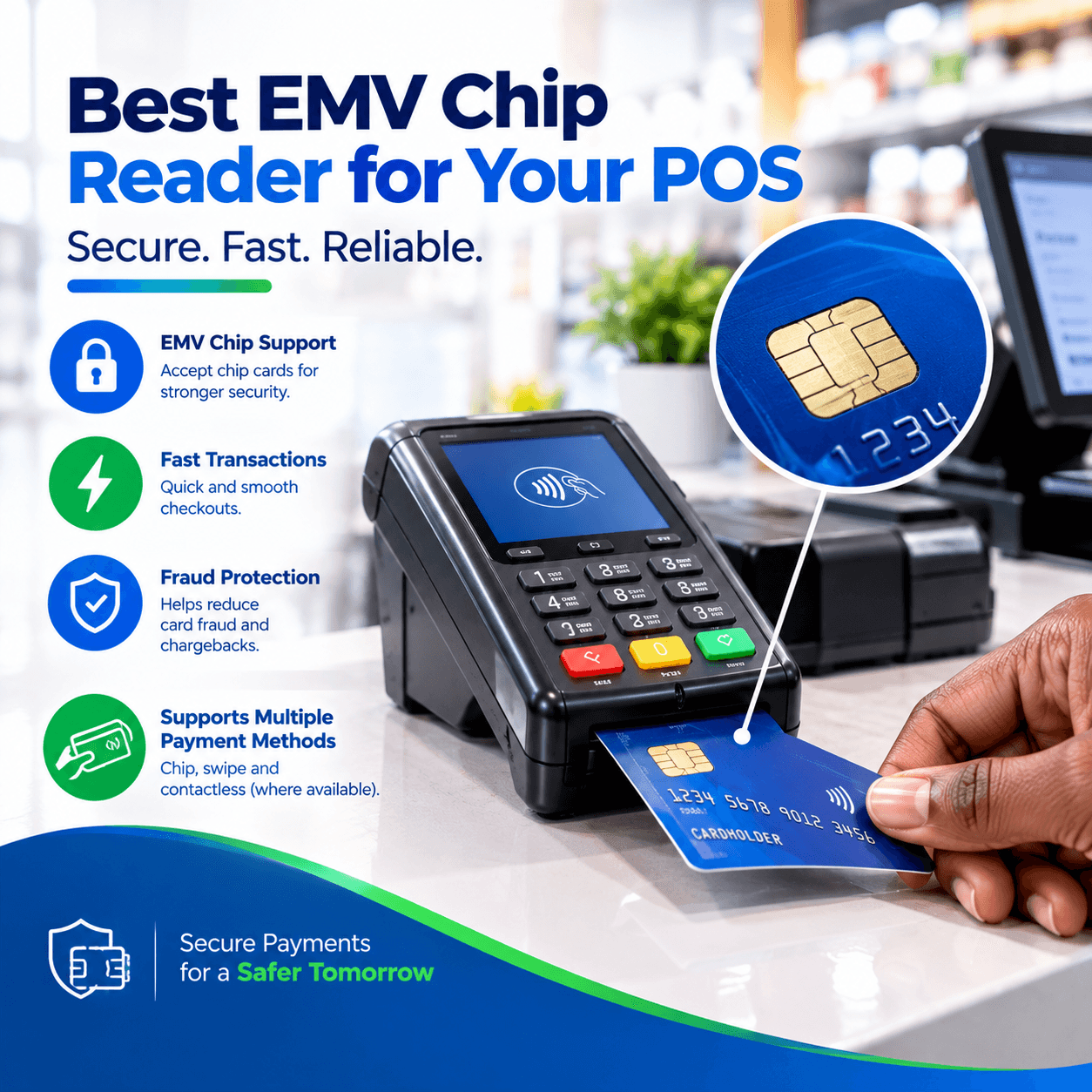
EMV chip reader technology is the small gold square on your customer’s card — and the machine that reads it has become the quiet standard at serious counters everywhere.
If your shop takes cards at all, the chip reader is the piece of hardware doing the security work: generating approvals the old magnetic stripe could never produce, and ending the fraud stories that followed swipe machines for decades.
But EMV is also one of the most misunderstood purchases in retail — owners buy terminals without knowing what the chip actually does, what it costs per sale, or how it should connect to the till.
This article explains the whole machine in plain language: what an EMV chip reader is, why it matters in this market, how a chip transaction actually works, how it integrates with your POS, what everything costs, and how to test any terminal before your money moves.
By the end, you will read a terminal quote the way a payment professional does — knowing exactly what you are buying and what you should refuse to pay for.
What an EMV Chip Reader Actually Is
EMV stands for Europay, Mastercard, and Visa — the three networks that created the global chip standard in the 1990s.
The technology itself is the microchip embedded in modern bank cards, and an EMV chip reader is the terminal that talks to that chip when a customer dips or taps.
Here is the honest engineering summary: the chip is a tiny computer that proves the card is genuine.
When a customer dips a card into an EMV chip reader, the chip and the terminal run a cryptographic conversation — creating a unique code for that one transaction, one time, that cannot be reused.
Contrast that with the magnetic stripe: a stripe carries the same static data every single swipe, so once that data is copied, it can be replayed anywhere by anyone.
The chip’s dynamic codes are why cloned-card fraud collapsed in every market that adopted EMV — the copied data becomes useless after a single use.
Most terminals sold today read all three ways: dip the chip, tap for contactless, or swipe the stripe as a fallback.
Chip-and-PIN is the common flow in this market — the customer dips and enters a PIN on the terminal’s keypad.
So when a vendor says EMV, they mean this: a terminal certified to read chip cards the secure, network-approved way — and any EMV chip reader worth buying carries that certification openly.
Why an EMV Chip Reader Matters in Kenya
The case for EMV rests on three arguments, and each one lands on your counter differently.
Fraud protection comes first: chip transactions are dramatically harder to counterfeit, and a shop running a proper EMV chip reader simply stops appearing in the fraud stories that follow swiped cards.
Card-issuing banks across this market moved to chip cards years ago, which means your customers are already carrying the technology — the only question is whether your counter can read it properly.
Liability is the second argument, and it is the one owners miss.
Across global card networks, liability rules shifted so that fraud on a non-EMV transaction tends to land on whichever party was less secure — usually the merchant still swiping stripes.
A shop that declines to support chip transactions inherits a risk position it never agreed to read closely, and a compliant EMV chip reader moves that risk back to where it belongs — with the networks and issuers built for it.
Customer trust is the third: the growing share of card-preferring customers — professionals, corporates, expatriates — expect to dip or tap without a conversation.
A counter that fumbles chips, or pushes every card customer toward the stripe, quietly signals that its payments are second-rate.
And there is a practical bank-behaviour argument too: many issuers in this market flag stripe transactions for extra scrutiny, so a shop running a genuine EMV chip reader sees fewer awkward declines at the counter.
None of this means cards replace mobile money — they do not, and should not.
It means the card customers you do get deserve the secure, modern flow they already expect — which is exactly what a certified EMV chip reader delivers on every dip.
How a Chip Transaction Actually Works
The flow is worth understanding, because it is what you are buying — and it takes about ten seconds end to end.
The customer dips the card into the EMV chip reader and leaves it there.
The chip and the terminal authenticate each other — the terminal proves it is a legitimate reader, the chip proves it is a genuine card.
The chip generates a one-time transaction code — unique to this sale, this amount, this terminal, this minute.
The terminal sends the request to the customer’s bank, the bank approves or declines, and the EMV chip reader prints the receipt while the card is still dipped.
The customer removes the card, and the transaction is closed — no signatures in most flows, just the PIN on the keypad.
What you never see is the part that matters: even if a criminal copied everything they could observe from that transaction, the one-time code is already spent and worthless.
That single property is the entire security argument for an EMV chip reader over a swipe machine.
Two flow variations deserve a note.
Contactless taps use the same chip — held over the reader instead of dipped — with the same dynamic security and often faster through the queue.
And offline authorisation exists in the standard for small values: some chip transactions can be approved on the terminal itself within risk limits when connectivity is weak, though the merchant carries defined risk on those — a nuance to ask each provider about before relying on any EMV chip reader offline promise.
EMV Chip Reader vs Magnetic Stripe vs Contactless
The three payment paths at your counter are not competitors — they are a hierarchy, and knowing it protects your money.
Magnetic stripe is the legacy path: static data, cloneable, and the reason chip cards exist at all.
Every serious EMV chip reader still accepts stripes as a fallback for damaged chips, but the stripe should be the exception at your counter, never the routine.
Chip dip is the secure workhorse: dynamic codes, PIN-verified, and the flow your bank’s fraud systems trust most.
Contactless tap is the same chip security delivered faster — the customer taps, the terminal reads the chip over the air, and the transaction completes in a couple of seconds.
A modern EMV chip reader does all three, and the difference shows up in the queue: taps and dips both move faster than cash for most baskets, and far faster than a stripe that needs three attempts.
There is also SoftPOS to understand — software that turns an ordinary Android phone into a contactless acceptance device, certified through the same EMV standards.
SoftPOS suits lean starters and mobile sellers, while a dedicated EMV chip reader suits fixed counters with steady card volume — the right answer depends on your counter, not the brochure.
One decision rule covers everything: the stripe is your fallback, the chip is your standard, and the tap is your speed — and any terminal worth buying treats all three as first-class paths on the same EMV chip reader.
Integrating an EMV Chip Reader With Your POS
The terminal is half the purchase; the integration is the other half, and it is where most owners get sold the wrong thing.
Standalone is the basic level: a card machine from your bank or payment provider sitting beside the till, with the cashier typing the amount twice — once on each device.
Payments work, but the records never meet, and the evening reconciliation becomes a manual matching exercise.
Semi-integrated is the middle level: the POS sends the sale amount to the EMV chip reader automatically, so the amount is right, but confirmations still get matched by hand at closing.
Fully integrated is the level worth buying: the card transaction lives inside the sale — approval, reference, and settlement all stamped on one record, with end-of-day reconciling itself by channel.
On a fully integrated setup, the cashier rings the basket once, the EMV chip reader receives the amount automatically, the customer dips or taps, and the approval lands on the sale without a second keystroke anywhere.
Refunds reverse to the same card, attached to their originals — no cash conversations, no missing money.
The evening report splits card takings against cash and mobile money, each reconciled to the shilling.
When you evaluate any EMV chip reader, ask the vendor directly which level they are selling — and then verify it live, because the levels look identical in a brochure and behave completely differently in month three.x
The pairing question matters too: your terminal must be certified with your acquirer or payment provider, not just with the POS software.
A EMV chip reader that is technically brilliant but uncertified with the bank that must actually settle your money is an ornament — confirm the certification chain before you sign anything.
Networks, Connectivity, and the Offline Question
Card approvals genuinely require connectivity to the customer’s bank — no vendor can honestly promise otherwise, and any that does is selling you a problem.
But real outages are rarely total, and this is where terminal design separates professionals from importers.
Terminals on SIM cards ride the mobile networks independently of your shop’s broadband — so when your router dies, a SIM-connected EMV chip reader keeps approving while the neighbour’s counter goes dark.
Terminals that share your broadband fail with it, which is why dual-path terminals — broadband primary, SIM fallback — are the resilient choice for fixed counters.
Ask each provider exactly which network path their terminal uses, and what happens when the primary path fails — the confident answer involves automatic failover and takes one sentence.
Offline chip authorisation deserves the honest framing from earlier: the EMV standard permits small-value approvals on the terminal within issuer-set limits, and some providers support it — but treat it as a defined exception with known risk, never as your EMV chip reader outage plan.
The robust plan for bad days is the same one that protects the rest of your counter: M-Pesa rides the mobile networks untouched by your router, cash never needed a connection, and the till itself should trade fully offline and sync later.
Power belongs in the same conversation — a terminal on battery, like a tablet-based EMV chip reader, keeps approving through blackouts that kill mains-powered desktop machines.
Test all of it physically before you pay the final instalment: the demo section below gives you the exact script.
What an EMV Chip Reader Costs
The money conversation has three layers — hardware, transaction fees, and integration — and quotes that blur them are hiding something.
Hardware first: standalone countertop terminals from banks and payment providers typically run KES 15,000–40,000, while mobile readers run less and SoftPOS is often free as a certified app.
Some providers rent terminals monthly instead of selling them — run both structures across three years before choosing, because the cheapest month-one is frequently the expensive year-three.
Transaction fees second: card acceptance in this market typically runs 1–3% per sale, varying by provider, card type, and volume — get the exact rate for each card category in writing before signing.
Integration third: on a serious platform, the connection between the POS and the EMV chip reader rides inside the software subscription rather than arriving as a bolt-on — be suspicious of vendors who price integration as an accessory, because in a mature platform it is architecture.
Price the whole picture honestly: a typical shop adding a certified EMV chip reader to an existing POS plans for the terminal, a per-sale fee, and possibly a small integration line — with nothing else hiding in year one.
Then weigh the return column the quote never shows: card customers who spend more per basket, walk-aways recovered, and the reconciliation evenings the integrated setup returns to you.
For most shops that carry any card volume at all, the fees are simply the cost of speaking the customer’s payment language — and a well-integrated EMV chip reader is what keeps that language fluent instead of approximate.
One negotiation note worth knowing: merchants with integrated setups and documented volumes are regularly offered better rates than standalone machines — worth asking for once your card line on the reports has a few months of history behind it.
Choosing an EMV Chip Reader: The Demo Test
Bring this script to every provider; it converts brochures into evidence in fifteen minutes.
Watch a real dip. Not a simulation screen — a genuine chip card dipped into the EMV chip reader being proposed, with the approval time witnessed and the receipt examined.
Watch a real tap. Contactless is where customers feel the speed — confirm it works on the terminal and time it through the queue.
Ask the integration level directly. Then verify: ring a sale in the POS and watch the amount cross to the terminal without retyping — any EMV chip reader pitch that cannot demonstrate this live is selling standalone and calling it integrated.
Confirm the certification chain. Which acquirers and providers is the terminal certified with, and is yours on the list — get the answer in writing, because this single question decides whether the machine can ever settle your money.
Test the failure paths. Kill the broadband and watch the terminal fall to SIM; remove the card mid-dip; ask what happens when a chip fails and the terminal wants the stripe — a serious EMV chip reader answers all three without improvising.
Read the fee schedule per card type. Debit, credit, international — each carries its own rate, and month three is too late to discover yours.
A provider who welcomes this script is telling you who they are; a provider who steers around it is also telling you.
Then ask for one reference merchant running the same EMV chip reader setup you are considering, and ask them a single question: what surprised you in the first month?
The answer teaches you more about the terminal — and the provider behind it — than the entire demonstration.
Setting Up Without Missing a Trading Day
Card reader rollout is gentle when sequenced properly, and the shop never closes.
Confirm the certification chain first: your acquirer, your POS platform, and the EMV chip reader model all agreeing in writing before any hardware arrives.
Configure the connectivity — broadband primary, SIM fallback tested with the SIM loaded and active, not still in its packet.
Run the live payment tests before training day: a real dip, a real tap, a refund reversed to the same card, and a split payment with part cash on one receipt.
Train the whole team on every path until the fastest and most hesitant cashier move alike — including the decline handling, the stripe fallback rules, and what to say when a chip misreads.
Cut over on an ordinary trading day with support reachable, and book the week-one review at the same time — the first EMV chip reader week always surfaces two or three workflow habits worth correcting while they are still cheap.
Watch the settlement reports daily for the first fortnight: confirm approvals are landing, money is arriving on the promised schedule, and the reconciliation matches the till.
From there the routine is small: five minutes at close, exceptions cleared, and the integration reconciling continuously underneath.
A structured EMV chip reader rollout alongside a modern POS typically runs days, not weeks — because the heavy lifting is certification and configuration, both done before the counter ever sees the terminal.
And the first card customer served smoothly through the full integrated flow is usually the moment the purchase stops feeling like hardware and starts feeling like infrastructure.
Mistakes Buyers Make
Five patterns catch owners first; learn them here without paying for them.
Buying standalone and calling it integrated. The two-amounts-typed-twice setup is the old ritual with a nicer terminal — insist on seeing the EMV chip reader amount cross from the POS live, or keep shopping.
Skipping the certification check. A terminal that cannot settle with your bank is a paperweight with a keypad — confirm the chain in writing before any money moves.
Signing fee schedules unread. Rates per card type, settlement timing, chargeback terms, fallback fees — read them all, because the EMV chip reader fee structure is where month three either surprises you or does not.
Letting the stripe become the routine. Every swipe-trained habit at the counter quietly rebuilds the fraud exposure the chip exists to end — dips and taps should be the default, and the stripe the exception your policy names.
Treating the terminal as separate from the till. The EMV chip reader earns its value through integration — bought alone, it is a faster way to run the same disconnected evening reconciliation.
A sixth worth naming: training one person on the terminal — card acceptance that lives in one employee’s head disappears whenever that employee is off, which is why whole-team training is the difference between owning the capability and renting it.
Owners who avoid these five get what a certified, integrated EMV chip reader promises and few deliver completely: secure approvals, clean records, and evenings that reconcile themselves.
Different Shops, Different Terminals
The right machine follows the counter; four quick portraits.
Groceries and mini-marts. Volume makes speed decisive — a fast integrated EMV chip reader with reliable contactless keeps the queue moving, and per-sale seconds compound across hundreds of daily transactions.
Restaurants and cafés. Table-side and split-bill flows matter more than raw speed — choose terminals and POS integration that bring the chip to the customer instead of carrying cards to the counter.
Boutiques and single-counter shops. A lean pairing — tablet POS with a compact EMV chip reader and SoftPOS as backup — covers every customer without cluttering a small counter.
Hardware yards and delivery businesses. Trade happens beyond the walls, so mobility leads: SIM-connected terminals and phone-based acceptance keep approvals following the goods, with the integrated record landing back at the till.
The pattern generalises: name where your card customers actually stand, then buy the EMV chip reader shape that meets them there.
For every shape, the standards hold: certified chain, integrated record, tested fallbacks — those three separate terminals that work from terminals that sit.
Frequently Asked Questions
What is an EMV chip reader and do I still need one if I take M-Pesa?
It is the certified terminal that reads the secure chip on modern bank cards — and yes, if you serve any card-carrying customers at all, because mobile money and cards serve different customers on different days.
A certified, integrated EMV chip reader means neither customer ever meets a payment your counter cannot speak.
How much does a chip transaction cost me?
Card fees typically run 1–3% per sale depending on provider, card type, and volume — get each rate in writing, then weigh it against the larger baskets and recovered walk-aways that card acceptance brings.
Will a chip reader work when my internet is down?
A SIM-connected terminal keeps approving through broadband failures, and the EMV standard allows limited offline approvals within issuer risk limits — but treat card approvals as connectivity-dependent at the core, and let M-Pesa and cash cover true outage days.
What is the difference between dipping and tapping?
Both read the same secure chip: dipping inserts the card into the EMV chip reader while tapping holds it over the reader — identical security, with the tap typically a couple of seconds faster through the queue.
Do I need a new terminal if I already have one from my bank?
Not necessarily — the question is integration: if the existing machine cannot receive amounts from your POS automatically and stamp approvals onto one record, ask your provider whether a certified, integrated EMV chip reader upgrade is available before replacing anything.
Is SoftPOS enough, or do I need a dedicated machine?
SoftPOS suits lean starters and mobile sellers — a certified app on an Android phone with no extra hardware — while steady card volume at a fixed counter usually justifies a dedicated EMV chip reader for speed, battery life, and reliability at rush hour.