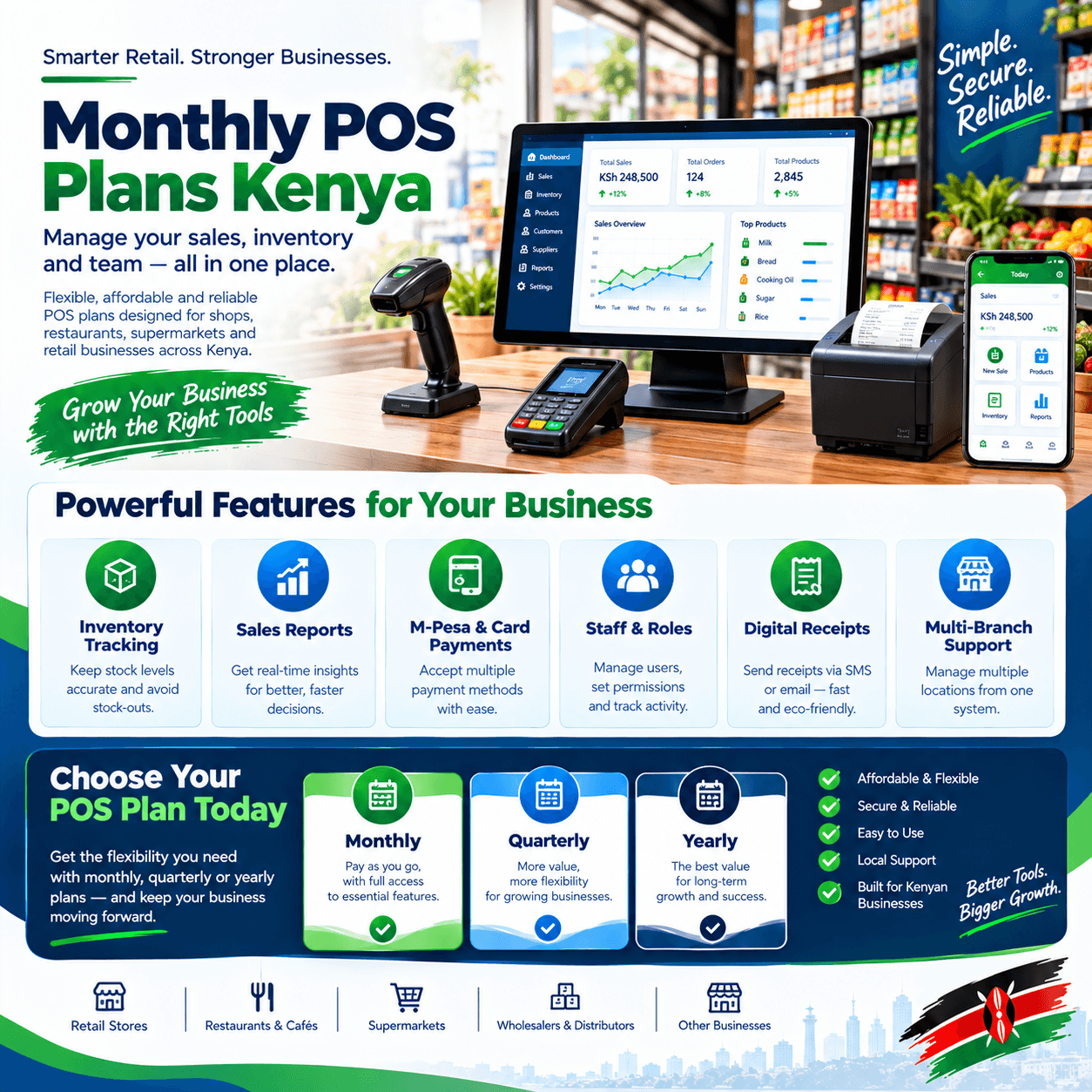
Monthly POS plans Kenya buyers are choosing the model that now dominates this market: instead of paying a large one-time licence for a till, you rent the software month by month — hardware, setup, and support arranged around it.
The shift happened for good reasons: lower entry cost, free updates, and a provider who has to keep earning your subscription every month.
But the model also introduced a new skill owners never needed before: reading a plan.
What is included, what is metered, what happens at renewal, and what happens if you stop paying — these questions decide whether a monthly plan is a bargain or a trap.
This article teaches that skill.
We will walk through what a monthly POS plans Kenya subscription actually covers, the three tiers you will meet, what each tier costs and suits, monthly versus annual billing, trials and freemium offers, upgrading and downgrading, and how to compare plans fairly.
By the end, you will read any plan sheet in minutes — and know exactly which tier your counter needs.
Monthly POS Plans Kenya: The POS Connection
A POS subscription is not a rental of nothing — it is a service agreement with three working parts.
The software licence is the core: the till application itself, running on your hardware, maintained and improved continuously by the provider.
Updates ride inside the plan: every new feature, security patch, and improvement ships to you automatically, because the provider updates one platform rather than a thousand installations.
Support is the third part: the help you call when something misbehaves, included in serious plans and billed separately in fragile ones.
This is why a monthly POS plans Kenya model changed the industry’s incentives — a provider you pay monthly has a standing reason to answer your calls, while a provider paid once in 2019 has none.
Compare that with the old one-time licence: a large cheque, then paid upgrades, manual backups, and per-call support that turned every crisis into an invoice.
The subscription inverted the risk: the provider now carries the obligation to keep the product good, because you can leave.
That is the honest case for the model — and the reason almost every monthly POS plans Kenya offering you meet will be built this way.
What the model does not change is diligence: a subscription is a contract, and contracts reward the owners who read them.
Everything that follows is how to read one.
What a Monthly Plan Actually Includes
Plan sheets blur because they compress different things into one price — so itemise every plan you evaluate against this list.
The software itself. The till application with its features — checkout, inventory, reporting, users — and the depth of these features is what separates tiers.
Updates and improvements. New features and patches delivered continuously, at no extra charge, on a serious monthly POS plans Kenya offering.
Standard support. Help channels during trading hours — phone, WhatsApp, email — with response expectations stated plainly.
Data storage and backups. Your records held centrally and backed up automatically — the quiet insurance inside every subscription.
User accounts. Some plans include unlimited staff logins; others meter them — a shop with five cashiers feels this line monthly.
Branch coverage. Single-location plans versus multi-branch platforms, and the per-branch increment named in advance.
Extras that ride along or bill separately. SMS bundles, receipt rolls, payment integration, and advanced reports — each either included, prepaid, or metered.
Two questions expose any plan in minutes: what is included, and what appears on the invoice in month thirteen that is not on this sheet?
A confident monthly POS plans Kenya provider answers both in one page; an evasive one tells you everything by dodging.
Get the answers in writing before comparing prices, because the plan with the smaller number is frequently the plan with the longer exclusions list.
The Three Tiers You Will Meet
The market’s plans sort into three honest tiers, and matching your shop to the right one is the whole decision.
Basic — roughly KES 1,500–3,000 monthly. Checkout, receipts, simple stock counts, and a handful of users — sized for kiosks, stalls, and small dukas with light inventory needs.
Mid-tier — roughly KES 3,000–7,000 monthly. Full real-time inventory, reorder alerts, user roles and approvals, M-Pesa integration, offline mode, and proper reporting — the tier most growing shops need, and the tier most owners underestimate.
Platform — roughly KES 7,000–15,000 and up monthly. Multi-branch consolidation, trade accounts, advanced audit trails, and API access — the tier for chains and ambitious single locations with complex operations.
The mistake that costs owners most is buying below their real needs to save two thousand shillings a month — then paying for it in stockouts, blind margins, and the second purchase eighteen months later.
The opposite mistake is equally real: paying platform prices for features a two-counter shop will never switch on.
A capable monthly POS plans Kenya provider will size you honestly — asking about your catalogue, counters, staff, and payment mix before recommending a tier.
Be suspicious of any provider who names a tier before asking a single question about your shop.
And be equally suspicious of a provider who has only one plan for everyone, because a shop selling thirty items and a shop selling four thousand are not the same business — a serious monthly POS plans Kenya menu recognises that.
Monthly POS Plans Kenya by Business Type
Tiers map to trades; five quick portraits with typical plan shapes.
Duka or kiosk. Basic tier covers checkout and simple stock — a total monthly POS plans Kenya commitment of a few thousand shillings a month including the subscription line.
Mini-supermarket. Mid-tier with full inventory, offline mode, and two counters — the subscription is the recurring core, with hardware bought once upfront.
Pharmacy or chemist. Mid-to-platform tier, because batch and expiry tracking push software depth up — a plan worth confirming feature by feature before signing.
Hardware yard. Mid-to-platform tier for units of measure and trade credit — the features that separate a hardware system from a general till ride on the monthly POS plans Kenya tier you choose.
Multi-branch group. Platform tier with per-branch increments — confirm the incremental cost of branch four in writing the day branch one goes live.
The pattern generalises: your trade’s two non-negotiable features determine your tier, and the plan that carries them cheaply is your candidate.
Never choose a tier by price alone — choose by the features your counter cannot trade without, then compare prices within that tier.
That single sequencing rule separates owners who buy once from owners who buy twice.
Monthly vs Annual Billing
Almost every provider offers both, and the difference is worth understanding before you sign either.
Monthly billing is the flexible path: low commitment, easy exit, and the natural choice for your first months with any monthly POS plans Kenya provider you have not yet earned trust in.
Annual billing is the discount path: providers typically reward the year upfront with a month free or equivalent — a real saving once you are confident in the relationship.
The sequencing most owners should follow: start monthly, evaluate properly for two or three months, then convert to annual with a provider who has earned it.
Converting before you have experienced a month-end, a stock count, and one support call is buying a discount with information you do not have yet.
Read the renewal terms either way: does the annual price renew at the same rate, is there a notice period to cancel, and what happens to your data if you leave?
A transparent monthly POS plans Kenya provider states all three on the plan sheet; a vague one reveals the answers at renewal time, which is the expensive moment to learn them.
One more term to check: price-change clauses.
Reputable providers hold your rate for the billing period and give notice before increases — a promise worth having in writing on any monthly POS plans Kenya agreement you sign.
Free Trials and Freemium Plans
Free is the most expensive word in software, so let us read its fine print together.
Free trials are legitimate and useful: a genuine 14-to-30-day trial on real hardware tells you more than any demo — take them, and test the offline behaviour and the reports during the trial window, not just the checkout.
Freemium plans — free forever, with paid upgrades — deserve sharper reading: the free tier usually withholds exactly the features that justify a system, real inventory depth, offline mode, and support chief among them.
Zero-cost plans with transaction fees monetise differently: the software is free, and a percentage rides on payments forever — run that arithmetic against your monthly takings before celebrating the zero.
Free plans with data monetisation are the rarest and least transparent — if a provider cannot explain how they make money on a free product, you have found the answer.
None of this makes free wrong: a stall trialling digital records loses little by experimenting, and a trial period is the cheapest due diligence available.
But a real shop with real stock should price any free monthly POS plans Kenya offer the way it prices everything else — total monthly cost, including every fee riding on every sale.
The comparison that matters is never free versus paid — it is the free plan’s true cost against the paid plan’s invoice, run across twelve months of your actual volumes.
Owners who run that arithmetic honestly usually discover the paid plan was the cheaper one all along.
Upgrading and Downgrading: The Flexibility Test
Growth is the whole point of the subscription model, so flexibility deserves its own reading.
Upgrading should be instant. Need trade accounts or a second counter next month? A serious monthly POS plans Kenya platform upgrades your tier the same day, pro-rated, without a renegotiation.
Downgrading should be possible. A quiet season or a slimmed operation should allow stepping down a tier — providers who refuse downgrades are telling you about their retention philosophy.
Adding counters and branches should be priced in advance. The per-terminal and per-branch increments belong on the plan sheet, not in a quotation you request later under time pressure.
Adding users should be predictable. Confirm whether staff logins are unlimited on your tier or metered, because a growing team meets this line monthly.
Feature unlocks should be demonstrable. Ask each vendor to show a tier upgrade happening live — the features appearing, the data intact, nothing migrating or breaking.
The flexibility question that catches owners most: what happens to my data and settings when I change tiers?
A confident monthly POS plans Kenya provider answers: everything carries over, instantly, because the tiers are one platform wearing different doors.
A provider who hesitates is describing a migration, and migrations are where upgrades go to die.
Test this in the demo on any plan you are considering — it is the difference between infrastructure that grows with you and infrastructure you outgrow.
What Happens If You Stop Paying
The exit terms are the part of every plan nobody reads until they need them — so read them now.
Suspension versus deletion. Most providers suspend access first and delete data only after a defined grace period — ask for both timeframes in writing, because they vary widely.
Your data must be exportable. Sales history, stock records, customer lists — in a usable format, at any time, including after you stop — a monthly POS plans Kenya agreement that charges you to leave with your own data has told you who owns whom.
Hardware is yours. You bought it — the subscription was software, so cancellation does not recycle your terminal, scanner, or printer.
Reactivation terms. If you pause for a slow season and return, confirm the cost and process — a fair provider restores access for a small fee, not a penalty.
Notice periods. Monthly plans typically need none or days; annual plans may need written notice before renewal — mark the date when you sign.
None of this is adversarial; it is hygiene.
Providers with clean, stated exit terms are confident in their product — the monthly POS plans Kenya relationship you want is one where leaving is possible and staying is preferable.
Ask every provider the exit question in the first meeting: if I cancel in month eight, exactly what happens?
The fluency of that answer predicts the entire relationship better than the feature list does.
Choosing a Monthly POS Plan: The Demo Test
Bring this script to every provider; it converts plan sheets into evidence in twenty minutes.
Match the tier to your shop live. Tell them your catalogue size, counters, staff, and payment mix — and check their recommendation survives your reality, because a serious monthly POS plans Kenya provider sizes before selling.
Ask for the inclusion list in writing. Every line from the earlier section — software, updates, support, backups, users, branches, extras — marked included, metered, or excluded.
Test the support channel. Call the support line during the demo week with a real question — the response time you experience is the response time you bought.
Verify the offline behaviour on the tier you are buying. Some entry tiers degrade offline — confirm the exact offline capability of your monthly POS plans Kenya tier before signing, not after the first outage.
Run the upgrade simulation. Ask them to show tier features unlocking live, data intact — the flexibility test from earlier, performed.
Read the renewal and exit terms aloud. Price changes, notice periods, data export — the monthly POS plans Kenya terms that decide year two, confirmed in the meeting rather than discovered in it.
A provider who welcomes this script has built an honest plan; a provider who steers toward the headline price is selling one.
Then ask for one reference on your chosen tier and a single question: has the price or the plan changed since you signed?
The answer — and how it is delivered — teaches you more about the provider than the entire plan sheet.
Comparing Monthly POS Plans Kenya Fairly
Fair comparison needs a level table — build it in five steps.
Normalise the tier first. Compare basic against basic, mid against mid — comparing a basic plan against a platform plan is how owners convince themselves the cheap one is equivalent, which the first month disproves.
Build the true monthly cost. Subscription plus metered extras — users, SMS, branches — at your actual volumes, because the headline monthly POS plans Kenya price is only the floor.
Add the year-one entry costs. Hardware and setup are usually separate from the plan — include them to see the true first-year commitment per provider.
Convert the annual options. Monthly times twelve against the annual rate — and note which providers discount, by how much, and on what renewal terms.
Weight the provider. Local presence, support responsiveness, references, and exit terms belong in the table — a plan from an accountable team and the same plan from a reseller are not the same plan.
The table proves in minutes what month three proves expensively: the cheapest plan and the best plan are rarely the same one.
Insist every provider confirm their inclusion list in writing against your table.
Providers who refuse have answered your final question — before any money moved, which is the cheapest possible time to learn it.
Mistakes Buyers Make
Five patterns catch owners first; learn them here without paying for them.
Buying the tier by price instead of features. The basic plan that lacks real inventory and offline mode costs its savings back in the first stockout — match features first, then compare monthly POS plans Kenya prices within the tier.
Ignoring the metered extras. Per-user fees, per-branch fees, and SMS bundles sit quietly under the headline — a plan that looks cheapest on the sheet is often the most expensive at your volumes.
Signing annual before earning trust. The discount is real — after two or three months of evidence; before that, you are buying a price break with information you do not have.
Never reading the exit terms. Data export, notice periods, and reactivation costs — the monthly POS plans Kenya terms that decide whether leaving is a formality or a negotiation.
Forgetting hardware from the comparison. Two providers with identical plans and different hardware bundles are different purchases — compare the whole year-one picture, not the subscription line alone.
A sixth worth naming: assuming the plan includes support — on fragile offers it is billed per call, and one teething month can erase a year of savings.
Owners who avoid these five get what a well-chosen monthly POS plans Kenya plan promises: predictable costs, room to grow, and no surprises in month thirteen.
What the Right Plan Is Worth
Price the return honestly, because the monthly line should be judged against what it guards.
A mid-tier subscription — KES 3,000–7,000 monthly — works out to KES 100–230 per day: the price of a soda for software that guards your stock record, reconciles your money, and reports your margins daily.
Against it stand the avoided costs the plan exists to prevent: stockouts, shrinkage, reconciliation evenings, and the second purchase you avoid by choosing the right tier the first time.
Run your own four-line arithmetic before comparing quotes, as with any system: your leakage, your dead stock, your blind hours, your bookkeeping time.
For most shops, the right monthly POS plans Kenya plan repays itself several times over within the first year — before counting a single extra sale from better-run days.
The compounding line is upgradeability: because the plan scales with tiers, the system you buy today remains the system you grow on — no re-platforming, no migration, no second project.
That continuity is the model’s quiet gift: a monthly POS plans Kenya subscription is not a cost you renew — it is infrastructure that improves while you trade.
Frame the purchase the way accountants do: a predictable monthly line with a defined scope beats an unpredictable annual risk every time the till misbehaves at 7 p.m. on a Saturday.
Frequently Asked Questions
How much do monthly POS plans cost in Kenya?
Basic tiers typically run KES 1,500–3,000 monthly, mid-tier with full inventory and offline mode KES 3,000–7,000, and platform tiers for multi-branch operations KES 7,000–15,000 and up.
Compare plans on true monthly cost — subscription plus metered extras at your volumes — because the headline monthly POS plans Kenya price is only the floor.
Is monthly billing better than paying annually?
Start monthly to earn evidence, then convert to annual with a provider who has proved themselves — annual typically saves a month or equivalent, but only worth it after a real month-end, a stock count, and a support call.
What is usually included in a plan?
The software licence, continuous updates, standard support, central backups, and a defined number of users — with extras like SMS, additional branches, and advanced reports either included, prepaid, or metered.
Get the inclusion list in writing on any monthly POS plans Kenya plan before comparing prices, because exclusions are where cheap plans pay for themselves expensively.
Can I upgrade my plan as my shop grows?
Yes, and it should be instant: tiers on a serious platform are one system wearing different doors, so features unlock the same day with data intact and nothing migrating.
Test the upgrade simulation in the demo on any monthly POS plans Kenya plan you are considering.
What happens to my data if I cancel?
A fair provider suspends access after non-payment, holds your data through a defined grace period, and exports it to you in a usable format on request — get all three terms in writing when you sign.
Is a free POS plan worth using?
Only for very small setups trialling digital records — free tiers typically withhold the features that justify a system, or monetise through transaction fees that scale with your takings.
Price any free monthly POS plans Kenya offer across twelve months of your real volumes before choosing it — the paid plan is usually the cheaper one by the second month.