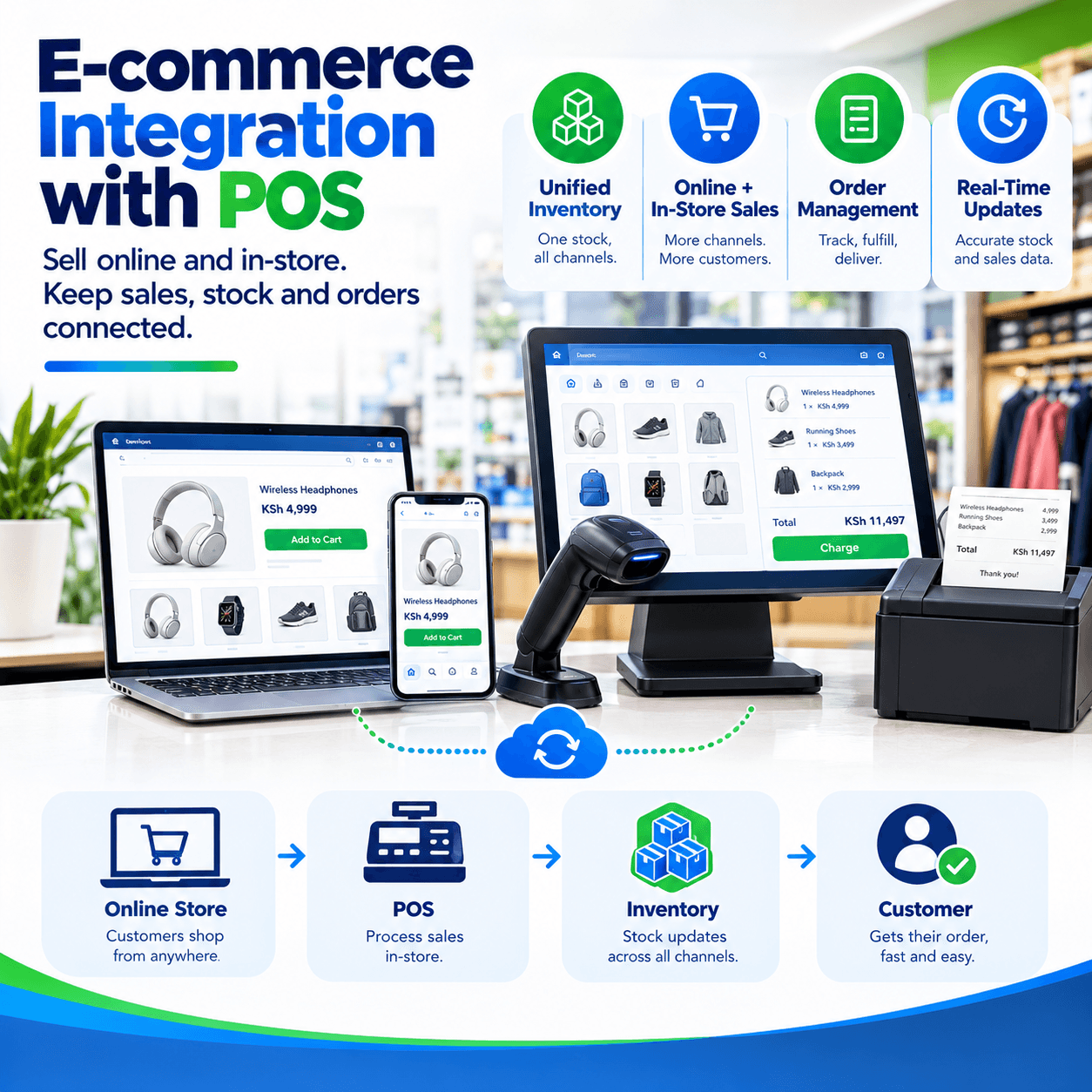
E-commerce integration is the connection between your online store and your counter till — and it is the difference between running one business and running two that argue daily.
When a customer orders online, the sale should appear on your till, the stock should leave your shelves on paper and in reality, and the money should land in one reconciled story.
Without integration, the online shop and the physical shop are strangers: separate stock counts, separate prices, separate customer lists, and evenings spent merging them by hand.
With a proper e-commerce integration, the website and the POS become one system wearing two doors.
This article explains that connection end to end: what integration actually syncs, what breaks without it, how stock, orders, customers, and payments flow between the two worlds, what it costs, and how to test any setup before you commit.
Selling online is no longer optional for growing shops — but selling online with a disconnected till is how good businesses invent double work.
The goal of a genuine e-commerce integration is simple to state and valuable to keep: one catalogue, one stock, one customer, one story — on every channel you sell.
What E-Commerce Integration Actually Means
Strip away the jargon and the phrase means one thing: your online store and your POS share the same data, automatically, both directions.
In a genuine e-commerce integration, four things sync continuously — catalogue, stock, orders, and customers.
The catalogue sync means products uploaded once appear everywhere: names, prices, images, variants, descriptions.
The stock sync is the heartbeat: every online sale decrements the same inventory the counter decrements, and every counter sale updates what the website shows as available.
The order sync means an online purchase lands on your till or dashboard as a real order — receivable, pickable, deliverable, and reportable.
The customer sync means your regular is one person across both channels, with one history and one loyalty balance.
Integration also has levels, and the differences matter more in month three than in the brochure.
Manual is the baseline most shops live on: the website and the till are separate systems, and a human copies between them — the definition of double work.
One-way is the middle level: the POS pushes stock or prices to the website, but orders still enter the till by hand.
Two-way real-time is the level worth buying: both sides update each other continuously, and neither channel can drift from the truth.
Any vendor selling you e-commerce integration should state their level plainly — and then demonstrate it live, because the levels look identical in a pitch and behave completely differently in a busy week.
There is also a scope question worth settling early: e-commerce here means any channel where customers order without standing at your counter — a proper web store, a WhatsApp catalogue, an Instagram shop, or a marketplace listing.
A serious e-commerce integration treats all of these as doors into one shop, rather than islands you maintain separately.
What it is not: a website that merely displays your phone number, and not a till that screenshots its catalogue for social media — those are brochures, not channels.
What Breaks Without E-Commerce Integration
Running online sales beside a disconnected till leaks money in five predictable ways.
Overselling comes first. The website shows eight units in stock; the counter sold six this morning; two customers pay for products that no longer exist — and refunds plus apologies follow.
This is the most common failure in shops without e-commerce integration, and it compounds daily because neither system knows what the other sold.
Double entry comes second. Every online order is retyped into the till, every price change is made twice, and every new product is uploaded twice — hours per week spent teaching two systems the same facts.
Price drift comes third. The website charges last month’s price while the counter charges this month’s, and customers discover the difference at the worst moment — checkout.
Split customers come fourth. Your best regular exists twice — once in the till, once in the web store — with two histories, two loyalty balances, and no recognisable whole.
Split reporting comes fifth. At month-end, two systems produce two truths, and reconciling them is an evening nobody enjoys.
Add the five lines together and the case for a proper e-commerce integration closes itself: each is a recurring cost that never appears on an invoice.
There is a quieter sixth cost too: shops running disconnected systems eventually stop trusting one of them — usually the online one — and quietly let it starve.
The channel that was supposed to grow the business becomes a noticeboard, because the labour of keeping it honest exceeded the value it showed.
Integration removes the labour, and the channel starts earning again — which is why e-commerce integration is less a feature than a decision about whether your online door stays open.
One Stock, Two Storefronts: E-Commerce Integration in Action
Inventory sync is the heart of the whole connection, so let us watch it work on an ordinary day.
A customer orders two lamps from your website at 10 a.m.; the e-commerce integration decrements the same stock position the counter uses — instantly, in both directions.
At noon, a walk-in buys the third lamp at the till; the website’s available count drops before anyone touches the web admin.
At 4 p.m., a delivery of twenty lamps is scanned in at the counter; the website shows the new availability within minutes.
No overselling, no manual updates, no private arithmetic in anybody’s notebook — one stock, telling one truth, everywhere.
Under that simplicity sit three mechanics worth understanding before you buy.
Real-time decrement. Online sales must reduce stock the moment payment clears, not in an overnight batch — because a busy afternoon is all the time a mismatch needs.
Reserved stock. An order placed but not collected — click and collect is exactly this — should hold its units aside so a counter customer cannot sell them from under the online buyer.
A capable e-commerce integration manages reservations as part of the same stock ledger.
Offline behaviour. When your shop’s internet dies, the till keeps trading locally and queues its sales — and the website’s stock pauses at the last synced truth.
This is where the till’s offline-first design and the integration meet: on reconnection, everything syncs in order, and the two storefronts agree again.
Ask each vendor the awkward combined question: what happens to online stock accuracy during a two-hour shop outage with steady counter trade?
The honest answer involves the sync queue and a brief window of imperfect website counts — and a e-commerce integration engineered properly minimises that window rather than pretending it does not exist.
One more inventory discipline matters online: product data quality.
A website exposes your catalogue to strangers, so names, images, weights, and variants must be clean — the e-commerce integration projects whatever your till holds, in both directions.
Shops that cleaned their catalogue for the counter find the web store half-built already; shops with messy data meet their mess on a public stage.
Orders Flowing to the Counter
Stock is half the sync; orders are the half customers actually feel.
On a proper e-commerce integration, an online order appears on your till or dashboard moments after payment — with items, quantities, the customer’s details, and the delivery instruction attached.
From there the order lives a visible life: received, picked, packed, dispatched or awaiting collection, and closed — each step stamped and searchable.
Click and collect deserves its own note, because it is the flow Kenyan customers love most: they order and pay from the couch, then walk past the queue to a counter that already has their parcel named and waiting.
The reservation mechanics from the stock section are what make that magic reliable — the units were held the moment payment cleared.
Delivery orders flow the same way with a rider step: the order on the till, the delivery note printed, the dispatch recorded, and the payment already reconciled online.
No phone calls copying addresses, no messages lost in WhatsApp, no driver arriving to find the item sold an hour ago.
Returns close the loop in both directions: an online return processed at the counter restores the stock and reverses the payment on one record — a flow any e-commerce integration must handle as cleanly as the sale.
Test the full order life in every demo: place a real test order online, watch it land on the till, collect it at the counter, and read the receipt and the report.
Then test the failure path: what happens to an order when the internet blinks mid-payment, and who reconciles it?
A mature e-commerce integration answers both with named, visible states — pending, paid, synced — rather than shrugs.
The commercial payoff shows up quietly: online buyers become counter visitors, counter regulars become online buyers, and every door sells with the same staff, the same stock, and the same books.
Customers and Loyalty in One Place
Your customer should be one person everywhere — and only integration makes that true.
On a connected e-commerce integration, the same profile follows the shopper across channels: online purchases appear in the counter’s history, and counter purchases appear in the web account.
Loyalty becomes one balance: points earned at the till spend online, and points earned online spend at the counter — which is precisely what makes a loyalty programme feel real instead of like two clubs.
Marketing sharpens too: SMS and email campaigns draw from one list with full history, so a customer who just bought lamps online does not get a lamps promotion by SMS the next morning.
The data compounds quietly: a e-commerce integration gives you the complete relationship — visit frequency across channels, basket sizes in each world, the products that pull customers from one door to the other.
That is the intelligence that decides what to stock, what to promote, and where your next growth actually is.
Privacy deserves one honest line: customers should know their details are shared between your shop and your store, and consent should be captured plainly at signup — trust is part of the product.
Ask every vendor how customer matching works — how the system decides that the online Jane and the counter Jane are one person, and what happens when it is wrong.
A confident e-commerce integration answers with matching rules and a merge tool; a vague answer means your loyalty data will eventually need an afternoon of untangling.
Online Payments and M-Pesa
Payments are where online trust is won or lost, and the integration decides how clean the money story is.
The web store needs its own payment rails: M-Pesa online checkout with the prompt pushed to the customer’s phone, card payments through a gateway, and increasingly the wallet options customers carry.
On a connected e-commerce integration, the online payment lands against the order automatically — reference stamped, sale marked paid, stock decremented, receipt issued by email or SMS.
The reconciliation is the quiet triumph: online takings, counter takings, and delivery payments all appear in one end-of-day report split by channel, matched to the shilling.
No more exporting website transactions into a spreadsheet beside the till report, hoping the totals agree.
Refunds reverse on the same rails: money returns through the channel it arrived on, attached to the original order, visible in the audit trail.
Ask every provider the settlement question early — when does online money actually reach your account, and does the e-commerce integration reporting show that timing per transaction?
Settlement timing is working capital: money that lands tomorrow is money you cannot reorder stock with tonight.
Fraud and disputes deserve their own paragraph: card-not-present payments carry a different risk profile than counter payments, so confirm what dispute support, verification tools, and rate limits your payment provider offers through the integration.
And test M-Pesa online specifically with a real transaction in the demo — the prompt, the confirmation, the order turning paid — because a e-commerce integration that demos payments in screenshots is asking you to buy its promises instead of its behaviour.
Pricing and Promotions Across Channels
One price book, applied everywhere, is the discipline that protects your margins online.
On a serious e-commerce integration, prices live centrally: change a price once at the till and the website follows — no second system to remember, no drift for customers to discover.
Promotions gain the same control: a weekend sale can apply online, in-store, or both, scheduled once and reported as a decision rather than dissolved into noise.
Channel-specific pricing is legitimate — delivery-inclusive prices online, counter prices without — and a capable e-commerce integration supports it as a rule rather than a workaround.
The danger to avoid is silent divergence: two price systems that were supposed to match and quietly stopped.
That divergence is how shops end up selling below cost online after a supplier increase reached one system and not the other.
Margin reports by channel close the loop: when the e-commerce integration reports margins per channel, you can see the true profitability of selling online — fees, delivery, and discounts included.
Ask to see that report in the demo with sample numbers, because the honest cost of a channel is only visible when the data is one story.
Choosing a POS With E-Commerce Integration: The Demo Test
Bring this script to every vendor; it converts claims into evidence in twenty minutes.
Place a real order. From a phone, order an item on the demo store and watch it land on the till — items, customer, payment, the whole record, in minutes.
Sell the last unit twice. Hold stock at one unit, sell it online, then attempt the same unit at the counter — a genuine e-commerce integration blocks the second sale and explains itself.
Change a price once. Update it at the till and refresh the website — the new price should appear without touching the web admin.
Walk a click-and-collect order. Order online, reserve, collect at the counter, and read the receipt — the full loop that your real customers will run weekly.
Kill the internet. Unplug the router, trade at the counter, reconnect, and watch the sync — including what the website showed during the gap.
Process an online return at the counter. Stock restored, payment reversed, one record — the flow every e-commerce integration claims and many fumble.
A vendor who welcomes this script has built the integration; a vendor who steers toward screenshots is selling one.
Then ask the two background questions: which channels does the integration cover — web store, WhatsApp, marketplaces — and who connects them, your team or theirs?
Finally, request one reference merchant running the same e-commerce integration setup and ask a single question: what surprised you in the first month?
The answer teaches you more about the connection — and the provider behind it — than the entire demonstration.
What E-Commerce Integration Costs
Pricing has four layers, and quotes that blur them are hiding something.
The POS subscription first: on serious platforms, the e-commerce integration rides inside a mid-to-upper tier rather than arriving as a separate product — be cautious of vendors who price the connection as a bolt-on, because in a mature platform it is architecture.
The online store layer second: hosted store fronts typically carry their own monthly cost, varying with features and transaction volume — confirm what is included and what is metered.
Payment fees third: online M-Pesa and gateway fees are typically percentages per transaction — get each rate in writing, and note that online fees usually exceed counter fees because the risk is higher.
Setup and data work fourth: cleaning the catalogue, loading images, configuring delivery zones, and testing flows — a real project for a real catalogue, and the layer amateurs skip.
Compare on year-one totals across itemised quotes: e-commerce integration priced properly is a known monthly line plus known percentages, with nothing surfacing in month thirteen.
Then weigh the return column the quotes never show: orders taken after closing hours, baskets from customers who never visit, delivery revenue, and the hours returned by ending double entry.
For most shops, a modest but steady online channel — enabled by a genuine e-commerce integration — covers its own costs within months, and the visibility of one unified report is the part owners say they would never give back.
Rolling Out Without Disrupting Either Door
Integration rollout rewards sequence, and neither the shop nor the website needs to close for it.
Clean the catalogue first: names, images, variants, weights, and cost prices — the website will publish whatever the till holds, so the till must be worth publishing.
Configure the connection before announcing it: stock rules, reservation behaviour, delivery zones, payment channels, and receipt formats — all tested with sandbox orders.
Run the e-commerce integration quietly for a week with friendly test customers: place real orders, collect them, return one, and read every report it produces.
Train the team on the new flows: the online order on the till, the click-and-collect handover, the return at the counter, and who owns each step during a shift.
Set the operating rhythm: orders reviewed at fixed times, delivery handovers documented, and the exception list checked daily — the small habits that keep automation honest.
Cut over publicly when a full test week reconciles cleanly, and book the first-month review at the same time — the e-commerce integration learning curve always surfaces two or three rules worth tuning.
One rollout rule overrides the rest: never launch the online door before the stock sync is proven, because overselling on day one teaches customers to distrust the channel you paid to build.
Mistakes Owners Make
Five patterns catch owners first; learn them here without paying for them.
Launching with unclean data. The website publishes the till’s mess — duplicate products, missing images, wrong weights — and the channel’s first impression becomes its permanent one.
Every successful e-commerce integration launch is preceded by a catalogue cleanup week.
Treating the online store as someone else’s job. Channels starve when nobody owns them: assign the orders, the responses, and the daily check to a named person — integration automates the sync, not the attention.
Ignoring the fee stack. Online percentages, delivery costs, and packaging all sit on top of the sale — read the e-commerce integration margin report by channel before scaling ad spend on a door that loses money quietly.
Running promotions in two systems. A discount applied on the website and separately at the till will drift — schedule promotions centrally, once, and let the integration carry them everywhere.
Expecting the website to fix the till. Integration projects what exists: a shop with messy stock and no cost prices meets the same problems online, now public — fix the e-commerce integration foundation before decorating the storefront.
A sixth worth naming: no returns policy published — online customers buy partly on the promise of easy returns, and a channel without a stated policy converts strangers at half the rate.
Owners who avoid these five get what a genuine e-commerce integration promises and few deliver completely: two doors, one business, and evenings with no merging to do.
One Business, Every Channel: The Reporting View
Integration’s quiet gift is the single report that finally describes your whole business.
On a connected e-commerce integration, takings split by channel — counter, web, delivery — with margins per channel, stock turns per channel, and customers ranked across all of them.
Decisions sharpen immediately: you can see which products belong online, which belong at the counter, and which earn their place in both.
Stock planning gains the same honesty: a e-commerce integration shows where each unit actually sold, so reordering follows demand by door instead of by habit.
The weekly review becomes one hour with one screen — channel performance, exceptions, slow movers, and the orders that failed to convert, all in the same place.
Owners running this rhythm describe the same shift: the business stops being a shop with a website and becomes one operation with several doors.
That is the strategic payoff of e-commerce integration — not the website, but the visibility that tells you where the next shilling of growth should go.
Different Shops, Different Channels
The right integration follows the trade; four quick portraits.
Groceries and mini-marts. Click and collect and rapid local delivery dominate — speed of order handling matters more than web design, and the e-commerce integration must reserve stock reliably against a busy counter.
Pharmacies. Batch and expiry discipline extends online: the web store must never sell a batch the till would refuse, and prescription-adjacent products need their own handling rules.
Fashion and boutiques. Variants rule — the online store must expose every size and shade as cleanly as the till, with images doing the selling the fitting room does offline.
Hardware and building materials. Quotes and bulk orders flow differently online: the e-commerce integration needs request-a-quote paths and delivery-heavy fulfilment, not just a checkout button.
The pattern generalises: name how your customers actually buy at a distance — collect, deliver, or enquire — and choose the e-commerce integration shape that matches, then test exactly that flow in the demo.
For every trade, the foundation is identical: one catalogue, one stock, one customer, one report.
Frequently Asked Questions
What is e-commerce integration in a POS?
It is the live connection that makes your online store and your till one system: catalogue, stock, orders, and customers syncing automatically in both directions.
The practical test is simple — a genuine e-commerce integration means an online sale appears on your counter within minutes, and a counter sale updates the website’s stock immediately.
Will it stop overselling between my shop and website?
Yes, when stock decrements in real time on both sides and click-and-collect orders reserve their units — the two sale paths draw from one ledger.
Confirm this in the demo by attempting to sell the last unit twice, on any e-commerce integration you are evaluating.
Does the online store work when the shop’s internet is down?
Your website stays up — it lives in the cloud — while the counter trades offline and queues its sales; during the gap, website stock reflects the last sync, then catches up fully on reconnection.
Ask each vendor how long that window lasts in practice, because a well-engineered e-commerce integration keeps it short and harmless.
Can customers earn and spend loyalty points across both channels?
Yes — one customer profile with one balance is the core of the customer sync, and it is what makes a loyalty programme feel real.
Verify it live: earn at the counter, redeem online, and check the e-commerce integration updates both histories instantly.
How do online payments reach my account?
Through the store’s payment rails — M-Pesa online checkout and card gateways — with each payment landing against its order automatically and settling on the provider’s schedule.
Confirm settlement timing and per-transaction fees in writing before choosing any e-commerce integration, because both affect your working capital and margins.
Is this worth it for a small shop just starting online?
Usually yes — and the honest sequence is to start small: a clean catalogue, a handful of best-sellers, click and collect, and one reconciled report.
A modest channel built on a genuine e-commerce integration grows cleanly, because every order from day one feeds the same stock, the same customers, and the same books.