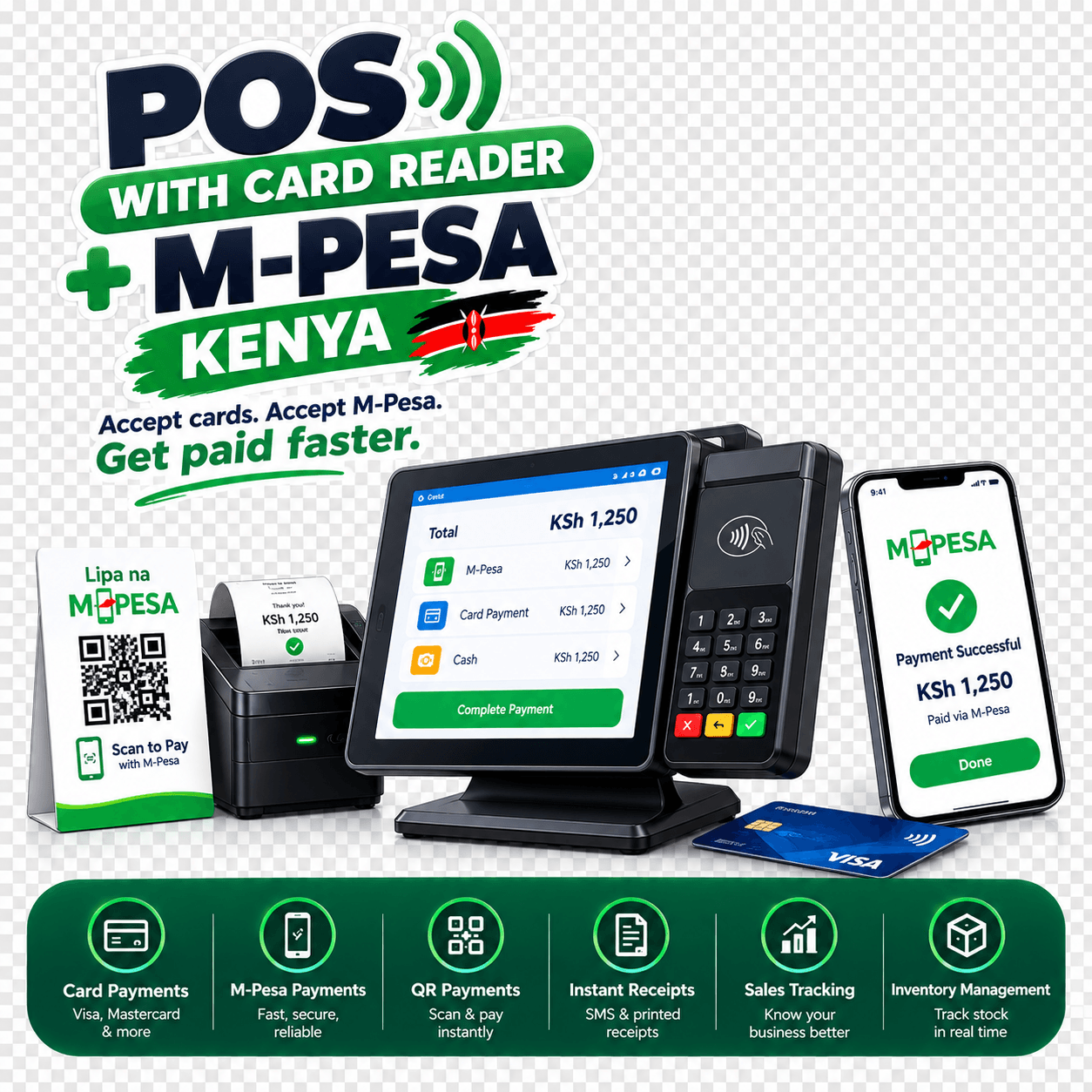
POS with card reader and M-Pesa Kenya shoppers look for after one specific bad afternoon.
A tourist stands at the counter of a Mombasa shop with a card in hand and a preference for paying with it, and the answer is the one no shop enjoys giving: we only take cash and M-Pesa.
The sale leaves. The customer leaves. And the owner is left doing arithmetic that keeps shopkeepers awake: how many sales walk out the door each month because the counter only speaks half the payment language?
In the same week, across town, a mini-mart watches a contractor put away his card and take his business — and his future bulk orders — to the supermarket next door.
Cards are no longer a tourist concern in Kenya; they are how a growing share of customers now prefer to pay, and the gap between shops that accept them and shops that do not is quietly widening.
This guide is about closing that gap properly.
We will walk through what a genuine POS with card reader and M-Pesa Kenya setup involves, how card and mobile money work together at one counter, what everything costs — including the fees nobody mentions upfront — and how to test any system before your money touches it.
By the end, you will know exactly what to buy, what it really costs per sale, and which questions end a vendor’s pitch in under a minute.
The Two Sales That Walked Away
Let us name the two customers precisely, because they are the business case.
The first is the card-preferring customer: the expatriate doing a weekly shop, the corporate buyer with a company card, the young professional who has not carried cash since 2019.
She is not hostile to M-Pesa; she simply wants her statement, her points, and her one habit.
The second is the cash-preferring customer who assumed the shop speaks card — and discovers at the counter that it does not, with a queue forming behind him and his dignity on the line.
Both walk to a competitor, and neither files a complaint; they just quietly re-route their monthly shop.
A proper POS with card reader and M-Pesa Kenya keeps both customers by making the payment method their choice, not the shop’s limitation.
Count the arithmetic honestly: if card-carrying customers are even five percent of your footfall with above-average baskets, the annual figure usually dwarfs the cost of the hardware that would have kept them.
There is a second, quieter cost to payment limitation: it caps basket size.
Study after retail study confirms it — customers paying by card spend more per visit than cash customers, because the physical act of handing over notes makes spending visible and spending by card does not.
A counter that takes only cash is, in a measurable way, a counter that asks customers to spend less.
And there is a third cost hiding in the accounting: cash-heavy shops spend real hours counting, recounting, banking, and reconciling — hours a mixed-payment till redistributes to customers instead.
That is the honest case for upgrading, and the rest of this guide is about doing it right.
What POS with Card Reader and M-Pesa Kenya Actually Means
Strip away the brochures and the phrase describes one counter that speaks all three payment languages natively: cash, card, and mobile money — as equal citizens on the same sale screen.
In a genuine POS with card reader and M-Pesa Kenya setup, the cashier rings up the basket once, and the payment choice belongs entirely to the customer: card tapped, M-Pesa prompt triggered, or notes counted, with every path landing on the same complete record.
That definition matters because the market sells three different things under similar labels.
Level one: the sticker. A till that records cash and M-Pesa, with a card machine from the bank sitting beside it as a separate device, separate record, separate evening reconciliation. Payments work; the records do not talk.
Level two: the semi-link. The card machine connects to the till enough to send the sale amount across, but the confirmation still gets matched by hand at closing time.
Level three: the full loop. Card, M-Pesa, and cash all recorded against each sale automatically — the card confirmation and the M-Pesa reference both stamped on the transaction and the receipt — and end-of-day reconciling itself by channel.
Only level three is a real POS with card reader and M-Pesa Kenya, and the differences between the levels sound small in a brochure and enormous in month three.
Level one reconciles in two places and argues with itself nightly. Level two halves the ritual and keeps the errors.
Level three ends the ritual, because the day was reconciled continuously as it happened.
Ask every vendor to place themselves honestly on this ladder — then verify the answer live with the demo tests later in this guide.
The market also splits on hardware philosophy, and the choice shapes your counter permanently.
Integrated terminals combine till and card reader in one device — clean counter, one vendor, one support line, often higher cost and less flexibility if payment providers change.
Paired setups keep your POS and a standalone card machine from your bank or PSP — often cheaper entry, but the integration depth depends entirely on whether your POS vendor and your payment provider actually cooperate.
A mature POS with card reader and M-Pesa Kenya works with either philosophy, but it must work — meaning automatic amount sync, automatic confirmation capture, and one reconciliation story at close of day.
Whichever route you take, insist on the full loop: one basket, one record, every payment method stamped.
The Card Machine: Choosing Your Reader
Card readers are where most of the confusing terms live, so let us clear them in plain language.
Countertop countertop terminals — the classic fixed devices from banks and PSPs — are sturdy, familiar to staff, and typically connect by SIM or broadband; they suit a fixed counter perfectly.
Mobile readers connect to a phone or tablet and make sense for delivery businesses, market stalls, and shops that occasionally sell outside four walls.
SoftPOS turns an ordinary Android phone into a contactless card acceptance device — an app, no extra hardware — and is the fastest-growing category for small merchants.
The right choice depends on your counter, not the brochure: a fixed shop with a fixed counter wants a countertop terminal paired to the till; a delivery business wants mobile; a lean startup might start with SoftPOS.
Connectivity shapes reliability: readers on SIM cards fail when the mobile network is congested, while readers sharing the shop’s broadband fail with the router — the best POS with card reader and M-Pesa Kenya setups put the reader on a different network path than the till.
Ask each provider how their reader stays online when the primary connection drops — the confident answer involves dual-path connectivity and is worth listening to.
Two practical questions separate good readers from shelf-ware: how fast is tap-to-approval at a busy counter, and does the device print or message receipts the way your customers expect?
Also verify settlement: when does card money actually land in your account — same day, next day, or after a weekend — and does your till report show that timing?
A POS with card reader and M-Pesa benefit reporting by settlement channel turns settlement timing from a monthly mystery into a daily line.
One more check nobody makes until it is too late: ask what happens if the reader fails on a Saturday — loaner device, replacement timeline, and who pays for the courier.
The answer tells you what the provider will be like to work with long after the sale.
How Card and M-Pesa Work Together at One Counter
The magic of a level-three setup is invisible: the customer chooses, the system follows.
Watch a real basket flow on a genuine POS with card reader and M-Pesa Kenya at a busy counter.
The cashier rings up 4,650 shillings across nine items. The customer hesitates. The cashier offers the choice without missing a beat — card, M-Pesa, or cash?
Card: the amount crosses to the reader automatically, the customer taps, approval lands in seconds, and the sale closes with the card reference stamped on the receipt.
M-Pesa: the prompt hits the customer’s phone from the till, the PIN is entered, the confirmation returns to the sale — reference attached, receipt printing, next customer.
Cash: counted, change given, drawer pops, record complete.
Three customers, three methods, one record-keeping system that never argued with itself.
Now the harder flows, where level-three systems earn their keep.
The split payment. 3,000 shillings in cash against a 7,400-shilling basket, the balance by M-Pesa — one sale, two payment lines, one receipt, seconds on the clock.
The deposit. Half today against goods collected Friday — the order held with its balance, no note under the till, no memory required.
The corporate account sale. A company buyer on account, card-style accountability with invoice-level detail, balance visible to the cashier before the next basket.
The refund to source. A return on a card sale reversed to the same card; a return on an M-Pesa sale reversed digitally — each refund attached to its original, visible in the audit trail.
Ask every vendor to demonstrate all four flows with real payments, because a POS with card reader and M-Pesa Kenya is judged at the counter, not in the brochure.
One more counter reality deserves its own line: staff training determines whether the customer gets the choice at all.
In shops where only one person knows the card flow, card acceptance quietly disappears whenever that person is off — the customer hears we only take cash and M-Pesa again.
Whole-team training on every payment path is not an optional extra; it is the difference between owning the capability and renting it.
A serious POS with card reader and M-Pesa Kenya provider includes that training as standard — and treats it as the handover that matters.
Offline Mode When Networks Fail
Kenyan trading conditions make one question unavoidable: what happens to payments when connections fail?
The honest engineering reality: card approvals genuinely require connectivity — no reader can approve a transaction during a total network outage, and no vendor can promise otherwise.
But real outages are rarely total, and this is where system design separates winnrs from pretenders.
When the shop’s broadband dies, a well-built POS with card reader and M-Pesa Kenya keeps trading: sales complete locally, M-Pesa payments ride the mobile networks untouched by your router, card customers pay by SIM-connected reader or pay another way — cash or M-Pesa — on the same receipt.
The failure mode to fear is the till freezing entirely and dragging every payment method down with it, which is precisely what offline-first architecture prevents.
Test the combined scenario in every demo: unplug the router mid-basket, complete a cash sale, record an M-Pesa payment against a second sale, take a card payment through the SIM path, then reconnect and show the clean sync.
A serious POS with card reader and M-Pesa Kenya passes that test without a script — it was built for these exact conditions.
Power belongs in the same drill: a battery-backed tablet terminal keeps ringing sales through a blackout that kills a desktop tower.
And printers connect directly, never through cloud services, because a receipt that depends on someone else’s server is not a receipt you can promise customers.
Make the offline test a written acceptance item before final payment on any POS with card reader and M-Pesa Kenya — it is the difference between a till for a brochure country and a till for Kenya.
The Fees Nobody Mentions Until Month Three
Payment acceptance has a fee structure that brochures blur, so let us name every cost honestly.
Card transaction fees run roughly 1–3% per sale in this market, varying by provider, card type, and volume tier.
M-Pesa business fees apply when you withdraw or transfer to bank — typically structured as a percentage with caps — and are separate from what your customer pays to send.
Settlement timing is a hidden cost of working capital: money that lands next-day is money you cannot spend today.
Terminal rental or purchase — some providers rent readers monthly, others sell them; run both across three years before choosing.
Chargebacks — rare but real — carry their own fees and paperwork when a card customer disputes a charge.
None of these costs are hidden from anyone who asks, but remarkably few owners ask before signing.
Ask every provider the exact per-sale percentage on each card type, what M-Pesa withdrawal costs at your volumes, settlement timing, and terminal terms — in writing.
Then run the fee arithmetic against the revenue argument: if card acceptance lifts sales even modestly and increases average basket size, the fees usually pay for themselves comfortably.
A useful discipline for any POS with card reader and M-Pesa Kenya evaluation: compute the fee cost on a typical Saturday’s takings, then compare it against the margin of the extra customers card acceptance would bring.
Fees are the cost of speaking the customer’s payment language — and the shops that win are the ones whose language is fluent.
One structural note worth knowing: integrated setups sometimes negotiate better rates than standalone machines, because volumes across the platform’s merchants count together.
When comparing quotes, ask whether integrated rates differ from standalone rates — the answer occasionally reshapes the entire decision on which POS with card reader and M-Pesa Kenya to buy.
Reconciliation: The Quiet Evening Revolution
Payment integration’s daily gift is the end of the closing-time detective ritual.
On a genuine POS with card reader and M-Pesa Kenya, the day reconciles itself continuously: every card approval and M-Pesa confirmation lands against its sale as it happens, references stamped, nothing to match by hand.
Close of day becomes a five-minute review: takings by channel — cash against the drawer, card against the settlement report, M-Pesa against the phone — each line agreeing without archaeology.
Exceptions appear on a list instead of hiding in totals: an approval awaiting confirmation, a reversal pending, a tip declared.
The manual version of the same evening — till receipt roll, card settlement sheet, phone inbox, and a calculator — takes forty minutes on a good day and leaves one mystery every month.
Monthly closing inherits the calm: when every day reconciles cleanly, month-end becomes a quiet Tuesday instead of an accountant’s dread.
For businesses with accountants, the change is immediate: clean channel splits, exportable records, and digital trails that reconcile to the penny.
Owners describe the transition identically across the market: first the evenings free up, then the discrepancies vanish, then they notice they have stopped thinking about payments at all.
That final stage — payments as boring infrastructure — is the real product of a POS with card reader and M-Pesa Kenya, and it is worth more than any feature on a comparison table.
The discipline requirement is small but real: five minutes of deliberate day-closing, every day, keeps the automation honest.
Shops that keep that small ritual get the full value of a POS with card reader and M-Pesa Kenya; shops that skip it slowly rebuild the darkness they paid to remove.
Reports: What Integration Makes Visible
Payment integration changes what you can see about your money, and the new visibility changes decisions.
Takings by channel daily — cash, card, M-Pesa — tells you instantly how much of today’s money is cleared and how much is cash awaiting the morning bank run.
Settlement timing by channel turns working capital into a schedule instead of a surprise: card money lands tomorrow, M-Pesa mostly same-day, cash tonight in the drawer.
Fee costs become measurable and negotiable — when channel volumes are on a report, a rate conversation with your payment provider happens with numbers instead of complaints.
Payment-mix trends reveal customer behaviour: the POS with card reader and M-Pesa Kenya reports often show digital share rising steadily as friction falls, which changes float planning, insurance, and security posture.
Refund histories attach to their originals — ending the small monthly mysteries that manual shops absorb as noise.
For accountants, the gift is completeness: a year of digital trails that reconcile to the penny, exportable in the formats they actually use.
Owners reviewing month three on an integrated system typically notice something else: peak-hour queues move faster, because payment choice at the counter removed the slowest manual step.
That speed compounds into goodwill, and goodwill compounds into regulars — the quiet commercial argument for a POS with card reader and M-Pesa Kenya that reports well.
Ask every vendor to walk you through the reporting screens with sample numbers before you sign.
Choosing Your Setup: The Demo Script
Bring this five-minute script to every vendor; it ends pretending efficiently.
Test one: the live trigger. A real M-Pesa payment triggered from the till to a real phone — prompt, PIN, confirmation, sale turning paid with reference stamped.
Test two: the real card. A genuine card transaction processed on the reader being proposed — approval time witnessed, receipt examined.
Test three: the split. Part cash, part M-Pesa on one basket, one receipt, seconds on the clock — the flow customers create daily.
Test four: the offline combined test. Router unplugged: cash sale completed, M-Pesa recorded against a second sale, clean sync on reconnection.
Test five: the refund to source. A card refund reversed to the same card; an M-Pesa refund reversed digitally — each attached to its original.
A POS with card reader and M-Pesa Kenya that passes all five live has earned a pricing conversation; one that fails any single test has failed the only exam that counts.
Then ask the background questions: which card schemes are supported, what are the exact per-sale rates by card type, what is the settlement timing, and what happens if the reader fails on a Saturday?
Finally, request two references from shops like yours, one question each: what changed about your evenings?
The answers from owners running a real POS with card reader and M-Pesa Kenya will teach you more than any demonstration.
Costs: What the Full Setup Runs
Let us price the complete picture honestly, layer by layer.
Hardware: tablet terminal, scanner, printer, drawer — KES 50,000–80,000 typical starter range — plus the card reader: standalone countertop terminals typically KES 15,000–40,000, mobile readers less, SoftPOS often free as an app.
Software subscription: mid-tier platforms with payment integration typically KES 3,000–7,000 monthly, with the integration itself usually included at that tier rather than bolted on.
Setup and training: KES 10,000–50,000 for full professional scope — catalogue, installation, channel configuration, whole-team training on every payment path.x
Ongoing: card fees per sale, M-Pesa business withdrawal fees, occasional terminal rental if not purchased outright.
The all-in year-one figure for a typical shop runs KES 90,000–150,000 — a wide band, because counter needs vary honestly.
Compare quotes on the same nine-item table as any system: hardware, reader, software, setup, training, support terms, fee rates, settlement terms, and year-one total.
The year-one total is the truest single number for any POS with card reader and M-Pesa Kenya comparison, because it drags every hidden fee into daylight.
Then weigh the return column: basket-size lift from card customers, recovered card-walking customers, and forty minutes of reconciliation returned to you nightly.
For most shops, the return column covers the subscription comfortably — the fees riding on each sale are simply the cost of fluency in every payment language your customers speak.
Ask each provider to itemise everything in writing; a confident POS with card reader and M-Pesa Kenya quote is itemised to the line, and the itemisation itself is a character reference.
Getting Started Without Missing a Day
Rollout is straightforward when sequenced properly, and the shop never closes.
Begin in the background: catalogue built, till configured, payment channels set up with your bank or PSP and tested against real transactions.
Insist on live tests — a real card approval and a real M-Pesa trigger — before training day, not simulations.
Train the whole team on every payment path until the fastest and the most hesitant cashier move alike: card flow, M-Pesa trigger, splits, deposits, refunds to source.
Include the awkward drills deliberately: the offline combined test, the refund to card, the customer who wants to pay half now and half Friday
Cut over on an ordinary trading day, run the first full reconciliation together with support present, and book the week-one review at the same time.
Watch the first week’s exception list closely — it surfaces the two or three workflow habits worth correcting while they are cheap to correct.
From month one, the routine settles: trade normally, review the day in five minutes, and let the integration reconcile continuously underneath.
A structured POS with card reader and M-Pesa Kenya rollout typically runs one to two weeks from booking to confident, independent trading.
Owners consistently describe the first Saturday with card customers served smoothly as the moment the decision felt real
Mistakes Buyers Make
Five patterns catch owners first; learn them here without paying for them.
Buying the card machine and the till separately, from different vendors. The two devices argue forever, reconciliation stays manual, and each blames the other on failure days — buy the pairing from one accountable team.
Not testing with real money. Simulated screens prove nothing; every claim should be verified with live card and M-Pesa transactions before final payment on any POS with card reader and M-Pesa Kenya.
Signing fee structures unread. Rates per card type, settlement timing, chargeback terms — read them all, because month three is too late to negotiate.
Training one person on the card flow. Card acceptance disappears whenever that person is off; whole-team training is the difference between owning capability and renting it.
Choosing by terminal brand instead of integration depth. A familiar reader badly integrated beats no reader at all — but a well-integrated setup beats both, and depth should decide.
Owners who sidestep these five get the outcome every POS with card reader and M-Pesa Kenya promises and few deliver completely: every customer pays how they prefer, every sale lands as one record, and every evening ends in five minutes.
Frequently Asked Questions
Can one POS really handle card and M-Pesa together?
Yes — and it should: both payment methods recorded against each sale automatically, with references stamped and end-of-day reconciling by channel.
Verify the full loop live in the demo before buying any POS with card reader and M-Pesa Kenya.
What does card acceptance cost per sale?
Typically 1–3% depending on provider, card type, and volume — get the exact rates per card type in writing, and run them against your typical Saturday takings.
Will it work when the internet fails?
The till should keep trading fully offline — cash and M-Pesa payments recorded locally, syncing on reconnection — while card approvals genuinely require connectivity and ride the reader’s own SIM path when broadband dies.
Do I need a special card machine?
You need a reader that integrates with your till — countertop, mobile, or SoftPOS — chosen for your counter, with automatic amount sync and automatic confirmation capture.
How long does settlement take?
Varies by provider: M-Pesa is typically same-day to next-day, cards typically next-day — confirm both in writing, because settlement timing is working capital.
Is it worth it for a small shop?
For most shops, yes: the basket lift from card customers, the recovered walk-aways, and the returned evenings usually repay a proper POS with card reader and M-Pesa Kenya inside the first year — and the first clean month-end is usually when owners stop asking.