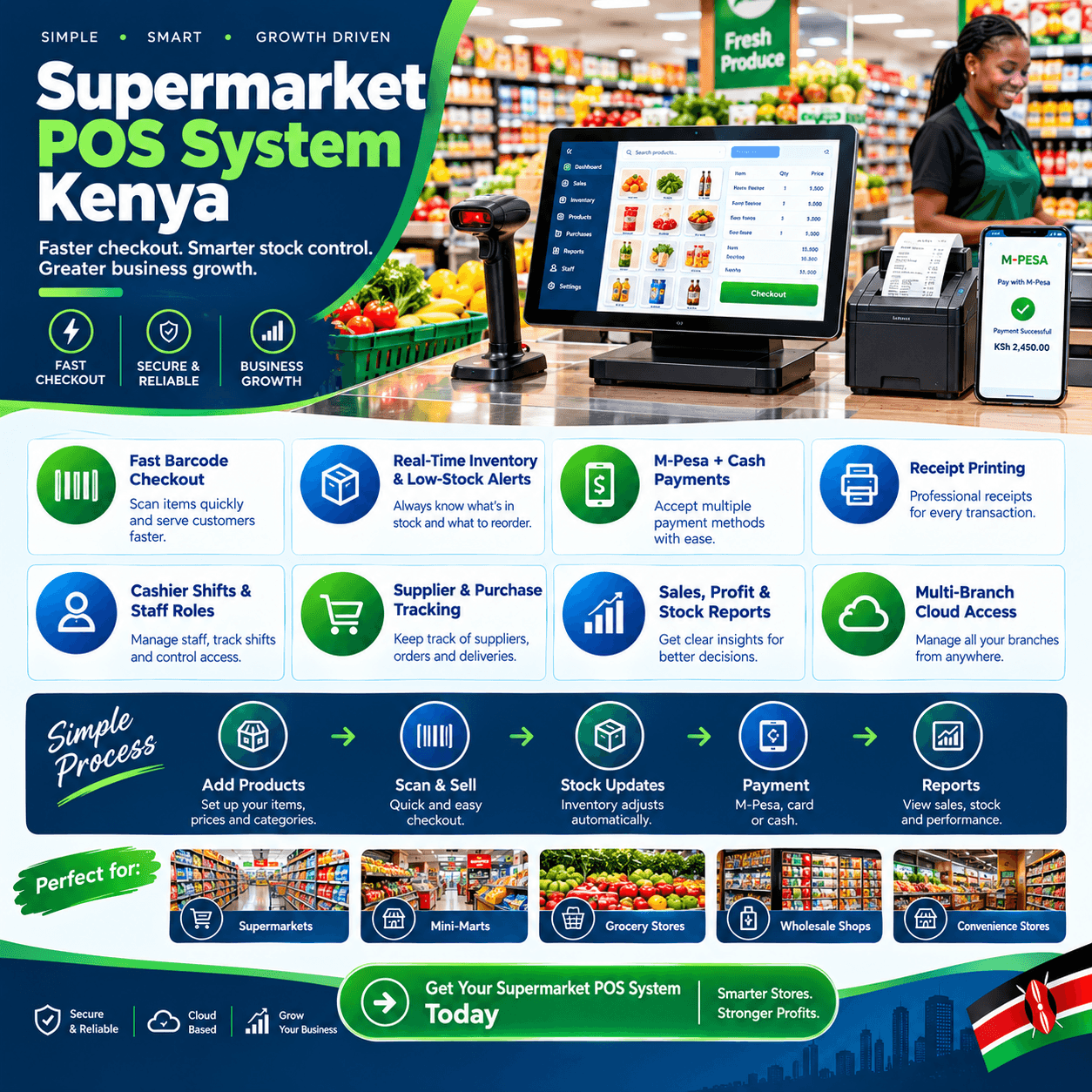
Supermarket POS system Kenya buyers are choosing machinery for the fastest trade in retail: hundreds of items in a single basket, dozens of customers in the queue, and margins that live or die on the seconds between them.
A supermarket is not a big duka — it is a different physics of retail, where checkout speed, weighed goods, promotions, and thousands of SKUs collide every hour.
A general till handles a supermarket the way a bicycle handles a highway: technically possible, quietly catastrophic.
This article is about the machine built for the highway.
We will walk through what a genuine supermarket POS system Kenya must do — speed at scale, scale integration, promotions, fresh-stock management, shrinkage control at volume — what it costs, and how to test any system before your money moves.
By the end, you will judge every system on the market with one question: can it keep the queue moving through your worst Saturday?
Supermarket POS System Kenya: The POS Connection
Everything a supermarket needs from technology flows through the counter, because everything a supermarket sells passes over it.
The till is simultaneously the checkout, the stock ledger, the promotion engine, the shrinkage sensor, and the supplier’s report card — which is why the supermarket POS system Kenya decision is really a whole-business decision.
Three properties define a genuine supermarket POS system Kenya.
Speed at volume first: the system must complete a sixty-item basket as fluidly as a three-item one, because peak-hour volume punishes every extra second.
Local intelligence second: the catalogue, prices, and stock live on the terminal, so scanning never waits for a network.
Structural honesty third: every item, every discount, every weighed good, and every variance is recorded with a name and a time.
A supermarket POS system Kenya without all three is a cash register pretending to be infrastructure.
What it is not: a basic till with more products loaded, and not a notebook system with scanners attached — both collapse at exactly the moment supermarkets earn: the Saturday rush with trolleys full.
The distinction matters because scale multiplies everything — every flaw that costs a small shop one second costs a supermarket a minute of queue.
That multiplication is the lens for the rest of this article: each capability below is examined at supermarket scale, not shop scale.
Speed at Scale: The First Commandment
At supermarket volume, checkout speed is not a feature — it is the business model.
The arithmetic is brutal and honest: a supermarket counter serving two hundred customers a day saves over an hour of queue time by cutting just twenty seconds per basket.
An hour of queue at peak is the difference between baskets completed and baskets abandoned in the aisle.
A genuine supermarket POS system Kenya is therefore engineered around the scan: instant, first-time reads on crushed boxes and shiny wraps, with zero retries as the acceptance standard.
The interface follows the same law: every common action in two taps, best-sellers on the home screen, and the payment view pre-filled before the last item is scanned.
Multi-counter coordination matters here too: two or more tills selling simultaneously must draw from one stock truth without arguing, and a serious supermarket POS system Kenya handles that coordination as architecture rather than accident.
Queue strategy completes the speed system: express lanes for small baskets, the fastest cashier on the busiest till, and a second counter that opens without a migration project.
In shops we configure, the timed result owners care about most is the same: the Saturday basket that took ninety seconds now takes forty-five — and the queue that curved out the door now clears in waves.
Test speed with your own volume in the demo: your sixty-item basket list, rung live, timed with a stopwatch, on the proposed hardware.
A supermarket POS system Kenya that hesitates on your basket will drown on your Saturday — and the stopwatch is the only referee worth trusting.
Weighed Goods and the Scale Integration
Produce, cereals, meats, and loose items are the supermarket’s margin centres — and their technical trap.
Every weighed sale has two failure modes: the wrong weight and the wrong price — and both are invisible on a general till.
A proper supermarket POS system Kenya integrates the scale into the till itself: the item is placed, the weight reads automatically, the price computes, and the line lands in the basket without a single typed figure.
No transcription, no mental arithmetic, no arguments at the counter about what the scale said.
Barcode scales extend the same discipline: goods pre-weighed and labelled at the back, so the counter scans the label like any other item — keeping the fast lane fast.
Pre-packaging plus in-counter scales together cover the full weighed-goods workflow, and a serious supermarket POS system Kenya supports both as first-class flows.
Fresh departments need price-book depth too: items priced per kilo that change with the market — tomatoes this week, a different figure next — updated centrally once, reaching every scale and counter together.
Shrinkage in weighed goods is structural: moisture loss, trimming, and spoilage are normal, but unrecorded waste is not — a capable supermarket POS system Kenya carries explicit waste entries so variances mean something.
Ask every vendor to demonstrate the full weighed flow live: place items on the scale, watch the price compute, modify the basket, and complete the payment — timed, with your own produce list.
The supermarket POS system Kenya that handles weighed goods fluidly has passed the test that general tills never can.
Promotions: The Supermarket’s Second Language
Promotions are how supermarkets compete, and the till decides whether they are strategy or chaos.
The promotion types a genuine supermarket POS system Kenya must run natively: percentage offers, fixed-price deals, multibuy mechanics — three for two, buy one get one — and combo pricing across departments.
Every promotion must apply automatically at the scan: the cashier never calculates, never memorises, never rings a deal wrong while the queue watches.
Scheduled promotions matter as much as the mechanics: a weekend offer that starts and ends by itself, across every counter, without a noticeboard or a memory exercise.
A capable supermarket POS system Kenya applies promotions from central rules — set once, applied everywhere, reported as decisions rather than dissolved into noise.
The membership tie-in is where supermarkets separate from general retail: loyalty pricing for members — the shelf price that drops for card holders — turns the till into the loyalty programme’s engine.
Member pricing requires customer identification at speed: a phone number tap or a loyalty card scan that prices the whole basket differently in seconds, without slowing the line.
That flow — identify, price, reward, track — is the loyalty loop a serious supermarket POS system Kenya runs on every transaction.
And the reports close the loop: promotion performance by item, by day, by uptake — telling you which deals actually moved stock and which moved nothing but margin.
Test promotions live in any demo: set a multibuy, a member price, and a scheduled offer — then ring them, breach them, and expire them.
A supermarket POS system Kenya that handles all three without a second typing step was built for your trade.
Inventory at Supermarket Scale: The Thousands Problem
A supermarket catalogue is a different species: thousands of SKUs, hundreds of suppliers, and stock that turns daily.
The catalogue build is the first mountain, and a vendor’s onboarding quality shows here before anywhere else: importing four thousand items with units, costs, categories, and barcodes is a project — and a serious supermarket POS system Kenya provider treats it as one, hands-on.
Fast movers earn special machinery: reorder points tuned per item, alerts that fire days before the shelf empties, and delivery-receiving that updates thousands of lines in a morning.
Receiving discipline is the accuracy engine: deliveries scanned against purchase orders, so a short carton surfaces while the driver is still at the gate — not at month-end.
Cost-price tracking matters more here than anywhere: supermarket margins are thin, and supplier price creep — the two-shilling slide across a hundred lines — is invisible without per-item costs carried daily.
A capable supermarket POS system Kenya shows margin drift before it reaches the bank statement.
Cycle counts replace the annual nightmare: top movers weekly, a department monthly, the whole store quarterly — each variance named, dated, and attributable.
Expiry awareness belongs in the same layer: first-expire-first-out picking for dated goods, and clearance reports that aim discounts at the stock about to die on the shelf.
Shelf-label printing completes the loop: price changes printed and posted the same day they change, so the shelf and the till agree — the disagreement that quietly burns trust at the checkout.
Ask every vendor the scale question directly: show me receiving for a two-hundred-line delivery, and a cycle count variance on one department — on your own product list if a trial load is allowed.
A supermarket POS system Kenya that demonstrates scale cleanly was built for it; one that demos with ten items was not.
Shrinkage at Volume: The Quiet Tax
Supermarket shrinkage is industrial in scale: small percentages of enormous turnover, leaking daily through a dozen doors.
The counter doors close first: per-user logins mean every void, refund, discount, and override carries a name — the foundation of supermarket POS system Kenya accountability at volume.
The exception report is the daily sensor: unusual voids, discounts beyond policy, refunds without matching returns, tills silent mid-morning — five minutes of reading that replaces an evening of wondering.
Refund discipline closes the lodest door: refunds that must reference a real sale, approved by a supervisor, stamped to the till and the time.
Price-tag fraud meets its match in item-level history: products selling consistently below their shelf price surface as patterns, not arguments.
The receiving bay is the other great leak: short deliveries accepted by eye become invisible shrinkage — a serious supermarket POS system Kenya makes scanning the delivery reflexive, and supplier shorts surface at the gate.
Waste entries keep the honest losses honest: spoilage, damage, and expiry recorded explicitly, so cycle-count variances point at theft rather than decay.
Cameras and tills pair into the same defence: the transaction log gives timestamps, the footage gives context — the combination that loss-prevention teams have relied on for decades.
In shops we configure, owners running this stack report the same quiet outcome: shrinkage does not vanish — it becomes visible, and visible losses are the only losses that can be managed.
Recovered shrinkage at supermarket scale typically repays the supermarket POS system Kenya inside the first year, before counting a single saved queue-minute.
M-Pesa, Cards, and Split Payments at the Rush
Payment speed at a supermarket is arithmetic: the slowest payment method defines your queue.
The payment mix at a Kenyan supermarket is uniquely wide — cash, M-Pesa, card, and increasingly wallet taps — and the till must treat all of them as first-class paths on one screen.
M-Pesa integration is the backbone: the till triggers the prompt, the customer confirms, and the sale marks itself paid with the reference stamped — no evening of matching messages to receipts across two hundred transactions.
Split payments must be effortless: part cash, part M-Pesa on a trolley-full is a nightly reality at supermarket counters, and a capable supermarket POS system Kenya completes it in seconds.
Card acceptance rides the same integration: a certified reader beside the till, amounts crossing automatically, approvals landing on the same record.
The decline path deserves design: a failed payment must not freeze the queue — record the sale, offer the next method on the same screen, move on.
End-of-day reconciliation is the quiet triumph: takings split by channel — cash against the drawer, M-Pesa against the phone, card against the settlement — each reconciled to the shilling across hundreds of transactions.
In shops we configure, the change owners mention first is always the evenings: forty minutes of payment archaeology compressed into five minutes of reading.
Ask every vendor for live payment tests in the demo — a real M-Pesa trigger, a real split payment, a real decline recovery — timed on your basket, not narrated on a slide.
A supermarket POS system Kenya that passes those tests at your volume has earned a pricing conversation.
Loyalty: Turning Shoppers Into Regulars
Supermarkets live on frequency, and the till is where frequency is manufactured.
A serious supermarket POS system Kenya runs loyalty natively: points per shilling, redeemable at the same counter, with balances visible before the next basket.
Member pricing deepens the hook: shelf prices that drop for identified members — the mechanism that makes carrying your number worthwhile and turns the till into a marketing engine.
The customer file builds the relationship: what each household buys, how often, and what they stop buying when they drift — the supermarket POS system Kenya data that powers a win-back message before the customer is lost.
Campaigns ride the same rails: SMS offers drawn from real purchase history — the shopper who buys maize flour monthly gets a flour offer, not a generic blast.
Points expiry and tier mechanics fit the same structure for operators who want them: simple is usually better, but the machinery should exist.
The commercial logic is frequency arithmetic: a shopper who visits weekly instead of fortnightly nearly doubles their annual value — and loyalty pricing is the lever that shifts the rhythm.
Ask every vendor to demonstrate the loop live: enrol a customer, apply member pricing on a basket, redeem points, and pull the campaign report.
A supermarket POS system Kenya that runs that loop without slowing the queue turns your till into your best marketing spend.
Offline Mode: The Saturday Law
The rule of supermarket trading: the busiest hours and the network failures share a calendar.
A genuine supermarket POS system Kenya must therefore be offline-first at every counter: catalogue, prices, promotions, and stock live locally, sales complete at full speed with the router dead, and everything syncs in order when the line returns.
The test is physical and takes three minutes: unplug the router mid-basket at one till, ring a full basket with a weighed item and a member price, complete it, then reconnect and watch the clean sync across all counters.
Systems that freeze, degrade, or desynchronise multi-counter stock offline fail this test — and they fail it on the Saturday when the street is busiest, because that is when networks choose to die.
Power rides the same law: a tablet-based counter on battery keeps scanning through the blackout that kills a desktop tower, and a small UPS keeps the network alive through short cuts.
Printers and scales connect directly to their terminals — never through cloud services — because a receipt or weight that waits on someone else’s server is a queue you invited.
Make offline behaviour a written acceptance item in your agreement, tested with your own catalogue and all counters before the final payment.
Ask each vendor one number: how long can every till trade fully offline before anything is at risk?
The confident answer is measured in weeks, not hours — and it is the difference between a supermarket POS system Kenya and a liability wearing a logo.
Choosing a Supermarket POS System Kenya: The Demo Test
Bring this script to every vendor; it converts claims into evidence in thirty minutes.
Time your basket. Your sixty-item list, rung live on the proposed hardware, stopwatch running — a supermarket POS system Kenya must finish it fluidly, no retries, no refreshes.
Weigh something. Your produce items on the integrated scale, price computed automatically, modified in the basket — the flow general tills cannot fake.
Run a promotion. A multibuy and a member price, applied automatically at the scan, then expired on schedule — no cashier arithmetic anywhere.
Receive a delivery. A two-hundred-line purchase order scanned in, one line short — the discrepancy should surface at the gate, not month-end.
Break a rule. Attempt a void without approval and a refund without a matching sale — a serious supermarket POS system Kenya blocks both and logs the attempts.
Kill the internet mid-basket. At one till, with other counters trading — offline sales must continue and sync cleanly across all of them.
Read the reports. Peak-hour analysis, promotion performance, and shrinkage exceptions — on realistic numbers, not an empty dashboard.
A vendor who welcomes this script has built for supermarkets; a vendor who steers toward small-shop screenshots is selling a till with more shelves.
Then ask for two references from supermarkets your size, one question each: what changed about your Saturday after three months?
The answers from owners running a real supermarket POS system Kenya will teach you more than any demonstration ever recorded.
Rolling Out Without Losing a Saturday
Supermarket rollout is a project — the only kind in this article series — and it rewards sequence absolutely.
Phase the catalogue build first: your thousands of items imported, unitised, and priced over two to four weeks in the background, department by department, while the shop trades on the old process.
Schedule counter-by-counter cutover: one till switches, trades a full week, and stabilises before the next — a rolling go-live that never puts the whole shop at risk on one day.
Run the opening stock count department by department, with the system live and fast movers first — never estimated, never transcribed from paper afterwards.
Train till by till: each cashier trained on the hardware they will run, including the weighed-goods flow, promotions, and the unplugged drill — the first Saturday should be the team’s tenth rehearsal.
Nominate a champion per shift, not per shop: peak hours have different teams, and every shift deserves its own peer coach.
Watch the first fortnight’s exception report daily: it surfaces the two or three workflow habits worth correcting while they are still cheap.
Book the department reviews at the same time as each cutover: reconcile, correct drifts, tune screen layouts against what the rush actually taught.
A structured supermarket POS system Kenya rollout typically runs three to six weeks counter by counter for a full store — longer than any other trade in this series, because the scale demands it.
The first clean month-end after full cutover — every department reconciled, every variance named — is the milestone owners describe as the day the store finally grew up.
Mistakes Supermarket Owners Make
Five patterns catch owners first; learn them here without paying for them.
Buying a shop till and adding shelves. The scale problem — weighed goods, promotions, multi-counter stock — cannot be patched onto retail software; a supermarket POS system Kenya must be built for volume from the architecture up.
Skipping the receiving discipline. The gate is where accuracy is born — deliveries accepted by eye leak invisibly at a scale that makes the leak a salary.
One login across shifts. Supermarket shrinkage hides behind shared tills — per-user logins are the cheapest security in the trade, and the supermarket POS system Kenya exception report is worthless without them.
Setting promotions by memory. Deals run verbally expire verbally — promotions must live as central rules with schedules, or margin dies at the scanner.
Measuring nothing. Without timed baselines and cycle-count variances, shrinkage and slowness stay feelings — the supermarket POS system Kenya reports exist to convert both into numbers you can manage.
A sixth worth naming: launching everything at once — the shop that cuts over all counters in one weekend discovers every flaw simultaneously at maximum volume; rolling go-lives exist precisely to prevent that.
Owners who avoid these five get what a proper supermarket POS system Kenya promises and few deliver completely: a queue that clears, shelves that reconcile, and a shrinkage line that finally has a name.
Different Stores, Different Setups
The right configuration follows the store’s shape; four quick portraits.
The neighbourhood mini-supermarket. Two to four counters, essentials-led range — speed and weighed goods lead, with loyalty as the frequency engine.
The full-line supermarket. Departments, fresh sections, and promotions at scale — the supermarket POS system Kenya must carry multi-counter coordination, scheduled campaigns, and department-level reporting.
The wholesale-cum-retail store. Trade customers beside walk-ins — units of measure, account sales, and tiered pricing push the specification toward platform tiers.
The supermarket with a butchery or bakery. In-house production consumes stock: the supermarket POS system Kenya must track recipes and production draws, not just sales — or those departments shrink invisibly.
The pattern generalises: name the one department or mechanic that makes your store unusual, and make the vendor prove exactly that in the demo, on your products.
For every portrait, the foundations hold: speed at scale, weighed goods, promotions, and offline mode — the four that no supermarket POS system Kenya should ever be bought without.
What a Supermarket POS System Kenya Costs
Pricing has three layers, and the scale changes every line.
Hardware first: per counter — terminal, scanner, printer, drawer, and scale integration where needed — typically KES 60,000–100,000 per lane, multiplied by your counter count.
Software second: a subscription, typically KES 7,000–15,000 and up monthly for genuine supermarket depth — multi-counter coordination, promotions, and department reporting — scaled by counter and branch count.
Setup and training third: catalogue migration at scale, department counts, per-counter training, and phased go-live support — typically KES 30,000–80,000 for a full store, because the project is genuinely bigger.
Judge the subscription against the volume it guards: a supermarket turning over millions monthly is buying infrastructure, not software — and the per-day framing makes it a rounding error with benefits.
Compare quotes on the same table across providers: hardware per lane, software monthly, setup total, support terms, and year-one all-in.
Then weigh the return column the quotes never show: queue minutes recovered at peak, shrinkage made visible, promotion margins protected, and the month-ends that stop being archaeology.
For most supermarkets, a single recovered shrinkage percentage point — or one avoided abandoned-basket Saturday — covers a meaningful share of year one.
Beware both extremes: the shop-till resold as a supermarket system, and the international platform billing enterprise features you will never switch on.
Ask what appears on the invoice in month thirteen that is not on the quote — and get the answer in writing on any supermarket POS system Kenya you are considering.
Frequently Asked Questions
What makes a supermarket POS different from a normal shop till?
Three structural things: speed engineered for sixty-item baskets, weighed-goods integration with in-counter scales, and promotions running as central rules across multiple coordinated counters.
A genuine supermarket POS system Kenya is built around those at the architecture level; a general till with more products added will fail all three at your first Saturday rush.
Can it handle weighed goods like produce and meat?
Yes — and it must: an integrated scale computes the price automatically at the counter, barcode scales cover pre-packed goods, and waste entries keep fresh-department variances honest.
Test the weighed flow live with your own items before signing any supermarket POS system Kenya.
How does it manage promotions and loyalty pricing?
Promotions run as scheduled central rules — multibuys, combos, and member prices apply automatically at the scan, with performance reported per campaign.
Verify both a multibuy and a member price live in the demo on any supermarket POS system Kenya you evaluate.
Will it work when the internet goes down?
A properly engineered one will: every counter trades at full speed offline, sales queue locally, and everything syncs in order across tills when the connection returns.
Make the multi-counter unplugged test a written acceptance item on any supermarket POS system Kenya before the final payment.
How long does implementation take for a full supermarket?
Three to six weeks for a typical store: catalogue phased in over weeks, counters cut over one at a time, departments counted with the system live, and every shift trained on its own hardware.
A structured supermarket POS system Kenya rollout keeps the shop trading normally on every one of those days.
Is it worth it for a mini-supermarket with two counters?
Usually yes — two counters already create the coordination, speed, and shrinkage questions the system answers, and the subscription is sized for exactly that stage.
The first clean Saturday on a supermarket POS system Kenya — queue cleared, variances named, promotions run themselves — is typically when two-counter owners stop asking whether they needed it.