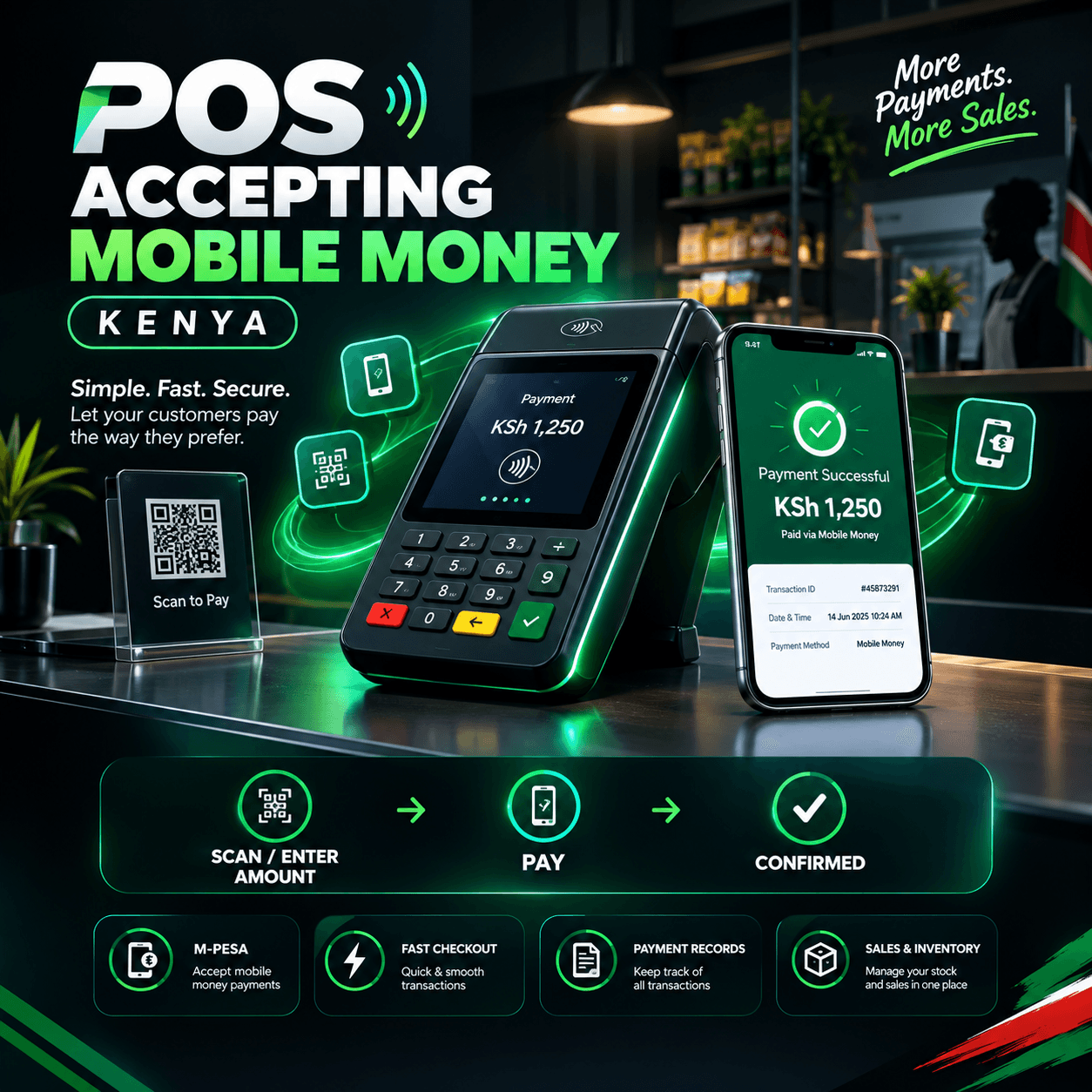
POS accepting mobile money Kenya searches usually begin at nine in the evening, with a phone in one hand and a receipt roll in the other.
Kioko runs a busy clothing shop in Eldoret, and every closing time followed the same ritual: match the day’s M-Pesa messages to the day’s sales, line by line, hoping they agree.
Most nights they almost did.
A confirmation from 8:40 a.m. belonged to a customer who paid before the sale was entered. A personal transfer from her sister sat in the same inbox. One payment of 2,350 shillings matched nothing at all.
By the time the drawer and the phone agreed, forty minutes had passed, one discrepancy remained unexplained, and the energy for family was gone.
Her sales were fine. Her evenings were not.
This guide is about ending that ritual — permanently.
We will walk through what a genuine POS accepting mobile money Kenya actually does, how the integration works behind the screen, what changes about reconciliation, split payments, credit and reports, what it should cost, and how to test any system before paying for it.
One thing becomes clear quickly in this market: nearly every vendor claims mobile money support, but the depth behind the claim varies more than the price does.
By the end, you will be able to tell a real integration from a sticker — in one demonstration, with your own money on the counter.
The Closing-Time Ritual Every Kenyan Shop Knows
Kioko’s ritual deserves a closer look, because almost every owner reading this has lived a version of it.
The till records one story: fourteen mobile money sales today. The phone records another: sixteen confirmation messages, two of them private, one of them unexplained.
Between the two stories sits the owner, reconciling by eye — scrolling, matching amounts, guessing at timestamps — night after night, month after month.
The costs are quiet but real: forty minutes an evening, a monthly total of a full working day spent on detective work.
Worse are the mismatches that never resolve — the payment taken but never entered, the sale entered but never paid, each one discovered late and argued about later.
In shops we configure, this exact ritual is the number-one reason owners go looking for a POS accepting mobile money Kenya in the first place.
The second cost is harder to see: because matching is manual, some staff skip it entirely on busy days and reconcile from memory at the end of the week.
Memory, as every owner knows, is not a reconciliation tool — it is a settlement negotiation with yourself.
There is also a fraud-shaped hole in manual matching that deserves its own honest paragraph.
A cashier can accept an M-Pesa payment, record a smaller sale, and pocket the difference — invisible in a shop where the phone’s inbox is the only ledger.
A proper POS accepting mobile money Kenya closes that hole by tying every payment to a specific transaction on a specific screen, stamped and searchable.
And a third cost hides in the confusion itself: staff avoid mobile money on busy days because manual matching is slow, and customers who wanted to pay digitally end up paying cash — or walking out.
Every one of these costs disappears when the till and the phone stop being two separate records.
That is precisely the job of a POS accepting mobile money Kenya — one story, told once, by the machine that was actually there.
What a POS Accepting Mobile Money Kenya Actually Means
Strip away the marketing and the term means one thing: the till and the mobile money system are connected, so a payment and its sale become the same record.
In a genuine POS accepting mobile money Kenya, the cashier rings up the sale, triggers the payment, the customer confirms on their phone, and the transaction updates to paid automatically — no typing, no matching, no memory.
The confirmation lives on the sale itself, where anyone with permission can see it, forever.
That is the definition worth holding onto as you evaluate vendors, because the market sells three very different things under the same label.
Level one: the sticker. The system takes cash only, and staff separately note M-Pesa payments on paper or in a parallel app. This is not integration; it is the old ritual with a nicer receipt.
Level two: the manual record. The cashier records that an M-Pesa payment was received against the sale, typing in the confirmation code by hand. Better — but the code can be mistyped, invented, or skipped, and nothing verifies it.
Level three: the live link. The system talks to the mobile money platform directly — triggering the payment prompt, receiving the confirmation, and marking the sale paid automatically, with the reference number attached.
Only level three deserves the name POS accepting mobile money Kenya shoppers and auditors can both trust.
The differences between the levels sound small in a brochure and enormous in month three.
Level one reconciles never. Level two reconciles eventually, with errors. Level three reconciles itself, continuously, while everyone keeps working.
Ask every vendor to place themselves honestly on this ladder — then verify the answer live, using the demo tests in the section below.
The POS accepting mobile money Kenya you want is always level three, at whatever price your budget finds it.
One more distinction matters: triggering payments is not the same as recording them, and the best systems do both.
Triggering means the customer’s phone receives the payment prompt at the counter — no PIN-hunting, no typos in the number, no paying the wrong till.
Recording means the system captures confirmations for payments that arrived outside the trigger — a transfer sent from home the night before, a payment made at the door.
A mature POS accepting mobile money Kenya handles both paths cleanly, because real customers do not always follow the workflow the brochure imagined.
Why Mobile Money Integration Changes the Whole Day
The evening ritual is the obvious beneficiary, but integration quietly improves the entire trading day.
Speed at the counter comes first: a payment that takes seconds instead of a minute-and-a-half keeps the queue moving, and queue speed is money in retail.
A POS accepting mobile money Kenya triggers the payment prompt directly to the customer’s phone from the sale screen — the customer enters their PIN, the till turns green, the receipt prints.
No numbers dictated across a counter, no screenshots, no wait, is this the right number?
Accuracy follows speed: when the system and the payment are linked, wrong amounts and wrong recipients largely stop existing.
Every owner has a story about a payment sent to a personal number by mistake or an amount keyed in wrong at rush hour; integration removes the moment where those mistakes are born.
Staff accountability tightens too — in a shop running a proper POS accepting mobile money Kenya, every digital shilling lands against a named transaction, which changes staff behaviour before anyone says a word about honesty.
The arithmetic of the evening changes shape entirely: end-of-day becomes five minutes, because the day was reconciled continuously as it happened.
And customer trust compounds quietly — receipts that match payments, refunds that reference real transactions, and a shop that never says the system is down when a customer wants to pay.
Owners who upgrade to a genuine POS accepting mobile money Kenya consistently report the same sequence: first the evenings free up, then the discrepancies vanish, then they notice they have stopped thinking about payments at all.
That last stage is the real product — infrastructure you stop noticing because it simply works.
How the Integration Works Behind the Screen
You do not need to be technical, but a plain-language picture helps you judge vendors honestly.
Modern systems connect to mobile money platforms through official interfaces — secure, documented channels built for exactly this purpose.
When a cashier finalises a sale on a POS accepting mobile money Kenya, the system sends a payment request carrying the exact amount.
The customer’s phone receives the prompt within seconds; they enter their PIN; the platform confirms; the system receives that confirmation and marks the sale paid — with the reference stamped on the receipt and the record.
The whole loop typically completes faster than counting cash and giving change.
Behind that simple loop sit three engineering questions worth asking any vendor.
First, what happens when a customer confirms but the shop’s internet blinks at that exact moment?
A well-built POS accepting mobile money Kenya reconciles the stray confirmation automatically on reconnection — the payment finds its sale, because both sides carry matching references.
Second, what happens when a customer pays the shop’s till number directly from their own phone, without the counter prompt?
Good systems provide a way to receive and match those payments too — a receive-and-match flow that keeps the record whole without manual retyping.
Third, how are refunds and reversals handled — does the refund flow back through the same linked channel, or does it become a cash conversation?
A disciplined POS accepting mobile money Kenya reverses digitally, with the reversal attached to the original transaction and visible in the audit trail.
Vendors who answer these three questions fluently have built the integration; vendors who improvise answers have bought one.
The difference shows up in your reconciliation within the first week of trading.
Reconciliation: The End of Evening Detective Work
Reconciliation is where integration pays rent daily, so let us walk through what close-of-day looks like on a properly connected system.
At closing, the day’s takings report shows every sale by payment type: cash counted against the drawer, mobile money matched to confirmations, each line complete.
The POS accepting mobile money Kenya has been reconciling all day, transaction by transaction — the evening report is simply the summary of work already done.
Anything unmatched appears on an exceptions list, not hidden inside a totals row: a payment awaiting confirmation, a duplicate flagged, a reversal pending.
Exceptions become a thirty-second review instead of a forty-minute archaeology.
Compare that with the manual version of the same evening: phone scroll, receipt roll, squinting at timestamps, guessing, and the one mystery payment that never resolves.
The deeper gift is monthly: when every day reconciles cleanly, month-end — the day accountants dread — becomes a quiet Tuesday.
Kioko, whose story opened this guide, describes the change the same way most owners do: she got her evenings back, and her books became boring.
Boring books are the highest compliment a POS accepting mobile money Kenya can earn.
There is a discipline requirement, and it deserves honesty: integration automates the matching, but the shop must still close the day deliberately.
Takings reviewed, drawer counted, exceptions cleared — five minutes of ritual that keeps the automation honest.
Shops that keep that small ritual get the full value of a POS accepting mobile money Kenya; shops that skip it slowly reintroduce the darkness they paid to remove.
Mobile Money Beyond M-Pesa
M-Pesa is the giant of the market, but it is not the whole market — and your counter will eventually meet the others.
A modern POS accepting mobile money Kenya should treat every payment method as a first-class citizen: M-Pesa, Airtel Money, and card payments recorded side by side on the same sale screen.
Customers do not choose shops by which wallet the owner prefers; they arrive with whatever is loaded on their phone that day. Turning away a payment method is turning away the customer holding it.
Ask every vendor directly: which mobile money providers does the live integration cover — triggering, recording, and automatic confirmation — not just which ones can be typed in manually? The answers separate real platforms from M-Pesa-only systems wearing a general label.
A capable POS accepting mobile money Kenya also reports by payment channel — M-Pesa takings, Airtel takings, cash, card — because settlement times differ and your banking rhythm follows them.
Settlement awareness matters practically: money that arrives instantly and money that lands tomorrow are different working capitals, and the reports should show you which is which.
Multi-provider support also future-proofs the purchase — payment preferences shift with promotions, incentives, and generations, and your till should not care.
The evaluation rule generalises from everything in this section: the more ways your customers can pay without friction, the more sales walk out completed instead of cancelled.
That is the commercial argument for a genuinely multi-channel POS accepting mobile money Kenya, and it compounds daily.
Split Payments: The Reality of the Counter
Real baskets rarely respect single payment methods — and the till must handle the mix without drama. A customer hands over 2,000 shillings in cash against a 5,300-shilling basket and sends the balance by mobile money.
In a notebook shop, that transaction becomes two half-records and a small evening argument. In a proper POS accepting mobile money Kenya, it is one sale with two payment lines — cash entered, M-Pesa triggered for the balance, the receipt showing both, the record complete.
Split payments should take seconds, because the queue behind the customer is watching how long they take. The same flow covers deposits and part-payments: a customer pays half today against goods collected Friday, and the system holds the order, the balance, and the story in one place.
No handwritten notes under the till, no dependence on whoever remembers the arrangement. Test splits explicitly in every demo — they are where half-built integrations show their seams.
A confident POS accepting mobile money Kenya vendor will run the split scenario unprompted, with real payments, before you ask. One that steers the demo back to single cash sales is telling you where its plumbing is thin.
The counter rule worth adopting: any payment combination a customer can describe in one sentence, the till should complete in one transaction. A POS accepting mobile money Kenya built for real shops passes that rule all day.
Credit Sales and Mobile Money Repayments
Shops that extend credit — fundis, contractors, regulars on account — have a second reconciliation problem: tracking repayments against balances.
Mobile money is how those repayments actually arrive: a payment lands on the shop’s number with a name in the memo and a balance nobody is sure about. A proper POS accepting mobile money Kenya closes that loop by living with the customer accounts, not beside them.
Every sale on account is stamped to a named customer; every repayment — received at the counter or matched from a direct transfer — lands against that customer’s balance.
The balance everyone sees is the same balance, updated the moment money moves, visible to the cashier before the next sale on account. Ageing reports do the chasing: who owes what, how long it has been owed, and who has gone quiet since March.
In shops we configure, the credit module paired with payment integration recovers more money in the first quarter than any other feature — because balances stop being negotiable memories.
The evening question of the old ledger — did he send the money or not? — becomes a lookup that takes four seconds. That four-second lookup, multiplied across every account customer you have, is the daily return of a POS accepting mobile money Kenya with real account depth.
If your shop carries a credit book today, make the repayments flow part of every demo — and watch specifically how a direct mobile money transfer finds its customer.
How a POS Accepting Mobile Money Kenya Handles Offline Trade
Here is the nuance most vendors hope you never ask about: mobile money itself runs on the mobile networks, not on your shop’s internet. During a fibre outage, your customer’s phone can still send a payment perfectly well — the mobile networks are untouched by your dead router.
The question is whether your POS accepting mobile money Kenya can record and reconcile that payment while your own connection is down.
Well-built systems handle this with a two-step design: the sale is recorded locally with the payment marked against it, and confirmations verify and reconcile automatically when the connection returns.
The worst systems fall back to the paper notebook precisely when the shop is busiest — which is the entire failure mode this technology exists to end. This is why offline capability and mobile money support must be evaluated together, as one question, not two.
Ask each vendor to demonstrate the combined scenario: unplug the router, ring up a sale, record a mobile money payment against it, print the receipt, reconnect, and show the clean sync.
A serious POS accepting mobile money Kenya passes that test without hesitating, because it was built for this market’s actual conditions. One that hedges — mentioning connection requirements or suggesting cash fallback — has told you which Saturday afternoon will go badly.
Power resilience belongs in the same conversation: a tablet terminal on battery keeps recording payments through a blackout that kills a desktop tower.
The pairing of offline-first design with live payment integration is, in our view, the defining spec of a POS accepting mobile money Kenya for Kenyan trading conditions — and it should be a written acceptance test in your agreement, not a hope.
The Reports: Where the Money Becomes Visible
Integration changes not just how payments are taken but what you can see about them afterwards. A connected POS accepting mobile money Kenya reports by channel — cash, M-Pesa, Airtel, card — daily, weekly, monthly, with each line reconciled to the shilling.
That single view changes banking rhythm: you can see instantly how much of today’s takings is already digital and cleared versus cash waiting for the morning deposit.
Fees become visible and negotiable: when channel volumes are measured, you can see exactly what each payment method costs you and whether a provider conversation is worth having.
Timing patterns inform staffing — the reports of a POS accepting mobile money Kenya show when digital payments peak, which is usually when your fastest cashier should be at the till.
Refund and reversal histories live attached to their originals, ending the monthly mystery of small differences. For accountants, the change is welcome and immediate: clean channel splits, exportable records, and a year of digital trails that reconcile to the penny.
Owners reviewing month three on a connected system typically notice something else: the payment mix itself has shifted, with digital share rising as friction falls. That shift has real value — less cash in the drawer, fewer counting errors, smaller security exposure, and a cleaner paper trail for loans and compliance.
A POS accepting mobile money Kenya does not just record the money; it makes the money’s behaviour visible enough to manage.
Choosing a POS Accepting Mobile Money Kenya: The Demo Tests
Claims are cheap; demonstrations are expensive to fake. Bring this script to every vendor.
Test one: the live trigger. Ring up a small sale and trigger a real payment to the vendor’s own till — watch the prompt arrive on a real phone, confirm it, and watch the sale turn paid automatically.
Any POS accepting mobile money Kenya that cannot pass this test live is not the level-three integration this guide describes — walk away.
Test two: the split. Process one basket as part cash, part mobile money, and read the receipt: two payment lines, one complete sale, seconds on the clock.
Test three: the direct payment. Send a payment to the shop’s till number from a different phone, outside the trigger flow, and watch how the system receives and matches it.
Test four: the outage. Unplug the router, record a mobile money sale offline, reconnect, and show the reconciliation — the combined test that matters most in this market.
A POS accepting mobile money Kenya that passes all four has earned a conversation about price; one that fails any single one has failed the only exam that counts.
Test five: the refund. Reverse a digital payment and follow the money — the reversal should flow back through the same channel, attached to the original sale.
Then ask the two background questions: which mobile money providers are covered by the live integration, and what happens to a payment confirmed during a connection blink?
Finally, request two references from businesses like yours, one question each: what changed about your evenings after installing?
The answers from owners running a real POS accepting mobile money Kenya will teach you more than the entire demonstration.
What a POS Accepting Mobile Money Kenya Costs
Pricing follows the same three layers as any modern system, with integration usually riding inside the software tier.
The software subscription on a genuine POS accepting mobile money Kenya typically sits in the mid tiers — deeper than bare-bones tills, because the integration and its reconciliation logic are real engineering.
Hardware is unchanged by payment capability: tablet, scanner, printer, and drawer at familiar market ranges, none of which care how the customer pays.
Setup and training are where integration value is protected — configuring the payment channels properly, testing each one live, and training staff on the trigger flow until it is muscle memory. Be suspicious of vendors who charge extra for payment integration as a bolt-on; in a serious platform it is architecture, not an accessory.
Equally, be suspicious of the free tier that promises mobile money support — ask at which of the three levels from earlier, and watch the answer carefully. Compare total year-one cost across quotes, exactly as with any system: hardware plus setup plus twelve months of subscription.
Then add the saving column the quotes will not show you: forty minutes of reconciliation per evening, recovered; discrepancies, ended; the audit trail, owned. For most shops, that saving column alone covers a meaningful share of the subscription on a proper POS accepting mobile money Kenya — before counting a single extra sale from faster queues.
Ask each vendor to itemise: what is included, what triggers fees, and what the per-SMS or per-transaction charges are, if any, in writing. Transparency at quotation is the cheapest available test of how the POS accepting mobile money Kenya relationship will feel at renewal time.
Getting Started Without Disrupting a Single Trading Day
Adopting a connected till is straightforward when sequenced properly, and the shop never closes. Begin with the catalogue and configuration in the background — products, prices, tax, and the payment channels configured and tested against real transactions.
Insist the payment setup is verified with live M-Pesa and Airtel test transactions, not simulation screens, before training day. Train the whole team on the trigger flow with the actual hardware: ring up, trigger, confirm, receipt — repeated until the fastest cashier and the most hesitant one move alike.
Include the awkward drills deliberately: the split payment, the direct transfer, and the router unplugged — a team rehearsed on a POS accepting mobile money Kenya greets the real moments with procedure instead of improvisation.
Cut over on an ordinary trading day, run the first end-of-day reconciliation together with support present, and book the week-one review at the same time.
Watch the first week’s exception list closely — it will surface the two or three workflow habits worth correcting while they are still cheap to correct.
From month one, the routine settles into its permanent shape: trade normally, review the day in five minutes, and let the system reconcile continuously underneath.
A structured POS accepting mobile money Kenya rollout typically runs one to two weeks from booking to confident, independent trading, with the doors open every day. Owners consistently describe the first clean month-end as the moment the decision paid for itself.
Mistakes Buyers Make With Mobile Money Integration
Five patterns catch owners first; learn them here without paying for them.
Buying the sticker level. A till that records cash and leaves M-Pesa to a notebook is the old system with new paper — confirm level three, live, in the demo.
Never testing with real money. Simulated screens prove nothing; every claim should be verified with actual payments before the final instalment on any POS accepting mobile money Kenya.
Skipping staff training on the trigger flow. When the prompt flow feels slow, staff quietly revert to dictated numbers and manual records — and the integration you paid for gets bypassed daily.
Ignoring the exception list. Unmatched items left uncleared slowly rebuild the darkness; five minutes of review keeps the automation honest.
Choosing single-channel in a multi-channel market. Locking the counter to one wallet serves the owner’s preference, not the customers’ — and customers vote with their feet.
Owners who sidestep these five get the outcome every POS accepting mobile money Kenya promises and few deliver completely: evenings free, books boring, and every digital shilling accounted for.
Frequently Asked Questions
Is a POS accepting mobile money Kenya worth it for a small shop?
Usually yes, and for the simplest reason: the smaller the shop, the more expensive each lost evening and each unexplained payment becomes.
Integration typically costs little more than a mid-tier subscription, and the reconciliation hours it recovers — plus the discrepancies it ends — usually repay a proper POS accepting mobile money Kenya within the first months.
Does it work when my shop’s internet is down?
The customer’s payment usually still goes through, because mobile money runs on the mobile networks, not your broadband.
A well-built system records that payment against the sale locally and reconciles it automatically when your connection returns — insist on the unplugged demo before buying any POS accepting mobile money Kenya.
Which mobile money providers should it support?
At minimum a live, automated integration with M-Pesa, with Airtel Money recorded and reconciled as a first-class channel — customers arrive with whatever their phones carry that day.
Can it handle part cash, part mobile money on one sale?
Yes, and it must: split payments completed in seconds, both lines on one receipt, one complete record — test this live in every demo.
What happens to refunds on mobile money payments?
On a proper system, the reversal flows back through the same digital channel, attached to the original transaction and visible in the audit trail — no cash conversations, no missing money.
How long does setup take?
One to two weeks for a typical shop: catalogue and payment channels configured with live tests, whole-team training on the trigger flow, and a guided first day.
A structured POS accepting mobile money Kenya rollout keeps the shop trading normally on every one of those days — and the first reconciled month-end is usually when owners stop asking whether it was worth it.