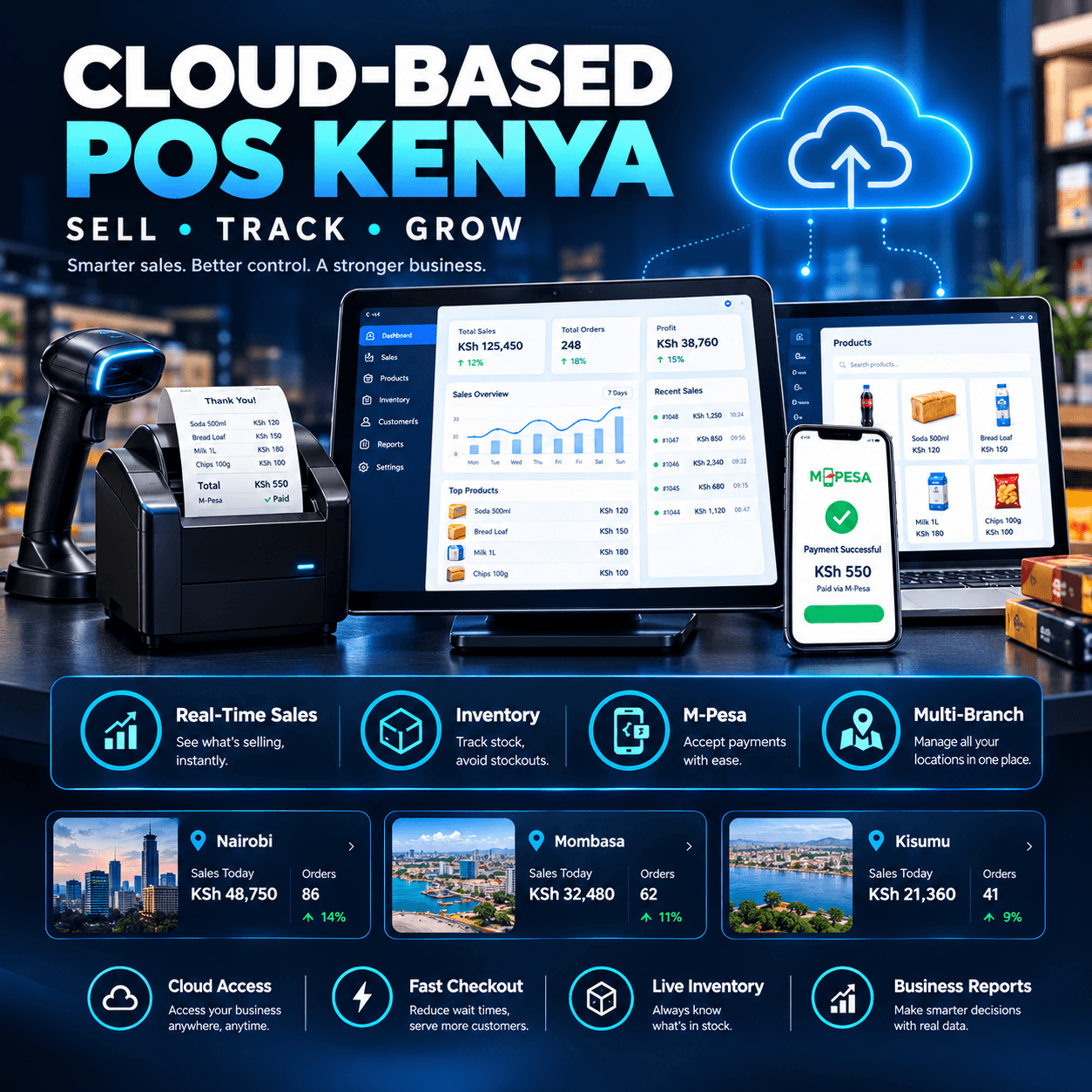
Cloud-based POS Kenya searches usually begin with a moment of captivity.
Kariuki has run a mini-supermarket in Thika for six years, and for six years he has not spent a full week away from the counter.
Not because the business needed him every minute — but because the records lived only there.
Sales lived in the till’s memory. Stock lived on the shelves and in his head. Anything he wanted to know required standing in the shop and asking.
When his sister’s wedding came, he attended it the way a guard attends a gate: phone in hand, waiting for the supervisor’s WhatsApp summaries, each one vaguer than the last.
The trip to the supplier in Nairobi — postponed twice, cancelled once — waited for a quiet month that never arrived.
His shop was profitable. His freedom was not.
The story of cloud systems in this market is the story of ending that captivity: the whole shop, live, in your pocket, wherever you are.
This article walks through what a genuine cloud-based POS Kenya actually is, how it behaves when the internet fails, what the cloud changes about visibility, security, growth and M-Pesa, what everything costs, and how to test any system before your money moves.
By the end, you will know exactly what to buy — and exactly what the cloud will and will not do for your counter.
What Cloud-Based POS Kenya Actually Means
Strip away the jargon and the concept is one sentence: your till’s brain lives on the internet instead of inside one machine.
In a cloud-based POS Kenya setup, every sale, delivery, and adjustment is recorded centrally — and your data is readable from any device with permission: the counter terminal, your phone, your laptop at home.
The old till was a vault: information went in at the counter and came out only if you were standing there.
A cloud system is a living record that follows you — which is why Kariuki’s successor problem, the WhatsApp summary, simply stops existing.
Three properties define the genuine article.
Live centralisation: one source of truth for sales, stock, and customers, updated the moment transactions happen.
Access anywhere: owner, manager, and accountant each seeing what their permissions allow, from wherever they actually are.
Continuous improvement: the software updates itself in the background, because the provider ships improvements to one platform rather than a thousand installations.
A cloud-based POS Kenya with all three is a different category of tool from the desktop machines that dominated this market a decade ago.
What it is not is a browser page that dies with the router — that distinction, the most misunderstood in this market, gets its own section below.
It is also not a luxury for chains: the visibility, backups, and freedom a cloud-based POS Kenya provides are sized and priced for the two-counter duka as comfortably as the ten-branch group.
Kariuki bought one in March.
The wedding he attends now is a wedding he is present at — because the shop reports to his phone at 11 a.m. whether he is in Thika or not.
The Day the Cloud Changes Everything
What does the cloud actually change on an ordinary trading day? More than the brochure suggests, so let us walk the day. It begins before you arrive: from bed, you open the app and see yesterday closed cleanly, today’s opening position, and the two reorder alerts the system raised overnight.
A supplier delivers at nine; the receiving clerk scans it in against the purchase order, and the stock position updates centrally before the driver has left the yard.
At mid-morning you are at the bank, and your phone shows a sales figure that is already an hour fresh — a cloud-based POS Kenya makes standing at the counter to know your numbers obsolete.
Your accountant, given read-only access, pulls the month’s records without visiting, without calls, without the USB stick ritual. An assistant manager approves a refund under her own login; the action lands on your dashboard with her name attached before the customer reaches the door.
A price change you make from a meeting in town reaches the counter in seconds — no noticeboard, no phone call, no yesterday’s price surviving on a scrap of paper. In the evening you review takings by channel — cash, card, M-Pesa — each reconciled, and you do it from your sofa.
Nothing in that day required your presence, and that is the entire point: a cloud-based POS Kenya separates knowing your business from standing inside it. Owners describe the shift the same way across the market: the shop stops being a place you must be and becomes a business you can direct.
That separation is what allows the second shop, the second supplier, the second week away — growth that a vault-till can never support. The freedom is real, and it compounds daily.
Cloud-Based POS Kenya vs the Desktop Till
The desktop till deserves a fair hearing, because it served this market for twenty years — and knowing what it does well clarifies what the cloud does better.
A desktop system stores everything on one machine in your shop: fast, private, immune to internet problems, and paid once.
What it cannot do is follow you — everyreport, price change, and stock check demands your physical presence at that machine.
What it also cannot do is recover gracefully when that machine fails: a dead hard drive with no recent backup is a horror story every second owner can tell.
And it grows badly: the second counter, the second branch, the accountant’s access — each is a workaround on a system built for one room.
A cloud-based POS Kenya inverts those properties: access anywhere, automatic backups, trivial multi-counter growth, and continuous updates — at the price of depending on connectivity unless engineered otherwise.
The honest comparison runs across five years, not five days.
The desktop’s one-time licence quietly collects costs: paid upgrades, manual backups, the IT person per crisis, and eventually the replacement machine.
The cloud’s subscription collects benefits: every improvement shipped free, backups you never think about, and support motivated monthly to keep you.
Run the arithmetic on your own numbers and the picture usually inverts — the rented brain is cheaper than the owned vault, and immeasurably more useful.
There is one case where desktop still wins outright: a shop with genuinely no connectivity and no prospect of it — though that case shrinks every year.
For everyone else, the cloud-based POS Kenya question is not whether the cloud is better in principle; it is which provider has engineered it for this market’s actual conditions.
Those conditions — power cuts, fibre cuts, congested networks — are exactly where the next section lives.
The Internet Question Every Cloud-Based POS Kenya Buyer Asks
Here is the question that decides purchases in this market, asked correctly: what happens when the internet dies at 1 p.m. on a Saturday?
The wrong answer — the one that has burned owners across the country — is a till that freezes and a queue that disperses.
Early cloud systems were built this way: brilliant when connected, useless when not, and Kenya has more not than their designers imagined.
The correct answer is architecture: offline-first design, where the terminal keeps a complete working copy of your catalogue, prices, and stock locally.
Sales complete, receipts print, stock decrements, and even credit sales record — all with the router dead.
Every transaction queues durably on the device, and when connectivity returns, everything syncs to the cloud automatically, in order, losing nothing.
The best implementations are invisible: an outage and an ordinary afternoon look identical in the data by close of day.
A genuine cloud-based POS Kenya for this market is therefore a hybrid — cloud where it transforms your visibility, local where it guarantees your trading.
Test this before anything else, physically, in the demo: unplug the router mid-basket, complete the sale, record an M-Pesa payment, reconnect, and watch the clean sync.
Any system that hesitates, downgrades, or apologises here has answered the only question that matters — and the answer is no.
Power belongs in the same drill: a battery-backed tablet keeps selling through the blackout that kills a desktop tower, and printers must connect directly rather than through cloud services.
Ask each vendor how long the shop can trade fully offline before anything is at risk — the confident answer is measured in weeks, not hours.
The market has matured here: a cloud-based POS Kenya built for Kenyan conditions treats the internet as a courier for copies, never as a lifeline for the counter.
Vendors who cannot articulate that distinction built for a country with better infrastructure than yours — and their till will prove it on your busiest day.
Real-Time Reports: The Shop in Your Pocket
Visibility is the cloud’s signature gift, and it changes decisions more than any single feature list can.
A well-built cloud-based POS Kenya puts five numbers permanently on your phone: today’s takings by channel, sales against yesterday and last week, top movers, low-stock alerts, and the exception list.
Each is live, not end-of-day — the figure you see at 2 p.m. is the morning’s trading, not yesterday’s summary retold.
The exception list deserves particular attention, because it is where the cloud protects you at a distance.
Unusual discounts, voids beyond the norm, refunds without matching returns — flagged with names attached, surfaced while they are still small.
An owner on a cloud-based POS Kenya describes the daily experience accurately: you stop reading everything and start reading what matters, usually in under five minutes.
Trends earn their keep weekly: which branch is climbing, which product line is sliding, which cashier’s baskets run largest, which hours deserve the strongest team.
Month-end, the traditional dread, becomes a quiet review — because the month was recorded live, reconciled daily, and stored centrally.
Your accountant’s access changes too: read-only permissions mean reports, exports, and reconciliations happen without visits, calls, or the January document hunt.
The deeper shift is behavioural, and every owner who crosses it mentions it: decisions move from memory to evidence, because evidence is now always in your pocket.
A dispute with a supervisor, a supplier, or a customer ends in a lookup instead of an argument.
That is the daily texture of a cloud-based POS Kenya reporting well — the shop becomes legible from anywhere, and legibility is management.
Ask every vendor to show the phone app during the demo, live, with data moving — a dashboard that only exists on a laptop screen is a promise about your future that reality will not keep.
Growth: From One Counter to Many Branches
The cloud’s second gift is scale, and it arrives earlier in a business’s life than most owners expect.
The second counter — the queue-breaking move every growing shop eventually makes — is trivial on a cloud platform: add the terminal, log in, sell.
Both counters report to the same central record, stock decrements from one ledger, and the day reconciles as one business instead of two islands.
The second branch is the same move with keys: your catalogue, price book, and customer records extend to the new location without a migration project.
Head office becomes your phone: every branch side by side, league-table style, with the lagging branch visible as opportunity rather than mystery.
Transfers between branches run as recorded transactions — sent, received, reconciled — so stock stops vanishing in pick-up trucks.
A cloud-based POS Kenya built for groups effectively turns separate locations into one large shop with many doors.
Group purchasing follows: volumes negotiated across the whole business instead of dribbles per branch, on data every supplier can read.
Consistency arrives free of charge: one price book, updated once, reaching every counter simultaneously — the end of silent branch-by-branch price drift.
And the owner’s role transforms with it: the cloud-based POS Kenya platform replaces the evening phone-around with a morning dashboard, and management by presence becomes management by visibility.
Most owners open branch two on the same platform they bought for branch one — which is the quiet financial argument for choosing a scalable system early.
The architecture you buy today is either the foundation of that growth or the first thing you will replace on the way to it.
Ask every vendor for their per-branch incremental cost in writing, so branch three’s budget is known the day branch one goes live.
Security and Backups: What the Cloud Does While You Sleep
The unglamorous cloud superpower is resilience — the disasters that end desktop-era shops simply do not land the same way.
Consider the desktop horror stories: the stolen terminal, the dead hard drive, the spilled tea, the fire, the ex-staff member who deleted a folder.
Each one took sales records, stock history, and customer data with it — years of the business’s memory, gone with one machine.
A cloud-based POS Kenya stores your data centrally and redundantly: the terminal is a window, not the vault.
If the machine dies, you log in from another device and continue — the same afternoon, not a new epoch.
Backups run continuously and automatically; nobody has to remember anything, which is precisely why nothing gets forgotten.
Ask each vendor directly: where is data stored, how often is it backed up, and can you restore a backup on request — the confident answer takes one minute and deserves to be in writing.
Access control is the second layer: one login per person, permissions matched to duties, and leavers deactivated the same day everywhere.
Every sensitive action carries a name and a timestamp, from anywhere — the audit trail of a cloud-based POS Kenya is searchable history, not a shoebox of receipts.
Encryption should be stated plainly: data protected in transit and at rest, no exceptions, no jargon required to explain it.
And test the exit door while you are at it: your data must be exportable in a usable format at any time — a provider confident in their service never fears your ability to leave.
Security configured this way is nearly invisible daily and priceless the one day it matters.
That asymmetry — small cost, enormous tail-risk coverage — is the strongest single argument for the cloud in this entire market.
M-Pesa on the Cloud Till
No cloud conversation in this market is complete without the payment rails, because mobile money is where the cloud earns daily, visible money.
A modern cloud-based POS Kenya links payments to sales at the moment they happen: the cashier triggers the prompt, the customer confirms, the till marks the sale paid with the reference stamped.
The old ritual — matching phone confirmations to receipts at closing time, line by line — simply ends.
Direct transfers sent outside the counter get received and matched too, so the record stays whole no matter how the customer chose to pay.
Split payments — part cash, part M-Pesa on one basket — take seconds, because the queue behind that customer is watching.
Repayments against customer accounts land on the balance everyone sees, updated centrally the moment money moves.
The end-of-day report splits takings by channel — cash, card, M-Pesa — reconciled to the shilling, turning close of business into five quiet minutes.
Everything reconciles centrally, which means it reconciles from anywhere: Kariuki reviews the day’s M-Pesa position from his sofa, not from behind the counter.
And because the payment data lives centrally, the reports gain depth — channel trends, fee visibility, and settlement timing all become lines you can actually read.
Ask every vendor the honest level of their integration: trigger with automatic confirmation, or just manual recording with a code typed by hand?
The second is not integration; it is the ritual with extra steps.
A serious cloud-based POS Kenya includes live payment tests before final payment — real prompts, real confirmations, witnessed by you — and treats that demonstration as the handover that matters.
What a Cloud-Based POS Kenya Costs
Pricing has three layers, and quotes that blur them are hiding something.
Hardware first: a tablet starter bundle — terminal, scanner, printer, drawer — typically runs KES 50,000–80,000, with a professional desktop setup stretching KES 80,000–150,000.
Software second, and this is where the cloud lives: a subscription, typically KES 3,000–7,000 monthly for mid-tier depth, KES 7,000–15,000 for platform and multi-branch tiers.
Setup and training third: full professional scope — catalogue build, supervised opening count, installation, configuration, whole-team training, go-live support — typically KES 10,000–50,000.
The subscription is the model’s signature: lower entry cost than a big desktop licence, with updates, backups, and improvements riding free inside it.
Judge it by daily cost — KES 200 a day against a system that guards your stock, reconciles your money, and travels in your pocket is a rounding error with benefits.
Compare quotes on a single table: hardware, software, setup, support terms, and year-one total — the truest number for any cloud-based POS Kenya decision.
Then weigh the return column the quotes never show: evenings reclaimed, discrepancies ended, shrinkage surfaced, and the second branch supported without a new platform.
Beware both extremes: the free app monetising your transaction volume forever, and the enterprise quote billing hundred-branch features to a two-room shop.
Ask what appears on the invoice in month thirteen that is not on the quote — the confident answer takes one sentence and predicts the whole relationship.
A transparent cloud-based POS Kenya quotation is itemised to the line, and the itemisation itself is a character reference.
Choosing a Cloud-Based POS Kenya: The Demo Script
Bring this script to every vendor; it takes fifteen minutes and ends pretending permanently.
Unplug the router mid-basket. Complete the sale, record an M-Pesa payment, reconnect, and watch the clean sync — the single most revealing test in this market.
Any cloud-based POS Kenya that freezes here has failed the only exam that counts.
Open the phone app live. Watch data move from the counter to the dashboard in front of you — not screenshots, not slides.
Trigger a real M-Pesa payment. Prompt to a real phone, confirm, watch the sale turn paid with the reference stamped.
Pull the reports on your data. Takings by channel, top movers, slow movers — a trial load of your own numbers if the vendor allows it.
Check the backups and the exit. Where data lives, how it restores, and how you export it if you ever leave — both answers in writing.
Ask the month-thirteen question. What appears on the invoice later that is not on this quote today?
A cloud-based POS Kenya vendor who welcomes this script is telling you who they are; a vendor who steers around it is also telling you.
Then request two references from businesses like yours, one question each: what surprised you after the first month?
The answers from owners running a real cloud system will teach you more than any demonstration ever recorded.
Finally, weigh local presence: a team that answers the phone on a Saturday is worth more than a feature list — because your failures will not respect weekdays.
Setting Up Without Losing a Trading Day
Cloud rollout is the gentlest in the industry, because the heavy infrastructure already exists.
Build the catalogue in the background — products, units, prices, costs — over one to two weeks while the shop trades on the old process.
Configure payment channels with live tests, not simulations: a real card approval and a real M-Pesa trigger verified before training day.
Count opening stock with the system live, section by section, fast movers first — never estimate, and never transcribe from paper after the fact.
Train the whole team on your hardware with your products, including the awkward drills: splits, refunds, and the router deliberately unplugged.
Nominate a champion by name before training day; teams learn fastest from the peer who has already made the mistakes.
Run parallel for two or three days — new system and old process side by side — comparing totals each evening before cutting over fully.
Give your accountant read-only access on day one, and set your own phone app alerts to the level you will actually read.
Book the week-one review at the same time as the installation: reconcile, correct small drifts, coach the wobbles while they are cheap.
A structured cloud-based POS Kenya rollout typically runs one to two weeks from booking to confident independent trading, doors open throughout.
Kariuki’s first week away — a proper supplier trip, phone in pocket, shop running visibly without him — was, in his words, the week he finally understood what he had bought.
Mistakes Buyers Make With Cloud Systems
Five patterns catch owners first; learn them here without paying for them.
Assuming cloud means offline-broken. The phrase cloud-based scares owners who remember frozen tills — but modern offline-first platforms trade through outages and sync later, and the demo test proves it in minutes.
Never sign a cloud-based POS Kenya without watching the router unplugged mid-sale.
Choosing on price alone. The cheapest quote skips training, migration, and support — the costs are not absent, only postponed to your first crisis.
One login for everyone. The cloud’s accountability dies the moment actions have no name; per-user logins are the difference between visibility and noise.
Ignoring the phone app in the demo. The pocket dashboard is the product you are actually buying — if it is clunky, buried, or absent, the freedom you are paying for is fiction.
No exit terms in writing. Data export, ownership, and handover support belong in the agreement, because a provider confident in their service never fears your leaving.
Owners who sidestep these five get what every cloud-based POS Kenya promises and few deliver completely: a shop that trades through anything, reports from anywhere, and grows without re-platforming.
The First Month on the Cloud
The platform settles into your routine within weeks, and the first month has its own rhythm.
Week one: everyone trades, you stay close, small questions go to support, and the exception list gets a daily two-minute read.
Week two: the alerts tune themselves to reality — reorder points adjusted to actual velocity, permissions matched to actual duties.
Week three: the reports start changing decisions — a price corrected, a delivery rescheduled, a clearance priced off real slow-mover data.
Week four: the month closes without a marathon, and the first full month sits in the cloud as your new baseline.
From there the habit is small and permanent: five minutes on the phone each morning, five at close, and the shop runs on evidence instead of memory.
Owners consistently describe the same inflection point in month two — the moment they realise they have not driven to the shop just to check something since installation.
That disappearance, not any feature, is what a cloud-based POS Kenya actually sells.
And when something odd surfaces, call while it is small: the support relationship you are paying for monthly exists precisely for these moments.
The shops that thrive on the cloud are rarely the ones with the best hardware — they are the ones whose owners learned to read the dashboard daily.
Kariuki’s line, six months in, is the honest summary most owners reach: the shop did not just get better software — it got an owner who could finally see it.
Frequently Asked Questions
Does a cloud-based POS work when the internet goes down?
A properly engineered one does: the terminal holds your catalogue and stock locally, trades fully offline, and syncs everything in order when the connection returns.
Make the unplugged test a written acceptance item before paying the final instalment on any cloud-based POS Kenya.
Is a cloud-based POS Kenya safe for my business data?
Yes — when the provider states encryption in transit and at rest, continuous automatic backups, and per-user access controls, all in writing.
Your data on a reputable cloud platform is safer than on one machine in the stock room, because the vault stops being a single point of failure.
What happens if my terminal is stolen or damaged?
You log in from another device and continue the same day — the terminal is a window, not the vault, and nothing is lost with the machine.
How much does it cost monthly?
Mid-tier platforms typically run KES 3,000–7,000 per month with updates and backups included; multi-branch and platform tiers run higher.
Compare on year-one totals across itemised quotes — the truest single number for any cloud-based POS Kenya decision.
Can I run two branches on the same system?
Yes, and this is the cloud’s signature strength: one catalogue, one price book, consolidated reporting, and recorded inter-branch transfers.
Confirm the per-branch incremental cost in writing before branch two, so growth budgets are known in advance.
Is it worth it for a small single shop?
For most shops, yes: the reclaimed evenings, surfaced shrinkage, and automatic backups usually repay the subscription within the first year — and the freedom of running the shop from your pocket is the part owners say they would never give back.
The first clean month-end is typically when owners of a cloud-based POS Kenya stop asking whether it was worth it.