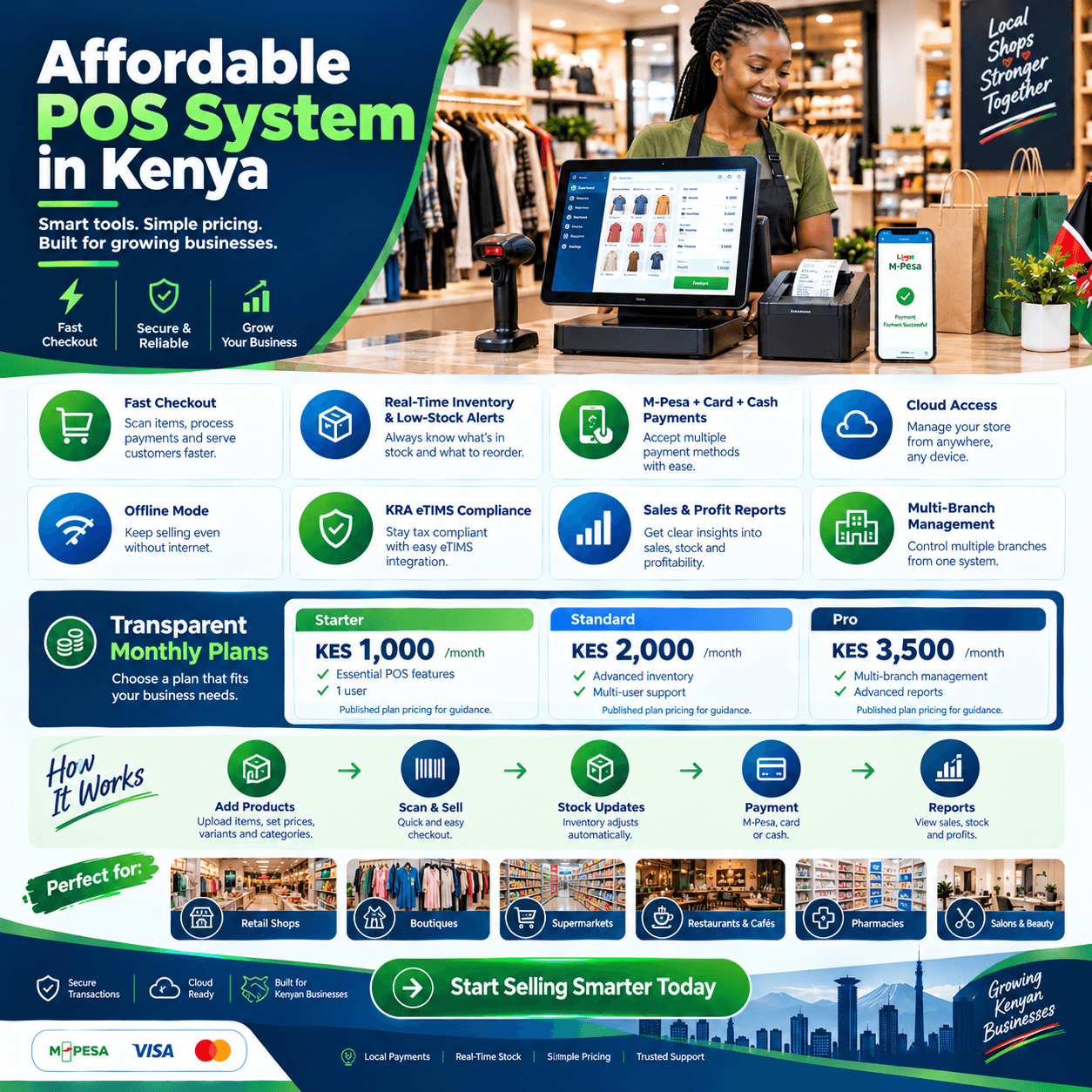
Affordable POS system in Kenya is a search with a trap built into it — because the cheapest system you can buy is almost never the most affordable one you can own.
Affordability is not the price on the quotation; it is the total the system costs you across the years it serves you, weighed against what it returns.
A KES 20,000 till that cannot track stock, dies with the router, and never gets properly trained into your team is the most expensive purchase in this market — full payment made, problem kept.
A KES 90,000 year-one setup that prevents stockouts, closes shrinkage, and reconciles your evenings is, by any honest measure, the affordable one.
This article teaches that distinction end to end: what a genuine affordable POS system in Kenya includes, what the cheap options really cost, the entry paths by budget, how to phase a purchase, and how to judge value before you sign.
By the end, you will be able to spend the least money that actually solves your problem — which is the only definition of affordability that survives year two.
Affordable POS System in Kenya: The POS Connection
Affordability in a POS is decided at the counter, not the invoice — because the till is where the returns are generated.
Every stockout prevented, every leak closed, and every reconciliation evening deleted is money the system pays you back, month after month.
That is why a genuine affordable POS system in Kenya is not the one with the smallest number attached — it is the one whose returns outrun its costs the fastest.
Three properties make a system affordable in the true sense.
Right-sizing first: paying for the tier your shop actually needs, not the tier a brochure advertises.
Completeness second: the essentials included — inventory, offline mode, M-Pesa, support — because features bought later cost double.
Returns third: the system must touch the four leaks every shop carries — stockouts, shrinkage, blind pricing, and bookkeeping hours.
A affordable POS system in Kenya with all three pays for itself; one without any of them is just a cheaper way to stay blind.
What it is not: the free app that withholds exactly what you need, and not the enterprise platform billing hundred-branch features to a two-room shop.
Both extremes fail the same test — money spent without returns — and the rest of this article is the arithmetic that keeps you between them.
The goal is simple to state and valuable to hold: spend once, spend right, and let the system earn the difference.
The Difference Between Cheap and Affordable
Let us define the two words properly, because the market trades on confusing them.
Cheap describes the price tag: the smallest number on the smallest quotation, usually achieved by removing exactly the things that make a till useful.
Affordable describes the outcome: the lowest total cost of owning a system that actually works, across setup, subscription, support, and the years between.
A affordable POS system in Kenya is therefore a value judgement, not a price judgement — and value has a method.
The method is four columns, run honestly.
Column one: what you pay upfront — hardware, setup, first month.
Column two: what you pay monthly — subscription plus every metered extra at your real volumes.
Column three: what the system returns — prevented stockouts, surfaced shrinkage, saved hours, priced honestly against your own numbers.
Column four: what it costs to be wrong — the second purchase when the first one fails, plus the months of blindness in between.
Cheap systems win column one and lose the rest.
A genuine affordable POS system in Kenya wins the four-column total — which is the only total a business actually lives with.
Owners who run this arithmetic before shopping behave differently in every meeting: they stop asking what is the price and start asking what is included.
That single question shift is worth more than any discount you will ever negotiate.
The True Cost of the Cheapest System
The bargain till has an invoice nobody shows you — so let us itemise it here.
The missing inventory. Cheap systems record sales but not stock — which means the leaks that justified buying anything stay wide open, and the affordable POS system in Kenya purchase becomes a cash register with a screen.
The offline failure. Cloud-only bargains freeze with the router — and the first Saturday outage costs a queue of customers, a day of paper, and the team’s trust in the system.
The per-call support. Support billed per incident converts your teething month into an invoice — one difficult week can erase a year of the savings that tempted you.
The retraining tax. Systems that were never properly set up get abandoned quietly; staff drift back to notebooks, and the second purchase happens eighteen months later at full price plus frustration.
The data hostage fee. Some cheap providers charge to export your own history — the exit fee that turns a bargain into a subscription to regret.
Add the lines and the pattern is consistent across this market: the cheapest affordable POS system in Kenya quote is usually the most expensive outcome by month six.
In shops we configure, the owners who arrived after a failed cheap purchase all tell the same story with different numbers: money spent twice, a year lost, and the same problems waiting at the end.
The lesson is not that cheap is always wrong — a stall selling thirty items is honestly served by a basic system.
The lesson is that cheap must match the shop: small catalogue, one attendant, forgiving hours — or the savings were never real.
Affordable POS System in Kenya by Budget
Entry paths exist for every realistic budget; here is what each level honestly buys.
Under KES 50,000 total. A lean tablet setup with entry-tier software: checkout, receipts, simple stock, and one counter — a legitimate affordable POS system in Kenya for kiosks and small dukas with light inventory needs.
KES 50,000–80,000. The standard starter bundle — tablet, scanner, printer, drawer — with mid-tier software carrying real inventory, offline mode, and M-Pesa integration: the tier most growing shops should aim for.
KES 80,000–120,000 year one. Two counters, a scale where the trade needs one, structured setup, and whole-team training — the shape of a properly equipped small supermarket or hardware counter.
Phased purchases stretch every budget further — covered in its own section below, and the single best tool an owner with a tight month has.
Match the budget to the shop honestly: a affordable POS system in Kenya decision starts with your catalogue size, counter count, staff, and payment mix — not with the number you hoped to spend.
A provider who sizes before quoting is protecting your affordability; a provider who quotes before asking is protecting their commission.
And whatever the budget, two lines are never the place to save: setup and training — the layer that decides whether the system is ever actually used.
What an Affordable POS System in Kenya Must Still Include
Affordability has a floor: cut below these five and the savings become fiction.
Real-time inventory. Sales must decrement stock instantly, offline included — a system without this cannot surface shrinkage, prevent stockouts, or justify a affordable POS system in Kenya purchase at any price.
Offline mode. The counter must trade through outages — catalogue, prices, and sales local, syncing when the line returns — because a till that dies with the router will fail on your busiest day.
M-Pesa integration. Live payment recording against each sale is not a luxury in this market — it is the difference between five-minute evenings and forty-minute archaeology.
Personal logins. One login per person, from day one — the cheapest control in retail, and the foundation every report and audit trail stands on.
Included support with a named channel. Help that answers during trading hours, inside the subscription — because a system you cannot get help for is a system you will abandon.
If a candidate fails any of these five, it is not a affordable POS system in Kenya — it is a cheap one, wearing the word.
Demand all five demonstrated live on your own products before comparing prices, because the five essentials are where cheap systems hide their omissions.
Everything beyond the floor is comparison shopping; the floor itself is survival shopping — and the affordable POS system in Kenya arithmetic only works above it.
Hardware on a Budget: What to Buy New, What to Save On
Hardware is where budgets get spent twice — once on the wrong bundle, once on the replacement.
Buy properly on four pieces: the scanner, because every retry is a stolen second and a cheap unit costs you daily; the printer, because direct-connected thermal units are the reliable floor; the terminal, because a lagging screen taxes every transaction; and the drawer, because automatic pops are pennies that buy hours.
Save intelligently on two: start tablet-based rather than desktop — the same capability at a fraction of the price, battery included for blackout resilience; and defer the specialised pieces — scales, label printers, second counters — until the trade proves you need them.
A affordable POS system in Kenya bundle bought from the same provider as the software arrives pre-configured and tested as a unit, with one support line when anything misbehaves.
Pieced-together hardware from different sellers argues forever, and the argument is always at your expense on a Saturday.
Ask each vendor what happens when a component fails: replacement timeline, loaner policy, and cost — the answer separates providers from importers.
And confirm the hardware is yours outright on any affordable POS system in Kenya agreement — rental structures exist and suit some owners, but ownership should be stated in writing either way.
The honest hardware rule for tight budgets: buy the boring, proven, replaceable components — because exotic kit is where affordability goes to die.
Free vs Affordable: Reading the Fine Print
Free is the most expensive word in this industry, so let us read its small print together.
Free software typically monetises one of three ways: transaction fees riding on every payment forever, paid unlocks for the features you actually need, or your data.
The transaction-fee model is the quietest: run it against your monthly takings before celebrating the zero — a shop moving a million shillings a month can pay six figures a year at some rates.
The unlock model withholds exactly the five essentials from the earlier section: real inventory, offline mode, integration, logins, support — each gated behind the subscription you were avoiding.
A affordable POS system in Kenya compared honestly against a free offer is a comparison of totals, not headlines: subscription versus fees-plus-unlocks, across twelve months of your volumes.
Free is genuinely right in one case: a stall trialling digital records with nothing to lose — experiment freely, learn the rhythms, and graduate when the shop grows.
For a real shop with real stock, the paid mid-tier is almost always the affordable choice by the second month.
Ask every free provider the direct question: how do you make money on me?
A confident affordable POS system in Kenya provider answers with a business model in one sentence; the free provider who cannot has answered with silence.
Phasing Your Purchase: Affordability Through Sequence
A tight budget does not need a smaller system — it needs a smarter order.
Phase one: the core till. One counter, scanner, printer, drawer, and mid-tier software with the five essentials — the affordable POS system in Kenya floor, live and earning within a fortnight.
Phase two: the second counter. Added when the queue data proves the need — on a proper platform, a new terminal joins the same stock and reports without a migration.
Phase three: the trade pieces. The scale for weighed goods, the label printer for unlabelled stock, the card reader for card customers — each added when its revenue case is visible in the reports.
Phase four: the channels. Second branch, online store, delivery flows — extensions of the same platform rather than new projects.
Phasing works because a serious platform is one system wearing different doors: the affordable POS system in Kenya you buy in phase one is still the system in phase four, with nothing migrated and nothing lost.
Confirm the growth path in writing before phase one: per-counter cost, per-branch increment, and upgrade pricing — so every later phase has a known price before you need it.
Never phase the essentials: inventory, offline mode, logins, and support belong in phase one, because they are the returns engine that pays for every later phase.
A provider who pushes you to buy everything on day one is optimising their quarter, not your affordability — a good affordable POS system in Kenya partner will sequence the purchase with you.
Phased correctly, the tightest budget buys the full journey — just on a schedule the cash flow can breathe with.
Paying for It: Structures That Help
How you pay matters as much as what you pay, and the market offers four honest structures.
Hardware upfront or in two instalments is the common pattern — ask for the split, because most providers accommodate it for a committed buyer.
Subscription monthly smooths the rest: the software cost spreads across the year instead of landing as one cheque.
Launch offers frequently fold setup into the first months of subscription — a fair affordable POS system in Kenya structure when the ongoing rate is competitive; read the rate after the offer period, not just the offer.
Annual payment typically saves a month or equivalent — worth taking after two or three months of evidence, not before your first support call.
Reserve a contingency of roughly ten percent for the small items that surface in month one: the extra cable, the second login, the receipt rolls.
And never finance core hardware on terms you would not explain aloud to your accountant — the till must survive a bad month without becoming a crisis.
Ask each provider to put the full payment schedule in writing: instalments, offer terms, renewal rates, and every recurring line — the affordable POS system in Kenya quotes worth signing are the ones with nothing hiding after the signature.
Comfortable purchases are sustainable purchases — and sustainability is what turns a till into infrastructure.
Choosing an Affordable POS System in Kenya: The Demo Test
Bring this script to every vendor; it converts quotations into evidence in twenty minutes.
Size me honestly. Tell them your catalogue, counters, staff, and payment mix — then check their recommendation against your reality, because a serious affordable POS system in Kenya provider sizes before selling.
Prove the five essentials. Live inventory decrement, the unplugged test, a real M-Pesa trigger, personal logins, and the support channel — all demonstrated on your products, not a slide.
Show the phasing path. Per-counter and per-branch costs in writing, with the upgrade mechanics demonstrated live — data intact, nothing migrating.
Read the four columns together. Year-one total, true monthly cost at your volumes, the returns arithmetic on your own leak estimates, and the cost of being wrong.
Call the support line. During the demo week, with a real question — the response you experience is the response you bought.
A vendor who welcomes this script is protecting your affordability; a vendor who steers toward the headline price is protecting theirs.
Then ask for one reference at your budget level and a single question: did the price stay the price after you signed?
The answer from an owner running a real affordable POS system in Kenya — and how it is delivered — teaches you more about the provider than the entire quotation.
Mistakes Buyers Make on a Budget
Five patterns catch budget buyers first; learn them here without paying for them.
Buying on the headline number. The quotation with the smallest figure is usually the one with the longest exclusions list — compare affordable POS system in Kenya offers on year-one totals and inclusion lists, never on the first line.
Cutting setup and training to save. The most expensive systems in this market are the ones staff never learned — a saving of twenty thousand creating a hundred-thousand problem.
Skipping the essentials to reach a price point. Inventory, offline mode, and M-Pesa are the returns engine — a system without them is affordable the way a bicycle is affordable for a highway.
Ignoring the metered extras. Per-user fees, per-call support, and SMS bundles sit quietly under the headline — the true monthly cost is what you will actually live with.
Buying twice. The failed cheap purchase followed by the proper one is the most expensive path in this market — the failed affordable POS system in Kenya attempt costs its full price plus a year of blindness plus the second purchase.
A sixth worth naming: assuming the tightest budget means the smallest provider — sometimes the regional team with the structured onboarding is the affordable one, because their systems actually get used.
Owners who avoid these five get what a properly chosen affordable POS system in Kenya promises: one purchase, made once, earning from the first month.
What Affordability Is Worth
Close the arithmetic the way the owner will live it.
The daily framing. A mid-tier subscription — KES 3,000–7,000 monthly — is KES 100–230 a day: the price of a soda for software guarding your stock, your money, and your evenings.
The return column. One prevented stockout of a fast mover often covers a month of subscription; one surfaced shrinkage pattern often covers the year; the reconciliation evenings returned to you are the part owners say they would never give back.
The avoided second purchase. Choosing right the first time is itself a return — the affordable POS system in Kenya decision is measured against the alternative history of buying twice.
The compounding line. Clean data improves every decision — buying, pricing, staffing — and evidenced decisions compound for as long as you trade.
Run the four columns on your own numbers before comparing any quote, because your leaks and hours are the benchmark every offer must beat.
For most shops, the affordable system pays for itself inside the first year — and everything after that is infrastructure working at a profit.
Frame it the way the accountants do: a affordable POS system in Kenya is not an expense to minimise but a return to maximise — and the two are decided by the same choices: the right tier, the full essentials, and one honest purchase.
Frequently Asked Questions
How much does an affordable POS system in Kenya cost?
A legitimate entry setup — tablet bundle plus entry-tier software — starts around KES 40,000–70,000 in year one, while the standard small-shop configuration with full inventory and offline mode lands KES 60,000–100,000 all-in.
Compare offers on year-one totals with inclusion lists attached, because the headline affordable POS system in Kenya price is only the floor.
Is a free POS system ever the right choice?
For a stall trialling digital records with a tiny catalogue, yes — experiment freely and graduate when the shop grows.
For a real shop with real stock, free tiers typically withhold the essentials or monetise through fees that scale with your takings — price any free affordable POS system in Kenya offer across twelve months of your volumes before choosing it.
What is the cheapest system I can buy without regretting it?
One that keeps all five essentials: real-time inventory, offline mode, M-Pesa integration, personal logins, and included support — on a single counter with a basic tablet bundle.
Below that floor the savings become fiction; at that floor, a affordable POS system in Kenya purchase is genuinely economical at almost any budget.
Can I buy now and add more later?
Yes, and you should — phased purchasing is the smartest budget tool in this market: core till first, second counter, trade pieces, and channels added as the revenue case shows in your reports.
Confirm the per-counter and per-branch costs in writing on any affordable POS system in Kenya before phase one, so every later phase has a known price.
Is it cheaper to buy hardware separately?
Usually no — mismatched kit means two sellers pointing at each other when something fails, and integration problems cost more than the bundle saved.
A matched affordable POS system in Kenya bundle from one provider arrives tested, configured, and supported as a unit — which is where the real economy lives.
How do I know a cheap provider will still be around in a year?
Ask three things: how long the product has been in production, for how many businesses, and what happens to your data if they close — confident answers arrive in writing on any affordable POS system in Kenya worth signing.
Then call one reference and ask what support was like in month six — the answer is the best survival indicator on the market.