 Vega
Reorder exception review examines the unusual stock signals that deserve a person’s attention before a buying decision. A low balance may reflect strong sales, a delayed receipt, a reservation or an incorrect record. A suggested purchase can therefore be a useful starting point without being the final answer. The review connects the stock position with the circumstances behind it.
For Kenyan shops, a reorder exception review should support a clear purchasing routine. Explore Vega POS and call 0725345345 to discuss stock visibility, purchasing records and the available controls in your setup. Bring actual examples so the demonstration addresses the decisions your buyers make.
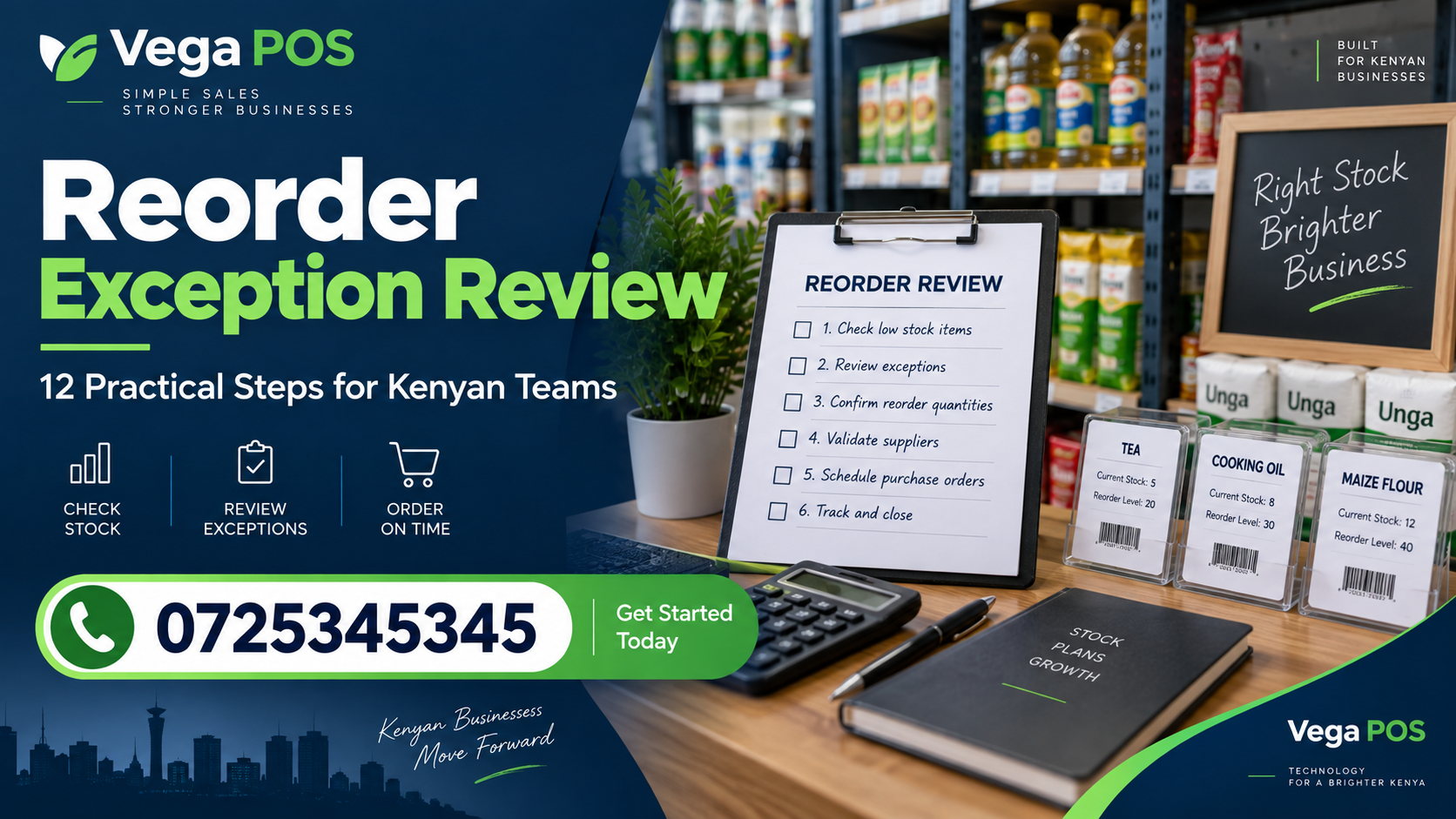
1. Define the purpose of a reorder exception review
Agree which situations should be reviewed before ordering. Examples include an unexpected demand jump, a balance that conflicts with a shelf count, an overdue supplier delivery or an item that has stopped selling. The review should focus attention on exceptions rather than force the buyer to investigate every ordinary product from the beginning.
Record the question that needs answering. Is the proposed quantity too high? Is stock already on the way? Does the product still belong in the range? A reorder exception review becomes more useful when every entry has a decision to support instead of a vague label saying check this item.
2. Confirm the product and purchasing unit
Start with a stable product identity and the unit used for buying. A carton, packet and individual piece can produce very different order quantities. Similar supplier references may also describe different pack sizes. Resolve these differences before comparing stock levels with a proposed purchase.
Use the supplier catalogue cleanup guide when the mapping is unclear. A reorder exception review should not approve a quantity that the buyer cannot translate into the actual goods expected at the receiving desk. Confirm packaging changes with current evidence rather than copying an old conversion.
3. Check whether the recorded balance is credible
Compare the system position with the relevant physical evidence when a discrepancy is suspected. Look for goods waiting to be received, a movement that has not been completed or items held away from the main shelf. Do not immediately buy more stock to cover a difference that may be caused by an unfinished record.
Use consistent storage references. The stock location labels guide helps employees check the same places. During a reorder exception review, record what was checked and what remains uncertain. A quick glance at one shelf is not the same as confirming the complete stock position.
4. Separate available stock from other quantities
Goods may be physically present but reserved, held for review or located at another branch. Ordered stock may not yet have arrived. Confirm how the business distinguishes these quantities in its actual records. The buyer needs to understand which stock can satisfy the next ordinary sale.
A reorder exception review should state the quantity basis explicitly. Avoid using an unexplained total that combines available, expected and committed goods. Ask the provider to demonstrate how the relevant screens handle these states and how staff can inspect the underlying transactions when a number looks unusual.
5. Review recent demand in context
Compare the recent pattern with the circumstances of the period. A large one-off order, a promotion, a temporary closure or missing trading days may make an average misleading. Keep those events visible instead of treating every change as a permanent shift in demand.
For reorder exception review, ask whether the proposed purchase responds to repeatable demand or a special event. Do not assume that yesterday’s unusually large sale will happen every day. Equally, a quiet period caused by a stockout does not necessarily show that customers no longer want the product.
6. Check outstanding supplier commitments
Look for open orders, accepted changes and partial deliveries before placing another purchase. Confirm the remaining quantity and the latest supplier response. Two employees can unintentionally order the same shortage if they review separate lists without seeing the existing commitment.
Keep an uncertain arrival date clearly labelled. Reorder exception review should consider the risk of waiting without pretending that expected stock is already available. If a second order is authorised, record how it relates to the first and who will handle any resulting overlap or cancellation discussion.
7. Understand the lead time being used
Ask how long the business currently expects between ordering and usable receipt. Distinguish the supplier’s stated dispatch time from the full journey through delivery, receiving and availability. A product that reaches the gate on Friday may not be ready for sale at the moment a customer needs it.
Use recent, relevant observations when reviewing the assumption. A reorder exception review can identify where the lead time is uncertain or has changed. Record the basis for any adjustment so the next buyer knows why a familiar product now requires earlier attention.
8. Consider storage and product life
The ability to buy a large quantity does not mean the shop can store or sell it appropriately. Review available space, handling requirements and product life where relevant. Keep purchasing decisions within the business’s established product procedures and do not assume that a discount compensates for unsuitable storage.
A reorder exception review should make these limits visible alongside demand. Ask whether the proposed quantity would crowd receiving areas or leave older stock overlooked. The final decision should explain how the goods will be handled, not merely why the supplier’s offer appears attractive.
9. Separate a price decision from a quantity decision
Supplier cost changes, selling prices and reorder quantities are related but different questions. A higher cost may require an authorised commercial review. It does not automatically justify buying an unusually large quantity or changing the counter price without approval.
Use the price change approval guide for the selling decision. In a reorder exception review, record the assumptions that affect the quantity and route separate price questions to the responsible person. This keeps the buyer’s explanation understandable when someone reviews the order later.
10. Record the decision and its reason
The outcome may be to order, wait, reduce a quantity, investigate a discrepancy or seek another authorised supply option. Record the approver, quantity basis and next action. A short explanation should connect the decision to the evidence rather than simply repeat approved or rejected.
Keep unresolved questions open under a named owner. Reorder exception review should not convert uncertainty into a blank field that disappears from attention. If the decision is temporary, record when it will be revisited and what information is expected before then.
11. Communicate the practical consequence
Receiving staff, branch teams or customer-facing employees may need to know what the decision means. Tell them the relevant action: an order is postponed, a substitute needs approval or a promised arrival remains uncertain. Share the information needed for their task without sending a long purchasing discussion to everyone.
The retail handover log guide can support this communication. Reorder exception review is only complete when the decision reaches the people who would otherwise act on an outdated assumption.
12. Compare the outcome with the original concern
After the next receiving or selling period, revisit selected exceptions. Did the goods arrive as expected? Was the quantity useful? Did the suspected record issue explain the shortage? The purpose is to improve the assumptions and process, not to judge a decision using information that was unavailable at the time.
Use the findings to refine future reorder exception review. Repeated catalogue confusion may need a catalogue fix; repeated delayed receipts may need a receiving improvement. Treat the review as a way to identify specific changes instead of an extra approval step with no learning.
Worked example: low stock with an open delivery
Imagine a shop sees a low balance on an item that usually sells steadily. The buyer checks the shelf, confirms the product unit and finds an existing order whose first delivery was accepted yesterday. A second quantity remains open, but the supplier has not confirmed the date. The buyer records both the expected stock and the uncertainty.
The authorised decision may be to wait until a stated review time, seek clarification or source a limited alternative. Whatever the outcome, the record explains why another full order was not placed automatically. This hypothetical example shows how reorder exception review connects demand, records and supply evidence.
Build a short exception worksheet
Include the product reference, trigger for review, current quantity basis, open supply references, demand observation, relevant constraint, decision, owner and review date. Keep the worksheet linked to the underlying records rather than copying entire transaction histories into it.
Test whether a second buyer can follow the explanation without asking the preparer to narrate it. If the reason is unclear, improve the decision note. If information repeatedly cannot be found, fix the underlying record process. Extra columns do not solve a missing source of truth.
Questions that improve a buying discussion
Should the system’s suggestion always be followed? Treat it according to your agreed controls and the assumptions behind the suggestion. Confirm how it is calculated and which circumstances it does not cover before relying on it.
Does a low balance always mean high demand? No. A low balance can have several causes, including incomplete receiving, reservations and record discrepancies. Investigate the relevant evidence.
How many exceptions should be reviewed? Choose a manageable scope based on the business’s actual risks and workload. Start with cases where a wrong decision would matter, then refine the routine as the records improve.
Useful platforms beyond retail purchasing
Some organisations operate several kinds of business. Prim serves salon workflows, TAS presents chama management, JAAT presents a digital mall and Dereva connects customers with drivers. Saseni presents writing order management. Review their current offerings according to the relevant activity.
For a custom website or business portal, explore Zama Web Experts. Confirm integration requirements separately. These links provide places to investigate suitable services; they do not establish shared stock information or automatic purchasing connections.
Run a pilot across contrasting products
Choose a small group that includes a steady seller, an item with occasional large orders and a product affected by irregular supply. These examples reveal different reasons for an exception. Reorder exception review should not be designed around only the easiest product and then applied unchanged to every other buying decision.
For each example, ask the buyer to explain the stock position, expected demand, outstanding supply and proposed action. Record how long it takes to find the evidence and which information is missing. The aim is to make the decision understandable, not to reward the longest explanation.
After the next delivery period, compare the pilot decisions with what actually happened. Distinguish an inaccurate assumption from a supplier change that nobody could reasonably have known in advance. Use the difference to improve the review questions rather than blame the employee for every unexpected result.
Reorder exception review should end with a short set of instructions that reflects your product range. Identify which cases need approval, which can be resolved by the buyer and which require a stock investigation. Keep the owner of those instructions visible so new employees can ask questions before introducing unofficial workarounds.
Keep the final checked and approved pilot examples with the instructions as a training aid. New buyers can compare an ordinary reorder with an exception and explain why the decisions differ. This practical discussion reveals misunderstandings early and helps the team apply the agreed review consistently without turning every purchase into a lengthy meeting.
Prepare your next Vega demonstration
Bring a normal reorder, an unusual demand example and an item with an outstanding supplier commitment. Ask the team to show the relevant stock and purchasing records, the available permissions and how an employee explains an exception to the next person.
Review Vega’s product information and call 0725345345. A useful reorder exception review starts with clear records and ends with a decision your team can explain. Pilot the routine on a small product range, review the results and improve the instructions before extending it across the business.