 Vega
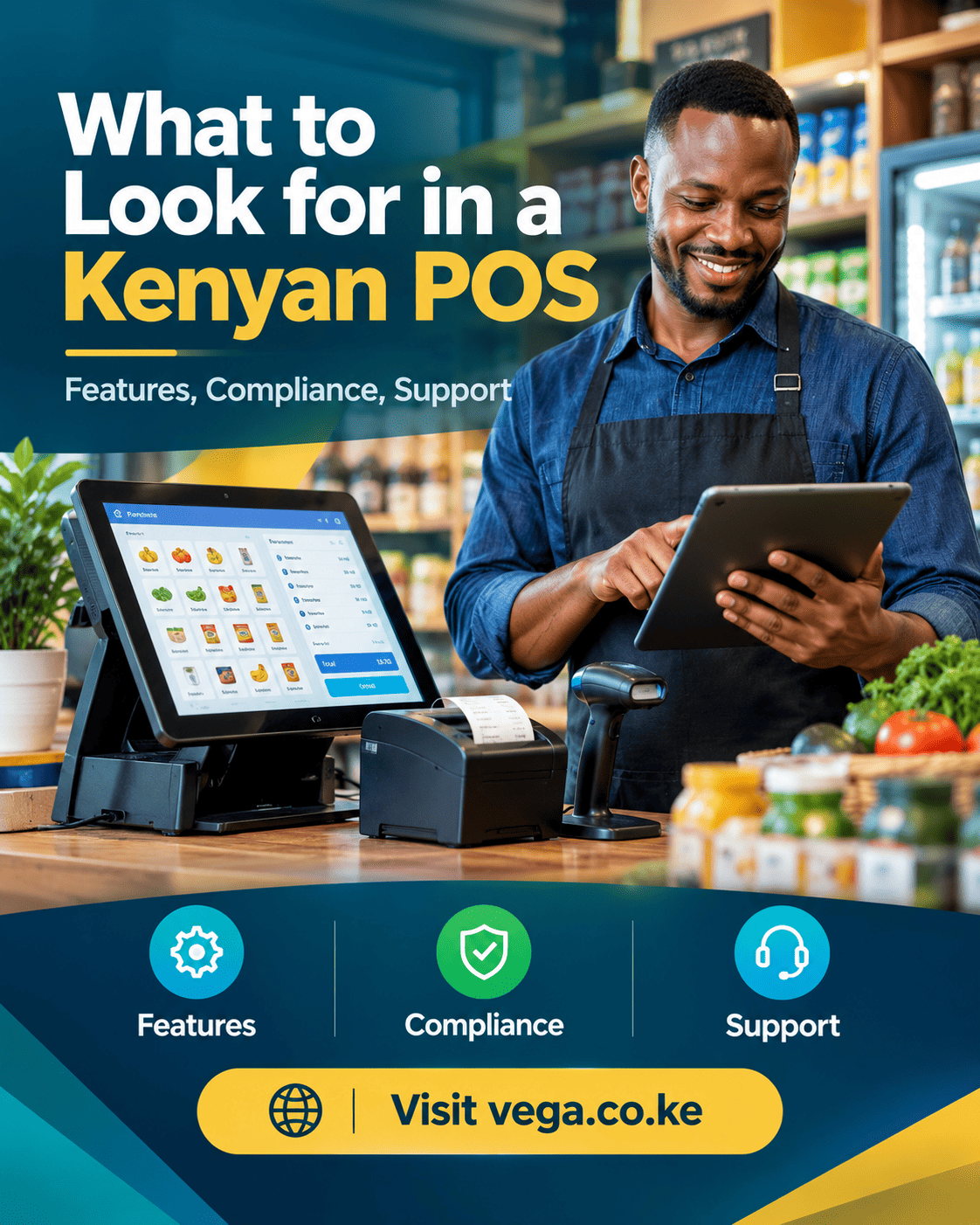
What to look for in a Kenyan POS system is one of the most important questions any shop owner must answer before investing in technology. A point-of-sale system is not just a cash register; it is the central nervous system of your retail business. The right system protects your revenue, while the wrong one drains your profits and wastes your time.
Understanding What to look for in a Kenyan POS system requires balancing local compliance, payment methods, and operational reliability. Whether you run a small duka in Nakuru or a large supermarket in Nairobi, your needs are specific to this market.
This guide explores What to look for in a Kenyan POS system step by step. We will cover tax compliance, mobile money integration, hardware durability, and vendor support.
Many Kenyan retailers suffer from unexplained cash shortages and stockouts because they choose systems designed for foreign markets. Knowing What to look for in a Kenyan POS system ensures you avoid these costly mistakes.
You will learn What to look for in a Kenyan POS system across essential categories like eTIMS compliance, M-Pesa STK Push, and offline mode.
By the end of this article, you will master What to look for in a Kenyan POS system and make a confident purchasing decision.
Let us look at why this is critical for your business. Knowing What to look for in a Kenyan POS system directly impacts your ability to survive power outages and internet drops.
You will discover What to look for in a Kenyan POS system through real-world scenarios like split payments and credit sales.
We will cover the best practices for evaluating hardware. What to look for in a Kenyan POS system must include barcode scanning speed and receipt printer reliability.
Do not let a vendor sell you a system that cannot handle local requirements. Understanding What to look for in a Kenyan POS system protects you from expensive mistakes.
Your staff will also benefit from a system that is easy to use. What to look for in a Kenyan POS system includes intuitive interfaces that reduce training time.
It is time to lock down your checkout process with the right tools. Knowing What to look for in a Kenyan POS system is your first line of defense against fraud.
We will explore What to look for in a Kenyan POS system for multi-branch operations and scalability.
Protecting your data is just as important as protecting your cash. What to look for in a Kenyan POS system must include secure cloud backups and user permissions.
Let us dive into the details. The guide to What to look for in a Kenyan POS system starts right now.
Why You Must Know What to Look For in a Kenyan POS System
In the past, a cash register and a notebook were enough. Today, the Kenya Revenue Authority (KRA) demands electronic tax invoicing. Customers expect to pay by M-Pesa. Power cuts and internet outages are common realities.
A generic POS system built for Europe or America will fail in Kenya. It may not integrate with M-Pesa. It may not meet eTIMS requirements. Knowing What to look for in a Kenyan POS system is the difference between a smooth operation and a daily struggle.
When you choose the right system, you gain control. You see your sales in real time. You track stock accurately. You reduce theft and errors.
Investing time in understanding What to look for in a Kenyan POS system pays for itself within months.
The High Cost of Choosing the Wrong POS
If you buy a system that does not fit the Kenyan market, you will face immediate problems. The most common issue is failed compliance. Without eTIMS integration, you risk heavy penalties from KRA. Your expenses may not be deductible for tax purposes.
The second cost is lost sales. If your POS cannot handle M-Pesa STK Push efficiently, queues grow. Customers abandon purchases.
The third cost is inventory chaos. A system that cannot track stock in real time leads to stockouts of fast movers and dead stock of slow movers.
Understanding What to look for in a Kenyan POS system prevents these financial leaks.
Step-by-Step Guide to What to Look For in a Kenyan POS System
Selecting the right system requires a structured evaluation. You cannot just compare prices. You must look at features, compliance, and support.
Here is the step-by-step guide on What to look for in a Kenyan POS system.
Step 1: Check for Mandatory eTIMS Compliance
The Kenya Revenue Authority requires all VAT-registered businesses to generate electronic tax invoices through the eTIMS system. This is not optional.
Any POS system you consider must be fully integrated with KRA’s eTIMS. It must automatically transmit invoice data to KRA at the time of the transaction.
Do not accept promises of “future integration.” The system must be eTIMS-ready today. Non-compliance can result in a penalty of twice the tax due.
eTIMS compliance is the most critical factor when evaluating What to look for in a Kenyan POS system.
Step 2: Demand Seamless M-Pesa Integration
M-Pesa is the dominant payment method in Kenya. Your POS must handle it smoothly. Manual confirmation of M-Pesa payments slows down checkout and creates errors.
Look for a system that supports M-Pesa STK Push. This sends a payment prompt directly to the customer’s phone. The POS confirms the payment automatically.
The system must also reconcile M-Pesa payments with cash sales in a single report.
Seamless M-Pesa integration is non-negotiable when considering What to look for in a Kenyan POS system.
Step 3: Ensure Robust Offline Functionality
Internet and power outages are a reality in Kenya. A POS system that stops working when the internet drops will lose you sales.
You must test the offline mode. The system should continue to process sales, print receipts, and record inventory locally. When the connection returns, it should sync automatically to the cloud.
A hybrid approach offers the reliability of offline operation with the visibility of cloud backups.
Robust offline mode is essential for What to look for in a Kenyan POS system.
Step 4: Evaluate Inventory Management Features
Your POS should do more than just ring up sales. It must help you manage stock.
Look for real-time inventory tracking. Every sale should reduce stock automatically. The system should send low-stock alerts so you reorder fast movers before you run out.
It should also support multiple locations, allowing you to transfer stock between branches.
Strong inventory management is a key part of What to look for in a Kenyan POS system.
Step 5: Test the User Interface for Speed
Your cashiers will use this system hundreds of times a day. It must be fast.
Look for a clean interface. Barcode scanning should be instant. Quick search should find products as you type.
A slow interface creates long queues and frustrated customers.
A fast, intuitive user interface is a critical factor in What to look for in a Kenyan POS system.
Step 6: Verify Local Customer Support
When your POS fails on a busy Saturday, you need help immediately. An email to an overseas vendor is useless.
You need a vendor with local support in Kenya. Ask about their response times. Do they offer WhatsApp support? Do they have local technicians who can visit your shop?
A two-hour response time is ideal for critical issues.
Local support is a top priority for What to look for in a Kenyan POS system.
Step 7: Review Security and User Permissions
Internal theft is a major risk in retail. Your POS must provide the tools to prevent it.
Look for unique user logins. The system should log every action, including voids and refunds, with the user’s identity.
You must be able to set role-based permissions. A cashier should not be able to approve large refunds without a supervisor.
Strong security controls are essential for What to look for in a Kenyan POS system.
Step 8: Consider Scalability for Growth
Your business will grow. Your POS must grow with you.
Look for a system that supports adding new tills, users, and branches without major disruptions. Cloud-based systems are inherently more scalable than on-premise ones.
Scalability protects your investment.
Future-proofing your business requires understanding What to look for in a Kenyan POS system.
Step 9: Evaluate the Total Cost of Ownership
Do not just look at the purchase price. Look at the total cost over three years.
This includes hardware, monthly software subscriptions, payment integration fees, training, and support.
Look for transparent pricing. Avoid systems with hidden fees for features you will need.
Understanding the total cost of ownership is part of What to look for in a Kenyan POS system.
Step 10: Ask for References
Before you buy, ask the vendor for references from other Kenyan shops.
Speak to other owners. Ask about their experience. How is the support? Does the system work well offline? Are there any hidden problems?
Real-world feedback is invaluable.
Using references to confirm What to look for in a Kenyan POS system is a smart move.
Best Practices for Evaluating a POS System
Test with Real Transactions
Do not rely on a controlled demo. Ask for a free trial or a pilot period. Use the system in your shop for a few days.
Test it during peak hours. Test the offline mode. Test the M-Pesa integration.
Real-world testing reveals issues that a demo will hide.
Involve Your Team
Your cashiers will use the system daily. Ask for their input.
Let them try the interface. Ask them what feels intuitive and what feels clunky.
Staff buy-in is critical for a smooth transition.
Check for Local Regulatory Updates
Tax and compliance rules change. Ensure your vendor has a proven track record of keeping up with KRA requirements.
Your system should be updated automatically to reflect new regulations.
Prioritize Reliability Over Fancy Features
A reliable system with core features is better than a complex system that crashes. Focus on eTIMS, M-Pesa, offline mode, and inventory tracking first.
Common Mistakes to Avoid
Ignoring eTIMS Compliance
Non-compliance leads to fines and penalties. This is not a feature you can add later. It must be built-in from day one.
Buying on Price Alone
The cheapest system often lacks local support or offline mode. It will cost you more in downtime and lost sales.
Assuming the Internet Is Always On
Kenya has excellent mobile coverage, but outages happen. A cloud-only system without offline mode is a recipe for disaster.
Not Testing the Interface
A system that works well on a large screen might be unusable on a tablet. Test the interface on the devices you will actually use.
Forgetting About Hardware
Your POS software needs reliable hardware. Ensure the vendor supports the hardware you plan to use, or buy a recommended bundle.
How vega.co.ke Helps
At vega.co.ke, we built our platform specifically for the Kenyan market. We understand What to look for in a Kenyan POS system because we designed it to meet those exact needs.
Our system is fully eTIMS compliant, automatically generating KRA-approved invoices for every sale. We offer seamless M-Pesa STK Push integration for instant payment confirmation.
We prioritize offline functionality. Our POS continues working when the internet drops, syncing data seamlessly when it returns.
We provide local support via phone and WhatsApp. You get fast help from people who understand the local market.
If you want a system that checks every box on your list, visit vega.co.ke today.
Frequently Asked Questions
1. Why is eTIMS compliance the most important thing to look for?
It is mandatory for VAT-registered businesses. Non-compliance results in a penalty of twice the tax due, and your expenses may not be tax-deductible.
2. How does M-Pesa STK Push improve checkout?
STK Push sends a payment prompt to the customer’s phone. The POS confirms payment automatically, eliminating manual entry and speeding up service.
3. What does offline mode mean for a POS?
The system can process sales, manage inventory, and print receipts without an internet connection. It syncs data to the cloud when the connection is restored.
4. How much does a good POS system cost in Kenya?
Monthly subscriptions range from KES 2,000 to KES 15,000, depending on features and branches. Hardware costs are separate.
5. What support should I expect from a local vendor?
Look for WhatsApp support, local phone numbers, and response times of a few hours for critical issues. Avoid vendors who only offer email support.
6. Can a POS system handle multiple branches?
Yes, cloud-based systems often support multi-branch management from a single dashboard, including stock transfers and consolidated reporting.
7. How do I ensure my POS is secure?
Use unique user logins, role-based permissions, and a system that maintains a full audit trail of all transactions.
8. How can vega.co.ke help my shop?
vega.co.ke offers a complete, Kenyan-built POS platform with eTIMS compliance, M-Pesa integration, offline mode, and local support. Visit vega.co.ke to learn more.
Take Action Today
Choosing a POS system is one of the most important decisions for your retail business. Knowing What to look for in a Kenyan POS system ensures you invest in a tool that protects your profits and helps you grow.
Start by prioritizing eTIMS compliance and M-Pesa integration. Test the offline mode. Verify the local support. Involve your team in the decision.
Do not settle for a generic system that does not fit the Kenyan market. Take control of your operations today.
Visit vega.co.ke to explore our platform. Let us help you find the perfect POS system for your shop.