 Vega
Till void review begins with a question the day’s sales total cannot answer: did the sale actually complete? A cashier scans an item twice, notices the second line and removes it before taking payment. Another cashier discovers a duplicate only after a receipt was issued. Both may describe the action as a void, but the evidence and remedy differ.
Set up a training basket with one lamp at KSh 900 and one bulb at KSh 150. The intended total is KSh 1,050. Run the exercise in a test environment with fictional receipt references. Ask staff to explain what happens to the ticket, payment and stock in each case rather than assuming that a particular button produces the right outcome.
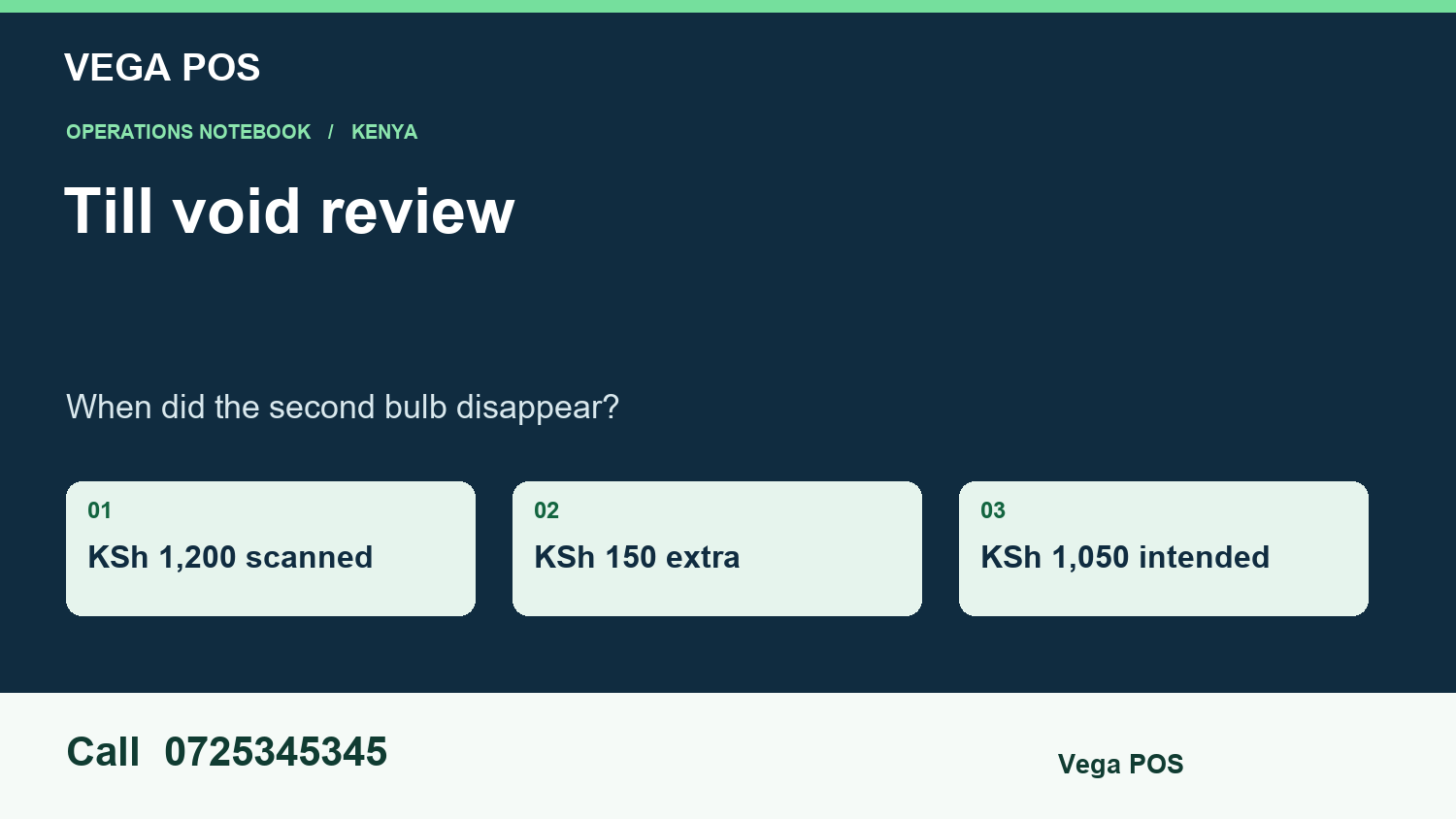
Till void review in four decisions
Use the four decisions below as a tabletop exercise. The case is fictional. Each decision pairs a new scenario with field notes drawn from a linked guide in our library. Read the scenario aloud first, and ask the next person to explain the result before consulting the notes.
1. Test a correction before settlement
Scan the bulb twice and inspect the unpaid ticket. It totals KSh 1,200. Remove one KSh 150 line and check that KSh 1,050 remains before taking payment. The test should leave one lamp and one bulb sold, not a sale plus an unexplained refund.
Agree whether pre-settlement corrections need reasons or approval under the shop’s policy. Excessive paperwork for an ordinary scan error can slow a queue, but a complete absence of visibility makes recurring catalogue or training problems harder to identify. Make the distinction explicit and teach the person reviewing the shift which actions warrant a closer look. Till void review should distinguish a cancelled unpaid line from a completed sale before comparing money movements.
Field notes from our retail quotation review guide:
Keep amendments under one reference
Customers often change quantities, replace items or ask for a different delivery arrangement. Keep revisions connected so the team can identify the latest offer. Give each version a clear date or revision marker using the available process. An employee should not need to compare several screenshots to discover which one the customer accepted.
Retain the reason for a material change. If an item was substituted because the original was unavailable, record whether the buyer approved that substitution. Retail quotation review works best when the history explains the decision without overwhelming the current document. Preserve earlier versions as evidence while making the approved version easy to find.
Recheck the accepted offer before creating the sale
Compare the accepted version with the intended transaction. Confirm the customer, products, units, quantities, prices and delivery instructions. Ask the team to demonstrate how the available system carries these details forward and how it prevents accidental duplication. Do not assume that every field transfers automatically or that a second click is harmless.
Record the connection between the quotation and the resulting order or sale. If only part of the offer is accepted, identify the remaining lines and their status. Retail quotation review should leave a traceable result rather than a quotation that appears open forever after the customer has already purchased the goods.
2. Test a correction after settlement
This time complete the KSh 1,200 transaction and issue a receipt before noticing the extra bulb. The customer was actually charged KSh 150 too much. Review the authorised correction process for the payment method used. A change to a report is not evidence that the customer received the money back.
Record the original receipt, reason, reviewer and settlement reference. Compare the expected drawer with physical cash only for cash movements. A refund to another payment channel must not be recorded as missing notes merely because the sale originally appeared on the till. For till void review after settlement, keep the original receipt and refund confirmation together.
Field notes from our cash float handover guide:
Separate float movements from sales
Money added for change or removed through an authorised procedure needs its own record. It should not be disguised as a sale, refund or discount to force a desired drawer balance. Ask the provider to demonstrate the available movement types and explain their effect on the shift review. Use the method that fits the actual event.
Record the reason, responsible person and supporting reference required by your business. Cash float handover should connect these movements to the relevant shift without making the incoming employee reconstruct them from messages. A clear movement record helps the reviewer distinguish an authorised change from an unexplained difference.
Review the routine after a small pilot
Start with a limited set of shifts and ask employees where the instructions were unclear. Did they know which figure to enter? Could they identify the correct drawer? Were interruptions handled consistently? These observations can reveal practical weaknesses before the process becomes standard across all counters or branches.
Make targeted corrections and repeat the example. Cash float handover should be simple enough to perform reliably during normal trading while keeping the necessary evidence. Adding more fields is not always the answer; clearer labels, a better sequence or an agreed reviewer may solve the actual problem.
3. Check which physical units moved
In the duplicate bulb scenario only one bulb left the shop. Ask the stock reviewer what the original posting did, what the correction should do and whether there is a genuine physical return. If the cashier refunds KSh 150 but leaves two bulbs deducted, stock is still understated.
If a different customer really returns a broken bulb, the shop needs a condition decision before returning it to saleable stock. Two identical monetary adjustments can therefore require different stock outcomes. Require the review to explain the object that moved, not merely the amount appearing on a correction report. Physical quantity is an independent check in till void review because refunding money does not identify the condition of a returned item.
Field notes from our barcode label checks guide:
Keep price changes under separate control
A correct barcode match does not authorise a new selling price. Where labels include prices, compare the price against the approved change and its effective date. Confirm whether an old promotional sticker needs removal. Staff should not guess which price applies when the shelf, package and counter disagree.
Use the price change approval guide alongside barcode label checks. Give the label job a reference that connects it to the approved price decision. This keeps a printing task from becoming an undocumented commercial change and helps the next shift explain the price shown to a customer.
Record failures in a useful way
Separate a code that will not scan from a code that scans to the wrong product. Also distinguish a correct product with an unexpected unit or price. These failures may need different owners. A printer adjustment will not solve an incorrect product mapping, and changing a product description will not repair torn label material.
For each failure, keep the item reference, label batch, location, observed result and next action. Use short, factual notes. Barcode label checks become easier to improve when the team can see repeated causes instead of a general complaint that the scanner is unreliable.
4. Read patterns without accusing staff
A weekly sample contains six corrections at the till beside the lighting display. That pattern could reflect a confusing barcode, an awkward scan angle, training needs or another cause. Compare correction reasons, total transactions and product references before drawing a conclusion about an employee. Two corrections in ten tickets mean something different from two corrections in three hundred.
Take one anonymised example back to the counter and try to reproduce the error. Record what can be established, what remains uncertain and who owns the next check. An exceptions report starts an investigation; it does not prove misconduct. Use till void review to select a case worth investigating and to document what the evidence actually establishes.
Field notes from our retail damaged stock guide:
Capture evidence that answers a question
Take only the evidence needed to show the condition and identify the goods. Useful photographs may show the overall item, affected area and identifying label. Record the delivery or transaction reference when relevant. Keep evidence in the approved business location so the reviewer can find it later.
Avoid collecting unrelated personal information or taking photographs that reveal customer details unnecessarily. A retail damaged stock record should answer what happened to the goods. It should not become an uncontrolled collection of private messages and photographs scattered across employees’ phones. Link the evidence to the case rather than relying on memory.
Confirm completion beyond the first action
Check that the physical goods, stock record and supporting documents agree. If goods were returned, verify the recorded quantity and collection evidence. If a replacement arrived, confirm how it was received. Keep financial follow-up with the appropriate person instead of assuming that a physical return closes every related issue.
Retail damaged stock can be physically resolved while a document remains outstanding. Make that distinction visible. The team should not reopen the same physical problem simply because a separate supplier response is still pending, nor should it lose the outstanding response by closing the entire case too early.
Till void review evidence sheet
Before running the example, cover the expected results and ask a colleague to predict them. Use the disagreements to decide which rule needs explaining. These are fictional test cases; use your own approved references for the real procedure.
| Test condition | Expected evidence |
|---|---|
| Remove an extra bulb before settlement | The unpaid basket falls from KSh 1,200 to KSh 1,050 without a customer refund. |
| Discover the same extra line after settlement | A KSh 150 correction is linked to the original receipt, tender and authorisation. |
| Refund a genuinely returned broken bulb | The financial correction and the stock condition decision have separate evidence. |
| Compare two tills with different traffic | Review correction rates and the circumstances of sample tickets. Raw counts alone cannot establish individual fault. |
Till void review: questions from the counter
Is an abandoned unpaid basket a refund?
No customer money needs refunding if no settlement took place. The business may still want evidence of the cancelled ticket, especially if it had reserved stock. Review the effects separately: an abandoned basket, a cancelled reservation and a completed refund are different events even if the final sale total is zero.
Who should review a till void?
Choose the role authorised by the shop’s policy. The reviewer needs enough information to distinguish a scan mistake from a settled transaction and to verify the resulting payment and stock movements. They do not need unrelated customer details. Keep the review fair by recording the explanation and what remains unconfirmed.
Do high correction counts prove a problem with one cashier?
They identify a question, not a conclusion. Compare trading volume, product mix, shift length and repeat references. A cashier assigned to the busiest counter can have more corrections but a lower rate. Test an actual example before changing permissions or attributing a stock difference to an individual.
Use till void review in your next demonstration
For a discussion about till void review, contact Vega POS on 0725345345. Bring one anonymised example, its starting position and the result your colleague expects. Ask for a demonstration using those details before assuming a particular feature or integration is available.
Other Kenyan business workflows
For a custom business portal, explore Zama Web Experts. If your team is working in another sector, these services provide different examples: Prim for salon bookings, sales and stock; TAS for chama records and contributions; Saseni for writing orders and delivery; JAAT for shop and product listings; Dereva for driver discovery. Use the service that fits your task; a link does not establish that the systems exchange data.
To compare the outcome of till void review with a related case, try our opening a second shop counter exercise. Use the same fictional reference throughout, then explain what the second exercise checks that the first one did not.