 Vega
Customer deposit allocation matters when one buyer has two open orders. Suppose an installer orders a door and a lock on different days and sends KSh 5,000 before either item is collected. A message saying “payment received” does not tell the shop whether the money belongs against the door, the lock or both.
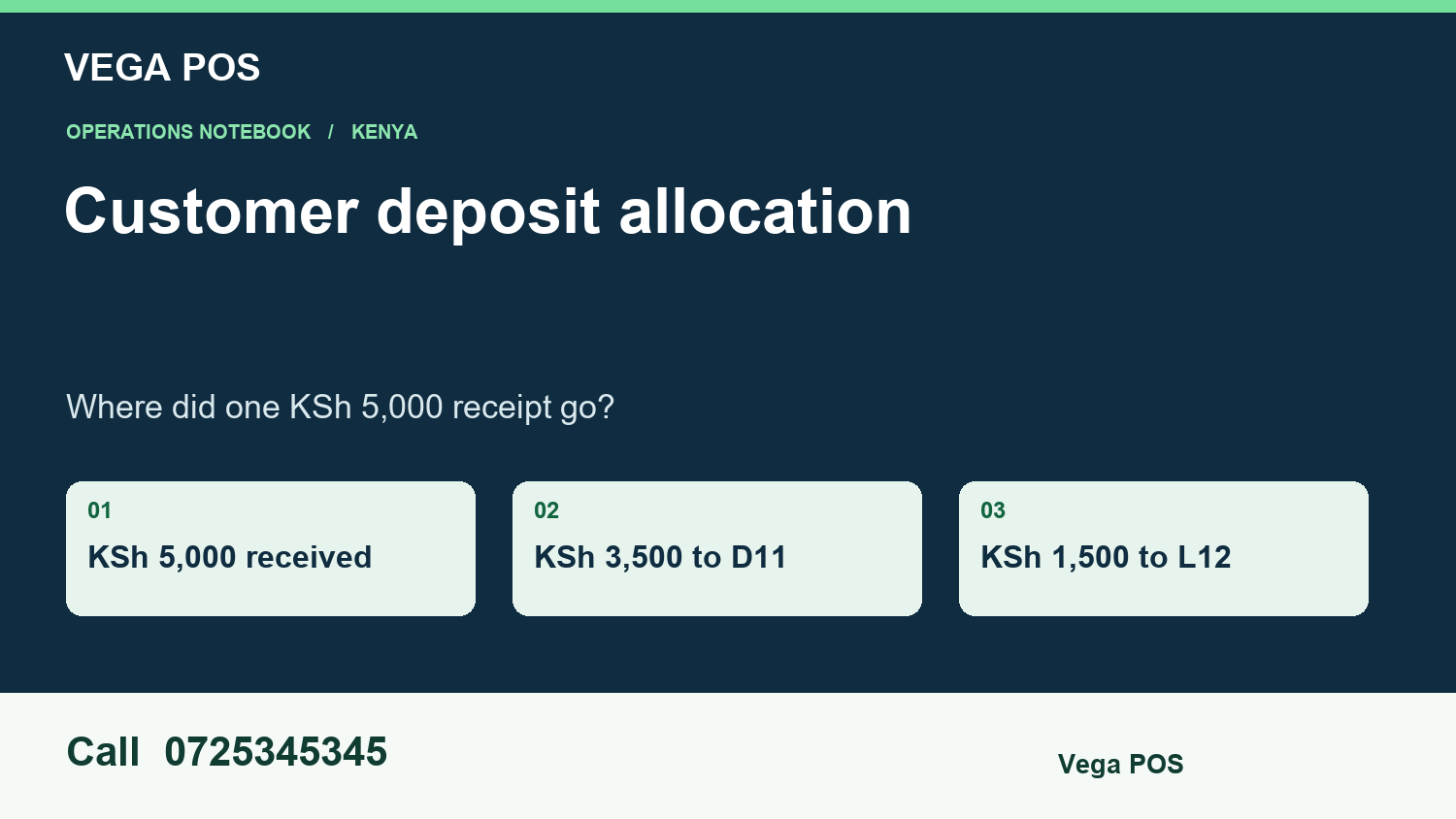
Use fictional orders D11 and L12 with authorised totals of KSh 12,000 and KSh 4,000. The customer’s instruction allocates KSh 3,500 to D11 and KSh 1,500 to L12. Give the cashier only a sample payment reference and the instruction. Ask the buyer and storekeeper to describe what each may conclude about payment, availability and collection.
Customer deposit allocation in four decisions
Use the four decisions below as a tabletop exercise. The case is fictional. Each decision pairs a new scenario with field notes drawn from a linked guide in our library. Read the scenario aloud first, and ask the next person to explain the result before consulting the notes.
1. Confirm the receipt before allocating it
A customer message is a useful lead, not independent proof that the business received the transfer. Follow the shop’s verification process against its authorised payment records. In the demonstration, confirm one KSh 5,000 receipt, record its reference once and distinguish it from the two allocations that follow.
A staff member looking at the payment register should not see two new receipts totalling another KSh 5,000. If confirmation is missing, leave the payment pending under the proper procedure. The assistant who answers the customer’s call should know what is being checked and who is responsible for checking it. Customer deposit allocation should never substitute for independent confirmation of the incoming transfer.
Field notes from our cash float handover guide:
Define who can approve a difference
Assign responsibility for reviewing a mismatch and deciding the next permitted action. The employee who counts the drawer should be able to report the observation without having to determine its cause immediately. A manager or other authorised reviewer can then examine the relevant records and document the outcome under your internal procedure.
Avoid turning a difference into an accusation before the facts are understood. Misclassification, timing and incomplete records can all require investigation. Cash float handover should preserve evidence and responsibility while allowing a fair review. This guide does not determine employee liability or replace your organisation’s employment and accounting procedures.
Plan for breaks and temporary cover
A short break can create the same responsibility questions as a full shift change. Decide how your business handles temporary cover and whether the drawer remains assigned to the original cashier. The procedure should fit your staffing model while preserving a clear explanation of who may transact during the period.
Do not assume that sharing a login is an acceptable substitute for recording cover. Confirm the supported user and permission arrangement with the provider. Cash float handover instructions should address the normal situations employees encounter, including busy periods when another colleague needs to help at the counter.
2. Split the advance by order reference
Apply KSh 3,500 to D11 and KSh 1,500 to L12. The unpaid balances are KSh 8,500 and KSh 2,500, assuming no other approved changes. Show the customer both destinations on a confirmation they can understand. Repeat the exercise with an instruction that says only “for my order”.
Staff should recognise that the split is now ambiguous, ask for clarification through the agreed channel and avoid guessing from the larger order value. Keep the confirmed transfer traceable even while the order allocation remains unresolved. Uncertainty about the destination is not evidence that money was never received. Keep the two customer deposit allocation lines connected to one receipt so an observer can reconstruct both balances.
Field notes from our retail quotation review guide:
Confirm quantities and selling units together
An accurate quantity with the wrong unit can still produce a serious misunderstanding. Ten boxes, ten pieces and ten metres describe different commitments. Record the selling unit beside every quantity and check how the system handles a pack containing several individual units. Do not assume that a supplier’s packaging description matches the unit used at your counter.
For example, imagine a customer requests six cartons and each carton contains twelve pieces. The quotation should make the offered basis clear before the team compares it with available stock. Retail quotation review should test the unit relationship using your actual products and supported configuration.
Give the offer a clear validity period
Record how long the quoted terms remain open under your business policy. A validity date gives staff a practical point at which to recheck price and availability. It does not replace a clear conversation about unusual items, changing supply conditions or a customer who needs a longer decision period. Make exceptions explicit and obtain the appropriate approval.
When a customer returns after the stated period, review the offer before converting it into a transaction. Confirm which terms still apply and issue an updated version where necessary. Avoid silently changing a document the customer has already reviewed. A revision clarifies decisions.
3. Do not confuse money received with goods ready
The lock is on the shelf but the door has not arrived. Ask a colleague to send a collection update about L12 without promising D11. The allocation record shows an amount against each reference; it does not identify who picked an item or whether the shop is allowed to release it.
Now change the lock specification and obtain an amended price. Keep the first payment reference intact and update the order terms through the approved process. Do not silently move the advance to another job merely because the goods on the shelf look more useful to the customer today. The collection message should refer to the order, whereas customer deposit allocation refers to the destination of the payment.
Field notes from our customer backorder tracking guide:
Identify the requested item precisely
Record the product, variant, size and required quantity. If the customer would consider an alternative, record that separately instead of replacing the original request. Similar descriptions can lead to an apparently completed backorder that does not meet the customer’s actual need.
Record the promise and its uncertainty
Write down what the business has actually agreed: the product, quantity, expected update and any conditions. Distinguish an estimated supply date from a confirmed collection time. If a supplier has not confirmed availability, staff should not present a hopeful date as a certainty.
Connect the request to a supply action
Identify whether the item is being purchased, transferred from another outlet or sourced through another approved route. Record the relevant reference when available. One supplier order may support several customer requests, so avoid assuming that the arrival of any quantity satisfies every waiting customer.
Review open backorders on a schedule
Check the open list for overdue updates, changed availability and requests that no longer have a next action. Sort the review by the commitments made to customers, not simply by the order in which notes appear. A short daily review may suit a busy shop, while another business may need a different routine.
4. Reassign or refund only with a clear instruction
Suppose the customer cancels L12 and asks to move its KSh 1,500 to D11. If permitted, D11 then carries KSh 5,000 and its unpaid balance is KSh 7,000. L12 should show why its allocation was reversed and where it went.
This is a reallocation of an existing receipt, not another payment into the till. If a refund is requested instead, follow the agreed approval route and check the actual refund outcome before confirming it. Use a separate completion reference so a second employee does not both transfer and refund the same KSh 1,500. Reopen the original customer deposit allocation when tracing a transfer; a newly created payment receipt would misstate the facts.
Field notes from our stock reservation expiry guide:
Include reservations in shift handover
Highlight holds that need attention during the incoming shift. Give the reference, location, current status and next action. Keep the handover concise and point to the full record for detail. Rewriting the entire case in several notebooks can create conflicting versions when the customer changes the arrangement.
Ask the receiving employee to locate one sample reservation and explain what must happen next. This quick check reveals unclear labels or missing information before a customer arrives. Stock reservation expiry becomes a shared routine when staff can follow the record without depending on the memory of the person who first took the enquiry.
Review recurring causes of overdue holds
Look at a small sample of reservations that repeatedly need extension or clarification. The issue may be an unrealistic collection window, poor product descriptions, uncertain payment status or a handover gap. Treat the pattern as a question to investigate, not proof that customers or employees are behaving badly.
Choose a specific improvement and check its effect on the next set of cases. Clarify a message, adjust an approval step or improve the location reference where appropriate. Stock reservation expiry should help the business make promises it can track, while reducing the amount of stock tied to arrangements nobody can confidently explain.
Customer deposit allocation control sheet
Before running the example, cover the expected results and ask a colleague to predict them. Use the disagreements to decide which rule needs explaining. These are fictional test cases; use your own approved references for the real procedure.
| Test condition | Expected evidence |
|---|---|
| Confirm one KSh 5,000 transfer | There is one payment reference before either order receives an allocation. |
| Assign KSh 3,500 and KSh 1,500 | D11 has KSh 8,500 outstanding and L12 has KSh 2,500 outstanding under the sample prices. |
| Leave the allocation unspecified | The receipt stays traceable while the business seeks instructions; neither order receives an invented allocation. |
| Transfer L12’s allocation to D11 with approval | D11 then carries KSh 5,000. The trace explains why L12 no longer carries the KSh 1,500. |
Customer deposit allocation: questions from the counter
Can one transfer pay toward two orders?
Yes, if the business supports and authorises the split. Keep one confirmed receipt and link its allocated amounts to distinct references. Test that the allocated total cannot exceed the receipt. If the buyer’s instruction allocates only KSh 4,000 of a KSh 5,000 receipt, identify the remaining KSh 1,000 as unresolved rather than silently distributing it.
What if the buyer sends a second payment with the same amount?
Match the independent payment references and confirmation evidence. Two equal amounts may be legitimate separate payments. Conversely, two screenshots of one transfer should not be treated as two receipts. The best demonstration includes both cases so staff learn to compare evidence rather than relying on a familiar amount or customer name.
What does a good customer confirmation look like?
It states the total confirmed receipt, the amounts assigned to D11 and L12, the remaining amount on each order and any unresolved allocation. Keep delivery promises separate. “Received and allocated” should not become “ready for pickup” unless the team has separately verified the goods and release conditions.
Use customer deposit allocation in your next demonstration
For a discussion about customer deposit allocation, contact Vega POS on 0725345345. Bring one anonymised example, its starting position and the result your colleague expects. Ask for a demonstration using those details before assuming a particular feature or integration is available.
Other Kenyan business workflows
For a custom business portal, explore Zama Web Experts. If your team is working in another sector, these services provide different examples: Prim for salon bookings, sales and stock; TAS for chama records and contributions; Saseni for writing orders and delivery; JAAT for shop and product listings; Dereva for driver discovery. Use the service that fits your task; a link does not establish that the systems exchange data.
To compare the outcome of customer deposit allocation with a related case, try our customer promise tracking exercise. Use the same fictional reference throughout, then explain what the second exercise checks that the first one did not.