 Vega
Vega Best ERP Software in Kenya: Complete Business Management Solution for Growing Companies
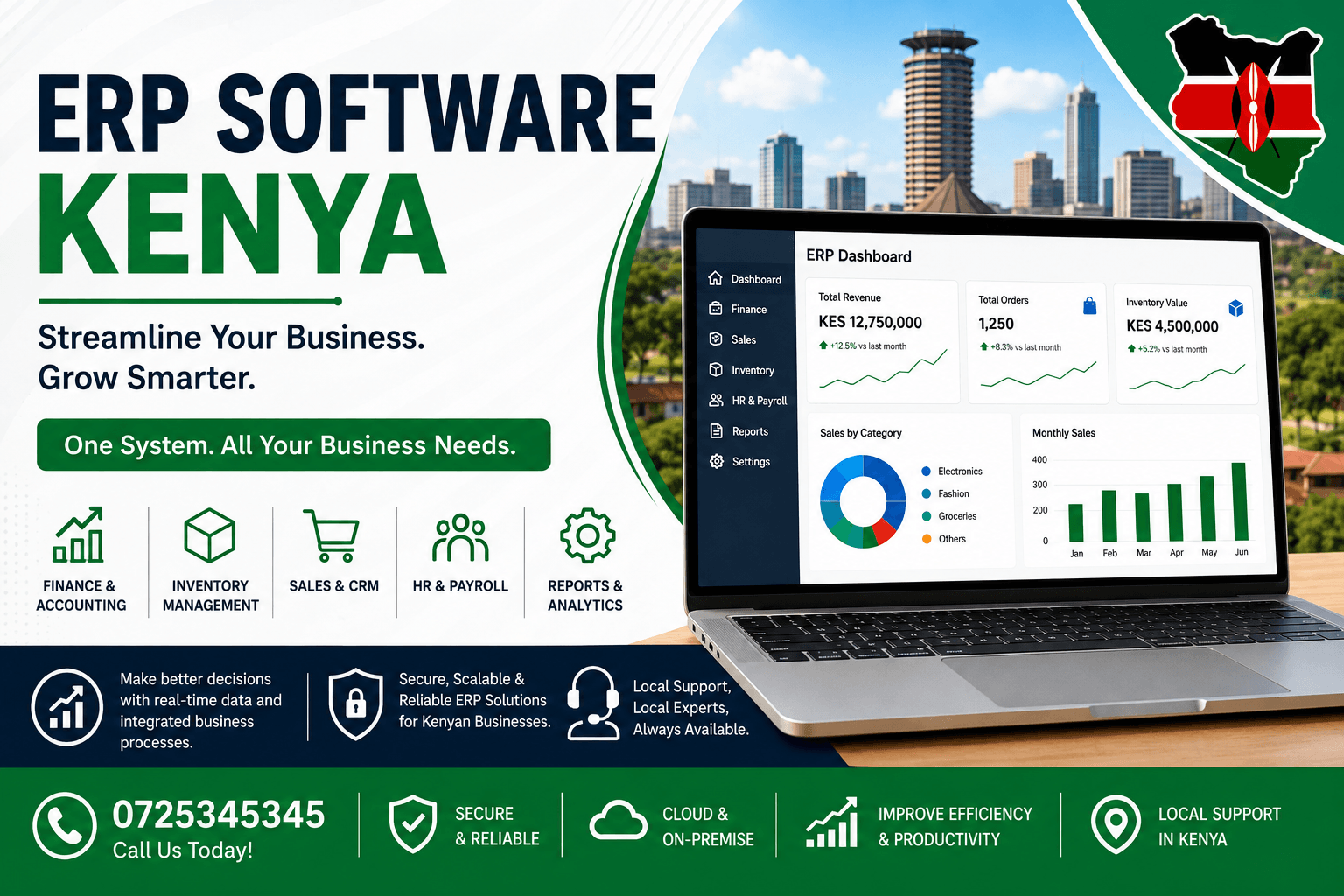
ERP Software Kenya is becoming an essential solution for businesses that want to manage accounting, inventory, sales, customers, HR, payroll, and reporting from one centralized platform. The right ERP system helps Kenyan businesses automate daily operations, reduce manual work, improve accuracy, and make better decisions using real-time business data.Running a growing business in Kenya becomes increasingly difficult when accounting, sales, inventory, employees, customers and purchasing are managed using different systemsModern ERP Software Kenya solutions help businesses automate accounting processes while giving managers better visibility into financial performance.
.Businesses searching for ERP Software Kenya need a solution that combines finance, inventory, sales, HR and reporting in one platform.With the right ERP Software Kenya solution, businesses can monitor stock levels, purchases and inventory movement from one centralized system.
One department may be working with spreadsheets, another may be using accounting software, while sales records, customer information and stock reports are stored somewhere else.
This makes it difficult for management to understand exactly what is happening across the business.
That is why more organizations are looking for ERP software in Kenya.
Enterprise Resource Planning (ERP) software brings important business operations together into one centralized systemA reliable ERP Software Kenya platform can reduce manual work, improve operational efficiency and provide real-time information for better decision-making.
Instead of operating several disconnected applications, businesses can manage finance, inventory, sales, purchasing, employees, customers and reporting from one platform.
For Kenyan SMEs and established organizations looking to improve efficiency, adopting a modern ERP system can provide better visibility, stronger financial control and a foundation for long-term growth.
Why ERP Software Kenya Is Important for Growing Businesses
ERP stands for Enterprise Resource Planning.
ERP software is a centralized business management system that connects different departments and processes within an organization.
Instead of having separate systems for accounting, inventory, sales, procurement and human resources, an ERP system allows these departments to work with shared business information.
For example, when a company makes a sale, a properly integrated ERP system can update the sales records, customer account, inventory quantities and financial information.
This reduces duplicate data entry and helps management work with more accurate information.
A comprehensive Key Features of ERP Software Kenya can include:
- Accounting and financial management
- Inventory management
- Sales management
- Customer relationship management
- Procurement and supplier management
- HR and payroll
- Point of Sale
- Manufacturing
- Project management
- Multi-branch management
- Business reporting
- Dashboards and analytics
- User permissions
- Audit trails
- Integrations
The objective is simple: give the organization one reliable system for managing its operations.
Why Businesses in Kenya Need ERP Software
Many Kenyan businesses start by using spreadsheets and simple accounting applications.
This can work when the company is small.
However, as transactions, employees, customers, suppliers, branches and inventory increase, managing everything manually becomes complicated.
You may eventually encounter problems such as:
- Different departments having different figures
- Difficulty determining current stock levels
- Delayed financial reports
- Duplicate data entry
- Missing customer information
- Poor expense tracking
- Complicated payroll administration
- Difficulty tracking supplier balances
- Limited visibility across branches
- Slow management decisions
- Human errors in reports
Implementing an ERP system in Kenya can help centralize this information.
Instead of asking different departments to prepare separate reports, authorized managers can access business information from a centralized platform.
Key Features of the Best ERP Software in Kenya
Not every ERP solution provides the same functionality.
Before selecting an ERP system, businesses should evaluate the modules and features that are most important to their operations.
1. Accounting and Financial Management
Financial management is one of the most important components of ERP software.
A good ERP system should help organizations manage financial transactions and understand their financial position.
Important functionality can include:
- General ledger
- Accounts receivable
- Accounts payable
- Expenses
- Customer payments
- Supplier payments
- Bank transactions
- Journals
- Cash flow reports
- Profit and loss statements
- Balance sheets
- Trial balance
- Financial dashboards
Centralizing financial information reduces the need to combine reports from several different systems.
Management can therefore make decisions using more current information.
2. Inventory Management
Businesses dealing with physical products need accurate stock information.
Manual stock management can become particularly difficult when the organization operates multiple shops, warehouses or branches.
An ERP inventory management system can provide visibility into:
- Available stock
- Stock movements
- Goods received
- Stock transfers
- Reorder levels
- Product categories
- Suppliers
- Warehouses
- Stock valuation
- Damaged products
- Sales history
This can help businesses reduce situations where popular products unexpectedly run out while other products remain overstocked.
3. Sales Management
Sales teams need an efficient way of managing transactions from quotation through payment.
ERP software can connect the entire sales process.
Depending on the implementation, businesses can manage:
Quotation → Sales Order → Delivery → Invoice → Payment
Keeping these processes within the same platform gives sales and finance teams access to consistent information.
Businesses can also monitor:
- Sales performance
- Outstanding invoices
- Customer balances
- Products sold
- Sales representatives
- Branch performance
- Revenue trends
4. Customer Relationship Management
Customers are one of the most valuable assets of any organization.
ERP software with CRM functionality can help companies maintain organized customer records.
Information can include:
- Customer contacts
- Previous purchases
- Quotations
- Invoices
- Outstanding balances
- Communication history
- Sales opportunities
- Follow-up activities
Sales teams can therefore understand customers better and avoid losing opportunities because information was stored in personal notebooks or spreadsheets.
5. Procurement and Supplier Management
Procurement is another area where businesses can lose significant amounts of money without proper controls.
ERP procurement software can help businesses manage the purchasing process.
This may include:
Purchase Request → Approval → Purchase Order → Goods Received → Supplier Invoice → Payment
Businesses can maintain supplier records and track purchasing activities from a centralized platform.
Management can consequently see what is being purchased, who approved it and which supplier provided the goods.
6. HR and Payroll Management
Growing businesses eventually need better systems for managing employees.
ERP solutions can incorporate HR functionality such as:
- Employee records
- Departments
- Attendance
- Leave management
- Payroll
- Allowances
- Deductions
- Payslips
- Employee documentation
- Performance records
Integrating HR and payroll with the wider business management system can reduce administrative work.
7. Point of Sale
Retailers, wholesalers, restaurants and other businesses that make counter sales may require a Point of Sale module.
An integrated ERP POS can connect daily sales directly with inventory and accounting.
Businesses can monitor:
- Cash sales
- Product sales
- Discounts
- Cashier activities
- Receipts
- Stock movement
- Daily sales
- Branch performance
This eliminates the need to manually transfer sales figures into another accounting or inventory system.
8. Multi-Branch Management
Managing several branches becomes challenging when each location operates independently.
Modern ERP software in Kenya can provide centralized multi-branch management.
Head-office administrators can monitor activities across different locations while controlling what individual employees are allowed to access.
Management can compare:
- Branch revenue
- Expenses
- Inventory
- Customers
- Purchases
- Employees
- Profitability
This provides business owners with a clearer picture of company performance.
9. Reporting and Business Intelligence
Having data is useful.
Understanding that data is even more valuable.
ERP dashboards can transform operational information into reports that help management answer questions such as:
- How much did we sell today?
- Which branch generated the most revenue?
- Which products are running low?
- Which customers owe us money?
- How much do we owe suppliers?
- What are our major expenses?
- Which products generate the highest revenue?
- How is the company performing compared with last month?
Good reporting can help managers identify problems earlier and make better decisions.
Benefits of ERP Software for Kenyan Businesses
Centralized Business Information
One major benefit of ERP software is having information in one centralized system.
Accounting, inventory, sales, purchasing and other departments can work using connected information.
This creates a more reliable source of business data.
Better Decision-Making
Managers need accurate information to make good decisions.
ERP systems can provide dashboards and reports that make important information easier to access.
Instead of waiting several days for reports to be manually compiled, management can monitor key performance indicators more efficiently.
Reduced Manual Work
Many businesses repeatedly enter the same information into different spreadsheets and applications.
ERP software can automate or connect some of these processes.
Reducing repetitive data entry saves employees time and can decrease human error.
Improved Inventory Control
Knowing what is available in stock helps businesses avoid unnecessary purchases and lost sales.
ERP inventory systems can provide real-time or near-real-time visibility depending on the implementation.
This helps purchasing teams make more informed procurement decisions.
Improved Financial Control
ERP systems connect operational transactions with financial information.
This can help finance teams track revenue, expenses, customer balances and supplier obligations more effectively.
Improved Collaboration
Departments should not operate as completely separate islands.
Sales needs information from inventory.
Finance needs information from sales.
Purchasing needs stock information.
Management needs information from everyone.
ERP software connects these operations, improving collaboration across departments.
Better Customer Service
When customer information is organized, employees can respond faster.
A salesperson can quickly review previous purchases, outstanding invoices or quotation history before communicating with the customer.
This creates a more professional customer experience.
Scalability
A business may start with one location and expand to several branches.
The right ERP platform should be capable of supporting this growth without requiring the organization to rebuild its entire business management infrastructure.
Cloud ERP Software in Kenya
Cloud ERP has become an important option for modern organizations.
Instead of depending entirely on software installed on individual office computers, cloud-based systems can make business information accessible through secure online environments.
Depending on the solution and permissions, authorized employees may access the system using:
- Desktop computers
- Laptops
- Tablets
- Smartphones
Cloud ERP can be particularly useful for companies operating several locations.
Management does not necessarily need to physically visit every branch to understand performance.
Cloud ERP vs Traditional Business Software
Traditional software can require businesses to maintain servers, installations and upgrades.
Cloud ERP can simplify some of these responsibilities because much of the infrastructure is managed centrally.
Businesses evaluating the two approaches should consider:
- Security
- Internet availability
- Data backups
- Accessibility
- Implementation costs
- Maintenance
- Scalability
- Integration requirements
The best approach depends on the organization’s operational requirements.
ERP Software for SMEs in Kenya
ERP systems are not exclusively designed for huge corporations.
Growing SMEs can also benefit from centralized business management.
A Kenyan SME might initially need:
- Accounting
- Inventory
- Invoicing
- Expenses
- Customers
- Suppliers
- Sales reporting
As the company expands, it can introduce additional functionality such as:
- Payroll
- CRM
- Procurement
- Manufacturing
- Project management
- Multi-branch management
Choosing a scalable ERP system allows businesses to introduce new functionality as their requirements change.
ERP Software for Manufacturing Companies in Kenya
Manufacturing businesses have more complicated operational requirements than many ordinary businesses.
They need to monitor both raw materials and finished products.
Manufacturing ERP software can support processes involving:
- Raw materials
- Bills of Materials
- Production orders
- Work orders
- Finished products
- Warehouses
- Purchasing
- Sales
- Production costs
- Quality processes
Connecting manufacturing with inventory and accounting gives management better visibility across the production cycle.
ERP Software for Retail and Wholesale Businesses
Retail and wholesale companies typically process large numbers of inventory transactions.
An ERP solution for these businesses can combine:
- POS
- Inventory
- Purchasing
- Suppliers
- Customer accounts
- Sales
- Accounting
- Branches
- Reporting
For businesses operating multiple outlets, centralized inventory visibility can be especially valuable.
ERP Software for Service Companies
Service companies may not require complicated manufacturing functionality, but they still need organized operations.
ERP software can help service businesses manage:
- Customers
- Quotations
- Invoices
- Projects
- Employees
- Expenses
- Payments
- Customer communication
- Financial reports
The ERP should therefore be configured around the organization’s actual processes rather than introducing unnecessary complexity.
ERP Software for Multi-Branch Businesses
Businesses expanding across Nairobi, Mombasa, Kisumu, Nakuru, Eldoret and other locations require systems that can scale with them.
A centralized ERP system can provide head office with consolidated reporting while allowing individual branches to perform their daily operations.
This can make expansion easier because new locations can follow standardized processes.
How to Choose the Best ERP Software in Kenya
Selecting ERP software should not simply involve choosing the system with the longest list of features.
Businesses should first understand their requirements.
Identify Your Business Problems
Ask:
What problems are we trying to solve?
Perhaps inventory records are inaccurate.
Maybe financial reports take too long.
Perhaps different branches are using separate spreadsheets.
Understanding the problem makes it easier to choose appropriate software.
Identify Required Modules
Create a list of essential functionality.
For example:
- Accounting
- Inventory
- POS
- CRM
- Payroll
- Procurement
- Manufacturing
- Projects
- Multi-branch
Separate essential requirements from features that can be introduced later.
Consider Integration
Your business may already use other platforms.
Check whether the ERP can integrate with the systems important to your organization.
Integration requirements might include:
- Payment platforms
- Banking
- E-commerce websites
- Mobile applications
- CRM platforms
- External accounting systems
- APIs
- Other business applications
Check Security
ERP software stores important company information.
Businesses should evaluate security features including:
- User permissions
- Role-based access
- Audit logs
- Backups
- Secure authentication
- Data protection procedures
Not every employee should have access to every part of the system.
Evaluate Reporting
Ask the ERP provider to demonstrate actual reports.
Do not evaluate the system based only on the dashboard appearance.
Check whether management can easily access the information needed for everyday decision-making.
Consider Support and Training
ERP implementation involves more than installing software.
Employees need to understand how the new processes work.
Businesses should consider:
- Initial configuration
- Data migration
- Employee training
- Technical support
- Documentation
- System updates
Good implementation can be just as important as the software itself.
ERP Implementation Process
Implementing ERP software should follow a structured process.
Step 1: Business Requirements Analysis
The provider should understand how the company currently operates.
Important workflows and challenges are documented.
Step 2: System Configuration
The ERP is configured according to the organization’s structure and processes.
Step 3: Data Migration
Existing information may need to be transferred into the new system.
This could include:
- Customers
- Suppliers
- Products
- Employees
- Opening balances
- Inventory
- Outstanding invoices
Step 4: Testing
The organization should test important workflows before fully launching the system.
Step 5: Employee Training
Users need training according to their roles.
Cashiers do not necessarily require the same training as accountants or administrators.
Step 6: Go Live
Once testing is completed, the organization can begin using the ERP for everyday operations.
Step 7: Continuous Improvement
ERP implementation does not necessarily end on launch day.
Businesses should continue reviewing workflows and reports as their operations evolve.
ERP Software vs Accounting Software
Accounting software primarily focuses on financial transactions.
ERP software is broader.
An ERP can incorporate accounting while also connecting it with:
- Inventory
- Sales
- Procurement
- CRM
- HR
- Manufacturing
- Projects
- Other operational processes
A small business may initially require accounting software.
However, once several departments need to share information, an ERP solution can become more appropriate.
ERP Software vs Excel
Excel remains useful for analysis and many everyday business tasks.
However, using spreadsheets as the primary system for a growing organization creates limitations.
Spreadsheets can become difficult to control when several employees need to modify information.
ERP systems provide structured workflows, permissions, centralized records and audit capabilities that spreadsheets were not designed to provide as a complete enterprise management system.
Frequently Asked Questions About ERP Software in Kenya
What is the best ERP software in Kenya?
The best ERP software depends on your organization’s size, industry, budget, required modules and integration requirements. Businesses should compare systems based on actual operational needs rather than selecting software solely because it has many features.
What does ERP mean?
ERP means Enterprise Resource Planning. It refers to software that integrates important business operations into a centralized platform.
Can small businesses use ERP software?
Yes. SMEs can use ERP software to manage accounting, inventory, sales, customers, purchasing and other processes. A scalable system can add more functionality as the company grows.
What businesses need ERP software?
ERP software can be useful for retailers, wholesalers, manufacturers, distributors, service companies and organizations operating multiple departments or branches.
Can ERP software manage inventory?
Yes. Inventory management is a common ERP function. Businesses can use it to monitor stock quantities, stock movements, purchases, warehouses and product availability.
Can ERP software manage accounting?
Yes. Many ERP systems contain financial management modules covering areas such as accounts receivable, accounts payable, general ledger, expenses and financial reporting.
Does ERP software include CRM?
Many ERP systems provide CRM functionality or integrate with CRM platforms. This helps organizations manage customer information, sales opportunities and communication history.
Can ERP software manage multiple branches?
Yes. Multi-branch ERP solutions can consolidate information from different locations while controlling employee access based on roles.
Is cloud ERP suitable for Kenyan businesses?
Cloud ERP can be suitable for Kenyan businesses that require centralized access, remote management and easier scalability. Companies should still evaluate connectivity, security, support and integration requirements before implementation.
Why ERP Software Is Becoming Important for Kenyan Businesses
Businesses today generate increasing amounts of operational information.
Customers expect faster service.
Managers require better reports.
Companies are opening additional branches.
Competition is increasing.
Organizations therefore need better visibility into their operations.
ERP software provides a foundation for bringing finance, inventory, sales, purchasing, employees and customer information together.
Instead of managing the company using disconnected applications, businesses can build more standardized and measurable processes.If your company wants to automate operations and gain better visibility into performance, investing in the right ERP Software Kenya solution can be an important step toward long-term growth.
Choosing ERP Software in Kenya
The right ERP software in Kenya should do more than digitize existing paperwork.
It should help the organization simplify operations, improve visibility and make better decisions.
Before choosing an ERP system, identify the biggest operational challenges within your business and determine which processes need to be connected.
Look carefully at accounting, inventory, sales, CRM, procurement, payroll, reporting, integrations, security and scalability.
Most importantly, choose an ERP platform that can support your organization today while providing room for future growth.
For growing Kenyan businesses, moving from disconnected spreadsheets and applications toward a centralized ERP platform can be an important step toward creating a more efficient, controlled and scalable organization.