 Vega
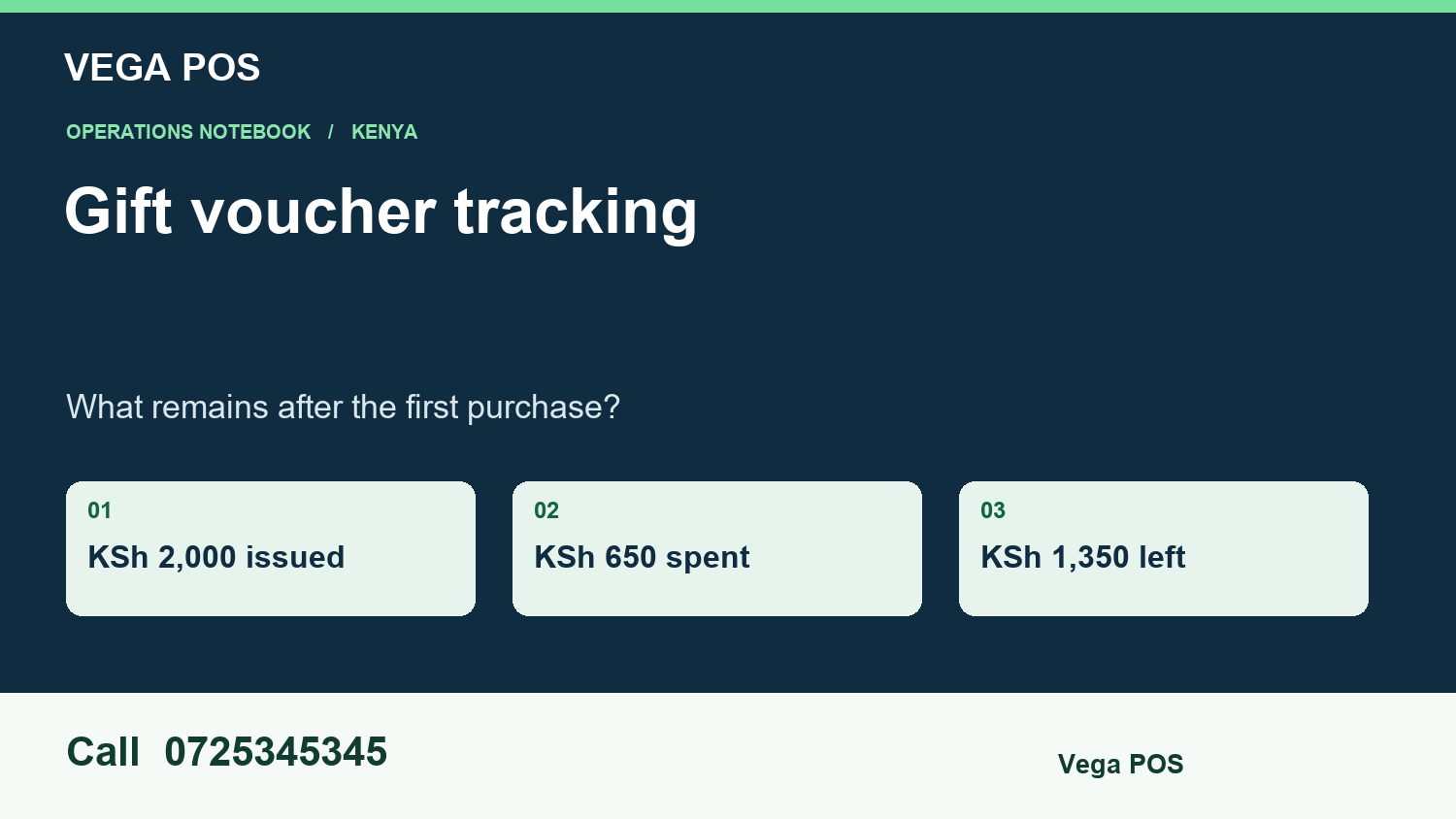
Gift voucher tracking answers two questions that a till total cannot: how much value was issued, and how much can the holder still spend? Consider a fictional KSh 2,000 voucher. Someone buys it on Monday. Another person uses it for goods worth KSh 650 on Wednesday. The drawer, voucher balance and goods sold are three different records. They need a common reference, not a single number entered everywhere.
This guide is a demonstration script for a Kenyan shop considering a voucher arrangement. Use test references, follow your own published terms and check which functions your POS setup actually supports. Ask a cashier to run the ordinary purchase while a colleague keeps an independent record on paper. The comparison matters more than a polished screen: two systems can show the same end balance while disagreeing about how it got there.
Gift voucher tracking in four decisions
Use the four decisions below as a tabletop exercise. The case is fictional. Each decision pairs a new scenario with field notes drawn from a linked guide in our library. Read the scenario aloud first, and ask the next person to explain the result before consulting the notes.
1. Issue one identifiable voucher
Start with test reference G41 and face value KSh 2,000. Note whether the voucher is issued after confirmed payment or as an authorised promotional award. Do not make those two starting events indistinguishable. A manager investigating a promotion later should be able to tell why value exists even where there was no cash receipt.
Give the customer a readable reference without placing usable redemption codes on a public training sheet. Now ask another cashier to search for the reference without creating anything. A lookup should identify the existing voucher; it should not create a second KSh 2,000 balance because someone printed a replacement receipt. A gift voucher tracking record should identify the event that first made G41 spendable.
Field notes from our retail quotation review guide:
Match every line to a clear product identity
Use the correct product reference and a description the buyer can recognise. Similar names do not necessarily mean interchangeable goods. Confirm the variant, packaging and relevant specification against the catalogue. Avoid copying an old quotation merely because its description looks close enough. The previous customer may have purchased a different model or pack configuration.
Give the offer a clear validity period
Record how long the quoted terms remain open under your business policy. A validity date gives staff a practical point at which to recheck price and availability. It does not replace a clear conversation about unusual items, changing supply conditions or a customer who needs a longer decision period. Make exceptions explicit and obtain the appropriate approval.
Separate quotation approval from payment confirmation
A customer’s approval of the offer and confirmation of payment are different events. Record each through the appropriate process. An email accepting a quotation does not prove that money has arrived, and a payment reference needs verification against the business’s payment records. Staff should follow the agreed controls before releasing goods or recording settlement.
2. Read the first redemption correctly
Buy KSh 650 of sample goods using G41. Expected remaining value is KSh 1,350. Ask the cashier to show the sale, the voucher amount tendered and the remaining balance. The KSh 650 was not collected as fresh cash at this checkout. If the till expects KSh 650 more notes when it closes, the tender was probably classified incorrectly.
Next try a KSh 1,500 purchase. Where split payment is supported and permitted, KSh 1,350 could be settled by voucher and KSh 150 by another method. Otherwise, stop and explain the alternative before taking money. The customer should know how much they are paying today. One test of gift voucher tracking is whether the cashier can explain the remaining balance without looking in the drawer.
Field notes from our cash float handover guide:
Make acceptance of responsibility clear
Agree how the outgoing and incoming employees acknowledge the handover. The record should indicate what was counted, which exceptions remain open and who accepted the next shift’s starting position. Do not use a generic acknowledgement that could be interpreted as agreeing to an amount the employee never checked.
Ask the demonstrator to show the available confirmation history. Can the reviewer identify who completed the handover and when? Can an employee change a confirmed figure without an appropriate record? Cash float handover should provide a useful trail rather than depend entirely on a handwritten name beside an unexplained total.
Test the closing calculation separately
Opening the shift correctly is only one part of the routine. Ask the team to demonstrate how the closing review uses the starting float, recorded cash activity and authorised movements. Use a fictional example whose expected result can be checked independently. Avoid assuming that a familiar total means every underlying entry is correct.
Check how the system presents a difference and what the reviewer can inspect before confirming the result. Cash float handover and shift closing should connect without collapsing into one unexplained number. The reviewer needs enough detail to understand the sequence and identify which entry requires attention.
3. Handle a reversal without losing the trail
Return the KSh 650 purchase before making any second sale. Decide under the shop’s terms whether a permitted return restores value to G41 or follows another route. If value is restored, the balance becomes KSh 2,000; if the shop refunds another way, do not also restore KSh 650. Preserve the original redemption and the reference for the authorised reversal.
Run the same reversal request a second time in the test setup. A reviewer should see why two requests cannot result in two credits. If that control is manual, name who checks it and what evidence they consult before authorising another adjustment. A reversal in gift voucher tracking should point back to the original spend and show who authorised the remedy.
Field notes from our retail damaged stock guide:
Distinguish the stage at which damage was found
Was the condition visible on arrival, discovered while unpacking, noticed on the shelf or reported after a customer transaction? Record the stage accurately. This helps the reviewer choose the appropriate documents and next contact. It does not automatically prove when the damage occurred or who is responsible.
For incoming goods, preserve the receiving references and any recorded exception. For existing shelf stock, note the location and the last relevant handling event if known. Retail damaged stock review should use the available evidence without filling gaps with assumptions that later become difficult to correct.
Include open cases in shift handover
Tell the next shift which cases need attention, where the goods are held and who owns the next action. Keep the handover brief and refer to the full record for evidence. Do not duplicate long descriptions across several notebooks, because copies can disagree after the case changes.
Use the retail handover log guide to keep responsibilities visible. A good retail damaged stock handover allows an employee who was absent at discovery to locate the goods and understand the immediate task without calling everyone involved.
4. Reconcile outstanding value at close
Use three sample vouchers for the daily check. Opening spendable balances total KSh 3,100. Issue KSh 2,000, redeem KSh 650 and restore KSh 200 through an approved return. Expected closing spendable value is KSh 4,650, assuming no other movements. Compare the total with the individual references.
A matching total does not exclude a KSh 200 credit posted to the wrong voucher. Pick one reference and trace the holder’s balance forwards; pick another and explain it backwards from close. Mark unresolved references for review rather than changing balances to make the control sheet agree. This is an operational illustration, not a rule for financial reporting. Review gift voucher tracking by reference as well as in total; an equal and opposite pair of errors can hide inside a correct total.
Field notes from our stock reservation expiry guide:
Set a clear review date and time
Use a date and time that employees and customers can understand. A phrase such as hold until tomorrow may create uncertainty when a message is read later or passed between shifts. Explain the relevant business hours and any agreed collection window. The important point is a shared expectation, not an unnecessarily complicated deadline system.
Make extensions deliberate and visible
Customers sometimes need more time, and a reasonable extension may fit your business policy. Record who approved it, the new review point and any changed condition. Do not repeatedly replace the original date without retaining an understandable history. Another employee should be able to see why a reservation remains open beyond the first promise.
Record release as a completed action
When release is authorised, use the supported process and verify its result. Confirm that the goods are available in the appropriate location and that any physical hold label is removed or updated. A change on screen does not tidy a package in the stockroom, while moving the package does not necessarily update the record.
Gift voucher tracking control sheet
Before running the example, cover the expected results and ask a colleague to predict them. Use the disagreements to decide which rule needs explaining. These are fictional test cases; use your own approved references for the real procedure.
| Test condition | Expected evidence |
|---|---|
| Issue G41 for KSh 2,000 | One authorised issue creates one spendable balance. A duplicate print produces no extra value. |
| Spend KSh 650 once | One completed redemption refers to the sale. Remaining value is KSh 1,350. |
| Attempt KSh 1,500 against KSh 1,350 | The cashier explains the KSh 150 difference and follows the supported split-payment or refusal route. |
| Reverse the first sale in isolation | The approved outcome is evidenced once. A restored balance and a separate refund must not both compensate the same customer. |
Gift voucher tracking: questions from the counter
A colleague says a voucher was paid for because a code exists. Is that enough?
No. A code can be reserved, issued through a promotion or generated during an abandoned sale. Find the issue event and its authorised basis before accepting it as spendable. Gift voucher tracking should let staff answer that question without revealing the full redemption code to someone who simply knows the customer’s name.
What if the terminal loses its connection during redemption?
Do not assume either success or failure from the blank screen. Search the test reference and the linked sale through the approved interface. If the balance already fell, a repeat redemption would charge the holder twice. If it did not, follow the documented recovery route. Name who may make that decision when the counter is busy.
How should a shift explain a replacement voucher?
Keep a reference linking the replacement to the original and confirm the old reference cannot also be spent where policy requires cancellation. Reprinting evidence of one balance is not a reason to create a second balance. Show the cashier how to verify the remaining value without copying a usable secret into ordinary handover notes.
Use gift voucher tracking in your next demonstration
For a discussion about gift voucher tracking, contact Vega POS on 0725345345. Bring one anonymised example, its starting position and the result your colleague expects. Ask for a demonstration using those details before assuming a particular feature or integration is available.
Other Kenyan business workflows
For a custom business portal, explore Zama Web Experts. If your team is working in another sector, these services provide different examples: Prim for salon bookings, sales and stock; TAS for chama records and contributions; Saseni for writing orders and delivery; JAAT for shop and product listings; Dereva for driver discovery. Use the service that fits your task; a link does not establish that the systems exchange data.
To compare the outcome of gift voucher tracking with a related case, try our opening a second shop counter exercise. Use the same fictional reference throughout, then explain what the second exercise checks that the first one did not.