 Vega
Vega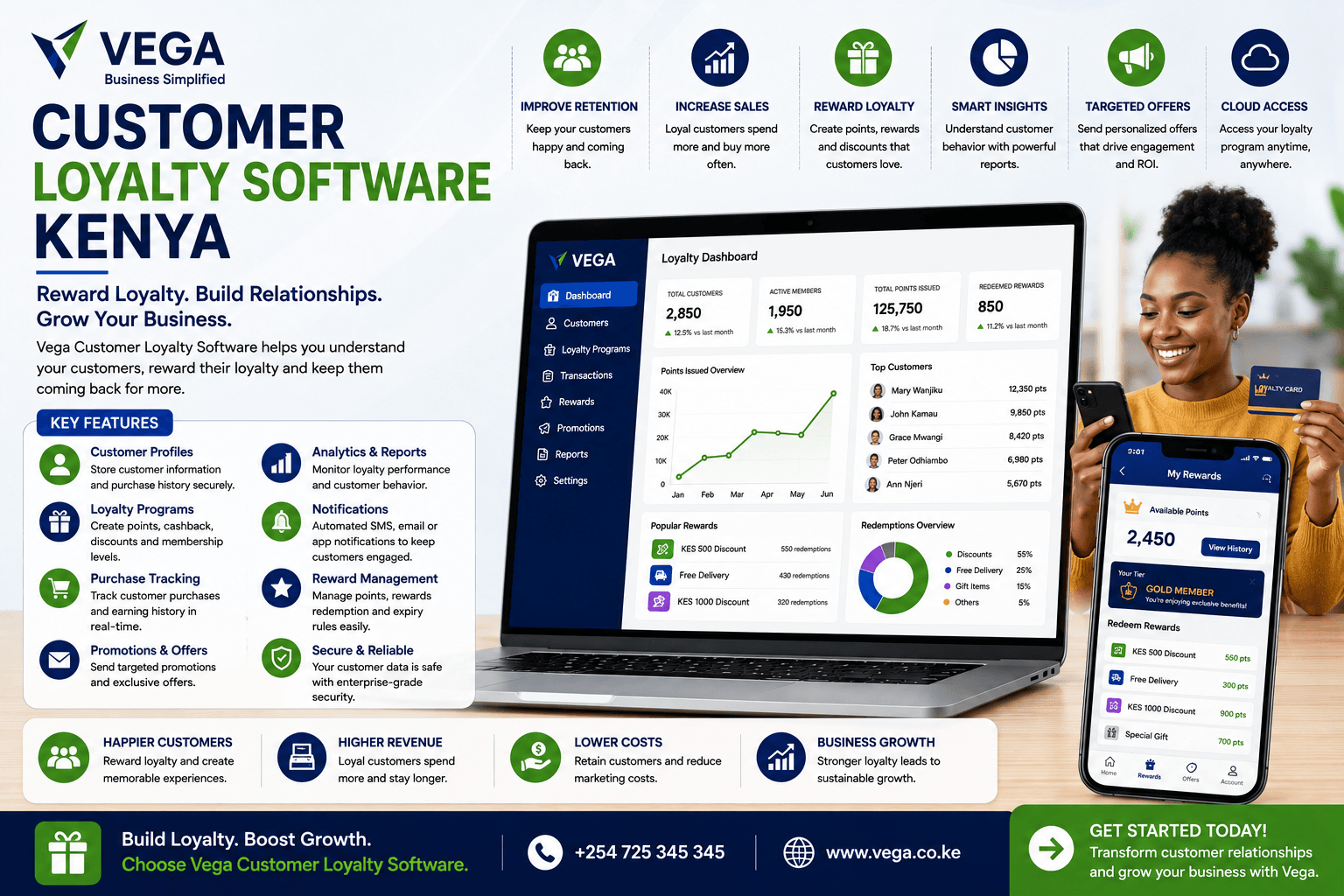
Customer Loyalty Software Kenya: A Complete Guide for Growing Businesses
Attracting a new customer is important, but keeping an existing customer can be even more valuable for long-term business growth. Customers who have a positive experience with a business are more likely to return, recommend the business to friends, and purchase more products over time.
However, customer loyalty does not happen automatically.
Businesses need to understand their customers, provide consistent service, communicate effectively, and create reasons for customers to keep coming back.
This is where Customer Loyalty Software Kenya can make a significant difference.
Modern customer loyalty software helps businesses organize customer information, understand purchasing behavior, create rewards programs, monitor customer activity, and improve engagement.
For retail shops, boutiques, supermarkets, electronics stores, pharmacies, restaurants, takeaways, and other growing businesses, customer loyalty technology can become an important part of a long-term growth strategy.
What Is Customer Loyalty Software?
Customer loyalty software is a digital system that helps businesses build and manage relationships with existing customers.
Instead of relying on paper loyalty cards or manually maintained customer lists, businesses can use software to organize customer information and track interactions.
A customer loyalty system can help businesses manage:
- Customer profiles
- Purchase history
- Rewards
- Customer activity
- Repeat purchases
- Promotional campaigns
- Customer communication
- Loyalty performance
This information helps businesses understand their customers and create better experiences.
Why Customer Retention Matters
Customer retention refers to a business’s ability to encourage existing customers to continue purchasing its products or services.
Retaining customers can help businesses:
- Increase repeat sales.
- Build stronger relationships.
- Improve customer satisfaction.
- Generate referrals.
- Strengthen brand loyalty.
- Reduce the cost of constantly acquiring new customers.
A business with loyal customers has a stronger foundation for sustainable growth.
Challenges Businesses Face With Customer Loyalty
Many businesses want loyal customers but struggle to build effective loyalty programs.
Common challenges include:
Poor Customer Records
Businesses may not have organized information about their customers.
Manual Loyalty Programs
Paper cards can easily become lost or damaged.
Limited Customer Insights
Without data, it can be difficult to understand customer preferences.
Inconsistent Communication
Customers may not receive timely information about promotions or new products.
Difficult Reward Management
Manually calculating points and rewards can consume significant time.
Customer loyalty software helps solve many of these challenges.
Benefits of Customer Loyalty Software
1. Better Customer Retention
Businesses can create structured loyalty programs that encourage customers to return.
Rewards, discounts, points, and personalized offers can give customers additional reasons to continue shopping.
2. Improved Customer Information
A centralized customer database makes it easier to understand purchasing patterns and customer preferences.
Businesses can use this information to improve products, services, and marketing campaigns.
3. Increased Repeat Purchases
Loyalty programs encourage customers to make additional purchases.
Businesses can reward customers based on their purchasing activity and create incentives for future transactions.
4. Better Customer Engagement
Regular communication keeps customers connected to a business.
Businesses can use customer information to provide relevant updates, promotions, and offers.
5. Improved Marketing
Customer data can help businesses understand which products are popular and which offers generate better responses.
This makes marketing campaigns more targeted and effective.
How Loyalty Programs Work
A modern loyalty program can follow a simple process.
Step 1: Customer Registration
Customers provide basic information when joining the loyalty program.
Step 2: Customer Purchases
The system records eligible purchases.
Step 3: Rewards Accumulate
Customers earn points, discounts, or other benefits based on predefined rules.
Step 4: Customer Receives a Reward
Once the customer reaches the required level, the reward becomes available.
Step 5: Business Monitors Performance
The business analyzes loyalty activity and identifies opportunities for improvement.
This process can be automated with modern software.
Types of Customer Loyalty Programs
Businesses can use different loyalty strategies depending on their industry and customers.
Points-Based Loyalty Programs
Customers earn points when they purchase products.
Points can later be exchanged for discounts or rewards.
Discount-Based Programs
Businesses provide special discounts to registered customers.
This approach is simple and easy for customers to understand.
Membership Programs
Customers receive exclusive benefits after joining a membership program.
Benefits can include special pricing, early access to promotions, or other offers.
Referral Programs
Existing customers receive rewards when they introduce new customers to the business.
This can help businesses increase their customer base through word-of-mouth marketing.
How Customer Data Improves Business Decisions
Customer information provides valuable insights into purchasing behavior.
Businesses can analyze:
- Frequently purchased products
- Purchase frequency
- Customer preferences
- Average transaction values
- Popular promotions
- Repeat purchasing patterns
These insights help businesses make better decisions about inventory, marketing, pricing, and customer service.
Customer Loyalty and Inventory Management
Customer loyalty software can also support better inventory planning.
When businesses understand what loyal customers purchase frequently, they can make better decisions about which products to keep in stock.
This can help businesses:
- Identify fast-moving products.
- Reduce unnecessary stock.
- Improve product availability.
- Prepare for seasonal demand.
- Improve purchasing decisions.
Better customer insights can therefore support better inventory management.
How Loyalty Software Can Increase Sales
Customer loyalty software can contribute to increased revenue in several ways.
Businesses can use loyalty programs to:
- Encourage repeat purchases.
- Promote selected products.
- Reward frequent customers.
- Introduce new products.
- Encourage larger purchases.
- Promote special offers.
- Increase customer engagement.
The objective is not simply to give discounts but to create meaningful reasons for customers to continue doing business with the company.
The Role of Personalization
Customers appreciate businesses that understand their needs.
Instead of sending the same offer to every customer, businesses can use customer information to create more relevant experiences.
For example, a clothing retailer could provide offers based on previous purchases, while a restaurant could promote products that customers frequently order.
Personalization can improve engagement and customer satisfaction.
Why Mobile-Friendly Loyalty Programs Matter
Customers increasingly use smartphones for communication, payments, shopping, and accessing business information.
A modern loyalty system should therefore provide a convenient experience across mobile devices.
Mobile-friendly systems make it easier for customers to:
- View rewards.
- Receive promotions.
- Access account information.
- Interact with businesses.
- Stay updated about offers.
Convenience can play an important role in customer retention.
Customer Loyalty Software for Small Businesses
Customer loyalty technology is not only for large corporations.
Small businesses can also benefit from structured customer retention strategies.
A small business can use loyalty software to:
- Maintain customer records.
- Track repeat purchases.
- Reward loyal customers.
- Understand customer preferences.
- Improve marketing.
- Increase repeat business.
For growing businesses, building customer loyalty early can create a strong foundation for future expansion.
Industries That Can Use Customer Loyalty Software
Customer loyalty solutions can be useful across many industries, including:
- Retail shops
- Supermarkets
- Boutiques
- Restaurants
- Takeaways
- Pharmacies
- Electronics stores
- Beauty shops
- Cosmetic stores
- Mobile phone shops
- Grocery stores
- Furniture businesses
Any business that depends on repeat customers can benefit from a structured loyalty strategy.
How Vega Helps Businesses Manage Customers
Vega is designed to help businesses simplify their everyday operations while maintaining better visibility into customer activity.
With Vega, businesses can organize important customer information alongside other business operations.
Businesses can benefit from:
- Customer management
- Sales tracking
- Inventory visibility
- Business reporting
- Payment tracking
- Staff management
- Supplier management
Having these functions within a practical business management environment helps owners maintain better control of their operations.
How to Choose Customer Loyalty Software in Kenya
Before selecting a loyalty solution, businesses should consider several factors.
Ease of Use
Employees should be able to learn the system without extensive training.
Customer Management
The system should make customer information easy to organize and access.
Reporting
Businesses should be able to measure loyalty program performance.
Scalability
The system should support the business as the customer base grows.
Security
Customer information should be protected using appropriate security controls.
Support
Reliable support should be available when businesses need assistance.
Common Customer Loyalty Mistakes to Avoid
Businesses can weaken their loyalty programs by making simple mistakes.
Avoid:
- Making rewards difficult to understand.
- Offering irrelevant promotions.
- Ignoring customer feedback.
- Failing to communicate with customers.
- Making redemption unnecessarily complicated.
- Collecting customer information without using it effectively.
- Providing inconsistent customer service.
A successful loyalty program should be simple, useful, and valuable to customers.
How to Build a Successful Customer Loyalty Strategy
Businesses can improve their loyalty programs by following these steps:
Understand Your Customers
Learn what customers purchase and what they value.
Create Simple Rewards
Customers should understand how they earn and use rewards.
Provide Consistent Service
A loyalty program cannot compensate for poor customer service.
Monitor Results
Review customer activity and measure the performance of your loyalty strategy.
Improve Continuously
Use customer feedback and business data to make improvements.
The Future of Customer Loyalty in Kenya
Customer expectations are changing as technology becomes more widely adopted.
Businesses are increasingly moving toward:
- Digital loyalty programs
- Mobile customer engagement
- Personalized offers
- Data-driven marketing
- Automated customer communication
- Real-time business analytics
These developments will give businesses new opportunities to create stronger relationships with their customers.
How Customer Loyalty Software Helps Businesses Compete
Competition is increasing across many industries in Kenya. Customers have more choices than ever before, which means businesses need to provide more than just products.
Customer loyalty software can help businesses compete by allowing them to:
- Understand customer preferences.
- Create personalized promotions.
- Reward repeat customers.
- Improve customer service.
- Monitor purchasing trends.
- Identify valuable customers.
- Build long-term relationships.
A business that understands its customers can create better experiences and stand out from competitors.
Measuring Customer Loyalty Program Performance
Creating a loyalty program is only the first step. Businesses should also measure whether the program is achieving its objectives.
Important performance indicators include:
- Number of registered customers
- Repeat purchase rate
- Customer retention rate
- Average customer spending
- Reward redemption rate
- Number of active loyalty members
- Customer engagement
- Revenue generated by loyalty customers
Regular analysis helps businesses identify what is working and what needs improvement.
Customer Segmentation for Better Marketing
Not every customer has the same needs. Customer segmentation allows businesses to group customers according to their purchasing behavior and preferences.
For example, a business can identify:
- Frequent customers
- New customers
- High-value customers
- Inactive customers
- Seasonal customers
- Customers interested in specific products
Businesses can then create more relevant offers for each group.
This can make marketing campaigns more effective while reducing unnecessary promotional costs.
Re-Engaging Inactive Customers
Some customers may stop purchasing from a business for several reasons. Instead of immediately considering them lost, businesses can use customer information to create re-engagement campaigns.
Businesses can encourage inactive customers to return through:
- Special offers
- Personalized discounts
- New product announcements
- Loyalty rewards
- Seasonal promotions
- Customer appreciation campaigns
Re-engaging existing customers can be an effective way to generate additional sales.
Customer Loyalty and Word-of-Mouth Marketing
Loyal customers can become some of the most valuable marketing assets for a business.
Customers who have positive experiences may recommend a business to:
- Friends
- Family members
- Colleagues
- Online communities
- Social media followers
A strong loyalty strategy combined with excellent customer service can therefore contribute to organic business growth.
Using Customer Feedback to Improve Services
Customer feedback provides valuable information that businesses can use to improve their operations.
Businesses should pay attention to feedback about:
- Product quality
- Pricing
- Customer service
- Delivery
- Staff behavior
- Waiting times
- Product availability
Loyalty software can be combined with customer engagement strategies to make it easier for businesses to understand customer needs.
How Loyalty Programs Support New Product Launches
Introducing a new product can be challenging because customers may not immediately know whether they need it.
Businesses can use their existing customer base to introduce new products more effectively.
For example, businesses can:
- Notify loyal customers about new products.
- Offer introductory rewards.
- Provide exclusive promotions.
- Collect customer feedback.
- Monitor early purchasing activity.
This allows businesses to test new products while engaging their existing customers.
Using Loyalty Rewards Without Reducing Profitability
Discounts can attract customers, but businesses need to design loyalty programs carefully.
A successful loyalty program should provide value to customers while protecting business profitability.
Businesses can achieve this by offering:
- Points instead of constant discounts.
- Rewards for specific products.
- Limited-time promotions.
- Rewards based on purchase levels.
- Exclusive offers for loyal customers.
- Referral incentives.
The goal should be to encourage repeat purchases rather than simply reducing prices.
The Importance of Customer Data Security
Customer information should be handled responsibly.
Businesses may collect information such as customer names, contact details, purchase history, and loyalty activity. Protecting this information is essential for maintaining customer trust.
Businesses should prioritize:
- Strong passwords
- User access controls
- Secure data storage
- Regular backups
- Employee training
- Appropriate system permissions
A secure customer management system helps businesses protect valuable information.
Integrating Customer Loyalty With Inventory Management
Customer loyalty information becomes even more valuable when it is connected with inventory management.
For example, if customer data shows that a particular product is frequently purchased by loyal customers, the business can make sure that product remains available.
This can help businesses:
- Improve stock planning.
- Reduce shortages.
- Identify popular products.
- Forecast demand.
- Improve purchasing decisions.
- Reduce excess inventory.
Connecting customer insights with inventory data creates a more complete view of business performance.
Customer Loyalty Software and Business Analytics
Business analytics allows owners to turn customer information into actionable insights.
Businesses can analyze:
- Sales trends
- Customer retention
- Product performance
- Purchase frequency
- Average transaction values
- Reward usage
- Customer engagement
These insights can help management make better decisions and develop more effective growth strategies.
Why Customer Loyalty Should Be Part of Digital Transformation
Digital transformation is not only about creating a website or using social media. It involves using technology to improve the way a business operates.
Customer loyalty technology can form part of a broader digital transformation strategy alongside:
- Inventory management
- Sales management
- Supplier management
- Employee management
- Payment tracking
- Business reporting
- Customer relationship management
When these functions work together, businesses can achieve greater visibility and operational efficiency.
Benefits of Customer Loyalty Software for Kenyan SMEs
Small and medium-sized businesses can gain significant advantages from digital customer management.
Customer loyalty software can help SMEs:
- Build stronger customer relationships.
- Increase repeat purchases.
- Understand customer behavior.
- Reduce manual record-keeping.
- Improve marketing.
- Track customer engagement.
- Compete with larger businesses.
Digital tools give smaller businesses access to information that can support smarter decision-making.
How to Encourage Customers to Join a Loyalty Program
A loyalty program will only succeed if customers see value in joining.
Businesses can increase registrations by:
- Offering a welcome reward.
- Explaining the benefits clearly.
- Keeping registration simple.
- Providing useful rewards.
- Making points easy to understand.
- Communicating regularly.
- Providing exclusive member benefits.
The easier and more valuable the program is, the more likely customers are to participate.
Building Long-Term Customer Relationships
Customer loyalty is not created through rewards alone. Businesses must consistently provide quality products, reliable service, fair pricing, and excellent communication.
A strong long-term customer relationship is built through:
- Trust
- Consistency
- Communication
- Convenience
- Quality
- Personalization
- Customer appreciation
Technology can support these efforts, but the customer experience should always remain the priority.
Final Thoughts on Customer Loyalty Software Kenya
The future of business growth depends heavily on customer relationships and the intelligent use of information.
Customer Loyalty Software Kenya gives businesses an opportunity to move beyond traditional loyalty cards and manual customer records. With the right system, businesses can understand customers better, reward repeat purchases, improve engagement, and make more informed decisions.
As Kenyan businesses continue to adopt digital technologies, customer loyalty management will become an increasingly important part of business strategy.
Businesses that invest in customer relationships today can create stronger brands, increase customer retention, and build sustainable growth for the future.
Frequently Asked Questions
What is customer loyalty software?
Customer loyalty software is a digital solution that helps businesses manage customer relationships, rewards, purchasing activity, and retention programs.
Is customer loyalty software useful for small businesses?
Yes. Small businesses can use loyalty systems to encourage repeat purchases and maintain stronger relationships with customers.
Can loyalty software increase sales?
It can help increase repeat purchases, customer engagement, and promotional effectiveness.
Why is customer data important?
Customer data helps businesses understand purchasing behavior and make better decisions.
Can loyalty software work with other business systems?
Modern business platforms can connect customer information with sales, inventory, reporting, and other operational functions.