Offline POS System Kenya
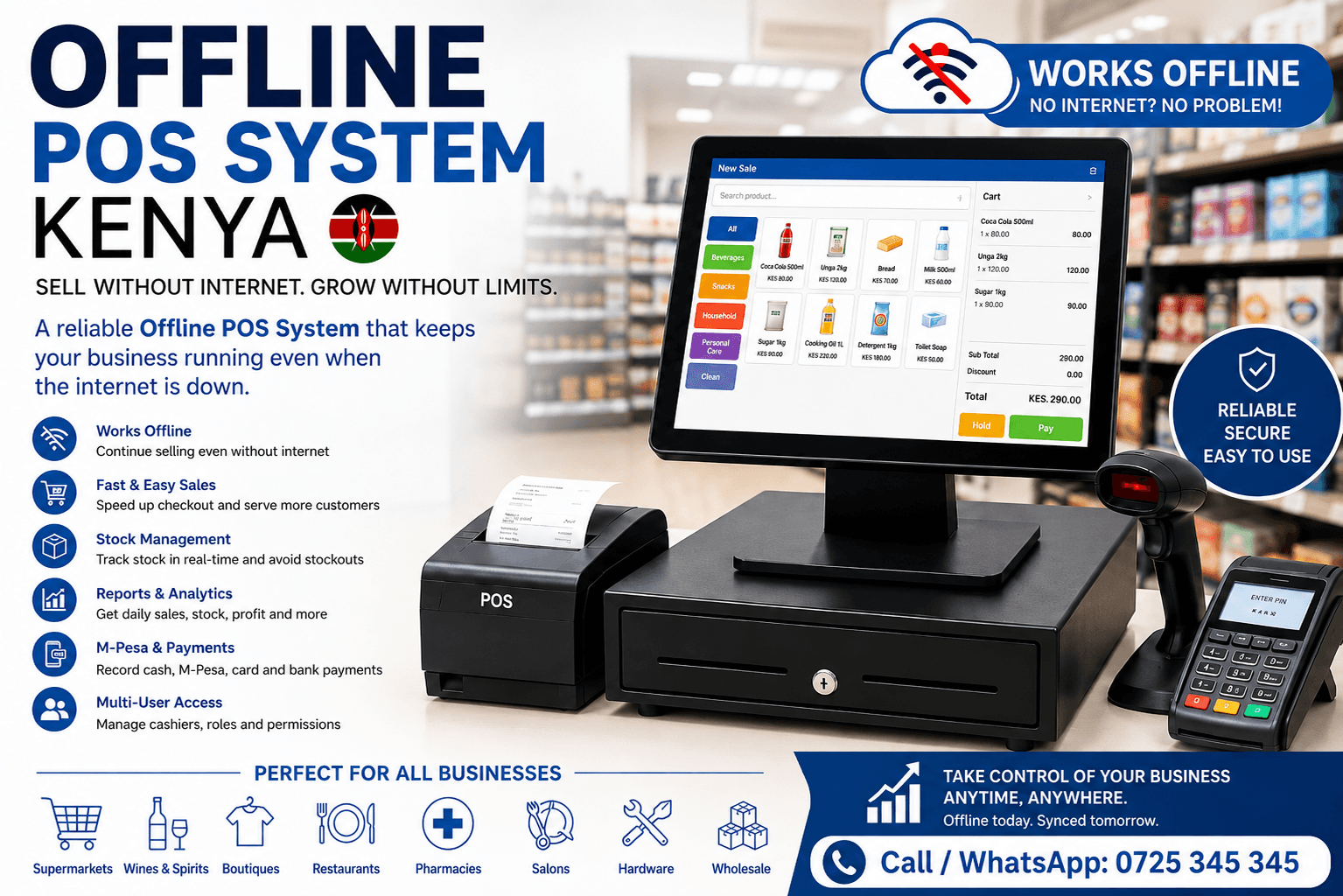
Running a business in Kenya today requires a fast, reliable and easy way to manage sales, stock, customers, payments and daily reports. Whether you own a supermarket, wines and spirits shop, boutique, cosmetics shop, hardware, mini-mart, salon, pharmacy, restaurant or wholesale business, one thing is clear: you need a system that does not stop working when the internet goes down. That is why many business owners are now searching for the best Offline POS System Kenya.
An offline POS system is a point of sale software that allows your business to continue selling, printing receipts, recording payments and managing stock even when there is no internet connection. This is very important in Kenya because internet interruptions, power issues, weak Wi-Fi, network downtime and mobile data challenges can affect daily operations. A serious business should not lose sales simply because the internet is slow or unavailable.
A good offline POS system in Kenya gives you control. It allows your cashier to continue serving customers, your stock to keep updating, your receipts to be generated and your reports to remain accurate. Once the internet is restored, the system can sync data, update cloud records and keep everything safe. This makes offline POS software one of the most practical solutions for businesses that want reliability, speed and business continuity.
What Is an Offline POS System?
An offline POS system is a sales management software that works without depending fully on the internet. Unlike systems that stop when there is no connection, an offline POS allows the business to continue operating normally. The cashier can select products, apply discounts, accept payments, print receipts and complete sales without waiting for the internet.
In Kenya, many businesses operate in places where internet connection is not always stable. Some shops are located in busy towns where network congestion affects internet speed. Others are in rural areas where connectivity can be unreliable. Even in Nairobi, Mombasa, Kisumu, Nakuru, Eldoret, Thika and other major towns, internet downtime can still happen. An offline POS system protects your business from these interruptions.
The main advantage of an offline POS system is that it gives your business independence. You are not forced to pause sales because of network failure. Customers do not have to wait unnecessarily. Staff can continue working. The business owner can still review sales, stock and cash movement. This is exactly why many Kenyan businesses prefer offline POS software.
Why Businesses in Kenya Need an Offline POS System
Kenyan businesses are becoming more competitive. Customers want fast service, clear receipts, accurate pricing and smooth payment options. At the same time, business owners want better control over stock, sales, staff and profit. Manual books and calculators are no longer enough for serious business growth.
An Offline POS System Kenya helps businesses avoid common problems such as missing stock, wrong prices, delayed receipts, poor cash tracking, unrecorded sales and cashier mistakes. It also helps the business continue operating even when internet connection is poor.
Imagine a supermarket during evening rush hour. Customers are queuing, cashiers are busy and sales are moving fast. Suddenly the internet goes down. If the business depends on an online-only system, operations may stop. Customers may get frustrated and leave. But with an offline POS system, sales continue normally. The business does not lose money. The cashier does not panic. The customer receives service as expected.
This is why offline POS is not just a software feature. It is a business protection tool.
Benefits of Using an Offline POS System Kenya
1. Continue Selling Without Internet
The biggest benefit of an offline POS system is that your business can continue selling even when there is no internet. This is very important for shops, supermarkets, restaurants and retail businesses where every minute matters.
When the internet fails, an offline POS keeps working. Products can still be scanned, bills can still be created and receipts can still be printed. This helps you avoid business interruptions and lost sales.
2. Faster Customer Service
Customers hate delays. A good offline POS system makes checkout faster because it does not depend on slow internet for every transaction. Cashiers can process sales quickly, especially during busy hours.
For supermarkets, mini-marts, pharmacies and fast-moving retail shops, speed is very important. The faster you serve customers, the more sales you can complete in a day.
3. Better Stock Control
Stock management is one of the biggest challenges for Kenyan businesses. Without a proper system, stock can disappear, expire, get damaged or be sold without being recorded. An offline POS system helps you track stock movement in real time.
Every sale reduces stock automatically. Every new purchase increases stock. The system can show low-stock alerts, fast-moving products and slow-moving products. This helps you know what to restock and what to stop buying.
4. Reduced Theft and Cashier Mistakes
Manual sales records can easily be manipulated. A cashier may forget to record a sale, enter the wrong amount or give unauthorized discounts. With a POS system, every transaction is captured properly.
An offline POS system can also support user roles, meaning each cashier has their own login. This makes it easier to know who made each sale, who cancelled a receipt and who handled specific transactions. It improves accountability in the business.
5. Accurate Reports
Business owners need reports to make good decisions. A strong offline POS system can provide daily sales reports, profit reports, stock reports, cashier reports, payment reports and product performance reports.
Instead of guessing how your business is performing, you can see real figures. You can know which products sell most, which cashier made more sales, which branch is performing better and how much cash should be available at closing time.
6. Works Well for Businesses Outside Major Towns
Not every business in Kenya is located in a place with strong internet. Many shops and supermarkets operate in towns, estates, rural centres and growing markets where internet may be unstable. An offline POS system is ideal for these areas because it does not stop working when the network is weak.
This makes it suitable for businesses in counties such as Kiambu, Murang’a, Meru, Nyeri, Kisii, Kakamega, Bungoma, Machakos, Kitui, Makueni, Kilifi, Narok, Bomet, Kericho, Uasin Gishu, Trans Nzoia and many others.
Who Needs an Offline POS System Kenya?
An offline POS system can be used by many types of businesses. It is especially useful for businesses that handle daily sales, stock and customer payments.
Supermarkets and Mini-Marts
Supermarkets need a POS system that can handle barcode scanning, receipt printing, stock control, cashier management, discounts and reports. An offline POS system ensures sales continue even when internet is unavailable.
Wines and Spirits Shops
Wines and spirits businesses need proper stock tracking because products move fast and stock losses can be costly. A POS system helps track bottles, cartons, brands, supplier purchases and daily sales.
Boutiques and Fashion Shops
Boutiques need to manage different sizes, colors, designs and prices. An offline POS system helps track stock and know which items are selling most.
Hardware Shops
Hardware businesses handle many items with different prices, units and suppliers. A POS system helps manage stock, quotations, sales, invoices and customer payments.
Restaurants and Cafes
Restaurants need fast order management, kitchen orders, table bills, waiter tracking and payment records. An offline POS system helps restaurants continue serving even when Wi-Fi is down.
Pharmacies and Chemists
Pharmacies need accurate stock tracking, expiry monitoring and receipt generation. A POS system helps reduce mistakes and improve inventory control.
Salons and Beauty Shops
Salons can use POS software to manage products, services, staff commissions, customer records and daily sales.
Wholesale and Distribution Businesses
Wholesalers need to manage bulk sales, customer balances, invoices, stock movement and supplier purchases. An offline POS system helps maintain smooth operations.
Key Features of the Best Offline POS System Kenya
A good offline POS system should not only record sales. It should help the business owner manage the whole business better. Below are important features to look for.
Sales Management
The system should allow fast selling through product search, barcode scanning, quantity adjustment, discounts and receipt printing. Sales should be easy for cashiers to process, even with minimal training.
Inventory Management
The POS should update stock automatically after every sale. It should show available stock, low stock, stock value, expired items and stock movement history.
Receipt Printing
Customers expect receipts. A good POS system should support receipt printers and allow the business to print clear receipts with business name, items sold, totals, payment method and date.
Barcode Support
Barcode scanning makes selling faster and reduces errors. For supermarkets, pharmacies and retail shops, barcode support is very important.
User Roles and Permissions
The system should allow different users such as admin, manager and cashier. The owner should control what each staff member can access. For example, a cashier should not access profit reports or change product prices without permission.
M-Pesa Payment Recording
In Kenya, M-Pesa is one of the most common payment methods. A good offline POS should allow staff to record M-Pesa payments, cash payments, bank payments and split payments.
Daily Sales Reports
The business owner should be able to see total sales per day, payment methods, cashier performance, discounts, refunds and profit.
Purchase Management
A good POS should help record stock purchases from suppliers. This helps calculate profit correctly and keep stock records updated.
Expense Tracking
Businesses also spend money on rent, salaries, transport, electricity and other costs. A POS system with expense tracking helps the owner understand real profit.
Customer Management
Some businesses sell to repeat customers. A POS system can help store customer details, purchase history, balances and loyalty information.
Multi-Branch Support
For businesses with more than one branch, the system should support branch management. Each branch can operate independently and sync data when internet is available.
Offline POS vs Online POS: Which One Is Better?
Both offline and online POS systems have advantages. An online POS system allows remote access, cloud reports and real-time syncing. However, it depends heavily on internet. If the internet goes down, sales may be affected.
An offline POS system is stronger for businesses that want reliability. It works even when there is no internet. The best option is a hybrid POS system that works offline and also syncs online when internet is available.
For many Kenyan businesses, a hybrid offline POS system is the best choice. It gives you the power of offline selling and the convenience of cloud reporting. This means the cashier can sell without internet, while the business owner can later view synced reports online.
Why Offline POS Is Important for Kenyan Retail Businesses
Retail businesses operate on speed and accuracy. Every product sold must be recorded. Every stock movement must be tracked. Every payment must be accounted for. When this is done manually, errors happen easily.
An offline POS system helps organize the business. It gives the owner better visibility. It also helps staff work faster. Instead of writing sales in books, the cashier uses the system. Instead of counting stock blindly, the owner checks stock reports. Instead of guessing profit, the system calculates sales and cost.
In Kenya, where many SMEs are growing fast, offline POS software can help small businesses operate like professional companies. It gives structure, discipline and better control.
How an Offline POS System Helps Reduce Business Losses
Many businesses lose money without knowing. Losses can come from stock theft, wrong pricing, expired stock, unrecorded sales, fake discounts, supplier mistakes, cashier errors and poor reporting.
An offline POS system reduces these losses by keeping accurate records. Every product has a price. Every sale is recorded. Every cashier has a login. Every stock change is tracked. Every receipt has a record.
When the owner checks reports, it becomes easier to detect problems. For example, if stock is missing but sales are low, there may be theft or wrong stock entry. If one cashier has many cancelled receipts, the owner can investigate. If certain products are expiring, the owner can reduce future purchases.
This level of control is difficult with manual books.
Offline POS System Kenya for Supermarkets
Supermarkets are among the businesses that need POS software the most. They handle many products, many customers and many transactions every day. A supermarket POS system should support barcode scanning, multiple cashiers, receipt printing, stock control, supplier purchases and daily sales reports.
An offline POS system is very useful for supermarkets because sales cannot stop due to internet failure. Customers need to be served quickly. Long queues can make customers leave. With offline POS, the supermarket continues operating smoothly.
The system also helps supermarket owners know which products are fast-moving, which products are slow-moving and which items need restocking. This improves cash flow and reduces dead stock.
Offline POS System Kenya for Wines and Spirits
Wines and spirits shops require strict stock control. Products are valuable, fast-moving and easy to lose if not monitored properly. An offline POS system helps track every bottle sold, every stock purchase and every payment received.
The system can help the owner know the best-selling brands, daily sales, profit margins and stock levels. It can also reduce cases of staff selling without recording. With user roles and cashier reports, accountability becomes easier.
For wines and spirits businesses in Kenya, offline POS software is a smart investment because it protects stock and improves sales control.
Offline POS System Kenya for Restaurants
Restaurants need fast and organized service. Orders must move from waiter to kitchen, bills must be prepared and payments must be recorded. If the internet goes down, service should not stop.
An offline restaurant POS system helps manage tables, orders, bills, receipts, staff and reports. It can also track food items, ingredients and sales performance. This helps restaurant owners understand what is selling and where money is going.
Whether it is a small cafe, nyama choma joint, fast food business, hotel restaurant or delivery kitchen, offline POS software can improve operations.
Offline POS System Kenya for Boutiques
Boutiques deal with stock variations such as size, color, design and category. Managing this manually can be difficult. An offline POS system helps boutique owners know what is available, what has been sold and what should be restocked.
It can also help track customer preferences. For example, if certain dresses, shoes or bags sell faster, the owner can buy more of those items. This improves sales and reduces slow-moving stock.
Offline POS System Kenya for Hardware Shops
Hardware shops have many products with different units such as pieces, meters, kilograms, packets, bags and cartons. Prices may also change depending on quantity or customer type.
An offline POS system helps hardware businesses manage products, sales, invoices, quotations, stock and supplier purchases. It reduces confusion and improves professionalism. Customers also trust a business more when they receive proper receipts and invoices.
What to Consider Before Choosing an Offline POS System Kenya
Before choosing a POS system, a business owner should look at several important factors.
First, the system should be easy to use. Your staff should not struggle to sell or print receipts. A complicated system may slow down operations.
Second, the system should work offline without problems. Some systems claim to be offline but still fail when internet is unavailable. A good offline POS must allow complete selling without internet.
Third, the system should support your type of business. A supermarket, salon, restaurant and hardware shop may have different needs. Choose a POS that fits your business model.
Fourth, the system should have good reports. Reports are very important because they help you make better decisions.
Fifth, the system should support future growth. As your business grows, you may need more users, more branches, more stock features or cloud access.
Finally, choose a provider who offers support, training and updates. A POS system is not just software. It is part of your business operations.
Common Problems Solved by Offline POS Software
Many business owners in Kenya face similar challenges. An offline POS system helps solve problems such as:
Poor stock tracking
Unrecorded sales
Cashier errors
Slow checkout
Missing receipts
Wrong product prices
Difficulty knowing profit
Internet downtime
Weak business reports
Poor staff accountability
Stock theft
Manual book confusion
Supplier purchase errors
Lack of customer history
By solving these problems, the POS system helps the business become more organized and profitable.
Why Manual Books Are Not Enough Anymore
Many small businesses in Kenya still use notebooks, calculators and handwritten receipts. While this may work at the beginning, it becomes risky as the business grows. Manual books can get lost, damaged, manipulated or entered wrongly.
Manual records also take time to analyze. The owner may not know exact sales, stock balance or profit until days later. This makes decision-making slow.
An offline POS system gives instant records. It saves time, reduces errors and improves control. It also makes your business look more professional.
Offline POS and M-Pesa in Kenya
M-Pesa is a major part of business payments in Kenya. Many customers prefer paying through M-Pesa because it is fast and convenient. A good offline POS system should allow the cashier to record M-Pesa payments correctly.
Even when the POS is offline, the business can record the M-Pesa reference manually. Later, when internet is available, the system can sync records or allow reconciliation. This helps the owner compare POS sales with M-Pesa statements.
For businesses receiving both cash and M-Pesa, this is very important. It helps avoid confusion and improves end-of-day balancing.
How Offline POS Helps Business Owners Manage Staff
Staff management is easier when every user has their own POS account. The business owner can see who made each sale, who gave discounts, who cancelled receipts and who handled cash.
This creates accountability. Staff become more careful because they know their activities are recorded. Managers can also compare cashier performance and identify training needs.
For businesses with many employees, this feature is very useful.
The Future of Offline POS Systems in Kenya
As more Kenyan businesses become digital, POS systems will continue to grow. However, the future is not purely online. Many businesses still need offline reliability. The best POS systems will combine offline selling with cloud syncing, mobile reports, M-Pesa integration and smart business analytics.
Business owners want systems that are simple, affordable and powerful. They want software that works in real Kenyan conditions, not just in perfect internet environments. This is why offline POS systems will remain important for shops, supermarkets, restaurants and SMEs across Kenya.
Why Choose an Offline POS System for Your Business?
Choosing an offline POS system means choosing business continuity. It means your sales do not stop when internet fails. It means your stock records remain accurate. It means your cashiers can serve customers faster. It means you can manage your business with confidence.
A good Offline POS System Kenya should help you sell, track stock, manage payments, print receipts, monitor staff and view reports. It should be simple enough for daily use and powerful enough to support business growth.
Whether you are starting a new shop or improving an existing business, offline POS software can help you move from guesswork to proper control.
Final Thoughts
An offline POS system is one of the best tools for businesses in Kenya that want reliability, speed and better management. It protects your business from internet downtime and helps you continue serving customers without interruption.
For supermarkets, mini-marts, wines and spirits shops, boutiques, pharmacies, restaurants, salons, hardware shops and wholesale businesses, an offline POS system is no longer a luxury. It is a smart business investment.
With the right POS system, you can reduce losses, improve stock control, manage staff, track payments and understand your business performance better. If you want to grow your business professionally, choosing the best Offline POS System Kenya is the right step.
Call to Action
Looking for a reliable Offline POS System Kenya for your shop, supermarket, wines and spirits, boutique, restaurant, salon or hardware business?
Get a POS system that works even without internet, tracks your stock, records your sales, supports M-Pesa payments and gives you clear business reports.
Contact us today and let your business sell smarter, faster and more reliably.