 Vega
VegaPack size conversion connects the unit a shop buys with the unit it stores, counts and sells. A supplier may deliver cartons while the counter sells individual pieces. Without a clear relationship between those units, receiving records and sales can tell different stories even when employees count carefully. Kenyan retailers should establish the conversion before importing a catalogue, printing labels or accepting a large delivery.
This pack size conversion guide helps you prepare realistic examples for Vega POS. Call 0725345345 to discuss your products and confirm the supported unit configuration in your setup. Bring a sealed pack, its supplier description and the way customers normally buy the item. A demonstration should prove the relationship rather than rely on a familiar product name.
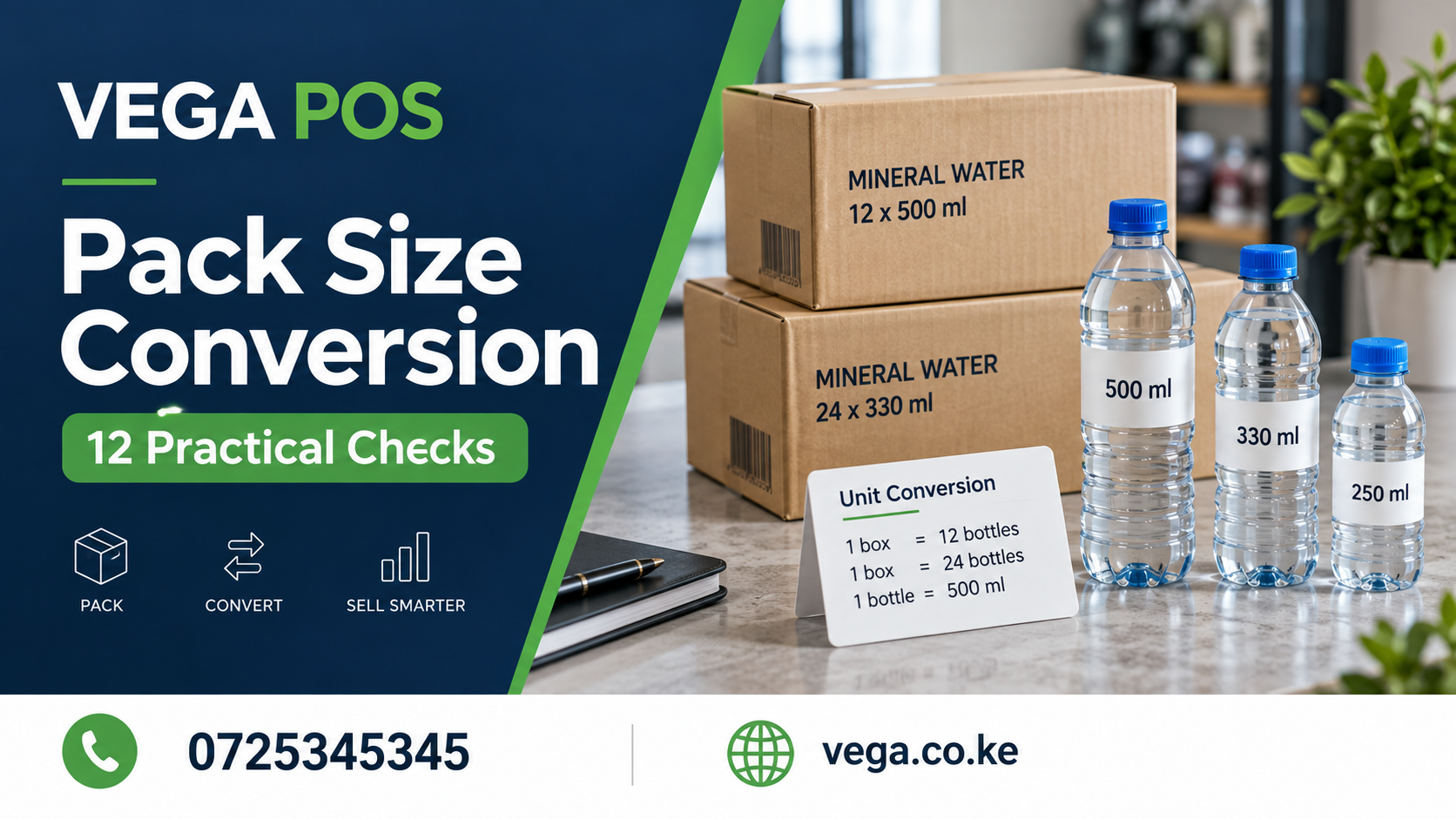
1. Define pack size conversion units clearly
Begin with the smallest unit the business needs to track accurately. This may be a piece, bottle, metre or another meaningful measure. Do not choose it simply because it appears first on a supplier invoice. The base unit should support the way the shop receives, sells and counts the product, including ordinary exceptions such as a partially opened pack.
Document the choice in plain language. A number without its unit is incomplete information. During pack size conversion review, ask two employees to explain what a balance of twenty means. If one describes twenty cartons and another describes twenty pieces, resolve that difference before asking either person to correct a stock record.
2. Verify the physical packaging
Read the actual pack label and count a representative sample where appropriate. Similar boxes can contain different quantities, and a supplier may change packaging while retaining a familiar description. Keep the relevant product reference, packaging description and confirmation date together. Avoid relying on an old spreadsheet whose source nobody can identify.
Distinguish a pack quantity from a product specification. A carton containing twelve bottles is different from a bottle containing twelve litres. Both numbers may appear prominently on packaging, but they describe different relationships. Pack size conversion should reflect the sellable goods rather than whichever number an employee notices first.
3. Map purchasing units to selling units
Write the relationship as a simple sentence, such as one carton contains twelve individually sold bottles. Check whether the business also sells sealed cartons. If it does, confirm how the system recognises the two selling options while preserving one understandable stock position. Do not create unrelated product records without discussing their effect on quantities and reports.
Use fictional quantities during the demonstration. Receive two cartons, sell three bottles and ask the team to explain the remaining balance. The example should show the unit used at each stage. Pack size conversion becomes easier to evaluate when the reviewer can calculate the expected result independently before looking at the software.
4. Treat different pack sizes as distinct cases
A six pack and a twelve pack may contain the same individual product but represent different packaging and selling choices. Confirm whether the business needs separate barcodes, prices or descriptions. A cashier should not have to remember which conversion belongs to an ambiguous label. The catalogue should make the intended option recognisable at the point of sale.
Do not assume that a promotional pack has the same relationship as the standard pack. Bonus items, mixed bundles and changing quantities need their own review. Pack size conversion should distinguish a fixed packaging relationship from a temporary offer, because combining the two can make later stock movements difficult to explain.
5. Separate quantity conversion from pricing
Knowing that one carton contains twelve units does not decide the selling price of either option. The business may offer a different price for a full carton. Keep the quantity relationship and price decision separate so a discount does not accidentally become a stock adjustment. Confirm the permissions required to change each setting.
Review the displayed unit on receipts and quotations. A correct total can still confuse a customer if the description suggests a different quantity basis. Pack size conversion should support clear commercial documents, with the relevant price and unit understandable to both the buyer and the employee checking the transaction later.
6. Test receiving with an incomplete pack
Real deliveries do not always arrive as complete sealed packs. Include an example with one full carton and several loose units, where that situation is relevant to your shop. Ask how the receiving employee records the delivery and how the system presents the result. The process should avoid an employee inventing a decimal carton without understanding its meaning.
Record shortages or damaged units through the appropriate exception process. A conversion factor should not be changed merely to make a particular delivery balance. Pack size conversion describes the product relationship; the receiving record describes what actually arrived. Keeping those facts separate helps the buyer investigate a supplier discrepancy.
7. Check sales and returns in both units
Demonstrate an individual sale, a full pack sale and a permitted return. Confirm that each event affects the stock position as expected and that the document identifies the unit used. Ask what happens when a customer returns only part of an earlier pack purchase. The handling should follow your agreed returns process and supported configuration.
Avoid assuming that reversing a price automatically reverses the correct quantity. Review the product identity, unit and movement together. Pack size conversion testing should include the employee who normally handles returns, because that person may encounter situations the catalogue administrator does not see during initial setup.
8. Decide how partial measures are handled
Some businesses sell quantities that are not whole pieces. If your products are measured by length, weight or volume, discuss the supported precision and rounding rules with the implementation team. Use examples from your actual trading practice. Do not apply a generic rule across products with different measurement needs.
Check how the quantity appears on screen, on the customer document and in a stock report. A display rounded for readability should not leave staff uncertain about the recorded amount. Pack size conversion needs a consistent explanation of precision so employees can distinguish a real difference from a presentation choice.
9. Make stock counts understandable
Employees may find it easier to count sealed cartons and loose pieces separately. Agree how those observations are entered and converted into the comparison unit. Keep the original count evidence so a reviewer can reconstruct the calculation. A final total alone may hide whether the employee counted packs, units or both.
Use one sample location for training. Ask a colleague to count it, another to calculate the expected total and a third to review the entry. Pack size conversion errors often become visible when different people explain the same physical stock. Resolve the wording and input process before applying the routine throughout the shop.
10. Review catalogue imports carefully
Before importing product data, identify which columns represent buying units, selling units and conversion factors. Confirm the required format with the system provider. A spreadsheet heading such as quantity per box may look clear to its author but remain ambiguous to the person mapping the file. Write down the intended meaning before uploading.
Test a small group containing the awkward cases, not only ordinary single units. Include different pack sizes and an item sold in more than one way if supported. Pack size conversion should be checked in the resulting records and a sample transaction, because a successful upload message does not prove that the imported relationship is correct.
11. Control later changes to conversion factors
Changing a conversion after trading has begun can affect how people interpret historical and current records. Ask the provider how the system handles such changes before editing a live product. A packaging change may require a new record, a dated configuration or another supported process. Choose the method that preserves a clear explanation of earlier movements.
Record the reason, approver and affected products. Do not let a busy employee change the factor to solve a single mistaken transaction. Pack size conversion maintenance should be deliberate, with a checked example and a review of labels, prices and open orders that depend on the relationship.
12. Train staff using visible examples
Keep a small reference set of common packaging alongside the training notes. Show the buying unit, selling unit and the expected stock movement for each example. Use the same terminology in the catalogue and instructions. Staff should not need to translate between three informal names for the same pack during a busy shift.
Ask employees to explain an exception in their own words. What would they do if a supplier delivers a different pack size? Who approves a catalogue correction? Where do they record a shortage? Pack size conversion training should teach when to pause and ask for help, as well as how to complete the ordinary transaction.
Worked example: cartons and individual bottles
Imagine a fictional shop that buys cartons containing twelve identical bottles and sells bottles individually. The team receives three complete cartons, giving thirty six bottles in the agreed base unit. It sells five bottles and expects thirty one to remain. The reviewer checks both the physical explanation and the system result.
Next, a customer asks to buy one complete carton. The team confirms how that sale is selected and expects the quantity to reduce by twelve bottles. The remaining nineteen bottles can be understood as one sealed carton and seven loose bottles if the physical arrangement matches. These numbers illustrate a test; they are not a recommended configuration for every product.
Finally, introduce an incorrect supplier description or an incomplete carton. Ask the employee to identify the exception without changing the established factor. A useful pack size conversion demonstration proves that staff can distinguish the product rule from a delivery problem and can leave evidence for the responsible reviewer.
Questions to ask during implementation
Can one product be bought and sold in different units? How are those choices shown to cashiers? Can a barcode select the wrong pack? What happens to existing records when the packaging changes? Ask the demonstrator to use your sample rather than answer only with a general statement about flexibility.
How are fractional quantities displayed? Can the business export a report with the unit clearly identified? Who can change the conversion? Include these questions in the evaluation notes. Pack size conversion affects several routines, so the people responsible for purchasing, selling and counting should agree on the same explanation.
Related business resources
Review Vega’s feature overview and plan information before arranging a demonstration. Use the retail operations guides to prepare questions about setup and stock workflows. Confirm the current configuration directly; a general product page cannot establish every detail of your pack and measurement requirements.
For other operational needs, explore Prim, TAS and Saseni according to their respective salon, chama and writing order purposes. Zama Web Experts offers custom software and portal development. These are separate services to evaluate, not evidence that stock or customer records automatically transfer between them.
For other workflows, explore JAAT and Dereva. Confirm each platform’s current services and suitability directly.
Build a reliable unit reference
Keep conversion examples beside the product setup instructions. Include a sealed carton, a partially opened carton and a return involving individual pieces. Ask a second employee to calculate the expected balance independently before comparing it with the system. If the two answers differ, resolve the unit definition first. Repeating transactions against an unclear conversion rule only creates more records to correct later.
Start with the products most likely to confuse staff. Record their physical packaging, agreed units and demonstrated movements. Keep the reference current when suppliers change a pack. A short, accurate list is more useful than a large catalogue of assumptions that employees cannot verify. Keep unit labels visible.
Call Vega on 0725345345 and bring those examples to your discussion. Good pack size conversion connects the goods on the shelf with the quantities on screen. When the relationship is clear, your team can explain purchases, sales and counts using one consistent basis rather than correcting unexplained differences afterward.