 Vega
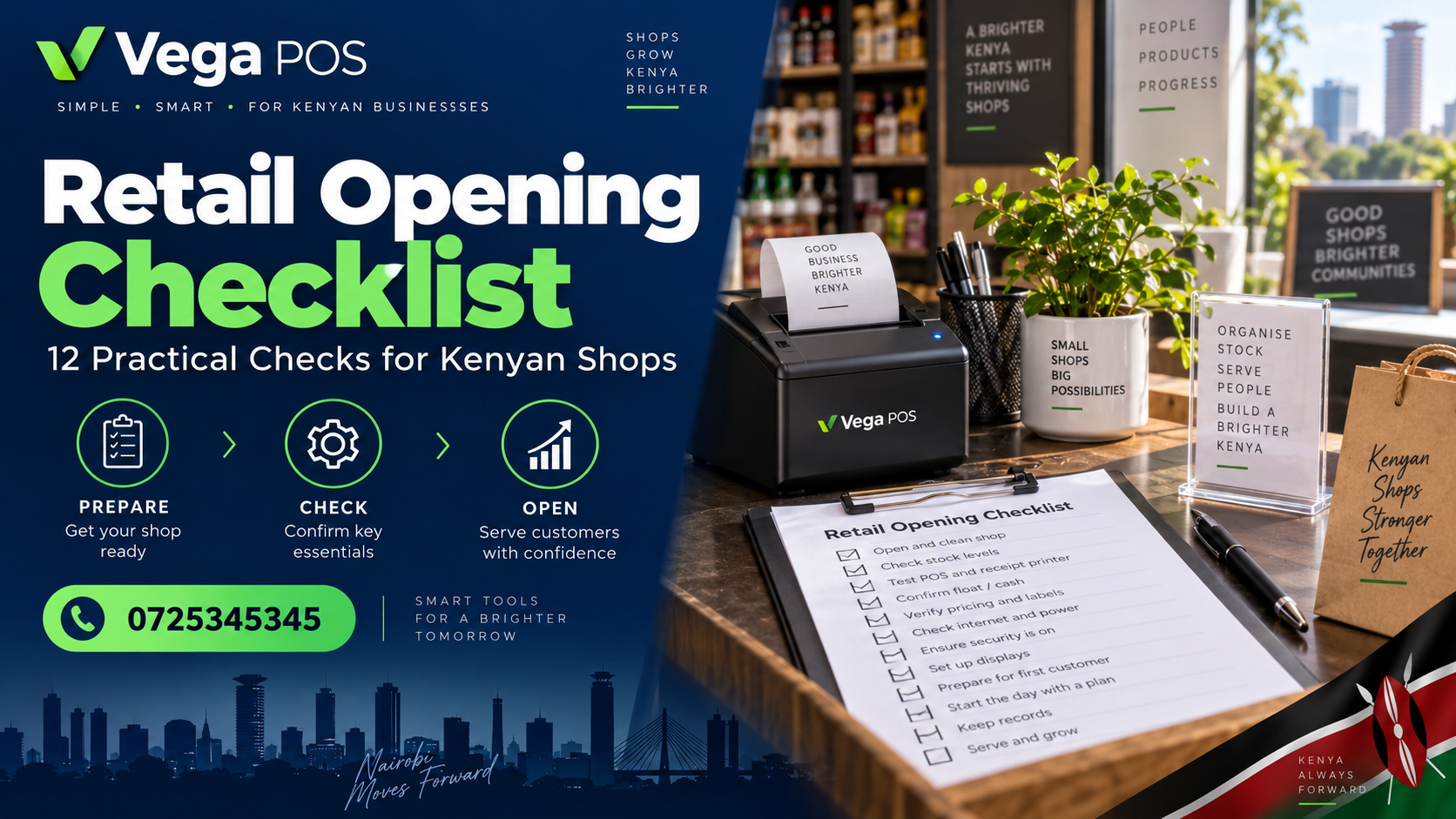
POS opening and closing procedures explained is the discipline that decides whether every trading day starts with certainty and ends with proof. A shop opens with a counted float, a working till and a named person responsible — and closes with a counted drawer, a Z report and a signed log. Those two bookends are where accountability lives, and everything between them inherits their honesty.
Most till losses and staff disputes do not happen mid-afternoon; they happen at the edges of the day. A drawer opened without a count has no baseline, so no closing figure can ever be wrong. A day ended without a Z report never really closed, and its gaps stay open forever. That is why practitioners of POS opening and closing procedures explained routines treat the bookends as the most valuable ten minutes in retail.
This guide covers the whole subject in plain language: the opening checklist, float setup, register discipline, mid-shift habits, X reports, the closing countdown, cash-up, reconciliation, securing the shop, handovers, written logs and the mistakes that undo them all. It closes with the 2026 rules that experienced users of POS opening and closing procedures explained systems are already building into their shifts.
Read it once from top to bottom, then turn the checklists into your own two laminated pages. By the end you will have named owners for both bookends, a variance policy nobody can argue with, and a daily rhythm built on the same foundations that make POS opening and closing procedures explained routines run quietly in shops of every size.
1. Why Day Boundaries Matter
Every trading day has exactly two moments where responsibility changes hands: the moment the till opens and the moment it closes. Accountability must attach to a named person at both, because a shift that begins in vagueness will end in vagueness too. The team behind POS opening and closing procedures explained rollouts calls these the bookends, and treats them as the anchor points of the entire audit trail.
The arithmetic of loss is unforgiving at the boundaries. Without an opening count, a closing shortage could have come from anywhere — the morning, the rush, the handover — and no honest staff member can prove otherwise. Without a closing Z report, the day’s totals never get fixed into records, so refunds, variances and missing receipts float unresolved into the next week.
Boundaries also protect the honest. A cashier who opened a counted float and closed against a Z report can prove their day in two documents, which is worth more than any speech about trust. Reviews of POS opening and closing procedures explained practice keep finding the same pattern: shops with strong bookends argue less, lose less and sleep better.
The goal of this whole subject is a boring, repeatable rhythm. Ten focused minutes at open, ten at close, every day, no exceptions. Boring bookends are the sound of a shop in control.
2. POS Opening and Closing Procedures Explained Simply
In one line, POS opening and closing procedures explained is this: open with a counted float under a named owner, and close with a counted drawer against a Z report. Prove the starting point, prove the ending point, and every number in between becomes checkable. That is the entire machine.
The two bookends use the same logic in mirror. Opening creates the baseline — this much cash, this till, this person, this time. Closing tests the day against that baseline and fixes the result into records with a Z report. Trainers who teach POS opening and closing procedures explained reduce it to two signed checklists, one laminated page each, kept at the counter.
The point of sale does the heavy lifting automatically. It tracks who opened which register, when, with what float, and it produces the X and Z reports that turn counting into arithmetic instead of memory. Shops that master POS opening and closing procedures explained at this level stop relying on recollection entirely — the system remembers, the checklist confirms, the signature commits.
Everything later in this guide is refinement. Different tills, handovers, card reconciliation, security — all of it hangs off the same spine: a proven start, a proven end, and a named person at each.
3. The Opening Checklist: Before the Doors Open
The opening checklist runs ten minutes before the first customer, and the version inside POS opening and closing procedures explained practice covers the machines before the money. Devices powered, network connected, card terminal awake, receipt printer loaded, and one test scan rung up and voided on a real product. Discovering a dead printer at 9:02 a.m. with a queue forming is a preventable embarrassment.
Next come the records. Yesterday’s Z report filed, the overnight notes read, any pending refunds or orders from the previous shift picked up. The opening shift inherits the shop’s open loops, and the checklist exists to make the inheritance explicit instead of accidental.
Then the displays and the floor. Customer screens on and showing today, shelf tags current, bags stocked, till area clean. Practitioners of POS opening and closing procedures explained routines treat this sweep as both preparation and inspection — the shop gets ready and gets checked in the same pass.
The checklist ends where accountability begins: the opening count of the float, signed by the person whose shift it is. Ten minutes, one page, one signature. When the doors open, the day already has a proven starting point and a name attached to it.
4. Float Setup and the Starting Count
The float is the fixed amount of cash each drawer starts with, and its discipline shapes everything that follows. The amount is identical every day, made up of sensible denominations for making change, and counted openly before the shift starts. Operators of POS opening and closing procedures explained systems keep the float constant precisely so that any closing variance has only one explanation — the day’s trading, not the starting point.
The count itself is a two-person habit where staffing allows. The incoming cashier counts, a witness confirms, and both sign the log with the time. Where the team is small, the count still happens visibly and gets recorded — the witness can arrive the moment the shop opens rather than before it.
Float custody needs one clear answer: who holds the key between shifts? Cash left in the drawer overnight, floats topped up informally from the safe without a note, and “we always start with about two thousand” are all the same failure wearing different clothes. Guides to POS opening and closing procedures explained practice settle it in one line — the float is counted, signed and locked, every single day.
The starting count is also the baseline that makes every later number meaningful. A drawer counted at close only means something against a drawer counted at open. Skip the opening and the closing becomes theatre; run both and variance becomes arithmetic.
5. POS Opening and Closing Procedures Explained for Registers
Each register is its own small kingdom with its own accountability, and the register chapter of POS opening and closing procedures explained keeps the rules blunt. Every till opens under a named user with a personal PIN, assigned to one drawer, with one float. One till, one owner, per shift — the sentence that prevents most cash disputes before they exist.
Multi-till shops multiply the discipline, not dilute it. Two drawers mean two counts, two logs and two signatures, and the temptation to “just share the second drawer” during a rush is where clean books begin to rot. Operators of POS opening and closing procedures explained systems configure the software so each user can only open the register they are assigned to, which turns the policy into physics.
Register opening is also a security moment. The drawer is counted in view of the camera where one exists, the float is verified against the signed closing figure from the night before, and any overnight discrepancy is flagged before trading starts — not discovered at month end.
The mirror image matters equally at close. A register that opened under a name should close under the same name, with the same person present at the count. When shifts overlap or swap mid-day, the handover rules from later in this guide take over — but the till never silently changes owners.
6. Mid-Shift Discipline Between the Bookends
The bookends hold the frame, but mid-shift habits keep the picture honest between them. The first is the drawer threshold: when cash in the till passes a set amount, the excess is dropped to the safe and the drop is logged. Programs built on POS opening and closing procedures explained practice set the threshold so the drawer never holds enough to be worth stealing — or worth arguing about.
The second habit is no-sale discipline. Every drawer open without a sale needs a reason and a record, because the no-sale count is one of the first things any investigation reads. Guides to POS opening and closing procedures explained routines treat frequent no-sales not as accusations but as questions the log should already answer.
Register breaks follow the same pattern. A cashier stepping away closes the screen, and the incoming colleague works under their own login — never under a lent PIN. The till’s accountability stays attached to one person at a time, even across a busy afternoon of swaps.
None of this is bureaucracy for its own sake. Mid-shift discipline exists so that the closing count has no mysteries to explain — the drops are logged, the no-sales have reasons, and the drawer’s history between the bookends reads like a story instead of a puzzle.
7. X Reports and Reading the Day So Far
The X report is the till’s read-only snapshot — everything the Z report will eventually say, printed without closing anything. Its role in POS opening and closing procedures explained practice is to let the shop read the day while the day is still correctable. Print an X at mid-shift or handover, compare the till against the expected figures, and catch problems while their causes are still standing in the room.
The handover use is the classic one. The outgoing shift prints an X, the incoming shift reads it, and both know exactly what the till holds at the moment of the swap. Support teams for POS opening and closing procedures explained systems recommend the mid-shift X for any till running heavy cash volume, since early skims keep the drawer light and the risk low.
Reading the X is a skill of comparison, not interpretation. Expected cash equals the opening float plus cash sales minus drops; expected card equals the card sales rung. A gap means something happened — a mis-rung tender, a refund, a missing receipt — and the X finds it hours before the Z would.
The rule that keeps X and Z distinct is simple: X reads, Z closes. Print as many X reports as the day needs, but only one Z, and only at the end. A Z printed mid-afternoon to “check something” ends the trading day at 2 p.m. and everything after it lives in limbo.
8. The Closing Countdown: Last Hour Habits
Good closings are prepared in the final hour, not improvised at the lock-up. The last-hour routine in POS opening and closing procedures explained practice is quiet and deliberate: paperwork finished, refunds processed, pending orders wrapped up, and the counter restocked so tomorrow’s opening checklist finds a tidy stage. A clean last hour is a gift to the next shift.
The cut-off needs defining before it arrives. After-hours sales — the customer at the door at 9:01 — follow a written rule: who may serve, how the sale is recorded, and which till absorbs it. Shops without a cut-off rule collect their most awkward variances in the fifteen minutes after closing, where nobody can prove anything.
Prepare the closing itself during the lull. The Z report takes seconds, the drawer count takes minutes, and both go smoother before the last customer than after the lights go down. Practitioners of POS opening and closing procedures explained routines stage the closing documents during the quiet stretch, so the final lock-up is mechanical rather than mental.
One boundary deserves its own sentence: the shop closes once. Reopening a closed till “for one thing” is how after-hours variances are born, and the log should treat any post-close opening as an event worth a line and a signature. The countdown ends with a lock, and the lock ends the day.
9. POS Opening and Closing Procedures Explained at Cash-Up
Cash-up is the ceremony that closes the day, and the sequence inside POS opening and closing procedures explained practice runs in strict order. Step one: close the till in the point of sale and stop trading. Step two: print the Z report. Step three: count the drawer. Step four: compare count against report. Step five: record the variance and sign. Step six: drop the cash to the safe.
The order is the protection. The Z prints before the count so the comparison is between two independent records — the system’s arithmetic and the drawer’s reality. Reversing the steps, counting first and closing after, opens a gap where adjustments can drift in unrecorded. Programs built on POS opening and closing procedures explained discipline treat the sequence as fixed, because every audit ever conducted reads the same order into the paperwork.
The comparison is where honesty gets tested, which is why the variance policy exists before the first discrepancy ever does. Small variances happen — a rounding here, a miscounted coin there — and the policy defines the threshold, the recording and the sign-off, so nobody improvises an explanation at 9:40 p.m.
Cash-up ends with the money moved and the day fixed. Cash in the safe, variance logged, Z filed, drawer left open and empty on the counter — the shop’s way of showing any observer that the day is finished and nothing sleeps in the till.
10. Counting the Drawer Without Arguments
The drawer count is the moment most likely to produce a dispute, so the counting discipline inside POS opening and closing procedures explained removes every argument in advance. Two people count together — the till owner and a witness — working in the same denomination order every time, saying figures aloud, and agreeing before writing anything down.
Many shops add the blind count: the counter totals the drawer without seeing the expected figure first, then the Z is compared afterwards. This removes unconscious drift toward the target number, and it is the reason auditors of POS opening and closing procedures explained setups rate the blind count so highly — the count records what is there, not what should be there.
The variance policy is written before it is needed. Under the threshold, record and move on. Above it, recount together, then record with a note — the reason if known, “unexplained” if not. What never happens is the silent shrug: a variance that vanishes into the next shift’s float teaches everyone that counts are negotiable.
Patterns matter more than single events. One shortage is life; the same till short every Friday is a conversation. The log from the counting routine feeds exactly this view, which is why teams that keep POS opening and closing procedures explained records spotless solve their cash questions with their own paperwork instead of with suspicion.
11. Reconciling Cards, Mobile Money and Vouchers
Cash is only one tender, and the cash-up that ignores the others is half a cash-up. The reconciliation step in POS opening and closing procedures explained practice compares three columns: what the POS recorded per tender, what the card terminal and mobile money systems settled, and what actually arrived in the bank or wallet. The three should agree — with timing explained where they do not.
Timing is the honest explanation most days. Card settlements batch overnight and mobile money payouts lag by minutes to hours, so the reconciliation compares like with like — today’s card sales against today’s terminal batch, even when the money lands tomorrow. Reviews of POS opening and closing procedures explained routines keep a settlement log beside the Z for exactly this purpose.
Vouchers, gift cards and store credit reconcile too. Redemptions rung at the till should match the card system’s redemption report, and credit issued from returns should appear in the liability figures from earlier disciplines. Any tender that moves value belongs in the closing comparison, or it becomes the quiet gap every auditor finds first.
The next-morning habit completes the loop. Whoever opens the shop confirms that yesterday’s settlements actually landed, and flags any missing batch while the trail is fresh. A reconciliation done at close and confirmed at open leaves no tender — cash, card, wallet or credit — unaccounted for.
12. Securing Cash, Devices and the Shop
The day does not end when the money is counted; it ends when the shop is secure. The lock-up stage of POS opening and closing procedures explained practice follows a fixed order: cash dropped and safe locked, devices shut down and charging, back-office machine logged off, spare keys accounted for, and the alarm set by the last person out.
Cash discipline overnight is simple — the drawer sleeps empty. Everything above the float lives in the safe, because a till holding a full day’s takings is an invitation written in banknotes. Guides to POS opening and closing procedures explained routines also cover the visible signal: an open, empty drawer at close tells any watcher that there is nothing here worth a break-in.
Devices deserve the same care as cash. Tablets locked away or locked down, terminals in their cradles and charging, the back-office computer logged off rather than left in the till screen — small habits that prevent both theft and the morning discovery of a system that updated itself overnight.
The last-person-out checklist binds it together: lights, door, alarm, one signature. Whoever holds that responsibility holds it visibly, and the log records the name and time. A shop that knows exactly who closed it is a shop where every other discipline in this guide keeps its meaning.
13. POS Opening and Closing Procedures Explained for Handovers
Handovers are the bookends’ hardest test, because two shifts meet inside one trading day. The core rule in POS opening and closing procedures explained practice is the clean break: either the outgoing shift runs a full cash-up and the incoming one opens a fresh float, or the drawer is counted and signed over together, with both signatures on the same line. What never happens is a drawer changing owners silently.
The count-and-carry option needs ceremony to stay honest. Outgoing counts, incoming verifies, both sign the handover line on the log, and the till’s accountability transfers at that moment — cleanly, visibly, with the X report printed as the snapshot of the day so far. Trainers of POS opening and closing procedures explained routines rehearse the handover like a procedure, not a conversation.
Beyond the cash, the handover carries the day’s open loops. Pending refunds, customers collecting orders, deliveries expected before close, the special instructions from the owner — all of it travels in a short written note, not in a hallway summary. Shops that write their handovers never hear “nobody mentioned it” again.
Overlapping shifts get one refinement: a brief walk-through at the till, notes passed in person, and the signature exchanged before the outgoing colleague unties their apron. The handover is the one moment of the day where two people share accountability on purpose — and the signature is what splits it again, cleanly.
14. Writing It Down: Logs and Checklists
Unwritten procedures decay on contact with a busy week, so the log stage of POS opening and closing procedures explained practice turns every bookend into ink. The daily log holds the opening count, the closing count, the Z total, the variance, the handover signatures and one notes line — whether it lives on paper at the counter or as a digital form the till produces.
The signature is the point of the log. A count that nobody signed is a rumour; a signature turns it into a record with an owner, a time and a witness. Programs built on POS opening and closing procedures explained discipline treat missing signatures as the first finding in any review, because everything else in the log depends on them.
The weekly review is where the log starts paying rent. Fifteen minutes scanning the week’s entries reveals the patterns single days hide — the Friday variances, the till that always counts heavy, the openings that skip the test scan. The log was written for this read, not for the drawer.
Keep the logs with the records. Filed beside the Z reports and the settlements, they complete the day’s paper trail — proven open, proven close, proven handover. A year of these pages answers more questions than any memory in the building, and it does so without asking anyone to remember anything.
15. Common Opening and Closing Mistakes to Avoid
The failures at the bookends repeat across shops with impressive consistency, and the mistake list inside POS opening and closing procedures explained practice is short enough to memorise. The gravest is the missing opening count — without it, every closing figure is unfalsifiable, and every dispute becomes a matter of tone rather than evidence.
The second family is sequence shortcuts: counting the drawer before printing the Z, skipping the reconciliation for card and mobile money, and dropping cash to the safe without logging the drop. Each one breaks the chain between two records that are supposed to prove each other. Audits of POS opening and closing procedures explained setups trace these chains first, because a broken link anywhere makes every honest number afterwards questionable.
The third family is structural: drawers shared between users, floats topped up informally, Z reports printed twice in one day, and variances recorded with no threshold policy to measure them against. Each is fixed in the settings once and honoured by habit forever. Practitioners of POS opening and closing procedures explained discipline fix the structure before coaching the people, because good habits cannot survive a bad setup.
The last mistake is closing under pressure — no checklist, no count, the lights already off and the staff half out the door. The end of the day is exactly when procedure matters most and energy matters least, which is why the last-hour preparation from earlier exists. A shop that closes in a rush will meet the consequences at the worst possible moment: the audit, the dispute, the quarter’s end.
16. POS Opening and Closing Procedures Explained: The 2026 Rules
The 2026 shift in POS opening and closing procedures explained is automation creeping into the bookends. Cashless tender grows every year, POS systems increasingly reconcile card and mobile money settlements automatically, and digital shift logs timestamp every count and signature without paper. The bookends stay; the ink fades.
The second shift is the alert layer. Modern systems flag the anomalies the weekly review used to catch — a till that never counts light, a Z printed twice, a drawer that opens without a sale more than usual. Operators of POS opening and closing procedures explained programs configure those alerts once and let the software watch the patterns between human reviews.
The third shift is documentation moving into the record. E-invoicing frameworks want end-of-day totals tied to validated transactions, which makes the Z report a compliance document as much as a closing habit — and digital logs make the whole bookend trail searchable in seconds. Shops that kept paper versions of the same discipline will find the electronic version familiar, only faster.
None of this changes the spine of the subject. A counted float, a named owner, a Z at close, a signed log — the 2026 tooling simply makes each proof cheaper, faster and harder to skip. Shops with clean bookends will experience the automation as a bonus; shops without it will discover that software automates habits, good and bad alike.
17. Your First 30 Days Action Plan
You can install both bookends in thirty days without closing a single trading day. Week one is the build: write the two checklists — one opening, one closing — decide the float amount, and set the variance threshold. Compare what you write against the POS opening and closing procedures explained checklist in this guide, and keep each page to one side of one sheet.
Week two is training and go-live. Teach the bookends to every shift, name the owners, print the laminated pages, and run both checklists for real from Monday. Treat the POS opening and closing procedures explained roll-out as a draft until one full week of Z reports lands without a skipped step.
Week three is the log and the handover. Start the daily log with signatures at every count, brief the handover rules, and run one clean shift swap under the new system. The POS opening and closing procedures explained routine only becomes real when it survives a Friday evening rush and a Saturday morning handover.
Week four is the review and the tune-up. Read one week of logs and Z reports, look for patterns rather than incidents, and adjust the float, the threshold or the checklist where the evidence asks. By day thirty the bookends should feel boring — and boring, in this subject, is the sound of every shift starting with proof and ending with proof.
Frequently Asked Questions
1. What is the first rule in POS opening and closing procedures explained for 2026? One till, one owner, per shift — and that owner counts at open and at close. Shared drawers dissolve accountability, and without a counted baseline and a proven close, no other control in the shop can work. Every procedure in this subject hangs on that single rule.
2. How much float should a till start with? Enough to make change comfortably for your first hours of trade, in sensible denominations, and the same amount every day. Too small a float sends staff hunting for coins mid-morning; too large a float leaves excess cash at risk for no reason. Fix the amount, count it openly, and never vary it without a note.
3. What is the difference between an X report and a Z report? The X reads the day without closing it — a snapshot you can print at mid-shift or handover as many times as needed. The Z closes the trading day once, fixes the totals into records and resets the till. Print X reports freely; print one Z, at the end, deliberately.
4. Who should count the drawer at closing? The till’s owner for the shift, together with a witness — two people, same order, figures said aloud. A blind count, where the counter does not see the expected figure first, makes the result even harder to argue with. Counting alone is the habit most variance disputes are born from.
5. What should I do if the cash does not match the report? Follow the variance policy you wrote on a calm day: recount together, record the figure, note the reason if one is known and “unexplained” if not. Under your threshold, sign and move on; above it, the note and the signatures matter most. One variance is life — a pattern is a conversation the log has already prepared you for.
6. Should closing procedures change for late-night or double shifts? The bookends never change — a counted open, a proven close, a signed log. What changes is the handover in between: double shifts need the count-and-carry ceremony with two signatures, and late closes need the lock-up checklist followed exactly, because tired staff and quiet streets raise the stakes. Adjust the schedule, never the discipline.
7. How long should I keep opening and closing records? Keep the logs, Z reports and settlement reconciliations with your tax records — five years is a common expectation, so confirm your local requirement and treat it as the floor. Filed by month, they take almost no space and answer disputes years later. A day’s paperwork that survives is a day nobody can misremember.
Here is your immediate move: tonight, write the two checklists — one page for opening, one for closing — covering devices, records, float, Z, count, variance and log. Compare them against the POS opening and closing procedures explained checklist in this guide, and leave room for two signatures on each page.
Tomorrow, set the float amount, name the owners, and run both bookends for real — counted open in the morning, Z and count at close, signatures all round. The POS opening and closing procedures explained habits take ten minutes each and turn every dispute that follows into arithmetic instead of memory.
Run the rhythm all week — every shift, both bookends, no exceptions — and start the daily log with the very first signature. A shop that trains its POS opening and closing procedures explained routines properly sounds different within days: calmer opens, quieter closes, and variances that arrive with paperwork already attached.
Review the first month’s logs this weekend: one week of Zs, one week of counts, patterns instead of incidents. Fifteen minutes a week with POS opening and closing procedures explained records is what tunes the float, the thresholds and the checklist before small frictions become settled habits.
Finally, put the monthly bookend review on the calendar — logs, variances, handovers, one page. That rhythm, plus the POS opening and closing procedures explained discipline built above, is how ordinary shops turn the two most fragile moments of the day into their strongest evidence through 2026.