Introduction
Retail businesses in Kenya are rapidly evolving as technology becomes more accessible and affordable. From small kiosks and boutiques to supermarkets and takeaways, business owners are increasingly adopting digital systems to simplify operations and improve efficiency.
One of the most important innovations driving this transformation is Retail Business Automation Kenya solutions.
Business automation refers to the use of software systems to handle daily operations such as sales tracking, inventory management, reporting, and payment processing with minimal manual effort.
Instead of relying on notebooks, spreadsheets, and manual calculations, retail businesses are now shifting to automated systems that handle everything in real time.
This change is not just about convenience—it is about survival in a competitive market where speed, accuracy, and efficiency determine success.
How Retail Automation is Changing Everyday Business in Kenya
Retail automation is not just a technology upgrade—it is a complete shift in how businesses operate daily.
In Kenya, automation is helping businesses move from survival mode to structured growth by improving:
- Speed of daily transactions
- Accuracy of stock records
- Transparency in financial reporting
- Customer service efficiency
- Overall business organization
What used to take hours of manual work can now be completed in seconds through automated systems.
What is Retail Business Automation?
Retail business automation is the process of using digital systems to manage and streamline retail operations without heavy manual input.
An automated retail system handles:
- Sales processing
- Inventory tracking
- Payment recording
- Staff management
- Reporting and analytics
- Customer transaction history
In simple terms, it replaces manual work with smart software.
This allows business owners to focus more on growth and customer service instead of paperwork and calculations.
Why Retail Automation is Growing in Kenya
Increasing Business Competition
Retail businesses are becoming more competitive every day. Customers expect faster service, accurate pricing, and better shopping experiences.
Automation helps businesses meet these expectations by speeding up operations and reducing errors.
Growth of Digital Payments
With M-Pesa dominating the Kenyan market, businesses now handle multiple payment methods daily.
Automation systems help track:
- Cash payments
- M-Pesa transactions
- Bank transfers
- Mixed payments
This ensures accurate financial records.
Need for Better Business Control
Many business owners struggle to monitor their shops in real time.
Automation solves this by providing:
- Live sales tracking
- Inventory updates
- Remote access to business data
The Hidden Cost of Manual Retail Operations
Many business owners do not realize how much money they lose through manual systems.
Common hidden losses include:
- Small unrecorded cash leaks
- Forgotten transactions
- Incorrect pricing during rush hours
- Expired or dead stock
- Over-ordering unnecessary items
These small inefficiencies accumulate over time and significantly reduce profit margins.
Automation helps eliminate these invisible losses by ensuring every transaction is recorded accurately.
Key Features of Retail Business Automation Kenya Systems
Automated Sales Tracking
Every sale is recorded instantly without manual input.
This helps business owners monitor daily revenue and performance easily.
Smart Inventory Management
Inventory updates automatically after every transaction.
Features include:
- Stock level tracking
- Low-stock alerts
- Product movement history
- Inventory valuation
Real-Time Reporting
Reports are generated automatically, showing:
- Daily sales performance
- Weekly summaries
- Monthly business trends
- Product performance
Payment Integration
Supports multiple payment methods including M-Pesa, cash, and card payments.
All transactions are recorded in one system for accuracy.
Staff Management
Businesses can assign roles such as cashier, manager, and admin to control access and improve accountability.
Benefits of Retail Business Automation Kenya
Increased Efficiency
Automation reduces manual work and speeds up daily operations.
Reduced Human Errors
Manual systems often lead to mistakes in calculations and stock tracking. Automation eliminates these errors.
Better Decision Making
Business owners can use real-time data to make smarter decisions about pricing, stock, and sales strategies.
Improved Customer Experience
Faster checkout and accurate billing improve customer satisfaction.
Higher Profitability
By reducing losses and improving efficiency, businesses naturally become more profitable.
Common Problems Automation Solves
Retail automation systems help solve common business challenges such as:
- Stock shortages
- Overstocking
- Cash tracking issues
- Missing sales records
- Employee accountability problems
- Slow reporting systems
These issues are common in manual retail setups but are significantly reduced with automation.
Industries That Benefit from Retail Automation
Retail Shops
Helps manage daily sales and fast-moving goods efficiently.
Boutiques
Simplifies management of sizes, colors, and fashion variations.
Supermarkets
Handles large inventories with ease and accuracy.
Electronics Stores
Tracks high-value items and accessories properly.
Takeaways and Restaurants
Improves speed of service and order tracking.
Why Manual Systems Are No Longer Enough
Manual systems rely heavily on human effort, which increases the risk of errors and inefficiencies.
They often result in:
- Delayed reporting
- Poor inventory control
- Financial inaccuracies
- Limited business insights
Retail automation solves all these problems by introducing structure and real-time control.
The Future of Retail Business Automation in Kenya
The future of retail is fully digital and automated.
Upcoming trends include:
- AI-powered inventory prediction
- Mobile-first retail management
- Cloud-based business dashboards
- Automated stock reordering
- Smart customer analytics
Businesses that adopt automation early will have a strong advantage in the market.
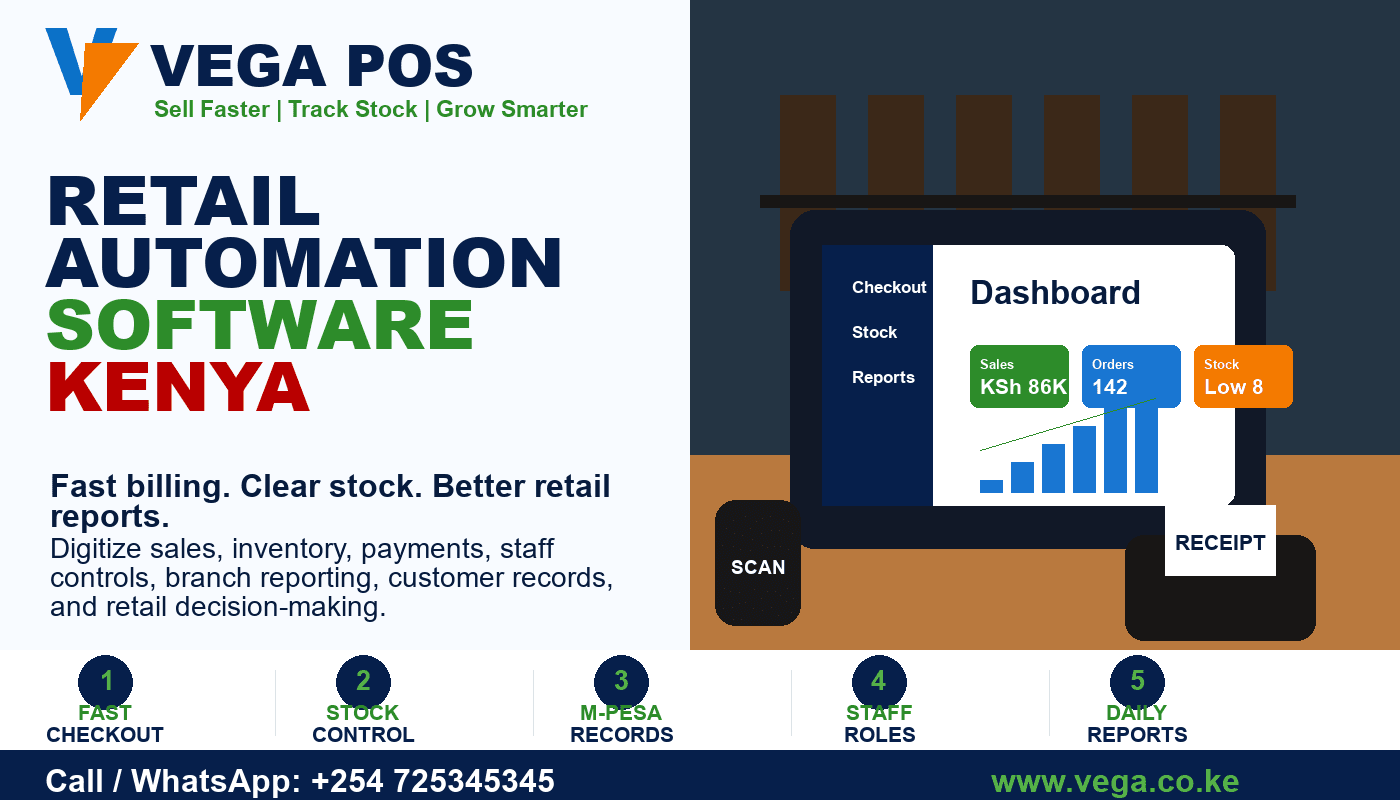
How Vega POS Supports Retail Automation
Vega POS is designed to help Kenyan businesses automate their daily operations easily and effectively.
It provides:
- Automated sales tracking
- Real-time inventory management
- M-Pesa and cash integration
- Staff role control
- Automated reporting
- Fast and simple checkout system
Whether you run a boutique, retail shop, takeaway, or electronics store, Vega POS helps you operate more efficiently and grow faster.
Best Practices for Retail Automation
To get the best results from automation systems:
- Train staff properly
- Keep product data updated
- Monitor reports daily
- Use insights for decision-making
- Review business performance regularly
Consistency ensures maximum benefits.
Conclusion
Retail Business Automation Kenya is transforming how shops operate by introducing speed, accuracy, and intelligence into daily business processes.
Automation helps businesses:
- Improve efficiency
- Reduce losses
- Track inventory accurately
- Serve customers faster
- Make smarter decisions
In today’s competitive environment, automation is no longer optional—it is essential for growth.
Businesses that adopt systems like Vega POS are better positioned to scale, reduce stress, and operate more professionally.
Get Started Today
📞 Call: +254725345345
🌐 Website: Vega.co.ke