Retail reorder planning helps a shop decide what to buy, when to buy it, and how much cash to commit. Without a clear process, an owner may order whatever looks low on the shelf while overlooking slow products, incoming deliveries, or demand that changed after a promotion.
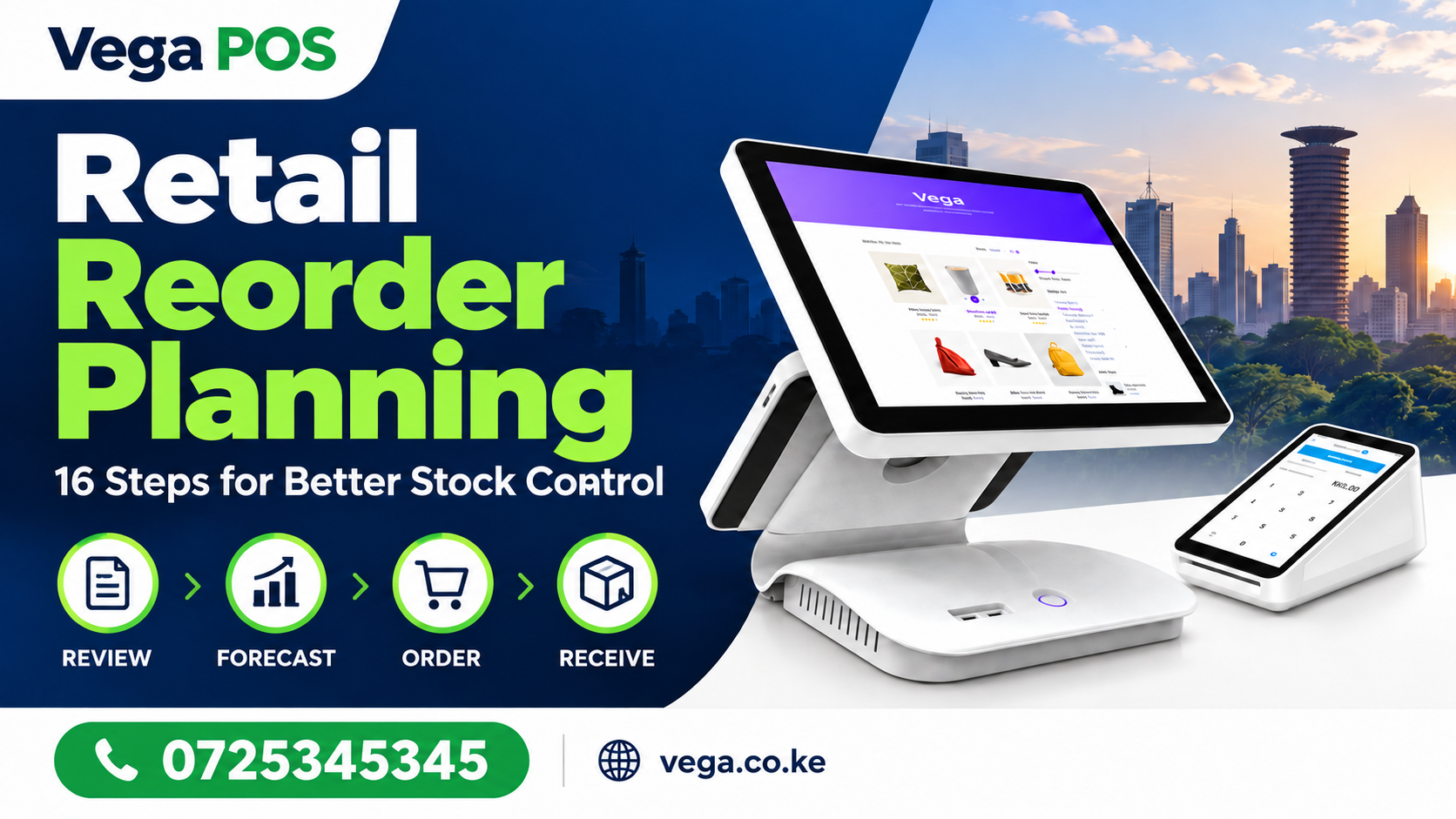
Vega POS can provide a starting point for reviewing recorded sales and stock. Confirm the reports and purchasing workflow available for your selected setup. This guide explains practical questions to bring to that discussion. For help reviewing your requirements, call 0725345345.
1. Start retail reorder planning with reliable stock
Start retail reorder planning by checking the records. Before calculating a reorder, check whether the current balance is trustworthy. A product that was received under the wrong name may look unavailable even when it is in the back room. A recent return may still be awaiting inspection. Those situations need different decisions from a genuine shortage.
Review physical exceptions and recent movements for important items. The supplier returns checklist explains how delivery checks support reliable quantities. Better purchasing begins with knowing what the shop already owns, where it is stored, and whether it is actually available to sell.
2. Choose the unit you are planning
Retail reorder planning requires a clear unit for each product. A supplier may sell cartons while customers buy individual pieces. If one report counts pieces and the order sheet counts cartons, state the conversion explicitly. Otherwise, a sensible-looking order can be several times larger or smaller than intended.
Keep variants separate when they serve different customer needs. Strong demand for a medium blue shirt does not automatically justify buying the same quantity of every size and colour. Use the boutique stock guide to review how product combinations affect availability and purchasing decisions.
3. Review sales over a meaningful period
For retail reorder planning, choose a period that reflects how the product normally sells. A single busy day can exaggerate demand, while a long average may hide a recent change. Compare similar trading periods and note holidays, events, opening hours, and other circumstances that could explain unusual results.
Sales are not the same as demand when an item was unavailable. If a product sold nothing because the shelf was empty, treating that as evidence that nobody wanted it can perpetuate the shortage. Keep a simple record of customer requests and known stockout periods alongside the sales figures.
4. Separate normal demand from promotions
In retail reorder planning, a discount, bundle, or special event may temporarily increase sales. Record when the promotion ran and whether the same conditions will continue. Reordering from promotional sales without that context can leave the shop with excess stock after customers return to their ordinary buying habits.
Also consider whether a promotion shifted demand away from another product. A popular offer can make a substitute look weaker than usual. Review the product group as well as individual items. The objective is to understand what customers chose, not simply repeat the largest quantity from the latest report.
5. Measure the supplier lead time
One input to retail reorder planning is lead time: the interval between placing an order and having accepted goods ready for sale. It may include supplier processing, transport, receiving, and shelf preparation. Ask staff to record actual dates rather than relying only on a supplier’s optimistic estimate or an old agreement.
Look for variability as well as the average. A supplier who usually delivers in three days but sometimes takes ten creates a different planning problem from one who consistently takes five. Document the conditions that cause delays, such as order cutoffs, delivery routes, or minimum quantities.
6. Use a simple reorder example
Imagine an item selling an average of five units per day, with an expected lead time of four days. The illustrative lead-time demand is twenty units. If the owner chooses an additional buffer of ten units, a starting reorder point would be thirty units, subject to the business’s circumstances.
This retail reorder planning example is a method, not a guaranteed recommendation. Demand may vary, the supplier may be late, and the buffer may tie up scarce cash. Review the assumptions with actual results. A formula is useful when employees understand what its inputs mean and when they should question them.
7. Include incoming orders and reservations
In retail reorder planning, check whether a purchase has already been placed before ordering again. Goods on the way may not yet appear as available stock, but ignoring them can create duplicate replenishment. Keep a clear record of outstanding orders, expected delivery dates, and accepted quantities when deliveries arrive in parts.
Consider committed stock separately from unrestricted availability. A reservation or agreed customer order may mean that some physical units are not available for new demand. Confirm how your process and software represent these commitments. Do not assume that every item physically on a shelf can safely support another sale.
8. Decide how much to order
In retail reorder planning, the reorder point answers when to review replenishment; it does not automatically determine the right purchase quantity. Consider expected demand until the next opportunity to order, current available stock, incoming goods, supplier pack sizes, and the cash the business can reasonably commit.
Minimum order quantities can make this decision harder. A discounted bulk purchase may look attractive while occupying storage and cash for months. Compare the expected benefit with the practical consequences. Where a quantity feels excessive, discuss smaller deliveries or alternative arrangements rather than treating a discount as sufficient justification.
9. Check shelf life and product change
Some products lose usefulness or saleability over time. Others become less attractive when device models, fashion preferences, or customer habits change. Retail reorder planning should consider these risks alongside recent sales. A historical average does not guarantee that the same item will remain desirable.
For phone stores, review compatibility and model changes before buying accessories in volume. The phone shop inventory guide discusses keeping product differences understandable. For other shops, agree the equivalent checks relevant to the products sold and the conditions in which they are stored.
10. Protect cash by prioritising purchases
When the available purchasing budget cannot cover every request, rank the items by business need. Consider reliable demand, customer importance, existing alternatives, supplier reliability, and the consequences of running out. Avoid using sales value alone when a high-value item rarely moves and consumes a large share of cash.
Keep retail reorder planning decisions visible to the person placing orders. A short explanation prevents a lower-priority purchase from displacing an essential replenishment simply because somebody noticed it first. Review priorities regularly, particularly when the shop changes its product range or experiences a period of uncertain trading.
11. Assign approval and ordering responsibilities
For accountable retail reorder planning, agree who prepares the suggested order, who checks it, and who communicates with the supplier. A small shop may combine these roles, but responsibility should still be explicit. Staff should know whether a suggestion is approved, awaiting review, or already ordered.
Keep price changes, substitutions, and delivery changes attached to the same purchasing record. Informal messages can be useful for communication, but the final decision should be understandable later. If wider approvals require a separate workflow, discuss custom business software with Zama and scope the requirement clearly.
12. Review the result after delivery
Once the goods arrive, compare the order with the accepted delivery and the subsequent sales. Did the stock last as expected? Was the buffer sufficient? Did a pack conversion create an unexpected quantity? Record the explanation while staff still remember the circumstances.
Use that evidence to improve the next retail reorder planning decision. Change one assumption at a time where practical so the result remains understandable. Automatically increasing every buffer after one shortage can create unnecessary excess stock. Equally, removing every buffer after a quiet week may ignore normal variability.
13. Build a weekly reorder meeting
A small shop can organise retail reorder planning through a short weekly review instead of a complicated planning department. Bring the proposed order, important exceptions, supplier updates, and available purchasing limits. Focus on decisions that need discussion, rather than reading every product line aloud regardless of significance.
End with an agreed action list: what to order, what to investigate, what to defer, and who follows up. Check the previous week’s unresolved items first. This makes the meeting a working routine rather than a repeated conversation in which nobody can tell whether the last decision was completed.
14. Test the process during a POS demonstration
To test retail reorder planning, bring one fast seller, one slow product, one variant group, and an outstanding supplier order to the demonstration. Ask the provider to show the information needed for your planning decisions. Confirm which reports are available and which steps require a separate spreadsheet or another agreed process.
Review Vega features, solutions, and pricing. The POS demo checklist can help structure the meeting. Ask for evidence of specific functionality rather than assuming that general inventory management includes every purchasing feature your business needs.
15. Keep other business activities distinct
Owners may also run services, property activities, group contributions, or delivery arrangements. Keep those records separate from retail reorder planning unless a clearly designed process connects them. Explore PRIM, PMS, TAS, and Dereva when considering those wider requirements.
A website link does not imply an existing integration or shared account. Confirm suitability, responsibilities, and any information exchange independently. For the shop itself, a clear purchasing process is more valuable than collecting unrelated features that employees cannot connect to the decisions they make every week.
16. Compare two purchasing choices before committing
Suppose an item sells steadily, but the supplier offers a discount only when the order doubles. Write down the smaller order’s cost, expected selling period, and next delivery opportunity. Then do the same for the larger order. Include storage and the practical effect of committing money that could replenish other products. Keep the assumptions visible so the owner can review the tradeoff rather than respond only to the discount percentage.
Keep supplier promises and internal decisions separate. A supplier may recommend a large quantity, but the shop owns the consequences of the purchase. Ask for clear delivery and product details, compare them with your records, and document the final decision. After the stock arrives, check whether the assumptions held. This review creates a practical learning loop that improves future orders without pretending that every outcome could have been predicted in advance. Share the lesson with whoever prepares the next purchasing suggestion so that the evidence remains useful.
For other online workflows, review JAAT’s digital mall and Saseni’s writing orders marketplace. Compare each platform against its intended purpose before considering it for your business.
Retail reorder planning: frequently asked questions
Can the same reorder rule apply to everything?
Usually, products need different treatment because demand, lead times, value, and storage conditions differ. Group similar items where that simplifies work, but retain the important exceptions. Review the grouping when trading patterns change rather than assuming a rule remains suitable forever.
Should we always buy the cheapest unit price?
No. Consider the total quantity required, delivery reliability, product suitability, storage, and cash tied up. A lower unit price can be a poor decision if the purchase creates excess stock that the shop struggles to sell. Compare the full operating consequences.
What should we do when data is limited?
Begin retail reorder planning with smaller purchasing decisions, clearly labelled assumptions, and frequent review. Record customer requests, delivery dates, and actual sales consistently. As the evidence improves, refine the plan. Avoid presenting an early estimate as a precise forecast that employees are expected to follow without judgement.
Make replenishment a repeatable decision
Retail reorder planning improves when the shop connects reliable records with practical supplier knowledge and clear responsibility. Start with a manageable product group, document the assumptions, and review what actually happens. Record who approves each order and when delivery should be reviewed. To discuss Vega POS, contact Vega, call 0725345345, or send a WhatsApp enquiry.