 Vega
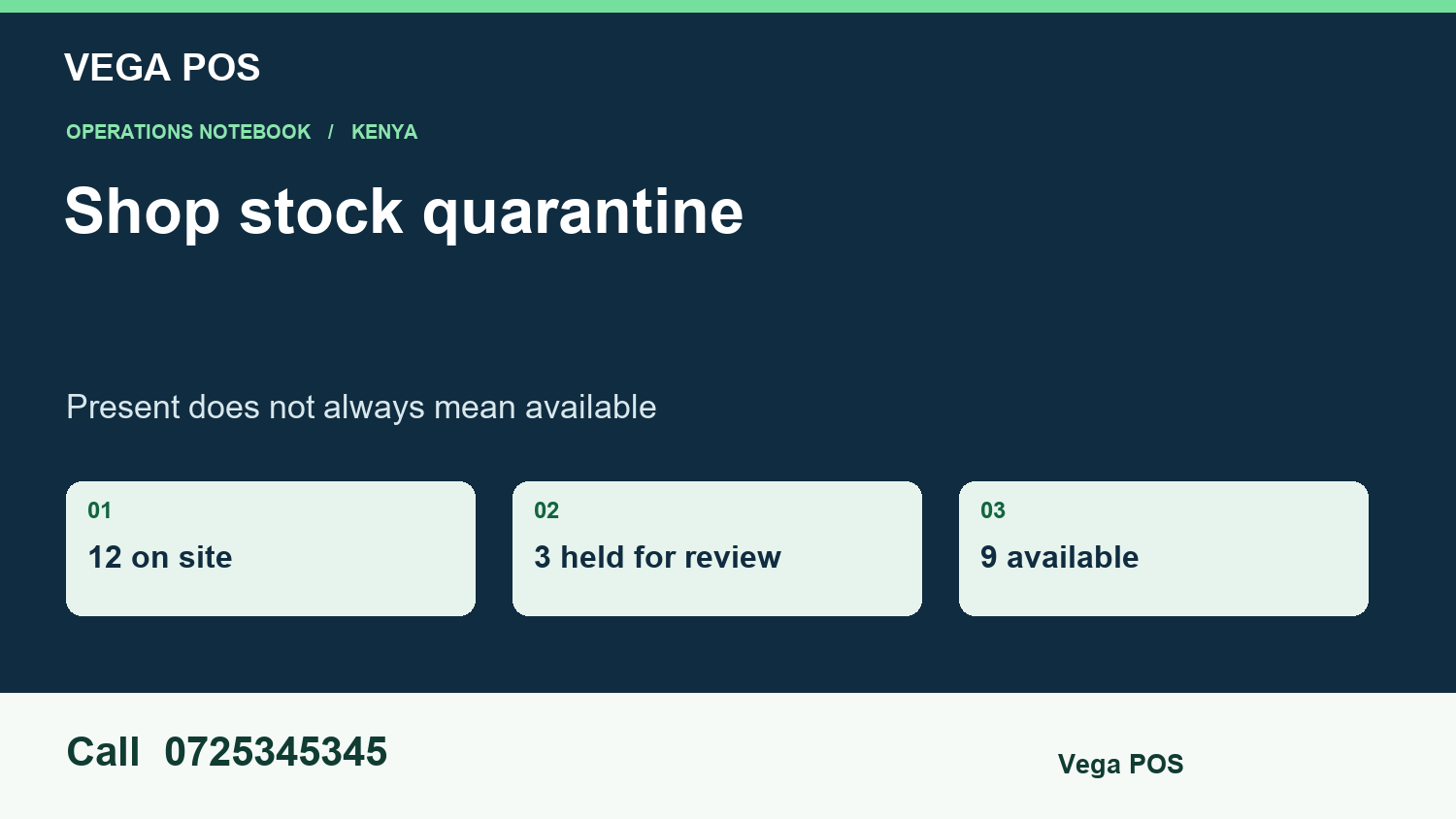
Shop stock quarantine means goods are physically present but held out of normal selling while a defined concern is reviewed. A fictional shop receives twelve boxed fans and finds signs of moisture on three cartons. Counting twelve on site is accurate. Promising twelve ready for customers is not justified until the condition review is complete.
This guide describes recordkeeping and handover, not a technical safety inspection. Follow the relevant product instructions and the business’s qualified review process. Do not test potentially unsafe equipment merely to complete an exercise. Use empty sample cartons and fictional references to rehearse the decisions: what is held, where it sits, who may release it and what evidence supports that release.
Shop stock quarantine in four decisions
Use the four decisions below as a tabletop exercise. The case is fictional. Each decision pairs a new scenario with field notes drawn from a linked guide in our library. Read the scenario aloud first, and ask the next person to explain the result before consulting the notes.
1. Separate presence from availability
Record twelve received physically, three held for review and nine available if all other checks have passed. Give the held units a clear location and reference. The record should prevent an ordinary picker from treating them as unrestricted stock.
If the system only shows one quantity, agree a safe supporting control before relying on it for customer promises. Shop stock quarantine is not a write-off by default: the three units still exist, and the review may lead to release, return, repair or another approved outcome. Keep those possibilities distinct until a decision is supported. For shop stock quarantine, keep this starting assumption visible beside the result.
Field notes from our retail damaged stock guide:
Capture evidence that answers a question
Take only the evidence needed to show the condition and identify the goods. Useful photographs may show the overall item, affected area and identifying label. Record the delivery or transaction reference when relevant. Keep evidence in the approved business location so the reviewer can find it later.
Review supplier communication carefully
When a supplier needs to respond, send a precise question through the approved channel. Include the relevant item, delivery reference, affected quantity and evidence. Ask for the next step under the applicable arrangement. Do not promise a replacement or credit to your own team before the supplier has confirmed its response.
Save the reply with the retail damaged stock case and distinguish a proposed solution from a completed one. An agreement to collect goods is different from collection having happened. Likewise, a promised credit remains open until the responsible employee checks the document and records the result.
Include open cases in shift handover
Tell the next shift which cases need attention, where the goods are held and who owns the next action. Keep the handover brief and refer to the full record for evidence. Do not duplicate long descriptions across several notebooks, because copies can disagree after the case changes.
Use the retail handover log guide to keep responsibilities visible. A good retail damaged stock handover allows an employee who was absent at discovery to locate the goods and understand the immediate task without calling everyone involved.
2. Make the handover understandable
At shift change, show the next custodian the three cartons, their location and the reason for the hold. Include any accessory or serial references needed to distinguish them from identical stock. A vague note saying “check fans” leaves too much room for someone to move the wrong units.
Ask the incoming employee to identify the held items without coaching. If one carton moves to an inspection area, record the new location while keeping the restriction. Moving an item is not the same action as releasing it, even if the destination is nearer the sales floor. This stage of shop stock quarantine tests a different question from the final total.
Field notes from our partial delivery tracking guide:
Start partial delivery tracking with a clear order
The order should identify the supplier, product, purchasing unit and agreed quantity. Record the delivery arrangement if it is known. An order for ten cartons is difficult to reconcile if the receiving team counts pieces without a confirmed conversion. Clarify the meaning of each quantity before the first delivery arrives.
Distinguish an expected split from a short delivery
A supplier may agree to deliver in stages, or a delivery may arrive short without prior agreement. Record which situation applies. The first is a planned schedule; the second needs clarification. Do not change the original order quantity just to make a short arrival look complete.
Give each receipt its own evidence
Keep a distinct receiving reference for each arrival. Record the date, related order, accepted lines, quantities and any exception. Link the supplier’s delivery document where appropriate. This allows the team to reconstruct the sequence without treating the latest document as a replacement for everything that happened earlier.
Reconcile the open quantity after every receipt
Compare the ordered quantity with accepted receipts and any authorised changes. Investigate a negative or unexpected outstanding balance. It may indicate an overdelivery, duplicate receipt, unit mismatch or an order amendment that was not recorded correctly. Do not treat the balance as trustworthy merely because it appears on a screen.
3. Release only the units actually cleared
Suppose the authorised reviewer clears two units and keeps one on hold. The expected available quantity becomes eleven and the held quantity becomes one, before other transactions. Record the two specific units and the approval reference.
Do not release the whole receipt because most of the batch passed. Test the label or selection used by the picker so the remaining held unit stays distinguishable. A release entry should identify who made the decision and what it applied to; a generic green status on the supplier record cannot explain the outcome of this particular inspection. Use shop stock quarantine to expose this exception before relying on the ordinary successful path.
Field notes from our barcode label checks guide:
Compare the item with its product record
Read the description on the physical package and compare it with the selected record. Check the meaningful differences: size, variant, quantity and selling unit. Similar names do not prove that two products are interchangeable. Two bottles may share a brand while containing different amounts, and a box may carry a different code from an individual piece.
Separate product labels from shelf information
A product barcode identifies an item or unit within the agreed process. A shelf label may also show a price, location or promotional message. Treat those functions separately during barcode label checks. An accurate shelf description does not prove that the product sticker underneath it belongs to the same record.
Investigate repeated or conflicting matches
If a code selects an unexpected record, stop that label batch and record the observed result. Compare the printed characters with the intended reference. Check whether a different item has been given the same internal code or whether the wrong template was selected. Avoid fixing the problem by changing several records at once.
Review after the first trading period
Check the first day’s reported exceptions after introducing a label batch. Ask receiving staff whether application was straightforward and cashiers whether scanning produced consistent matches. Inspect a small sample on the shelf again. The goal is to discover practical problems that were not visible during printing.
4. Reconcile the final disposition
If the last unit goes back to the supplier, record its actual dispatch and the relevant acknowledgement. The shop then holds eleven units if nothing else moved. If the supplier authorises a credit, track that commercial outcome separately from the physical return.
Shop stock quarantine review should also explain why the problem occurred and whether future receipts need an extra check. Use the case to improve receiving instructions, not to create an automatic accusation against a supplier or employee. Close the hold reference only when the physical and decision records tell the same story. The final shop stock quarantine record should explain the outcome to someone who was not present.
Field notes from our reorder exception review guide:
Define the purpose of a reorder exception review
Agree which situations should be reviewed before ordering. Examples include an unexpected demand jump, a balance that conflicts with a shelf count, an overdue supplier delivery or an item that has stopped selling. The review should focus attention on exceptions rather than force the buyer to investigate every ordinary product from the beginning.
Check whether the recorded balance is credible
Compare the system position with the relevant physical evidence when a discrepancy is suspected. Look for goods waiting to be received, a movement that has not been completed or items held away from the main shelf. Do not immediately buy more stock to cover a difference that may be caused by an unfinished record.
Separate available stock from other quantities
Goods may be physically present but reserved, held for review or located at another branch. Ordered stock may not yet have arrived. Confirm how the business distinguishes these quantities in its actual records. The buyer needs to understand which stock can satisfy the next ordinary sale.
Compare the outcome with the original concern
After the next receiving or selling period, revisit selected exceptions. Did the goods arrive as expected? Was the quantity useful? Did the suspected record issue explain the shortage? The purpose is to improve the assumptions and process, not to judge a decision using information that was unavailable at the time.
Shop stock quarantine test sheet
Before running the example, cover the expected results and ask a colleague to predict them. Use the disagreements to decide which rule needs explaining. These are fictional test cases; use your own approved references for the real procedure.
| Test condition | Expected evidence |
|---|---|
| Twelve cartons present, three held | Nine are available only if their other checks passed; the held units remain identifiable. |
| Held carton moved for review | Location changes without silently removing the restriction. |
| Two of three held units cleared | Available quantity rises to eleven before other movements, and one remains held. |
| Last unit returned to supplier | The physical return and any commercial credit are recorded as separate outcomes. |
| Shift changes during review | The next custodian identifies the held units and responsible reviewer without guessing. |
Shop stock quarantine: questions from the counter
Is held stock automatically damaged?
No. A hold can exist because a check is incomplete or documentation is uncertain. Record the actual reason without asserting a defect that has not been established. The responsible reviewer decides the disposition through the approved process. Keep the physical restriction effective while that decision is pending.
Who may release a held unit?
The person or role authorised under the business’s procedure, using the relevant evidence. A warehouse move or new label should not accidentally grant release. Record the exact units covered by the decision, particularly when only part of a batch is cleared, and communicate the outcome to pickers.
Can the shop promise goods under review?
Do not describe them as ready when release is unresolved. Explain the verified availability and follow the customer’s agreed alternatives. A future release may change the position, but an expected inspection result is not a completed result. Update the promise only when the responsible person confirms the change.
Use shop stock quarantine in your next demonstration
For a discussion about shop stock quarantine, contact Vega POS on 0725345345. Bring one anonymised example, its starting position and the result your colleague expects. Ask for a demonstration using those details before assuming a particular feature or integration is available.
Other Kenyan business workflows
For a custom business portal, explore Zama Web Experts. If your team is working in another sector, these services provide different examples: Prim for salon bookings, sales and stock; TAS for chama records and contributions; JAAT for shop and product listings; Dereva for driver discovery. Use the service that fits your task; a link does not establish that the systems exchange data.