 Vega
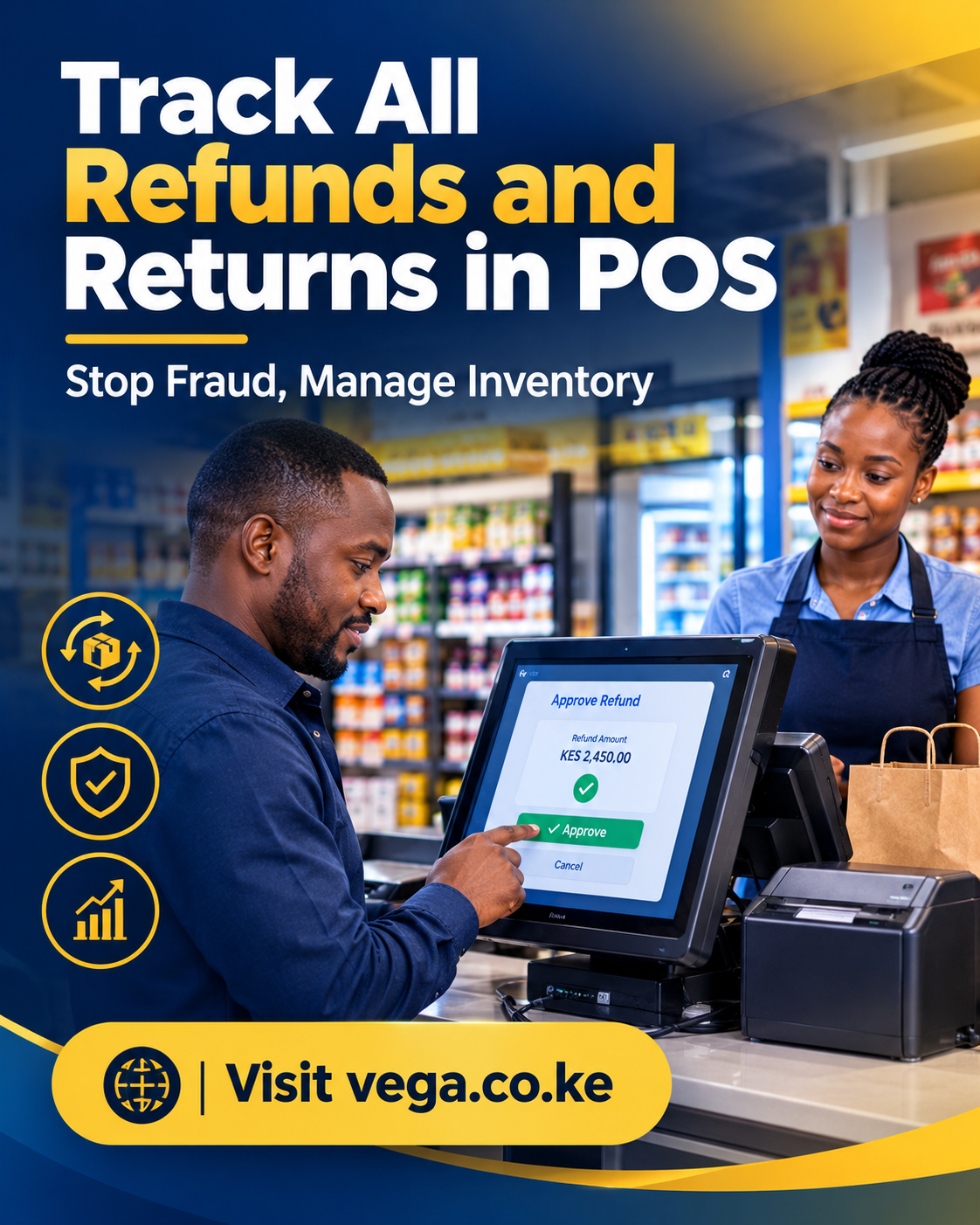
Track all refunds and returns in POS is essential for protecting your retail business from fraud and inventory loss. Every time a customer returns an item, your system must record the event accurately. Without strict tracking, refunds become a major loophole for theft and financial leakage.
Understanding the Track all refunds and returns in POS capabilities helps you maintain absolute control over your revenue. Whether you run a busy supermarket in Nairobi or a small duka in Nakuru, managing returns is critical.
This guide explores how a Track all refunds and returns in POS system transforms your daily operations. We will look at practical steps to implement it correctly.
Many Kenyan retailers suffer from unexplained cash shortages caused by fake refunds. Implementing a Track all refunds and returns in POS strategy eliminates this risk by creating a clear audit trail.
You will learn how to configure a Track all refunds and returns in POS step by step. We cover everything from user permissions to daily reporting.
By the end of this article, you will master the Track all refunds and returns in POS setup. This knowledge will save you from financial losses and inventory discrepancies.
Let us look at why this feature is non-negotiable for modern retail. A Track all refunds and returns in POS system ensures your business can survive the complexities of customer service.
You will discover how a Track all refunds and returns in POS helps you maintain accurate financial records for tax compliance.
We will cover the best practices for managing staff access. A Track all refunds and returns in POS is your first line of defense against internal fraud.
Do not let a dishonest employee or a forgotten return destroy your profit margins. Maintaining a Track all refunds and returns in POS gives you total peace of mind.
Your honest staff will also benefit from the stability provided by a Track all refunds and returns in POS. It protects them from false accusations and unfair blame.
It is time to lock down your checkout counter. A Track all refunds and returns in POS is the ultimate tool for revenue protection.
We will explore how a Track all refunds and returns in POS supports multi-branch operations. You can monitor all locations from a central, secure dashboard.
Protecting your data is just as important as protecting your cash. A Track all refunds and returns in POS ensures your transaction history remains intact and private.
Let us dive into the details of this vital technology. The guide to Track all refunds and returns in POS starts right now.
By implementing these strategies, you build a resilient and trustworthy business. A Track all refunds and returns in POS is an investment in your long-term survival.
Why You Must Track All Refunds and Returns in POS
In retail, returns are a normal part of business. A customer might buy the wrong size. They might discover a defect. They might simply change their mind. However, the process of handling these returns is where many shops bleed money.
If you do not use a Track all refunds and returns in POS feature, you are operating blind. A cashier could process a fake refund, pocket the cash, and mark the item as returned to stock. Without a digital trail, you would never know it happened.
This level of transparency is a powerful deterrent. When employees know that the system records every action, they are less likely to attempt fraud.
Furthermore, a Track all refunds and returns in POS protects your inventory integrity. If an item is returned, it must be inspected. Is it damaged? Can it be resold? The system should track the condition of the returned item.
The High Cost of Ignoring Return Tracking
If you do not have a reliable way to Track all refunds and returns in POS, you are leaving the door open for financial leaks. The most direct cost is internal theft.
Without a secure system, you cannot pinpoint where cash is disappearing. You might end up firing innocent staff members while the real culprit continues to exploit the loophole.
The second cost is inventory shrinkage. If returned items are not recorded properly, your physical stock will not match your system stock. This leads to dead stock and inaccurate purchasing decisions.
Investing in a system to Track all refunds and returns in POS is not an expense. It is a vital insurance policy for your business operations.
Step-by-Step: How to Track All Refunds and Returns in POS
Setting up a secure return process requires the right tools and strict policies. You cannot just hope your staff are handling returns correctly. You must enforce it through your software.
Here is the step-by-step process to successfully Track all refunds and returns in POS.
Step 1: Configure User Permissions
The foundation of secure returns is user access. Do not allow standard cashiers to process refunds unsupervised.
In your POS settings, configure the system so that a refund action requires a manager’s approval. The manager must log in to authorize the transaction.
This simple restriction is the most effective way to Track all refunds and returns in POS securely.
Step 2: Require Original Receipts or Digital Proof
To prevent fraudulent returns of items that were not purchased at your shop, enforce a strict receipt policy.
Your POS should allow you to search for the original transaction using the receipt number or the customer’s phone number. If the sale cannot be found in the system, the return should be denied.
Linking the return to the original sale is a critical feature to Track all refunds and returns in POS accurately.
Step 3: Record the Reason for the Return
Every return must have a reason. Was the item defective? Was it the wrong size? Did the customer simply change their mind?
Configure your POS to require a reason code for every refund. This data is invaluable. It helps you identify problem products and suppliers.
When you Track all refunds and returns in POS with reason codes, you gain deep business insights.
Step 4: Link Refunds to the Original Payment Method
Fraud often involves refunding a card payment in cash. Your POS must prevent this.
If a customer paid via M-Pesa, the refund should be sent back to their M-Pesa account. If they paid by card, it should reverse to the card.
Enforcing this rule makes it much harder for staff to manipulate the system. It is a core component of any secure process to Track all refunds and returns in POS.
Step 5: Inspect and Grade Returned Items
A returned item cannot automatically go back to the shelf. It must be inspected for damage.
Create categories in your system for returned items. For example, “Resalable,” “Damaged,” and “Return to Supplier.” The cashier or supervisor must select the condition.
This step ensures your inventory remains accurate when you Track all refunds and returns in POS.
Step 6: Automate Inventory Updates
When an item is refunded, the system should automatically adjust the stock levels.
If the item is deemed “Resalable,” it should be added back to available stock. If it is “Damaged,” it should be moved to a separate write-off category.
Automating this process eliminates manual errors and makes it easier to Track all refunds and returns in POS.
Step 7: Issue Compliant Refund Receipts
Every return transaction must generate a receipt. This receipt proves that the refund was processed legitimately.
Ensure your system prints or emails a refund receipt. For tax compliance, this is especially important if you are dealing with VAT-registered products.
A clear paper trail is vital if you need to Track all refunds and returns in POS for KRA audits.
Step 8: Monitor Refund Reports Weekly
The data is there, but you must use it. Set aside time every week to review your refund reports.
Look for patterns. Are certain cashiers processing more refunds than others? Are specific products being returned frequently?
Regularly reviewing reports is the only way to truly Track all refunds and returns in POS effectively.
Step 9: Train Staff on the Return Policy
Your staff cannot follow rules they do not understand. Train them on the company return policy.
They should know how to handle a customer whose return is rejected. They should understand the importance of checking receipts and inspecting items.
Well-trained staff are essential to successfully Track all refunds and returns in POS.
Step 10: Conduct Surprise Audits
Do not wait for the monthly report. Conduct random checks on returned items.
Look at the physical items in the “Returned” bin and cross-check them with the digital records in the system.
Surprise audits keep everyone accountable and ensure you continue to Track all refunds and returns in POS accurately.
Best Practices for Managing Returns
Create a Clear Written Policy
Your customers and staff must know the rules. Display your return policy at the counter and on receipts.
For example, “Items must be returned within 14 days with a valid receipt.” A clear policy reduces disputes and makes enforcement easier.
Clarity is the foundation when you Track all refunds and returns in POS.
Separate Duties
Do not let the same person process the return and pocket the cash.
If a cashier initiates the return, a supervisor must approve it. If the supervisor approves it, the cashier must hand the physical cash back to the customer.
Separation of duties reduces the opportunity for collusion and fraud.
Audit High-Value Returns
A return of a KSh 100 item is low risk. A return of a KSh 10,000 item is high risk.
Review high-value returns immediately. Ensure the item is physically present and in good condition before issuing the refund.
This targeted approach makes it easier to Track all refunds and returns in POS.
Track Returns by Customer
Frequent returns might indicate a specific problem. A customer might be buying items, using them, and returning them.
If you have a customer profile system, you can track who is returning items. If a customer has an unusually high return rate, you can flag their account.
Tracking by customer adds another layer of intelligence when you Track all refunds and returns in POS.
Use Digital Records Exclusively
Do not use a notebook to record returns. Paper records are easily lost or altered.
Use your POS system for everything. Digital records are timestamped, secure, and searchable.
Digital records guarantee you can Track all refunds and returns in POS without doubt.
Common Mistakes to Avoid
Cash Refunds Without Receipts
This is the most dangerous mistake. It opens the door to massive fraud. A cashier can simply give cash to a friend and mark an item as returned.
Strictly enforce a “no receipt, no cash refund” policy. Offer store credit instead if the customer lacks a receipt.
This policy is vital to Track all refunds and returns in POS.
Shared Logins
If everyone uses the same login, your tracking is useless. You will never know which employee approved a fraudulent return.
Require unique logins for all staff. This ensures accountability at every step.
Protecting your login credentials is essential to Track all refunds and returns in POS.
Ignoring the Root Cause
Why are so many items being returned? Is it a quality issue? Are your cashiers not explaining how products work?
Use the data to address the root cause. If a specific product is always returned, stop buying it.
Using data to improve is the ultimate goal of tracking returns.
Delayed Processing
If returned items sit at the counter for days, they get lost or stolen.
Process returns immediately. Inspect the item, issue the refund, and return the item to stock right away.
Prompt processing is a key part of a safe return system.
Not Auditing the Process
If you do not audit, staff will get lazy. They will skip the steps. They will bypass the system.
Regular audits keep the system robust. Show your team that you are paying attention.
How vega.co.ke Helps
Managing returns manually is a nightmare. That is why vega.co.ke is designed to make the process seamless and secure.
With vega.co.ke, you can easily Track all refunds and returns in POS.
Our platform allows you to set up strict user permissions. Cashiers cannot process a refund without manager approval, eliminating the risk of internal theft.
You can link refunds to the original transaction, ensuring that customers only return items they actually bought.
We provide detailed reporting on returns. You can see exactly which items are coming back and why. This data helps you make better inventory decisions.
If you want to close the loopholes and protect your cash, visit vega.co.ke today. Let us help you build a more secure retail environment.
Frequently Asked Questions
1. Why is it important to track all refunds and returns in POS?
It prevents internal fraud and theft. It also helps you maintain accurate inventory levels. Without tracking, refunds can be used to steal cash.
2. How do I prevent cashiers from processing fake refunds?
Require manager approval for all refunds. Enforce a strict receipt policy. Ensure refunds are sent back to the original payment method (e.g., M-Pesa to M-Pesa, not cash).
3. What should I do if a customer does not have a receipt?
If you cannot find the sale in your system, refuse the cash refund. You can offer store credit or an exchange if the item is in good condition.
4. Can I issue a refund to a different M-Pesa number?
It is highly discouraged. Refunding a different number opens a loophole for fraud. Always refund to the number that made the original payment.
5. How do I track returns for inventory purposes?
Your POS should require you to select the condition of the returned item. It can then automatically update the stock as “resalable” or “damaged.”
6. Who should have access to process refunds?
Only trusted supervisors or managers should have the system permissions to approve refunds. Standard cashiers should not have this access.
7. How often should I review refund reports?
You should review refund reports at least weekly. Look for anomalies, such as one cashier processing an unusually high number of returns.
8. How can vega.co.ke help with tracking returns?
vega.co.ke provides built-in user permissions, original sale linking, and detailed return reports. It makes managing returns secure and accurate. Visit vega.co.ke to learn more.
Take Action Today
Unmanaged returns are a silent killer of retail profits. You cannot afford to leave your refund process open to abuse.
Implementing a system to Track all refunds and returns in POS is the most effective way to protect your cash and inventory.
Start by configuring user permissions and requiring manager approvals. Enforce a strict receipt policy.
Review your return reports weekly. Investigate anomalies immediately. Train your staff on the importance of following the process.
Do not wait until you experience a major loss. Take steps to secure your refund process today.
Visit vega.co.ke to explore our secure POS features. Build a stronger, safer, and more profitable retail business.