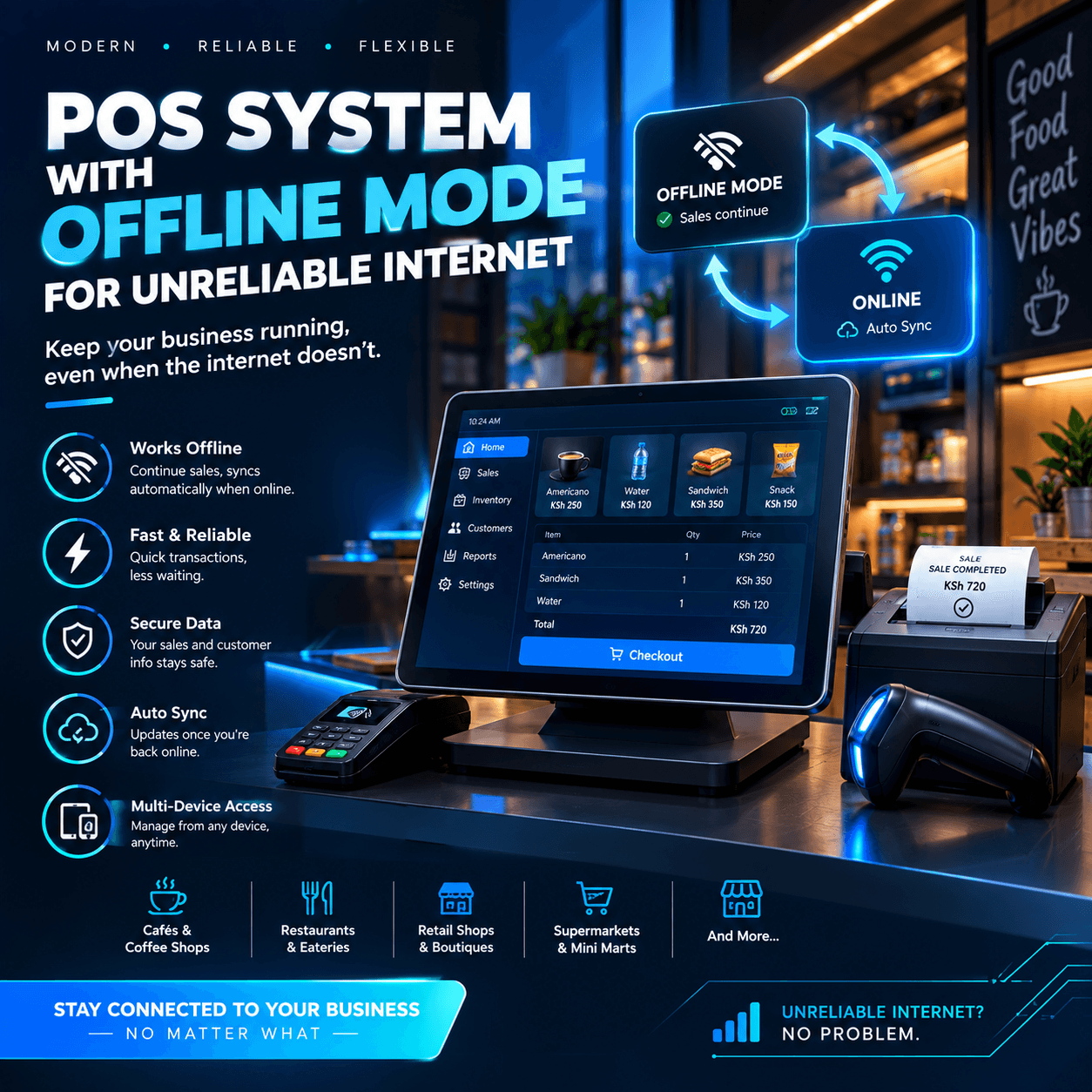
POS system offline mode for unreliable internet shopping usually begins the same way for every shop owner: with a story about the day the internet died at the worst possible moment. Maybe it is your story. The fibre line was cut by a road crew at half past noon on a Friday.
The mobile networks were congested by everyone else who had just lost their connection too. Your cloud-based till froze mid-transaction, your assistant started recording sales in the back of an old exercise book, and by closing time the day’s records were a shambles of scrawled figures, missing receipts, and arithmetic nobody trusted.
Somewhere in that mess — between the unrecorded sales and the customers who quietly decided to shop elsewhere — you made a decision that your livelihood would never again depend on a router’s mood.
This field guide was written for that moment of decision, and it is deliberately different from the buying guides you have already read. Instead of opening with feature lists, it opens with scenarios: a fourteen-minute blackout that rearranged a shopping street’s loyalties, a full trading day without a single byte of connectivity, a migration from paper to digital told the way it actually unfolds on a real counter.
Along the way, we will dissect the three categories of systems sold under one label, hand you the ten questions that end every sales pitch, run the downtime arithmetic most owners never do, and close with a checklist you can carry into any negotiation.
By the final page, you will know exactly how to judge whether a POS system offline mode for unreliable internet is genuinely built for your world — or merely labelled for it.
And if you read only one story before scrolling, make it the first one below — because every claim in this guide about a POS system offline mode for unreliable internet is tested against the scene it must survive.
Fourteen Minutes in May
Rose runs a mini-mart on a busy access road in Nairobi’s suburbs. On the second Tuesday of May, a contractor’s backhoe sliced through the neighbourhood’s main fibre line at 12:47 in the afternoon.
Within ninety seconds, the supermarket across the road went dark — its tills frozen, its card machines dead, its staff standing behind the counters with the particular helplessness of people watching revenue evaporate.
Within fourteen minutes, that supermarket had taped a handwritten sign to its door, and the afternoon footfall had drifted, customer by customer, across the road to Rose.
Inside Rose’s shop, absolutely nothing had happened. Her cashier ran out of things to be surprised about in the first ten seconds, because a shop running a proper POS system offline mode for unreliable internet does not notice a fibre cut at all. Scanning continued at the same speed.
Prices came from the terminal’s local catalogue, not from a server across town. A customer returned a leaking container of cooking oil; the refund was processed, approved, and receipted offline without a single pause. Another regular paid by mobile money — the confirmation buzzed on her phone from the network side even though the shop’s broadband was dead, and the till recorded the payment against the sale instantly.
This is the moment the difference between a cash register and a POS system offline mode for unreliable internet reveals itself: not in a brochure, not in a demo, but at 12:47 on an ordinary Tuesday when the ground is literally being dug up outside.
When the fibre was spliced that evening, Rose’s terminal quietly flushed its queue — the day’s sales, the refund, the stock movements from a morning delivery — into the cloud in perfect order.
Her end-of-day report was complete, her stock counts were exact, and her accountant would never know the internet had been gone for six hours.
That invisible, self-healing reconciliation is the defining behaviour of a POS system offline mode for unreliable internet, and you should accept nothing less from any system you buy.
As for the fourteen minutes — they rearranged loyalties. Regulars who had tolerated the supermarket’s queues discovered a shop that was open, fast, and unbothered.
Goodwill of that kind is the invisible inventory of every owner of a POS system offline mode for unreliable internet: it never appears on a stock report, but it compounds daily, and it was earned for the price of one well-engineered afternoon.
The Three Kinds of Point-of-Sale When the Network Fails
Every product on the market, whatever the packaging says, belongs to one of three categories.
Identifying the category is the first and most important act of buying, because the labels lie but the architecture never does.
Category one: cloud-only. These systems store everything remotely and fetch everything on demand. When the connection breaks, they break with it — or they let you view a cached dashboard while refusing to complete a sale.
If a vendor’s product cannot finish a transaction while unplugged from the internet, it is not a POS system offline mode for unreliable internet; it is a dashboard with a barcode scanner attached, and no quantity of feature bullets will change that on the day you need it.
Category two: offline-bolted. These systems were built for the cloud, and offline support was added later under competitive pressure.
The result is a survival mode that handles simple cash sales of known items and then falls apart: refunds are blocked, customer lookups fail, discounts are disabled, and staff are left apologising in the middle of a queue.
A half-built POS system offline mode for unreliable internet of this kind is arguably more dangerous than category one, because it teaches your team to trust a safety net that has holes precisely where reality will land.
Category three: offline-first. These systems were designed from day one on the assumption that the network is a guest, not a resident.
Your entire catalogue, your prices, your stock levels, and your customer records live on the terminal; the cloud is where copies and reports go, not where permission must be requested.
Only this category has earned the name POS system offline mode for unreliable internet in the full sense — the outage changes nothing because the network was never load-bearing.
So when you shortlist any POS system offline mode for unreliable internet, your first task is forensic, not commercial: determine which of the three categories the product truly belongs to.
The sections that follow give you the tools — architectural, practical, and financial — to do exactly that.
Anatomy of an Offline-First Machine
You do not need an engineering degree, but you do need to know the four organs that make genuine offline operation possible — because every vendor claim ultimately reduces to them.
The local brain. An offline-first terminal holds a complete working copy of your business on the device itself: every product, price, promotion, tax rule, stock level, and customer profile.
When a cashier scans an item during an outage, the answer comes from the terminal in milliseconds, because a POS system offline mode for unreliable internet never has to ask anyone’s permission to do its job.
The durable queue. Every sale completed offline is written to a protected local queue — a sealed envelope that survives restarts, power cuts, and battery swaps. It cannot be duplicated, reordered, or lost.
This queue is effectively cash sitting in your drawer, and a serious POS system offline mode for unreliable internet treats it with cash-level discipline: encrypted, tamper-evident, and safe on the device until it is delivered.
The sync engine. When connectivity returns, the queue drains to the cloud automatically, in the exact order the transactions occurred, resuming safely even if the connection fails again halfway.
The best implementations need no human action at all — no sync button, no end-of-day export. With a mature POS system offline mode for unreliable internet, an outage and a normal afternoon are indistinguishable in the data by closing time.
The honest ledger. Finally, the system must reconcile: takings, stock decrements, receipts, and payment records must add up to the penny against what physically happened on the floor, whether the internet was up for eight hours or down for eight.
This closing-the-books integrity is the ultimate test of a POS system offline mode for unreliable internet — and in the next section we turn it into arithmetic you can run on your own numbers.
The Downtime Calculator: What One Hour of Darkness Actually Costs
Most owners never price their outages; they simply endure them. Let us price one, using deliberately modest figures so the exercise survives scepticism.
Suppose your shop serves about 90 customers on an average day at an average basket of 850 shillings — roughly 76,500 shillings in daily revenue. Your busiest three-hour stretch carries about a third of the day’s trade, so one peak hour is worth roughly 8,500 shillings.
Now suppose the connection drops for six hours a month, half of that during peak periods — a conservative estimate in most trading neighbourhoods. The direct revenue lost in those peak hours is on the order of 25,000 shillings a month. Add the quieter hours lost to slow manual workarounds, the mispriced sales from paper records that never reconcile, and the customers who simply did not come back after being turned away, and a realistic monthly cost of downtime climbs well past 40,000 shillings.
Annualised, that is half a million shillings — vanishing through a hole in the roof that most owners have never once measured.
Run this arithmetic on your own numbers before you look at a single POS system offline mode for unreliable internet quotation, because the moment you know your downtime bill, the entire purchasing conversation changes.
The honest comparison for a POS system offline mode for unreliable internet is not against another vendor’s quote — it is against the figure you just calculated, the one your business is already paying every month whether you buy anything or not.
Once that number is on paper, most owners find that every POS system offline mode for unreliable internet conversation stops being about cost and starts being about how quickly the investment retires a loss they have been carrying for years.
The Ten Questions That End Every Sales Pitch
Bring this list to every demonstration. A confident vendor will welcome it; an evasive one will reveal himself by the third question.
1. What exactly keeps working when the internet is off? Insist on specifics, not adjectives. Refunds? Discounts? Customer lookup? Split payments? A genuine POS system offline mode for unreliable internet answers with a complete list and offers to prove it live, unplugged, in front of you.
2. Where does the offline queue live, and what can destroy it? You are listening for local, durable, encrypted storage that survives restarts and power loss — and honest answers about device limits.
3. Show me a sync — then break it halfway. Watch the queue drain. Then kill the connection mid-sync and watch it resume cleanly when restored.
A trustworthy POS system offline mode for unreliable internet recovers without duplicates or gaps; a fragile one loses data in front of your eyes, which is the cheapest lesson you will ever get.
4. What does your offline mode deliberately NOT do? Every honest vendor can name limits. A vendor who claims everything works offline, always, has told you nothing and probably knows less.
5. How do two tills stay coordinated during an outage? If you run more than one counter, this is where shallow systems fail — overselling the last unit from both terminals at once.
Multi-terminal behaviour is a make-or-break property of any POS system offline mode for unreliable internet in a two-counter shop, so test it explicitly.
6. How long can we trade offline before anything is at risk? You want an answer measured in weeks of normal trading, not hours.
7. What happens to M-Pesa payments recorded during an outage? The mobile networks often keep working when your broadband does not.
A well-engineered POS system offline mode for unreliable internet records the payment against the sale locally and verifies it automatically at sync — no scribbled confirmation codes, no end-of-day detective work.
8. How are offline refunds approved and audited? Permissions must not loosen just because the connection dropped; outages are precisely when controls matter most.
9. How many years has this offline mode been in production — and for how many businesses? Resilient offline operation is refined by years of real outages in real shops.
A POS system offline mode for unreliable internet bolted together last quarter has not yet met enough bad Fridays to be trusted with yours.
10. Who answers when it misbehaves on a Saturday at noon? Get a name, a channel, and a response-time commitment.
Then do one final thing: ask for the answers in writing. A vendor selling a genuine POS system offline mode for unreliable internet will put them on paper without hesitation, because written claims that survive the demo survive the relationship — and a refusal to write anything down is itself the most honest answer you will collect all day.
A Day in the Life: Trading Through a Total Blackout
Let us follow a single shop through a full day with no internet whatsoever, because the whole point of this purchase is that such a day should be unremarkable.
6:40 a.m. The shop opens. The fibre has been dead since last night’s storm and the mobile data in the area is congested. The morning briefing takes ninety seconds: it is down, it does not matter, trade normally.
On a POS system offline mode for unreliable internet, that sentence is a fact, not a hope — the terminal wakes with the full catalogue, yesterday’s stock, and every customer profile loaded locally.
9:15 a.m. A supplier delivers sixty cartons of stock. The receiving clerk scans each carton against the purchase order — offline — and the stock counts update on the terminal in real time.
By eleven, the shelf figures on screen match the shelves themselves, which is the everyday miracle of a POS system offline mode for unreliable internet that owners of cloud-only systems never get to enjoy.
1:00 p.m. Peak trade. The queue runs eight deep for twenty minutes straight.
Scanning is fast, prices are instant, three customers pay by mobile money with the payments recorded cleanly against each sale, two pay cash, one asks for a price check on an unlabelled item and gets an answer in two seconds.
Nobody behind the counter has mentioned the internet once, because a POS system offline mode for unreliable internet renders the outage a matter for the network provider’s conscience, not the shop’s.
6:12 p.m. The fibre returns. The terminal detects the connection and flushes the day’s queue — 214 sales, one refund, one delivery, eleven new customer signups — into the cloud in perfect order inside two minutes.
9:04 p.m. Close of day. The end-of-day report prints complete: takings by payment type, stock movements, staff totals, the refund against its original sale.
The owner reviews it from her sofa on her phone. Nothing is missing, nothing is doubled, nothing needs a phone call. That is the quiet promise of a POS system offline mode for unreliable internet kept at full strength: the worst connectivity day of the year ends as an ordinary line in an ordinary report.
From Exercise Book to Offline-First: A Migration Diary
Wanjiku has run a hardware and paint shop for eleven years, and until last year her records lived in four exercise books whose spines had surrendered before their contents did.
Her migration to a digital till is worth telling because almost everything that surprised her will surprise you too.
The great stock count. Counting every item in the shop for the first time in years was humbling: the system’s opening-stock exercise revealed that her mental inventory and her physical inventory disagreed on hundreds of items, and that several full shelves were full of things nobody had bought since 2021.
Her vendor’s team ran the import and reconciliation with her — which is exactly the support you should demand from whoever supplies your POS system offline mode for unreliable internet, because dirty data is the single biggest cause of first-month frustration.
The champion cashier. One cashier, the youngest, took to the terminal immediately and began coaching the others. Wanjiku’s advice to every buyer: identify your champion early, and let the team learn from a peer rather than a lecture.
Every capable POS system offline mode for unreliable internet provider offers structured training, but the human infrastructure inside your shop is what makes it stick.
The storm. A county-wide power fault killed the estate’s internet for two days — the exact scenario Wanjiku had privately worried would prove her purchase foolish. Instead, it proved the opposite: the shop traded both days without a whisper of disruption, and the exercise books stayed in the drawer.
The unplugged test nobody schedules is the truest certification a POS system offline mode for unreliable internet will ever receive — and when it passes, the last doubt in the owner’s mind dissolves with it.
The Money Question: What to Pay For, and What to Never Pay For
Pricing is where good intentions meet small print, so let us separate the legitimate line items from the ones that should make you stand up and leave.
Pay, happily, for four things. First, the software subscription — the living cost of a platform that improves monthly.
Second, the hardware bundle, bought from the same provider as the software so one team owns the whole machine.
Third, onboarding: data migration, opening stock count, and staff training, done hands-on. Fourth, responsive support with a committed response time.
A POS system offline mode for unreliable internet quote that itemises these four is a quote from a provider who understands what they are actually selling.
Never pay for three things. Never pay extra for offline mode itself — it is architecture, not an add-on, and a vendor who charges for the thing that keeps your shop alive has told you exactly how they think.
Never pay per-sync or per-outage fees, which are as nonsensical as charging for air. And never accept vague licensing charges that arrive unexplained on invoices for a POS system offline mode for unreliable internet you thought you had priced completely — ambiguity at quotation stage becomes resentment at invoice stage.
Frame the daily cost honestly. Take the total monthly cost, divide by trading days, and compare it to your downtime bill from the downtime calculator earlier.
When a POS system offline mode for unreliable internet works out to the price of two cups of tea a day against a measured loss of over a thousand shillings a day, the negotiation is already over — the only remaining question is which provider earns the business on service, training, and trust rather than price.
And discount the extremes equally. The suspiciously cheap no-name kit that fails its first outage will cost you a Saturday’s revenue and your staff’s confidence; the enterprise platform built for hundred-branch chains will bill you for complexity a single shop will never switch on.
The durable middle ground is where a serious POS system offline mode for unreliable internet lives — right-sized, clearly quoted, and upgradeable when you open your second location.
Four Shops, Four Playbooks
The right depth of offline capability depends on how your category trades. Four vignettes from the field.
The wine and spirits shop. Peak trade runs from five in the evening to close, exactly when residential estates’ connectivity degrades worst.
Baskets mix units — singles, six-packs, crates — and evenings are when one careless outage would cost a fifth of the day.
For this owner, the non-negotiables were unit conversions at speed and instant local price lookup, and the deciding moment in her evaluation came when the vendor unplugged the router unprompted to show what their POS system offline mode for unreliable internet does at seven o’clock on a Friday.
The pharmacy. Dispensing cannot pause for a router, and neither can the paperwork behind it: batch numbers, expiry dates, and first-to-expire-first-out discipline must hold offline as firmly as online, because a regulator’s question does not care what the internet was doing in March.
A compliance-grade POS system offline mode for unreliable internet keeps every audit trail intact through every blackout — which is why pharmacies should weigh offline record integrity as heavily as dispensing speed.
The salon with a retail corner. Upstairs premises in older buildings often have the worst signal in town, and the business is really two businesses: booked services and walk-in retail.
What sold the owner here was a POS system offline mode for unreliable internet that treated appointments and shelf sales as one till, so the day’s books closed as one truth regardless of how many bars the signal showed.
The bookshop in school season. January’s textbook rush is a once-a-year stress test: queues to the door, variants by class and publisher, and zero tolerance for a frozen screen at the worst possible hour.
The owner’s criterion was brutal and correct — the POS system offline mode for unreliable internet had to survive her busiest hour unplugged, because that is precisely when the network historically chose to fail.
The pattern generalises: name the transaction your business cannot afford to lose, then require the system to perform it flawlessly offline — and make the vendor prove exactly that in the demo.
The Signing-Day Checklist
You have run the demos, asked the ten questions, and done the arithmetic. Before money changes hands, work through this list — slowly.
Live test passed on your products, your counter: mid-sale disconnection, offline refund, offline price check, clean resync, verified stock decrement. If any step wavered, the POS system offline mode for unreliable internet in front of you has told you everything you need to know.
Offline depth confirmed in writing: what works, what does not, and how long you can trade offline before anything is at risk.
Multi-terminal behaviour verified, if you run more than one counter — including what happens when both tills sell the last unit of something simultaneously.
Payments mapped for outage conditions: cash and mobile money recorded cleanly offline, card fallback understood, end-of-day reconciliation proven.
Onboarding scope agreed: who imports your data, who leads the stock count, who trains your staff, and how long it takes.
Support commitments in writing: channels, hours, response times, and what happens on weekends and public holidays — the honest measure of a POS system offline mode for unreliable internet provider is who picks up the phone on a Saturday.
Total cost of ownership itemised: subscription, hardware, training, SMS bundles, updates, and every recurring charge named in advance.
Ownership and exit understood: your data belongs to you and can be exported in a usable format if you ever leave.
Security posture stated plainly: encryption at rest and in transit, role-based permissions that hold offline, and what happens if a terminal is stolen or destroyed.
References called: at least two businesses like yours, asked one question — tell me about your worst outage since you installed it. The answer you get from a satisfied POS system offline mode for unreliable internet customer is worth more than any brochure ever printed.
Sign only when every line has an answer you would be comfortable explaining to a business partner — because that is precisely the standard a purchase this consequential deserves, and any POS system offline mode for unreliable internet provider worth the contract will help you get to yes the careful way.
The Weekend You Install
Go-live should be boring, and boredom is engineered in advance. Here is the weekend sequence that works.
Friday evening, after close. Data goes in: the full catalogue, correct prices, tax rules, supplier details, and the opening stock count you completed earlier in the week.
Lean on the provider’s team heavily — a hands-on migration is part of what you paid for, and a well-supported POS system offline mode for unreliable internet deployment treats this evening as the foundation of everything that follows.
Saturday, staff day. Train the whole team on the real hardware with the router deliberately unplugged. Ring up sales offline, process a refund offline, receive a delivery offline, then reconnect and watch the sync together.
A cashier whose first outage was their tenth rehearsal will greet the real thing with a shrug — and that calm is the ultimate return on a POS system offline mode for unreliable internet investment, worth as much as any report the software will ever print.
Sunday, the soft open. Run a handful of friendly customers or low-stakes transactions end to end, then close the day and read the first report line by line.
Confirm takings match the drawer, stock matches the shelves, and the day’s receipts are complete and numbered. This hour of inspection is your acceptance test — do not skip it, and do not sign off any POS system offline mode for unreliable internet rollout until its first solo day adds up perfectly.
Monday, trade. Full cutover on an ordinary day, old process retired to a drawer for one week of sentimental safekeeping.
For the first fortnight, glance at the sync status after any outage and skim the evening report; after that, the system becomes what it was always meant to be — infrastructure you stop thinking about.
Objections Overheard at the Counter
Every buyer carries hesitations into this decision. Let us answer the five that come up most often, honestly.
Paper has served me for twenty years. It has — at a price that never appears on any receipt: the shrinkage you cannot see, the stockouts you discover too late, the hours lost reconstructing records, and the decisions made on guesses.
A POS system offline mode for unreliable internet does not ask you to abandon your discipline; it gives that discipline a memory that never forgets, never miscounts, and never runs out of pages.
The internet always comes back eventually. It does — but eventually is not a business strategy, because your customers do not wait eventually.
The queue forms in the first sixty seconds and the first defection happens in the second minute. The entire purpose of a POS system offline mode for unreliable internet is to remove the word eventually from your vocabulary and replace it with immediately.
It is too expensive for a shop my size. Compare it, once and honestly, against your measured downtime bill from the downtime calculator earlier, your monthly shrinkage, and the bookkeeping hours you pay for in your own evenings.
Sized correctly, a POS system offline mode for unreliable internet is one of the few purchases that retires an existing, recurring loss rather than adding a new one — which is a fundamentally different kind of spending.
My staff will never learn it. They learn what they rehearse. One training day, one nominated champion, and one deliberately unplugged drill session produce teams that trade through blackouts on autopilot.
Providers of a well-supported POS system offline mode for unreliable internet see this transformation weekly; the staff who resist hardest on Monday are usually running the till best by the following month.
I will wait for the technology to settle. Offline-first architecture is not a new experiment awaiting maturity — it is the settled answer to a problem that has plagued retailers for a decade.
The shops adopting a POS system offline mode for unreliable internet this year are not beta testers; they are simply the ones who stopped subsidising their competitors’ busy afternoons.
Myths That Cost Shopkeepers Money
Five persistent myths, examined and retired.
Offline mode is only for rural areas. Estate fibre gets cut in the capital, urban networks congest at peak, and buildings in the Central Business District have dead zones three floors up.
Connectivity risk is a geography of buildings and backhoes, not counties — and a POS system offline mode for unreliable internet earns its keep on any street where a router has ever blinked, which is every street.
My data is in the cloud, so it is safe. Your records may be safe; your revenue is not.
Cloud storage protects information, but a cloud-only till still stops selling when the journey to that cloud is severed — which is why the industry needed the POS system offline mode for unreliable internet category at all: it protects the selling, not just the telling.
You cannot take M-Pesa while offline. The mobile networks and your shop’s broadband are different infrastructures, and they fail at different times.
Customer payments frequently keep flowing during a shop-side outage, and a well-built POS system offline mode for unreliable internet records and reconciles them cleanly until your own connection recovers.
Modern tills need fast internet to work well. An offline-first terminal does its daily work entirely on local hardware; the internet is a courier for copies, not a consultant for decisions.
Scanning speed, price lookup, and receipt printing on a POS system offline mode for unreliable internet are identical whether your connection is fibre-fast or absent altogether.
If it says offline on the website, it works offline. This myth deserves its place in the hall of expensive lessons: labels are marketing, demonstrations are engineering.
Only the unplugged live test — mid-sale, mid-refund, mid-sync — reveals whether a POS system offline mode for unreliable internet is the real article, which is why this guide has returned to that test in more sections than any other single idea.
Frequently Asked Questions
Does offline mode make the system slower when the internet is working normally?
No — and it is worth understanding why.
An offline-first terminal makes its decisions locally even at the best of times, so scanning, pricing, and checkout are just as fast online as off; the network is only ever carrying copies to the cloud in the background.
If anything, owners of a well-built POS system offline mode for unreliable internet report faster checkouts than their old cloud-dependent setups, because nothing on the counter ever waits for a server.
What happens if my terminal is stolen or damaged while it is holding offline sales?
A properly designed system stores its queue durably and syncs it from any device once you log in with your credentials — so the sales are not lost with the machine, any more than the cash in a safe is lost when a shelf breaks.
This resilience-by-design is one of the quiet superpowers of a mature POS system offline mode for unreliable internet: the money and the record survive the hardware, which is precisely what system should mean.
Can I run two branches when one has good internet and the other barely has any?
Yes, and this is one of the strongest cases for going offline-first.
Each branch trades independently on its local terminal, and each syncs to the same central dashboard whenever its connection allows — so head office sees a consolidated picture built from two very different networks.
Multi-branch owners consistently find that a POS system offline mode for unreliable internet equalises visibility between their connected and poorly connected locations in a way single-mode cloud systems never quite manage.
How do I verify that everything actually synced after a long outage?
Ask this question at the demo and learn where the answer lives on day one.
A serious POS system offline mode for unreliable internet shows you a sync report — every queued transaction, its order, its status — and your end-of-day totals must reconcile against the drawer exactly as they would on any ordinary day.
Verification is the whole point of computerising; make sure your system lets you do it in under a minute.