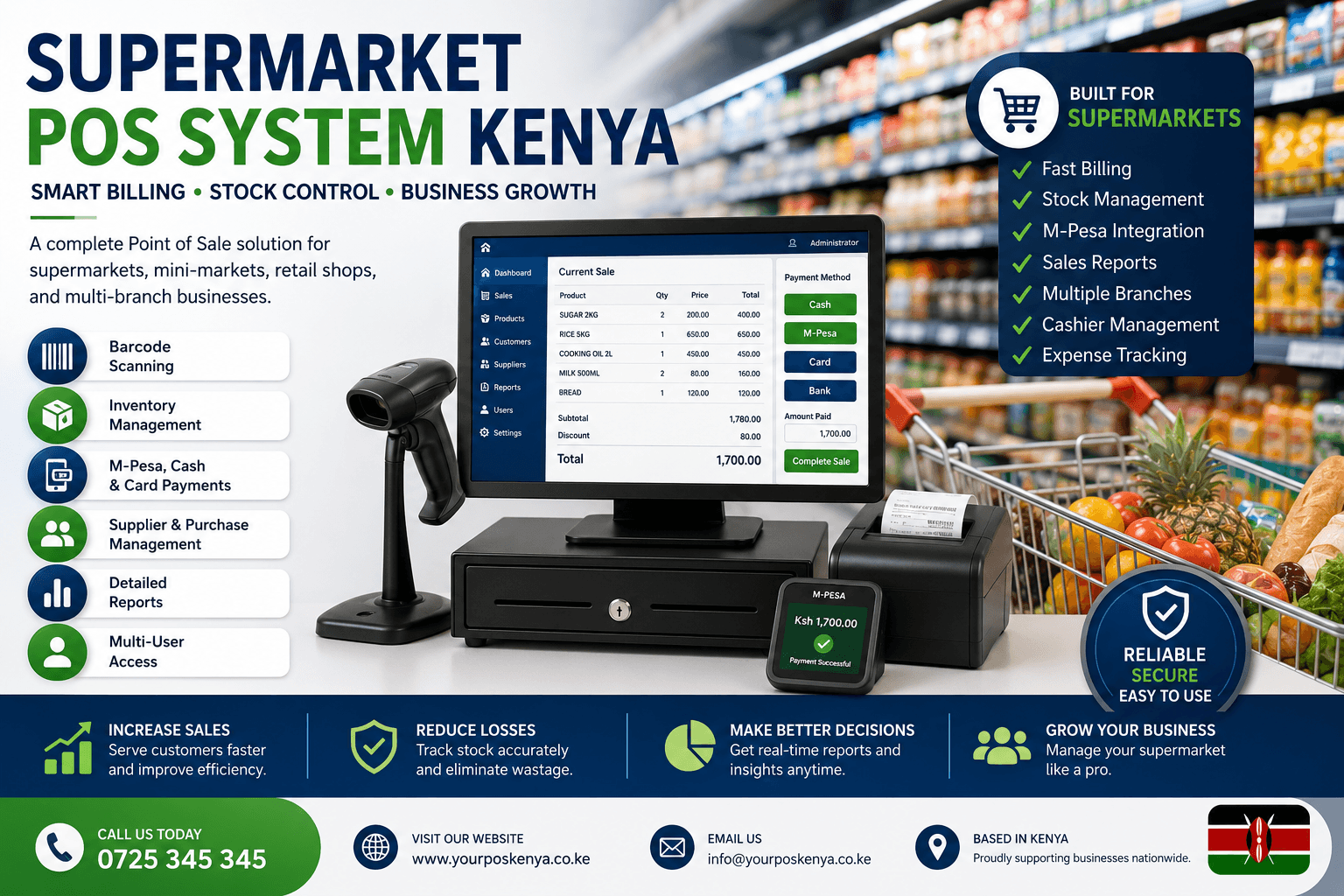
 Running a supermarket in Kenya today requires more than just good products and friendly customer service. Supermarkets deal with fast-moving stock, multiple suppliers, daily sales, cashiers, M-Pesa payments, discounts, receipts, expenses, and reports. Without a reliable system, it becomes easy to lose money through stock errors, wrong pricing, theft, unpaid supplier records, or poor sales tracking.
A Supermarket POS System Kenya is designed to help supermarket owners manage sales, stock, payments, customers, suppliers, and reports from one simple platform. Whether you operate a mini-market, retail shop, wholesale store, grocery supermarket, or multi-branch supermarket, a good POS system gives you full control of your business.
What Is a Supermarket POS System?
A supermarket POS system is a digital point-of-sale solution used to process sales, print receipts, manage inventory, track payments, and generate business reports. Instead of using manual books or basic cash registers, the system allows your cashier to scan items, calculate totals, apply discounts, receive payments, and issue receipts quickly.
In Kenya, a modern supermarket POS should support common business needs such as barcode scanning, M-Pesa payments, cash payments, card payments, stock alerts, supplier management, sales reports, expense tracking, and cashier accountability.
Why Supermarkets Kenya Need a POS System
Supermarkets handle many products every day. Some products move fast, others expire, and some need regular price updates. A manual system can easily lead to confusion and losses. With a supermarket POS system, you can know what is selling, what is remaining in stock, which cashier sold what, and how much profit your business is making.
A POS system helps you reduce theft, avoid stock shortages, improve customer service, and make better business decisions. It also saves time because daily sales reports, stock reports, and payment summaries are generated automatically.
Key Features of a Supermarket POS System Kenya
1. Fast Sales and Billing
A good supermarket POS system allows cashiers to serve customers quickly. Items can be added using barcode scanners, product search, or product codes. The system calculates totals automatically, applies discounts where needed, and prints receipts instantly.
This helps reduce queues and improves the shopping experience for customers.
2. Barcode Scanning
Barcode scanning is important for supermarkets because it reduces typing errors and speeds up checkout. Each product can have a barcode linked to its price, stock quantity, and category.
When the cashier scans the item, the system automatically picks the correct product and price.
3. Inventory and Stock Management
Stock control is one of the most important parts of supermarket management. A POS system helps you track stock in real time. Every sale reduces stock automatically, and every purchase or stock entry increases stock.
You can know when products are running low, which products are out of stock, and which items are overstocked. This helps you avoid dead stock and lost sales.
4. M-Pesa, Cash and Card Payment Support
Most customers in Kenya prefer paying through M-Pesa. A reliable supermarket POS system should support different payment methods including cash, M-Pesa, bank transfer, and card payments.
This makes it easier to reconcile payments and reduce confusion at the end of the day.
5. Cashier Management
In a busy supermarket, you may have several cashiers working in shifts. A POS system allows each cashier to log in using their own account. This makes it easy to track who made each sale, cancelled a receipt, gave a discount, or handled a payment.
Cashier accountability helps reduce theft and mistakes.
6. Supplier Management
Supermarkets buy goods from many suppliers. A POS system helps you record supplier details, purchases, invoices, payments, and balances. You can easily know which supplier delivered what, how much you owe, and when payments are due.
This makes supplier management more professional and organized.
7. Purchase and Restocking Records
When new stock arrives, the system records the purchase, buying price, selling price, quantity, supplier, and date. This helps you calculate profits correctly and maintain accurate stock records.
You can also compare supplier prices and choose the most profitable suppliers.
8. Sales Reports
A supermarket POS system provides daily, weekly, monthly, and yearly sales reports. You can see total sales, payment methods, top-selling products, low-selling products, cashier performance, and branch performance.
These reports help business owners make informed decisions instead of guessing.
9. Profit and Loss Tracking
A good POS system should not only show sales but also help you understand profit. By recording buying prices and selling prices, the system can calculate gross profit and show which products bring the best returns.
This helps supermarket owners focus on profitable products.
10. Expense Management
Supermarkets have daily expenses such as rent, salaries, electricity, transport, packaging, repairs, internet, and cleaning. A POS system with expense tracking helps you record all expenses and compare them against sales.
This gives a clear picture of your business performance.
11. Multi-Branch Management
For supermarket owners with more than one branch, a POS system should support multi-branch management. You can track sales, stock, transfers, and reports for each branch from one dashboard.
This is useful for supermarkets expanding to different locations in Kenya.
12. Stock Transfers
If one branch has excess stock and another branch has low stock, the system can record stock transfers. This helps reduce wastage and improves stock balancing across branches.
13. Product Categories
Products can be grouped into categories such as food items, drinks, cosmetics, household goods, electronics, bakery, fresh produce, toiletries, and stationery. This makes reporting easier and helps the owner understand which category performs best.
14. Discount and Promotion Management
Supermarkets often run offers and promotions. A POS system allows you to set discounts on selected products, categories, or total purchases. This helps you run promotions professionally while still tracking profits.
15. Customer Management
A POS system can store customer records, purchase history, loyalty points, and contact details. This is useful for supermarkets that want to reward loyal customers or send promotions through SMS or WhatsApp.
Benefits of Using a Supermarket POS System Kenya
A supermarket POS system helps reduce business losses by improving accuracy and accountability. It also improves customer service because checkout becomes faster and more organized.
The system helps the owner know what is happening in the business even when they are not physically present. You can monitor sales, stock, and cash flow from the dashboard.
Another major benefit is better decision-making. Instead of relying on guesswork, you can use reports to know what to restock, what to stop buying, and where your business is losing money.
Who Can Use a Supermarket POS System?
A supermarket POS system is suitable for:
Mini supermarkets
Retail shops
Wholesale shops
Grocery stores
Convenience stores
Cosmetic shops
Hardware shops
Liquor stores
Pharmacies
Bookshops
Electronics shops
Multi-branch retail businesses
Any business that sells products and needs to track sales and stock can benefit from a POS system.
Why Choose a Local POS System in Kenya?
Choosing a local POS system in Kenya gives you better support, local payment integration, and features designed for Kenyan businesses. A system made for the Kenyan market understands M-Pesa payments, local tax needs, receipt formats, supplier management, and common retail challenges.
Local support is also important because when your system has an issue, you need quick assistance. A supermarket cannot afford long downtime because every minute affects sales.
Supermarket POS System with M-Pesa Integration
M-Pesa is one of the most important payment methods in Kenya. A POS system with M-Pesa integration helps confirm payments faster and reduces errors caused by manual confirmation.
This improves cashier speed, payment accuracy, and daily reconciliation. It also gives the business owner a clear record of mobile money payments.
Cloud-Based Supermarket POS System
A cloud-based POS system allows you to access your supermarket data from anywhere. You can check sales, stock, and reports using a computer, tablet, or phone.
This is ideal for business owners who travel, manage multiple shops, or want to monitor their business remotely.
Offline and Online POS Support
Internet downtime can affect business operations. A good supermarket POS system should support offline sales and sync data when the internet returns. This ensures your supermarket continues selling even when the network is unstable.
How a POS System Reduces Theft
Theft in supermarkets can happen through unrecorded sales, stock manipulation, fake discounts, cancelled receipts, or cash shortages. A POS system helps reduce these issues by tracking every transaction.
The owner can see cashier reports, voided sales, discounts, stock changes, and payment summaries. This creates accountability and reduces loopholes.
Reports Every Supermarket Owner Should Track
A good supermarket POS system should provide reports such as:
Daily sales report
Stock balance report
Low stock report
Profit report
Cashier report
M-Pesa payment report
Supplier report
Purchase report
Expense report
Product movement report
Customer report
Branch report
These reports help the owner understand the real position of the business.
Best Supermarket POS System Kenya
The best supermarket POS system in Kenya should be easy to use, fast, secure, and affordable. It should help you manage sales, stock, suppliers, payments, expenses, and reports without complications.
A good system should also be scalable so that it can grow with your business. Whether you start with one branch or several branches, the system should support your growth.
Why Your Supermarket Needs a POS System Today
If you are still using books, Excel, or a basic cash register, you may be losing money without knowing. A supermarket POS system gives you control, visibility, and confidence.
You can know your daily sales, stock value, fast-moving products, slow-moving products, profit margins, and payment records. This helps you manage your business professionally and grow faster.
Conclusion
A Supermarket POS System Kenya is an important tool for any supermarket owner who wants to improve sales, control stock, reduce losses, and manage the business better. With features such as barcode scanning, M-Pesa support, cashier management, supplier tracking, stock control, and business reports, the system makes supermarket operations easier and more profitable.
Investing in a reliable POS system is not just about billing customers. It is about protecting your business, improving efficiency, and making smarter decisions every day.
How to Choose the Right Supermarket POS System in Kenya
Choosing the right POS system is an important decision for any supermarket owner. A cheap or weak system may look affordable at first, but it can cause serious problems later. You need a system that is simple for cashiers, powerful for managers, and reliable for daily business operations.
Before choosing a Supermarket POS System Kenya, consider the following factors:
1. Ease of Use
Your cashiers should be able to use the system without confusion. A good POS system should have a clean dashboard, simple product search, quick billing, barcode support, and clear payment options.
If the system is too complicated, it can slow down sales and increase mistakes.
2. Speed at Checkout
Supermarkets serve many customers daily. The POS system should process sales quickly, scan products fast, calculate totals instantly, and print receipts without delay.
Fast checkout improves customer satisfaction and reduces long queues.
3. Stock Accuracy
A supermarket POS system should update stock automatically after every sale. This helps you know the exact quantity available for every product.
Accurate stock records help prevent stockouts, overstocking, and losses caused by poor inventory control.
4. M-Pesa Payment Support
Since many customers in Kenya use M-Pesa, your POS system should make mobile money payments easy to record and reconcile. This helps reduce payment errors and improves financial tracking.
5. Reports and Analytics
A good POS system should give clear reports that help you understand your business. You should be able to view sales, profit, stock movement, expenses, supplier balances, cashier performance, and product performance.
Good reports help you make better business decisions.
6. Security and User Permissions
Not every staff member should access everything in the system. A reliable supermarket POS system should allow you to create user roles such as cashier, supervisor, accountant, manager, and admin.
This helps protect sensitive business information and reduces misuse.
7. Multi-Branch Support
If you plan to open more branches, choose a system that can grow with you. Multi-branch support allows you to manage several outlets from one dashboard.
You can compare branch performance, transfer stock, monitor sales, and manage staff across all branches.
8. Local Support
Technical support is very important. When your POS has an issue, your supermarket operations can be affected. Choose a provider that offers reliable support, training, and quick response.
A local Kenyan POS provider understands local business challenges better.
Common Problems a Supermarket POS System Solves
Many supermarkets in Kenya lose money because of poor systems, manual records, and weak supervision. A POS system helps solve many daily problems.
Poor Stock Control
Without a proper system, it is hard to know what is available, what is missing, and what needs restocking. A POS system gives you real-time stock visibility.
Cashier Errors
Manual calculations can lead to wrong totals, wrong change, or wrong pricing. A POS system reduces errors by calculating everything automatically.
Theft and Fraud
Some losses happen through fake discounts, cancelled sales, unrecorded items, or stock manipulation. A POS system keeps a record of every action, making it easier to detect suspicious activity.
Slow Customer Service
Long queues can discourage customers. Barcode scanning and quick billing help cashiers serve customers faster.
Poor Business Reports
Many business owners only know how much cash was collected but not the exact profit, stock value, or product movement. A POS system gives detailed reports.
Supplier Confusion
Supermarkets buy from many suppliers. Without a system, it is easy to forget balances, invoices, deliveries, or payment history. Supplier management keeps everything organized.
Supermarket POS System Kenya for Small Businesses
A POS system is not only for large supermarkets. Small shops, mini-markets, and retail stores can also benefit from POS software.
For a small supermarket, the system can help manage:
Sales
Stock
M-Pesa payments
Receipts
Expenses
Customers
Suppliers
Daily reports
This helps the business owner run the shop professionally from the beginning.
Supermarket POS System Kenya for Large Supermarkets
Large supermarkets need stronger features because they handle more products, more staff, more customers, and more branches.
A large supermarket POS system should support:
Multiple cashiers
Multiple branches
Barcode scanning
Bulk product upload
Supplier invoices
Purchase orders
Stock transfers
Advanced reports
User permissions
Accounting support
Loyalty programs
Inventory valuation
This helps large supermarkets reduce losses and improve efficiency.
Cloud POS vs Desktop POS for Supermarkets
When choosing a POS system, many business owners ask whether they should use cloud-based POS or desktop POS.
Cloud-Based POS System
A cloud POS system stores data online and allows you to access reports from anywhere. You can check your supermarket sales using your phone, laptop, or tablet.
Benefits include:
Remote access
Automatic backup
Multi-branch support
Easy updates
Better data security
Real-time reports
Cloud POS is ideal for modern supermarkets that want flexibility and growth.
Desktop POS System
A desktop POS system is installed on a local computer. It can work well for businesses that do not need remote access.
However, desktop POS may have limitations such as poor backup, limited access, and difficulty managing multiple branches.
For most growing supermarkets in Kenya, a cloud-based POS system is usually more flexible.
Important Hardware for a Supermarket POS System
A complete supermarket POS setup may include both software and hardware. The hardware depends on the size and needs of your supermarket.
Common POS hardware includes:
Computer or POS terminal
Barcode scanner
Receipt printer
Cash drawer
Label printer
Customer display
Weighing scale
Router or internet connection
Backup power system
The right hardware helps the POS system work smoothly.
Barcode Scanner for Supermarket POS
A barcode scanner is very important for supermarkets. It helps cashiers scan products quickly instead of typing product names manually.
This reduces errors, saves time, and improves checkout speed.
Receipt Printer for Supermarket POS
A receipt printer allows you to issue professional receipts to customers. Receipts help customers confirm their purchases and also improve business credibility.
A good POS receipt should show:
Business name
Receipt number
Date and time
Cashier name
Items purchased
Quantity
Price
Total amount
Payment method
Thank-you message
Stock Management for Supermarkets in Kenya
Stock management is one of the biggest challenges in supermarket operations. A supermarket can have hundreds or thousands of products, and each product must be tracked properly.
A supermarket POS system helps you monitor:
Opening stock
New purchases
Stock sold
Damaged stock
Returned stock
Expired items
Stock transfers
Current stock balance
Low stock alerts
This helps you avoid losses and maintain enough products for customers.
Expiry Date Tracking
Supermarkets sell products that can expire, such as food, milk, bread, medicine, cosmetics, and household items. A good POS system should help track expiry dates so that you can sell products on time and avoid losses.
Expiry tracking is especially useful for supermarkets dealing with fast-moving consumer goods.
Product Pricing Management
Prices can change because of supplier cost changes, promotions, inflation, or business strategy. A POS system makes it easy to update prices and maintain accurate selling prices.
You can also set different prices such as:
Retail price
Wholesale price
Discount price
Branch-specific price
Customer-specific price
This is useful for supermarkets that serve both retail and wholesale customers.
Customer Loyalty Program
A supermarket POS system can support customer loyalty programs. This allows customers to earn points when they shop and redeem rewards later.
Loyalty programs encourage repeat purchases and help you build long-term customer relationships.
Why POS Reports Matter in Supermarket Growth
Reports help you understand what is really happening in your business. Without reports, you may think your supermarket is doing well because sales are high, but expenses and stock losses may be reducing your profit.
A POS system helps you answer important questions such as:
Which products sell the most?
Which products are not moving?
Which cashier made the most sales?
Which payment method is most used?
Which supplier gives better margins?
Which branch is performing best?
How much stock value do I have?
How much profit did I make today?
These answers help you grow your supermarket with confidence.
Supermarket POS System Kenya with Accounting Features
A good POS system should support basic accounting features or connect with accounting tools. This helps supermarket owners track income, expenses, supplier payments, debts, and profit.
Accounting features may include:
Sales income
Purchase records
Supplier balances
Expense records
Payment summaries
Profit reports
Cash flow reports
Tax reports
This makes financial management easier and more organized.
Supermarket POS System Kenya for Wholesale and Retail
Some supermarkets sell both retail and wholesale. A good POS system should support different pricing levels and customer types.
For example, a customer buying one item may pay retail price, while another customer buying cartons may pay wholesale price. The POS system should handle this without confusion.
Why Supermarkets Should Avoid Manual Records
Manual records may seem simple, but they become difficult as the business grows. Books can get lost, damaged, or manipulated. Manual records also take time and may contain many errors.
A POS system gives better accuracy, security, and speed.
With a POS system, you no longer need to guess your sales, stock, or profit. Everything is recorded in one place.
Signs Your Supermarket Needs a POS System
You need a supermarket POS system if:
You do not know your exact stock balance
You struggle to track daily sales
Your cashiers make many errors
You suspect stock theft
You cannot track supplier balances well
You spend too much time preparing reports
You use books or Excel for everything
You want to open more branches
You want to accept M-Pesa professionally
You want better control of your business
If you are experiencing any of these issues, a POS system can help you manage your supermarket better.
Supermarket POS System Kenya for Better Customer Experience
Customers want fast service, accurate pricing, and professional receipts. A POS system helps you deliver a better shopping experience by reducing delays and mistakes.
When customers are served faster, they are more likely to return.
POS System Training and Support
After installation, staff training is important. Cashiers, managers, and business owners should understand how to use the system properly.
Training should cover:
How to make sales
How to receive payments
How to print receipts
How to add products
How to update stock
How to check reports
How to manage users
How to handle returns
How to close daily sales
Good training helps your team use the system confidently.
Supermarket POS System Kenya Pricing
The cost of a supermarket POS system in Kenya depends on features, number of users, number of branches, hardware, M-Pesa integration, support, and customization needs.
Some systems charge monthly, yearly, per branch, or as a one-time license. The best option depends on your business size and budget.
When comparing pricing, do not only look at the cheapest option. Consider reliability, support, features, security, and future growth.
Why Invest in a Professional Supermarket POS System?
A professional POS system helps you save money in the long run by reducing losses, improving stock control, increasing cashier accountability, and giving better reports.
It also helps your supermarket look more organized and trustworthy.
Call to Action
Looking for a reliable Supermarket POS System Kenya for your retail shop, mini-market, wholesale store, or supermarket? Get a modern POS solution that helps you manage sales, stock, M-Pesa payments, suppliers, cashiers, expenses, and reports from one simple dashboard.
Upgrade your supermarket today and take full control of your business operations.
Final SEO Summary
A supermarket POS system is one of the best tools for retail business growth in Kenya. It helps supermarket owners manage billing, stock, suppliers, cashiers, M-Pesa payments, reports, expenses, and branches more effectively.
Whether you run a small shop or a large supermarket, investing in the right POS system can help you reduce losses, improve service, and grow your business faster.
Extra SEO Title Ideas
Best Supermarket POS System Kenya for Retail Shops and Supermarkets
Affordable Supermarket POS System Kenya with M-Pesa and Stock Control
Supermarket POS Software Kenya for Sales, Inventory and Reports
Reliable POS System for Supermarkets in Kenya
Retail and Supermarket POS System Kenya for Business Growth
Extra Meta Descriptions
Get the best Supermarket POS System Kenya for billing, barcode scanning, M-Pesa payments, stock control, supplier management, cashier tracking, and reports.
Manage your supermarket better with a reliable POS system in Kenya. Track sales, inventory, expenses, cashiers, suppliers, and customer payments easily.
Looking for supermarket POS software in Kenya? Improve sales, stock control, reporting, M-Pesa payments, and multi-branch retail management.
FAQ Section
What is the best supermarket POS system in Kenya?
The best supermarket POS system in Kenya is one that supports fast billing, barcode scanning, stock management, M-Pesa payments, cashier tracking, supplier management, reports, and business growth.
Can a supermarket POS system work with M-Pesa?
Yes. A good supermarket POS system in Kenya can support M-Pesa payment recording or integration to make payment reconciliation easier.
Can I use a POS system for a mini supermarket?
Yes. A POS system is suitable for mini supermarkets, retail shops, convenience stores, grocery shops, and large supermarkets.
Does a POS system help reduce theft?
Yes. A POS system helps reduce theft by tracking sales, stock changes, cashier activity, discounts, cancelled receipts, and payment records.
Can I manage multiple supermarket branches with one POS system?
Yes. A multi-branch POS system allows you to manage sales, stock, transfers, staff, and reports for different branches from one dashboard.
Does a supermarket POS system support barcode scanning?
Yes. Barcode scanning is one of the most important features of a supermarket POS system because it speeds up checkout and reduces errors.
Can I track profit using a POS system?
Yes. If the system records buying price and selling price, it can help calculate profit and show product margins.
Is cloud POS good for supermarkets?
Yes. Cloud POS is good for supermarkets because it allows remote access, automatic backup, real-time reports, and easier multi-branch management.
What businesses can use a supermarket POS system?
Retail shops, supermarkets, mini-marts, wholesale shops, grocery stores, pharmacies, cosmetic shops, liquor stores, hardware shops, and electronics shops can use a POS system.
Why should I choose a Kenyan POS provider?
A Kenyan POS provider understands local business needs such as M-Pesa, local support, Kenyan retail operations, and faster technical assistance.