 Vega
Retail kit assembly turns separate items into a saleable set, but the attractive package can hide a stock mistake. A fictional hardware shop offers one brush, one roller and two trays as a decorating kit. Selling five kits consumes five brushes, five rollers and ten trays. A receipt saying five kits is only useful if the component records explain that movement too.
This workshop helps a Kenyan shop rehearse the process before changing its live catalogue. Use sample references and confirm which assembly functions your POS configuration supports. Choose either a stocked assembled kit or a bundle whose components are deducted at sale, then document that choice. Mixing those methods can deduct the same components twice. Ask a storekeeper and cashier to explain the expected result independently.
Retail kit assembly in four decisions
Use the four decisions below as a tabletop exercise. The case is fictional. Each decision pairs a new scenario with field notes drawn from a linked guide in our library. Read the scenario aloud first, and ask the next person to explain the result before consulting the notes.
1. Choose the stock event
In the stocked-kit method, assembling five kits moves the required components out of their loose stock balances and creates five kit units. Selling one kit later reduces the kit balance, not the components a second time. In the bundle method, packing a display example does not necessarily create a separate stock item; the agreed component deductions happen on sale.
Write the chosen sequence beside a sample transaction. Ask what happens if assembly is cancelled before any sale. A reversible training example should return to the same starting quantities without inventing a purchase or concealing a loss. For retail kit assembly, keep this starting assumption visible beside the result.
Field notes from our pack size conversion guide:
Separate quantity conversion from pricing
Knowing that one carton contains twelve units does not decide the selling price of either option. The business may offer a different price for a full carton. Keep the quantity relationship and price decision separate so a discount does not accidentally become a stock adjustment. Confirm the permissions required to change each setting.
Check sales and returns in both units
Demonstrate an individual sale, a full pack sale and a permitted return. Confirm that each event affects the stock position as expected and that the document identifies the unit used. Ask what happens when a customer returns only part of an earlier pack purchase. The handling should follow your agreed returns process and supported configuration.
Avoid assuming that reversing a price automatically reverses the correct quantity. Review the product identity, unit and movement together. Pack size conversion testing should include the employee who normally handles returns, because that person may encounter situations the catalogue administrator does not see during initial setup.
Make stock counts understandable
Employees may find it easier to count sealed cartons and loose pieces separately. Agree how those observations are entered and converted into the comparison unit. Keep the original count evidence so a reviewer can reconstruct the calculation. A final total alone may hide whether the employee counted packs, units or both.
2. Identify the limiting component
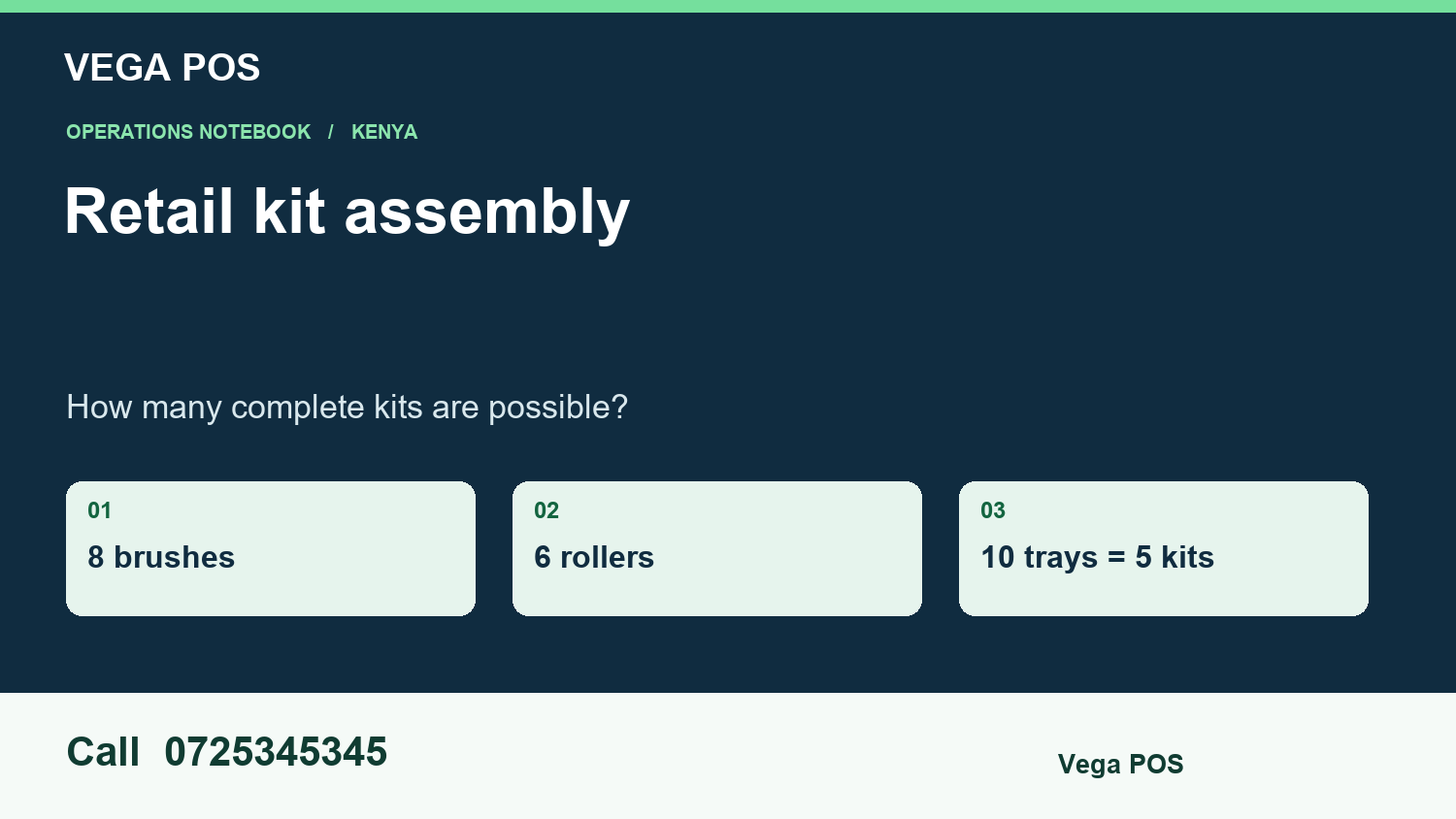
Start with eight brushes, six rollers and ten trays. The recipe needs one brush, one roller and two trays. Five complete kits are possible, with three brushes and one roller remaining loose. Do not report six kits merely because six rollers exist.
Now reserve two trays for a separate customer order. If those trays are unavailable for assembly, only four kits can be promised. Keep the reservation decision visible to the packer. A total stock report may be numerically correct while overstating the quantity that staff are allowed to consume for this promotion. This stage of retail kit assembly tests a different question from the final total.
Field notes from our reorder exception review guide:
Confirm the product and purchasing unit
Start with a stable product identity and the unit used for buying. A carton, packet and individual piece can produce very different order quantities. Similar supplier references may also describe different pack sizes. Resolve these differences before comparing stock levels with a proposed purchase.
Use the supplier catalogue cleanup guide when the mapping is unclear. A reorder exception review should not approve a quantity that the buyer cannot translate into the actual goods expected at the receiving desk. Confirm packaging changes with current evidence rather than copying an old conversion.
Check outstanding supplier commitments
Look for open orders, accepted changes and partial deliveries before placing another purchase. Confirm the remaining quantity and the latest supplier response. Two employees can unintentionally order the same shortage if they review separate lists without seeing the existing commitment.
Communicate the practical consequence
Receiving staff, branch teams or customer-facing employees may need to know what the decision means. Tell them the relevant action: an order is postponed, a substitute needs approval or a promised arrival remains uncertain. Share the information needed for their task without sending a long purchasing discussion to everyone.
The retail handover log guide can support this communication. Reorder exception review is only complete when the decision reaches the people who would otherwise act on an outdated assumption.
3. Check the kit at checkout
Give the kit its agreed selling reference and test its label beside the labels on individual components. The cashier must know which reference to scan. A loose brush sold separately should not consume an entire kit, and scanning every item inside an already priced kit can overcharge the customer. Use a fictional kit price of KSh 900 and a separate brush price of KSh 180.
Ring up one kit and one extra brush. The expected charge is KSh 1,080. Inspect both the receipt description and the stock result; the correct money alone does not prove the catalogue is configured correctly. Use retail kit assembly to expose this exception before relying on the ordinary successful path.
Field notes from our barcode label checks guide:
Print a small sample first
Print a few labels using the actual printer, label material and intended settings. Inspect whether text is readable and whether the barcode fits without being clipped. Check the edges and the space surrounding the printed code. Do not assume that an image which looks clear on a laptop will remain usable on the smallest label roll.
Place labels where people can use them
Agree a sensible label position for each packaging type. Staff should find it without covering important product information or opening the package. Avoid folds, seams and places likely to rub against shelves. If a supplier code remains visible beside your own label, demonstrate which code staff should scan and why.
Keep price changes under separate control
A correct barcode match does not authorise a new selling price. Where labels include prices, compare the price against the approved change and its effective date. Confirm whether an old promotional sticker needs removal. Staff should not guess which price applies when the shelf, package and counter disagree.
Train the exception routine
Show cashiers what to do when scanning fails during a queue. They need a supported search method and a clear way to confirm the selected item. Picking the first similar description may complete the sale quickly while creating a stock error that appears much later.
4. Reverse a kit with missing pieces
A customer returns a kit with one tray missing. Follow the shop’s approved return terms rather than automatically adding one complete kit to saleable stock. Record what physically arrived, its condition and the authorised customer settlement separately. A refund does not restore the missing tray.
If the shop dismantles a kit internally, record the actual components recovered and identify any discrepancy. Retail kit assembly needs this reverse path before a promotion begins, because staff otherwise improvise when the first incomplete package reaches the counter. Close the example only when another person can reconcile each component. The final retail kit assembly record should explain the outcome to someone who was not present.
Field notes from our retail damaged stock guide:
Separate the goods from ordinary selling stock
Use a clearly identified holding location according to your business procedures. The purpose is to prevent an item awaiting review from being mistaken for available stock. Mark the case reference and keep the affected quantity identifiable. Staff should know which items are waiting for a decision and which have already been cleared.
Do not interpret a holding label as a final assessment of safety, usability or value. Appropriate handling depends on the product and the circumstances. The stock location labels guide can help name the holding area consistently without confusing its address with the product code.
Give the review a named owner
Assign someone who can investigate or route the case to the right decision maker. Include a review date and a practical next action, such as checking the delivery record or asking the supplier about its returns procedure. A case described only as pending tends to remain pending because nobody knows what should happen next.
Record the authorised outcome
Possible outcomes depend on the goods and your procedures. The review may lead to a supplier return, an approved record correction or another documented decision. Use the applicable handling rules and qualified advice where the product requires it. This operational checklist does not decide whether damaged goods are suitable for use or resale.
Retail kit assembly test sheet
Before running the example, cover the expected results and ask a colleague to predict them. Use the disagreements to decide which rule needs explaining. These are fictional test cases; use your own approved references for the real procedure.
| Test condition | Expected evidence |
|---|---|
| Five complete kits assembled | The chosen assembly method records five brushes, five rollers and ten trays consumed or reserved at the correct event. |
| Only eight trays available | At most four complete kits can be offered under the stated recipe, before considering other restrictions. |
| One kit and one extra brush sold | The sample charge is KSh 1,080 and component or kit balances follow the documented method. |
| One tray missing on return | The physical receipt does not create a complete saleable kit without a supported remedy. |
| Assembly cancelled before sale | The reversal restores the appropriate quantities once and preserves the original reference. |
Retail kit assembly: questions from the counter
Should every kit be a separate stock item?
No. Choose the method that matches the business process and the supported system configuration. A preassembled stocked kit and a sales bundle can have different stock events. Document the method, demonstrate one sale and reversal, then compare component balances. Do not switch methods halfway through a promotion without an approved transition.
What if a component is substituted?
Obtain the appropriate approval, define the revised recipe and make the customer-facing description accurate. A cheaper tray or different brush is not automatically an equivalent replacement. Keep the recipe used for each assembly traceable so a later return can be assessed against what was actually supplied.
What should the manager count?
Count both complete kits and loose components, using the chosen stocking method to avoid counting the same items twice. Inspect incomplete packages separately. A sealed carton labelled as five kits still needs a reliable assembly record; the printed label does not establish that every required piece was packed.
Use retail kit assembly in your next demonstration
For a discussion about retail kit assembly, contact Vega POS on 0725345345. Bring one anonymised example, its starting position and the result your colleague expects. Ask for a demonstration using those details before assuming a particular feature or integration is available.
Other Kenyan business workflows
For a custom business portal, explore Zama Web Experts. If your team is working in another sector, these services provide different examples: Prim for salon bookings, sales and stock; TAS for chama records and contributions; JAAT for shop and product listings; Dereva for driver discovery. Use the service that fits your task; a link does not establish that the systems exchange data.