 Vega
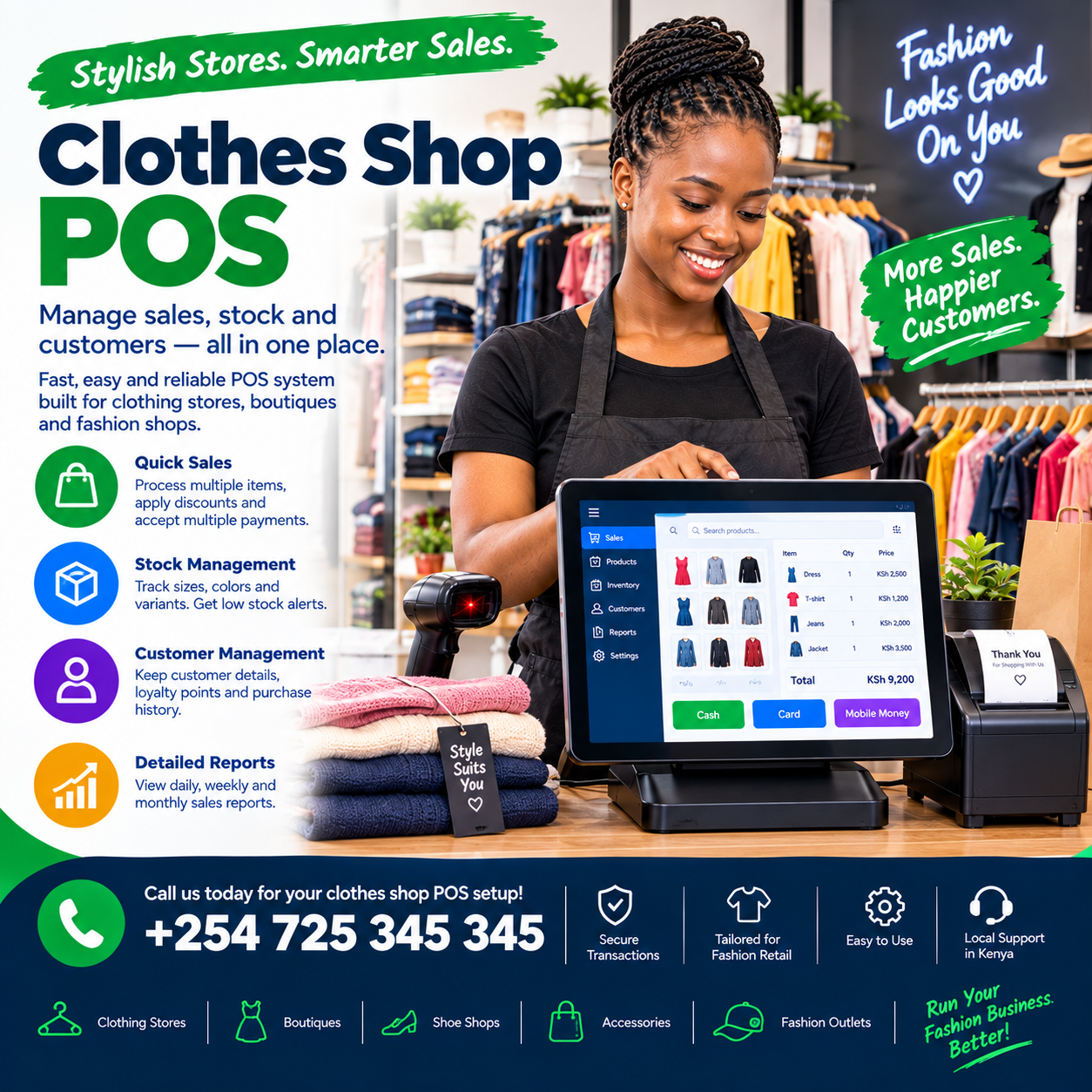
Clothes shop POS requirements begin with a truth no other retail faces: in a clothes shop, one design is fifteen different products — five sizes across three colours, each with its own stock, its own pace, and its own customer asking for it by name.
An ordinary till counts quantity; a clothes shop lives or dies on knowing which size, in which colour, is on which rack.
That single difference shapes every requirement in this article — from the size grid at the counter to the exchange culture that defines the trade.
Kenyan clothes shops carry their own realities too: the bale trade and graded secondhand stock, school-uniform seasons that compress a year’s demand into weeks, and customers who buy on WhatsApp and exchange at the counter.
A genuine clothes shop POS is built for all of it — sizes, exchanges, seasons, and the bale — not a general till with fashion prices typed in.
This article walks through what that system must do, section by section: variants, receiving and tagging, exchanges, seasonal markdowns, customers, channels, secondhand stock, and the demo test that separates real systems from decorated ones.
By the end, you will judge every option with one question: does it see my shop the way my customers do — item by item, size by size?
Clothes Shop POS: The POS Connection
A clothes shop is relationship retail at counter speed — and everything it needs from technology flows through the till.
Every sale tells the system which size and shade moved; every customer interaction builds the history that personal service runs on; every season’s buying leans on last season’s evidence.
That is why a clothes shop POS is not a cash register with hangers — it is the memory the whole shop runs on.
Three properties define the real thing.
Variant intelligence first: sizes and colours tracked as distinct positions that never silently merge — the clothes shop POS foundation everything else stands on.
Customer depth second: sizes, preferences, and purchase histories attached to named regulars, so any cashier serves any customer like the owner would.
Season awareness third: sell-through, ageing stock, and markdown support built for a trade that turns with fashion, not with shelf life.
A clothes shop POS without all three counts dresses instead of managing them.
What it is not: a spreadsheet of designs, and not a memory exercise — the shop that runs on the owner’s recall works until the owner is away, the staff changes, or the second branch opens.
The distinction matters because clothes shops scale on relationships and racks, and both need records to grow past one person’s head.
In shops we configure, owners describe the graduation the same way: the till stopped being a calculator and became the shop’s memory — the clothes shop POS difference in one sentence.
Sizes and Colours: The Heart of a Clothes Shop POS
Ask any clothes shop owner what breaks ordinary software first, and the answer is always the same: sizes and colours.
The capability that defines a genuine clothes shop POS is variant management done as structure, not as free text typed into a product name.
The design exists once as a parent product — brand, style, cost basis — and lives as child positions: five sizes across three colours, each a distinct stock unit.
Each child is received separately, sold separately, counted separately, and reported separately — the clothes shop POS structure that keeps the data clean for years instead of decaying in months.
The counter difference is immediate and commercial.
A customer asks for the wrap dress in a medium, blue — the cashier opens the grid and answers in two seconds: we have it in your size, in blue and black.
That two-second answer is a sale saved: the general till says we have three of this dress, and the clothes shop POS answer says exactly which one.
The size grid also drives the counter’s honest questions: which sizes sell fastest in your market, which colours carry each design, and which positions strand stock nobody wears.
The size-curve report reads those patterns: mediums outselling larges two to one means the next order should say so — a clothes shop POS turns the pattern into the purchase order.
Images at the counter complete the grid: each colourway photographed, so the cashier confirms the shade, not just the style — ending the wrong-item handovers that general tills invite.
Ask every vendor to demonstrate the full variant flow on your own items: build one design with your sizes and colours, receive two variants, sell a specific size, and show the grid — a clothes shop POS that fumbles that on your stock will fumble it forever.
Receiving and Tagging: From Bale to Rack
Clothes stock often arrives unlabelled — from bales, exhibitions, tailors, and suppliers — and the system must bridge the gap between the crate and the rack.
The workflow starts at receiving: new items entered with variants, costs, and photos, then barcoded by the shop itself.
A label printer connected to the system prints size-coded barcode tags on the spot — every piece priced, identified, and scannable before it hangs.
That single habit transforms the counter: checkout becomes a scan instead of a price hunt — the queue-killer of unlabelled shops, ended by a clothes shop POS with proper tagging flow.
For the bale trade, receiving carries an extra layer: graded stock entered as distinct positions — grade A pieces at one cost, grade B at another — so the secondhand shelf stays honest.
Receiving against purchase orders keeps suppliers accountable: what was ordered, what arrived, and the difference — recorded while the delivery is still on the counter.
Cost prices deserve their line on every variant: your margins are only as honest as the costs entered the day the bale opened — a clothes shop POS that carries them per variant shows which designs actually earn.
The buying-trip workflow matters too: record the order from your phone as you walk the market or exhibition, and let the delivery arrive already half-catalogued.
Tagging discipline pays forever: a rack where every piece scans means exchanges settle in seconds, counts run in minutes, and the till never guesses.
Ask every vendor to run the flow live: receive an unlabelled piece, print its tag, scan it at the counter — a clothes shop POS that completes that chain in minutes was built for your reality.
Exchanges and Returns: The Trade’s Daily Reality
No trade exchanges stock like clothes: the size that did not fit, the colour that looked different at home, the gift that missed — exchanges are daily business, and the till must treat them as routine.
The exchange flow on a proper clothes shop POS is one continuous record: the original sale found by receipt, customer, or item; the piece returned to its exact variant; the replacement issued from its own position — nothing reconstructed, nothing guessed.
Receipts matter, but they are not the only path: the customer who lost the paper is found by name or phone in the clothes shop POS history — the exchange settles on evidence instead of memory.
Size-for-size swaps should be frictionless: same design, different size — two scans, one record, seconds on the clock.
Cross-item exchanges carry policy: credit issued at the original price, applied against the new piece — with the difference collected or refunded transparently.
Refunds follow the same discipline: money returns through the channel it arrived on — M-Pesa reversal, card reversal, or cash with approval — each attached to its original sale.
The exchange report is the quiet intelligence: which designs come back, in which sizes, for which reasons — the clothes shop POS feedback loop that sharpens buying and sizing next season.
And the accountability layer rides along: every exchange and refund carries a name and an approval where policy demands it — protecting the shop without punishing the honest counter.
Exchange policy deserves one deliberate decision at setup: windows, conditions, and who approves what — encoded once, enforced automatically, and stated clearly to customers.
Ask every vendor to demonstrate the full exchange live: original sale found, size swapped, record complete — a clothes shop POS that makes exchanges effortless has passed the trade’s defining test.
Seasons, Markdowns, and the Stock That Ages
Fashion stock breathes with the calendar, and a genuine clothes shop POS breathes with it.
The rhythm is unique: buy a season ahead, sell through a window, and mark down what the window closes on.
Sell-through reports are the steering wheel: what percentage of each design sold at full price, how fast, per size and colour — the clothes shop POS reading that separates buying on evidence from buying on hope.
Ageing reports expose the closing window: pieces that entered in March and have not moved by June need action while markdowns can still recover cash.
Markdown management deserves structure: discount a specific size, a specific colour, or a whole design — with the reduction visible as a decision in reports, not dissolved into noise.
The discipline protects margin twice: the dying positions get cleared, and the healthy stock beside them keeps its full price — the clothes shop POS precision that blanket sales destroy.
Uniform and school-season shops run a sharper version of the same clock: demand compresses into a few January weeks, and the clothes shop POS must carry variant grids by school, size, and age — with reorder points tuned to the calendar, not the average.
Clearance discipline completes the cycle: clear the racks, bank the cash, and let the season’s data write the next order.
That closed loop — buy, sell, read, rebuy — is what turns a clothes shop from a shop with taste into a shop with a system.
A proper clothes shop POS is the loop’s engine, and the owners who run it describe the same shift: the racks stop being guesses and become a portfolio.
Customers: The Rack’s Best Friend
A clothes shop’s moat is not price — it is knowing the customer, and the clothes shop POS is where that knowledge becomes durable.
Every sale attached to a named customer builds a profile no memory can match: what she bought, when, in which size, at what price.
The service moments follow naturally: her preferred size comes up before she says it; her alteration notes travel with her record; her favourite brand’s new arrivals get mentioned, not discovered.
A capable clothes shop POS turns those moments into standard practice — every cashier serving every regular with the owner’s attentiveness.
Loyalty closes the loop: points or simple rewards tracked in one balance, earned at the counter and redeemed anywhere you sell.
Marketing rides the same rails: new-arrival messages to customers who bought that brand, win-back notes to regulars quiet for two months — sent through SMS or WhatsApp to opted-in numbers.
The data also sharpens buying: your top twenty customers’ collective preferences are the most honest trend report a clothes shop will ever read.
And the awkward moments settle gracefully: the exchange without a receipt becomes a lookup, because the clothes shop POS remembers the sale, the size, and the day.
One privacy line worth keeping: customers should know their details are recorded, and consent captured plainly — trust is the product, in data as on the rack.
Ask every vendor to show the customer flow live: find a regular, show her history and sizes, log a preference, send a new-arrival message — a clothes shop POS that makes that flow effortless is built for your trade.
WhatsApp and Instagram: The Second Storefront
Your clothes shop already sells on WhatsApp and Instagram — the question is whether the till knows about it.
The unmanaged version runs on memory: a DM sale gets bagged, the rack’s count goes stale, and the next customer who asks about the piece finds it gone.
A managed version connects the channels: the clothes shop POS holds one stock truth, and each channel-side sale is recorded against it in seconds.
Full e-commerce integration goes further: an online store synced to the till, stock decrementing both ways, orders landing at the counter, one customer across both doors.
But even the light version transforms the shop: every Instagram sale rung on the till keeps the rack honest, the reports complete, and the reconciliation simple.
Payment flow matters here: M-Pesa for DM sales, recorded against the sale with the reference stamped — a capable clothes shop POS keeps digital payments attached to their items without evening archaeology.
Click-and-collect becomes a natural service: she orders from the couch, the piece is held under her name, and she skips the queue to collect.
WhatsApp receipts deepen the channel: the itemised receipt with the piece’s details becomes her record and your thread — the clothes shop POS conversation that starts at the sale and continues at the next drop.
Ask every vendor which channels they support natively, and who connects them — then test the flow that matches how your customers actually buy at a distance.
A clothes shop POS that treats Instagram as a real door — not a brochure — is the one that will still be serving you when your channels multiply.
Mitumba and Secondhand: Graded Stock Done Right
The bale trade is a Kenyan institution, and it deserves systems built for it — because graded secondhand stock breaks ordinary tills in unique ways.
The bale arrives as a gamble: mixed pieces, unknown condition, and pricing that happens piece by piece as the bale opens.
A capable clothes shop POS handles the flow: pieces entered as graded positions — premium, grade A, grade B — each with its own cost basis and its own price.
Per-piece tagging matters more here than anywhere: every piece scanned as it is priced, so the bale’s investment becomes countable stock instead of a disappearing pile.
The margin report tells the trade’s truth: which grades earn, which bales paid, and which supplier’s bales outperform — the clothes shop POS evidence that turns bale buying from luck into strategy.
Best-piece photography feeds the premium channel: the grade-A pieces shot and posted to WhatsApp or Instagram, sold against the same stock the counter holds.
Damaged and unsellable pieces exit through write-offs: recorded explicitly, with the bale’s economics kept honest — a clothes shop POS that tracks the dregs as data, not as invisible losses.
Consignment fits the same structure where it exists: pieces held and sold on another party’s behalf, with commissions and payouts ledgered cleanly.
The counter speed question matters in this trade too: busy weekend trade on graded stock needs scanning, not price-hunting — tags printed at processing keep the rush moving.
Ask every vendor how their system handles graded secondhand stock: bale entry, per-piece tagging, grade reporting — the clothes shop POS that answers fluently was built for this market.
The Counter and the Fitting Room
Clothes shopping involves the fitting room — and the till’s job is to keep the sale alive across that journey.
Held baskets are the mechanism: the customer takes three pieces in, the basket holds at the counter, the queue continues — and the sale resumes when she returns, without starting over.
A capable clothes shop POS holds multiple baskets at once, each named or numbered, so two customers’ fitting journeys never collide.
The reserve flow extends the same idea: a piece held for a customer until tomorrow, recorded as a held order rather than a promise — the clothes shop POS structure that turns maybes into returns.
Counter speed still rules the final moment: the scan, the payment, the receipt — a busy Saturday needs the whole flow under thirty seconds, and a proper clothes shop POS delivers it.
Gift receipts fit the trade naturally: the piece rung once, two documents issued — the price-hidden gift copy and the exchange-capable record.
The layaway version serves bigger purchases: deposit paid, piece held, balance settled on collection — one record through every stage.
And the staffing rhythm follows the shop’s curve: the hourly report shows when fittings peak and when the rack work happens — the clothes shop POS schedule written by the shop’s own customers.
Ask every vendor to demonstrate a held basket and a reserve live: interrupted, resumed, completed — the flows every clothes counter runs weekly, proven in minutes.
Offline Mode: The Fitting Queue Cannot Wait
Internet in this market is a guest that leaves without warning, and a Saturday fitting queue cannot inherit its mood.
A serious clothes shop POS must therefore be offline-first: the catalogue with images, prices, variants, and customer records live on the terminal, sales complete with the router dead, and everything syncs when the line returns.
The test is physical and takes two minutes: unplug the router mid-basket, sell a specific size, look up a regular’s history offline, take an M-Pesa payment — the mobile networks carry it even when your broadband is down — then reconnect and watch the clean sync.
Systems that freeze or degrade to a survival mode fail this test on the Saturday when the street is busiest — which is exactly when networks choose to fail.
Exchanges continue offline too: the clothes shop POS finds the original sale from local records and processes the swap through the outage.
Power rides the same drill: a tablet-based counter on battery keeps the shop alive through the blackout that kills a desktop tower.
Receipt and label printing connect directly to the terminal, never through cloud services — a tag printer that depends on someone else’s server is not a tool you can promise the shop floor.
Make offline behaviour a written acceptance item in your agreement, tested with your own catalogue before the final payment.
For a clothes shop POS, offline capability is not a feature among features — it is the difference between a quiet Tuesday glitch and a lost Saturday.
Choosing a Clothes Shop POS: The Demo Test
Bring this script to every vendor; it converts claims into evidence in twenty minutes.
Build one of your products live. Your design, your sizes, your colours — then receive two variants and sell a specific size: the variant flow is the heart of any clothes shop POS, and hesitation here ends the demo.
Show the size grid at the counter. The cashier view must answer the customer’s real question — which size, which colour, how many — in two seconds.
Run an exchange. Original sale found, size swapped, record complete — the trade’s defining flow, performed live on any clothes shop POS you evaluate.
Print a tag. Receive an unlabelled piece and print its barcode on the spot — the bridge from bale to rack.
Mark down one variant. Discount a single size, not the whole design, and show it in the reports as a decision.
Hold a basket. Interrupt a sale, resume it, complete it — the fitting-room flow, proven.
Kill the internet mid-sale. Sell offline, reconnect, watch the sync — non-negotiable in this market.
Read the reports. Sell-through, size curves, and ageing stock on realistic numbers — not an empty dashboard.
A vendor who welcomes this script has built a clothes shop product; a vendor who steers toward grocery screenshots is selling a till with prices typed in.
Then ask for two references from clothes shops specifically, one question each: what changed about your buying decisions after three months?
The answers from owners running a real clothes shop POS will teach you more than any demonstration ever recorded.
Rolling Out a Clothes Shop POS
Rollout has one dominant task: capturing existing stock, variant by variant.
Begin with the catalogue structure: your designs, brands, and variant grids built in the background while the shop trades on the old process.
Then the physical count: every piece scanned by variant into the system, tagged where unlabelled, graded where secondhand — the afternoon that becomes the foundation of everything the clothes shop POS will ever tell you.
Load customer records as you go: your regulars from memory, notebook, or phone — names, numbers, sizes, and preferences — so personal service survives the switch.
Schedule installation for a weekday morning, never a Saturday, with payments tested live: M-Pesa trigger, card reader, split payment, and deposit flows.
Train the whole team on the flows that matter in this trade: variant selling, exchanges without receipts, held baskets, and the unplugged drill — so the first real rush is the team’s tenth rehearsal.
Nominate a champion by name before training day; counters learn fastest from the peer who has already made the mistakes.
Run parallel for two or three days — new system and old process side by side — and compare totals each evening before cutting over fully.
Book the week-one review at the same time as the installation: reconcile, correct small drifts, and tune the screen layout against what the counter actually taught you.
A structured clothes shop POS rollout typically runs one to two weeks from booking to confident independent trading, with the doors open every day.
The first weekend fully live — variants found in seconds, regulars greeted by name from the screen — is the moment owners describe as the day the shop finally matched its own ambition.
Mistakes Clothes Shop Owners Make
Five patterns catch owners first; learn them here without paying for them.
Tracking designs instead of variants. The count says three dresses; the truth is one medium in blue and two larges nobody asked for — variant blindness is the most expensive habit in this trade, and a proper clothes shop POS exists to end it.
Skipping the opening count by variant. Estimated stock corrupts every size curve and every markdown decision — count every piece once, properly, with the system live.
Leaving customers out of the system. A till that records sales but not customers throws away the shop’s entire advantage — relationship data is the reason a clothes shop POS is worth more than a cash register here.
Marking down by feel. Markdowns applied without ageing data discount the pieces that would have sold, and spare the ones that will not — let the clothes shop POS reports aim the discounts.
Letting Instagram sales stay off the books. Every unrecorded channel sale quietly corrupts the stock truth the whole system depends on.
A sixth worth naming: no exchange policy encoded — the window, the conditions, and the approvals decided once in the system, so the counter never improvises.
Owners who avoid these five get what a proper clothes shop POS promises and few deliver completely: every size known, every regular remembered, and every season bought on evidence.
Different Clothes Shops, Different Setups
The right configuration follows the stock; four quick portraits.
The boutique. Variants and images lead — deep size-and-colour grids, styling bundles, and customer preference data drive the specification.
The mitumba shop. Bales, grades, and per-piece tagging dominate — the clothes shop POS here lives on processing speed and grade reporting.
The uniform and school-wear shop. Seasonal compression, variant grids by school and size, and reorder points tuned to January — the calendar is the specification.
The multi-branch fashion retailer. Transfers between branches carry variants with them, head office sees every position across locations — the clothes shop POS platform question becomes structural rather than optional.
The pattern generalises: name the one thing your stock does that no other does, and make the vendor prove exactly that in the demo, on your items.
For every portrait, the foundations hold: variants, exchanges, offline mode, and M-Pesa — the four that no clothes shop should ever run without.
What a Clothes Shop POS Costs
Pricing has three layers, and quotes that blur them are hiding something.
Hardware first: a tablet starter bundle — terminal, scanner, printer, drawer, and a label printer for unlabelled stock — typically KES 50,000–90,000 depending on the tagging workflow.
Software second: a subscription, typically KES 3,000–7,000 monthly for mid-tier with full variant and customer depth, and KES 7,000–15,000 for platform tiers with multi-branch, e-commerce, and advanced reporting.
Setup and training third: catalogue build with variants and images, the full stock capture, installation, configuration, whole-team training, and go-live support — typically KES 10,000–50,000 depending on catalogue size.
Judge the subscription by daily cost: a few hundred shillings a day for a system that remembers every customer and reads every season is a rounding error with benefits.
Compare quotes on a single table: hardware, software, setup, support terms, and year-one total — the truest number for any clothes shop POS comparison.
Then weigh the return column the quotes never show: exchanges settled in seconds, markdowns aimed by data, repeat visits from remembered regulars, and buying decisions that finally match the size curve.
For most shops, a single well-aimed season — one avoided overbuy, one cleared rack — covers a meaningful share of year one.
Beware both extremes: the free app that cannot express a variant, and the enterprise quote billing hundred-branch features to a two-room shop.
Ask what appears on the invoice in month thirteen that is not on the quote — and get the answer in writing on any clothes shop POS you are considering. The transparent quotation is the only kind worth comparing — and the itemisation itself is a character reference.
Frequently Asked Questions
Why does a clothes shop need a special POS instead of a normal one?
Because clothes stock is variant stock: one design in five sizes and three colours is fifteen distinct products, and a quantity till cannot tell which one sold or which one is stranded.
A clothes shop POS tracks every size and colour separately — which is the structural difference between counting stock and knowing it.
Can it handle exchanges when the customer lost the receipt?
Yes — the original sale is found by customer name, phone, or item, and the exchange processes against that record with the return and replacement both logged. Confirm the receipt-less exchange live in the demo of any clothes shop POS before you sign.
Does it work for graded secondhand and mitumba stock?
A capable one does: pieces entered as graded positions with their own costs, tagged per piece as the bale opens, and reported by grade so the bale’s economics stay visible. Ask for the bale-to-rack flow on any clothes shop POS you evaluate.
Can it manage school-uniform seasons?
Yes — variant grids by school, size, and age, with reorder points tuned to the seasonal calendar and the year’s history informing the next January’s order.
Will it work when the internet goes down?
A properly engineered one will: variants, images, prices, and customer records live on the terminal, sales complete offline, and everything syncs in order when the connection returns. Make the unplugged test a written acceptance item on any clothes shop POS before the final payment.
Is it worth it for a small clothes shop?
Usually yes — small shops live entirely on regulars and full-price sell-through, and both are exactly what variant tracking and customer records protect. The first season bought on data from a clothes shop POS — one avoided overbuy, one cleared rack — is typically when small-shop owners stop asking whether they needed it.