 Vega
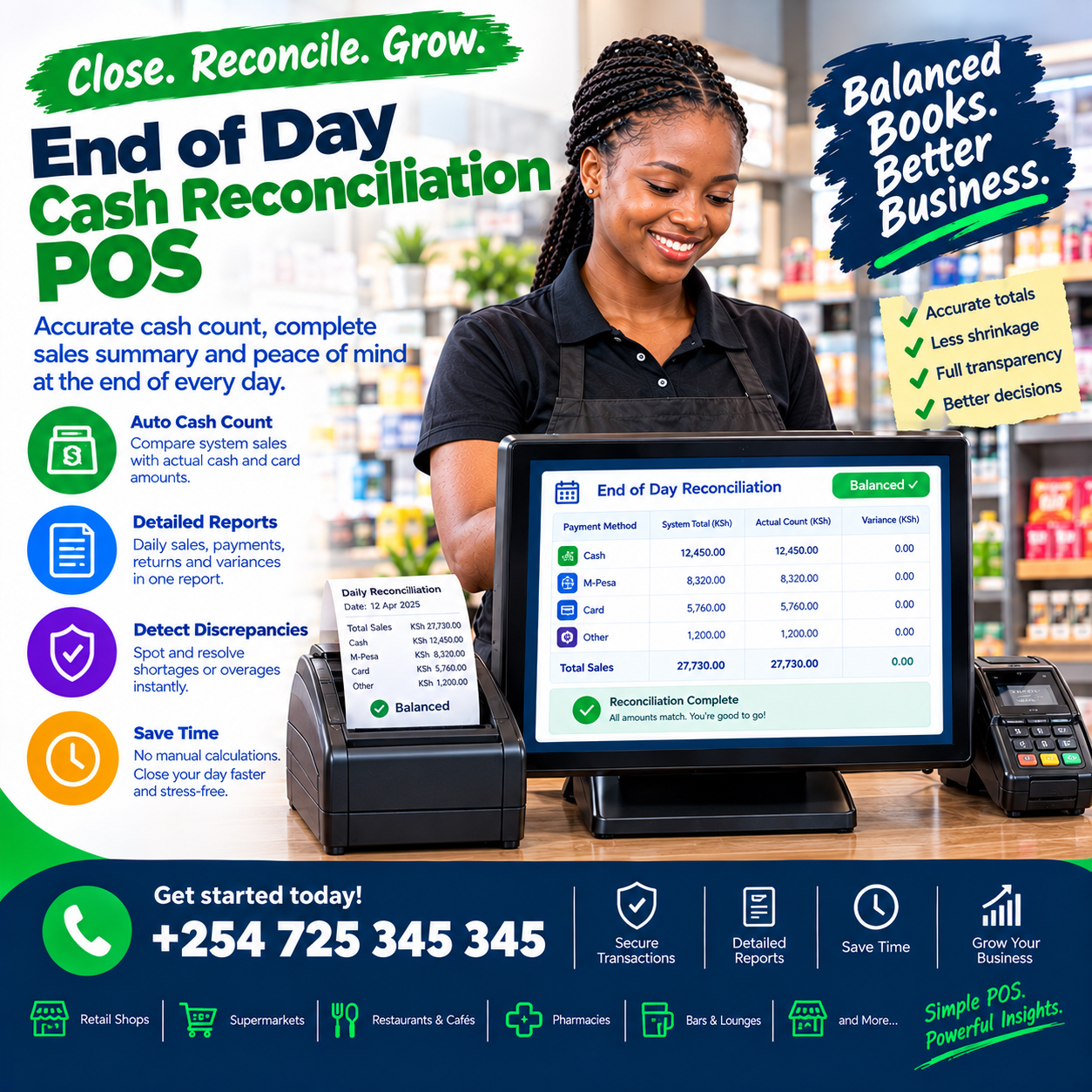
End of day cash reconciliation POS capability is the five-minute ritual that decides whether your books are trustworthy — because the moment of closing is where every shilling either gets counted, explained, and filed, or quietly absorbed into a mystery nobody will ever solve.
Every shop in the country knows the two versions of closing.
The untracked version: receipt roll, calculator, phone inbox, and forty minutes of archaeology ending with one payment of 2,350 that matches nothing — absorbed, again, into a difference nobody can explain.
The tracked version: drawer counted against the system’s expectation, M-Pesa matched against recorded confirmations, exceptions read, day filed — five minutes, one screen, done.
The difference is not effort or honesty.
It is whether the till has been maintaining the answer all day — a running expectation the reconciliation can compare against — or whether the close is being reconstructed from paper after the fact.
This article builds the ritual end to end: what reconciliation actually means, the expectation the system maintains, the counting procedure itself, how variances are handled, the multi-channel close that includes M-Pesa, and the reports the ritual feeds.
Then the offline question, the demo test, the rollout, the mistakes, and the worth — because by the end, you will judge every system with one question: does closing the day take five minutes and end with everything explained?
End of Day Cash Reconciliation POS: The Connection
Reconciliation is a comparison — and a comparison needs two sides that actually exist.
Side one: what the drawer physically holds at close of day.
Side two: what the drawer should hold, given every sale, payout, and top-up recorded since opening.
Manual shops only have the first side — so the close becomes a reconstruction, guessing at the second from receipts and memory, and every gap between the two is absorbed rather than explained.
A genuine end of day cash reconciliation POS maintains the second side automatically: the system tracks every cash movement transaction by transaction, so the expectation at close is exact — and the reconciliation becomes a simple, honest comparison.
Three properties define the real thing.
Maintained expectation first: the system knows what the drawer should hold at any moment, updated with every sale, payout, top-up, and refund — not estimated at midnight from a receipt roll.
Structured close second: the counting procedure is guided by the system itself — expected figure shown, actual entered, variance computed — the end of day cash reconciliation POS sequence that removes arithmetic from the most error-prone moment of the day.
Named outcomes third: every close ends filed — balanced, over, or short — with the shift, the till, and the cashier attached, and the result searchable for years.
A system without all three produces closes that feel finished and reconcile nothing.
What it is not: a z-report that prints totals without a counting procedure, and not a spreadsheet where someone types figures from memory — both produce documents, and neither produces accountability.
The distinction matters because the close is where trust in the whole system is born or lost: a first reconciliation that adds up makes the till credible forever, while a first close that does not teaches the team the numbers are optional.
In shops we configure, owners describe the change the same way: the close stopped being an investigation and became a confirmation — the end of day cash reconciliation POS difference that shows up as shorter evenings and books that survive any audit.
The Expectation: Built All Day, Compared at Night
The reconciliation’s power comes from work the system did hours earlier — the running expectation, maintained silently from the moment the shift opened.
It begins with the float: the counted drawer entered at shift open becomes the starting figure — the end of day cash reconciliation POS baseline that every later comparison depends on, and the thirty seconds that separate proven closes from guessed ones.
Through the day, every cash sale increments the expectation automatically, calculated to the shilling on screen — no mental arithmetic, no manual tally, no “roughly right.”
Every payout decrements it: money leaving the drawer for expenses, refunds, or deliveries routes through approval and updates the figure — because unrecorded payouts are the classic hole through which reconciliation dies.
Every top-up and change-giving adjustment lands the same way: recorded, attributed, and folded in — the end of day cash reconciliation POS ledger with no unexplained chapters.
Mid-shift checks become possible and painless: a supervisor compares the drawer against the expectation at any moment, catching a drifting till hours before the close — the early warning manual shops only get at 9 p.m., when it is too late to matter.
By close, the expectation is complete: the exact figure the drawer should hold, computed from the day’s entire trading history — waiting only for the count to confirm it.
That is the structural difference from every manual shop: reconciliation compares two existing numbers, rather than constructing one of them from paper after the fact.
Ask every vendor to demonstrate the live expectation in the evaluation: three cash sales and a payout, then a mid-shift check — the comparison must be instant and exact.
The system that maintains that figure faithfully is the one that makes every close boring — which is precisely what a well-run counter should be.
The Close: A Guided Ritual, Not a Guess
The counting procedure itself is where good systems earn their keep — because the moment is error-prone by nature: tired staff, a busy day behind, and arithmetic under pressure.
A well-designed end of day cash reconciliation POS guides the ritual instead of leaving it to memory.
The screen shows the expected figure first — what the drawer should hold — then walks the count: notes by denomination, coins by roll, entered as they are counted.
The system computes the total and the variance automatically: no subtraction in the head, no calculator, no rounding debates at the counter.
If the count matches, the close confirms and files — balanced, named, timestamped: the end of day cash reconciliation POS outcome that takes thirty seconds and builds the shop’s credibility daily.
If the count differs, the variance is captured with its size and direction immediately — before the drawer is disturbed, while the trail is warm and the shift is still present to explain it.
The recount belongs in the same flow: a second count on a discrepancy, verified by two people where policy demands, and the final figure recorded with both names.
Skip-counting discipline completes the ritual: the drawer counted in the same order every night, distractions set aside, and the door closed — because the close is the day’s most valuable five minutes and deserves its own guard.
And the whole procedure files itself: shift, till, cashier, float, expectation, count, variance, notes — the end of day cash reconciliation POS record that used to take a page of handwriting and now takes none at all.
Ask every vendor to walk the close in the demo, timed: a shift closed from expectation to filed record in under two minutes — anything slower is a system that will quietly train your team to skip it.
Variances: Named, Small, and Explainable
Every counter produces variances eventually — the discipline is whether they arrive as named, small, explainable events or as month-end mysteries with no address.
On a tracked counter, the variance is born at the close: counted drawer against expectation, difference computed, and the result attached to the shift that produced it — the end of day cash reconciliation POS specificity manual shops never achieve.
Small variances are normal: rounding, miscounts, and the honest accidents of a busy day — and the report exists to show them as small, so the owner stops treating every shilling like a scandal.
Patterns are the signal: one variance is noise; one cashier with weekly shorts, one till that drifts every Friday, or one shift-time that misses consistently — those are conversations, and the report exists to surface them early while the trail is warm.
The variance report reads in five minutes: every close of the week — expectation, count, difference — ranked by size, filterable by person and by day.
Act through process, never ambush: a pattern earns a conversation, a review of the exception report, or a quiet check of the footage — because data used as a weapon destroys the trust the reconciliation was built to create.
The overages matter as much as the shorts: a drawer consistently over is as suspicious as one consistently short — the end of day cash reconciliation POS report that watches both directions, because skimmers leave change behind too.
And the clean weeks count: months of zero or near-zero variances are evidence the counter is tight — proof for your insurer, your accountant, and your own sleep.
The honest framing for the team: the ritual protects the honest first, because a named, reconciled close is a day nobody can hang a loss on — and that reassurance is worth more to your best cashier than to you.
The Multi-Channel Close: M-Pesa Reconciles Too
Cash is only half the modern drawer — and the close that ignores the digital rail is half a reconciliation, with half the mysteries.
The M-Pesa side closes the same way: the system’s recorded confirmations — every payment bound to its sale during the day — compared against the platform’s statement, each matched to the shilling.
Unmatched items surface on the exception list: a payment awaiting its sale, a transfer recorded for collection, a reversal pending — visible, named, and resolvable in minutes rather than hidden inside totals.
The split-payment sales close cleanly too: the basket paid part cash and part M-Pesa reconciles on both rails simultaneously — one record, both channels accounted, the end of day cash reconciliation POS completeness that manual closes never achieve.
Card settlements join where they exist: approvals recorded during the day matched against the acquirer’s figures — the third rail folded into the same five-minute review.
The banking decision follows naturally: cash to the deposit, M-Pesa transfer scheduled, settlement timing known — the close feeding the morning’s banking instead of guessing at it.
And the day’s full report prints or saves complete: takings by channel, cash variance, digital matches, exceptions with names — the end of day cash reconciliation POS document that accountants receive instead of shoeboxes.
Ask every vendor to demonstrate the multi-channel close in the demo: cash counted, M-Pesa matched, exceptions listed — the whole evening in five minutes, timed.
A system that only reconciles the drawer is solving half your problem — and half a reconciliation, examined honestly, is where the other half’s mysteries live.
The Reports the Ritual Feeds
Every nightly close deposits one entry into the records that make the whole system valuable — and the compounding starts within the first week.
The variance ledger. Every close filed — expectation, count, difference, shift, till, person — building the end of day cash reconciliation POS history that turns shrinkage from a feeling into a dataset.
The pattern report. Variances by cashier, by till, by day of week — the trends that surface conversations worth having while the trail is warm.
The channel picture. Cash versus M-Pesa versus card, daily and monthly — the split that informs float sizes, banking rhythms, and security.
The accountant’s file. Thirty clean closes assembling the month automatically — exports instead of shoeboxes, the end of day cash reconciliation POS month-end that arrives without a reconstruction weekend.
The audit trail. Every close drillable to its source — every sale, payout, and top-up behind the expectation, searchable months later, the depth that survives insurers and authorities alike.
Reports should reach your phone without export buttons — the day’s close readable from home, the variance visible before the morning meeting.
Ask every vendor to demonstrate the close history on realistic data — thirty days of filed closes, variances ranked, patterns visible — not an empty screen.
The compounding line is decision quality: float sizes, banking schedules, staffing at close, and even which tills need attention — all flowing from the same ritual, kept daily.
Offline: The Close Survives the Router
Closes happen through power cuts and fibre cuts in this market — and the ritual cannot pause just because the network did.
A genuine end of day cash reconciliation POS must therefore be offline-first: the expectation maintained locally all day, the close procedure working at full speed with the router dead, and the filed record syncing in order when the line returns.
The test is physical and takes two minutes: unplug the router mid-shift, trade in cash, close the shift offline — then reconnect and watch the filed close land intact.
Systems that freeze at close, lose the day’s expectation, or fail to file offline fail this test — and they fail it on the busiest Saturday, when networks choose to die and the close matters most.
The expectation survives offline too: the day’s sales and payouts recorded locally keep the comparison figure current — because a close without a live expectation is just a count.
Power rides the same drill: a battery-backed tablet keeps the ritual alive through the blackout that kills a desktop tower — because power and connectivity usually fail together.
Printers connect directly — never through cloud services — because a z-report that waits on someone else’s server is not a report you can promise the close.
Make offline closing a written acceptance item in your agreement, tested with a full shift before the final payment on any end of day cash reconciliation POS you are considering.
Ask each vendor one number: how long can the shop trade and close fully offline before anything is at risk?
The confident answer is measured in weeks, not hours — and it separates a system built for this market from one adapted to it.
Choosing One: The Demo Test
Bring this script to every vendor; it converts claims into evidence in twenty minutes.
Run the full close. A shift opened with a float, trades through the day, then closed — guided count, automatic variance, filed record — the end of day cash reconciliation POS ritual timed end to end in under two minutes.
Plant a variance. A drawer counted with a deliberate difference — the system must name the shift, the till, the time, and the direction, instantly.
Watch the expectation live. Three cash sales and a payout through the day, then a mid-shift check — the comparison must be exact, to the shilling.
Close the M-Pesa rail. Digital payments matched against confirmations, exceptions listed, the split-payment sale reconciling on both channels at once.
Read the variance history. A month of filed closes — ranked, filterable, patterns visible — not an empty screen.
Attempt a skipped step. A close without a float, a count without the guided procedure — a serious system insists on the ritual, because shortcuts are how the gaps are born.
Unplug the router before the close. The full ritual offline — non-negotiable in this market.
Ask the month-thirteen question. What appears on the invoice later that is not on this quote today?
A vendor who welcomes this script has built the ritual; a vendor who steers toward a totals report is selling a printout, not a reconciliation.
Then ask for one reference from a business your size and a single question: when did you last have a close you could not explain?
The answer from an owner running a real end of day cash reconciliation POS — usually a pause, then a date from months ago — teaches you more than any demonstration.
Rolling Out the Ritual
The rollout has one sensitive task: introducing a nightly discipline to a counter that may have closed loosely for years — and the communication matters as much as the configuration.
Announce it openly as protection for the shop and the people in it: a close that reconciles protects the honest cashier first, because a named, balanced day is a day nobody can hang a loss on.
Configure the structure first: shift opens with floats, payout approvals set, counting denominations configured — the end of day cash reconciliation POS framework decided before the first close, not improvised after.
Train every person who will ever close: the guided count, the variance capture, the recount rule, and the filing — rehearsed on real hardware until the ritual survives a busy Saturday.
Nominate a champion by name; counters learn fastest from the peer who has already closed a tracked shift.
Set the policy questions deliberately: who closes, who recounts, what variance triggers a conversation, and who is called when the numbers will not agree — decided once, applied everywhere.
Run parallel deliberately: the old closing habit and the tracked ritual side by side for two or three days — then retire the old way formally, on an ordinary trading day.
Do not retrofit suspicion: do not re-examine last year’s drawers through the new lens — the point of the rollout is that the guessing era ends at go-live, not that it gets rewritten backwards.
Book the week-one review at the same time as the setup: reconcile the first closes together, tune the thresholds, and read the first variance report with the team.
A structured end of day cash reconciliation POS rollout typically runs days, not weeks — because the ritual rides inside the till you already run.
The first week of clean closes — every day filed, every variance explained, every morning starting with trust — is the milestone owners describe as the day the shop’s books grew up.
Mistakes Owners Make
Five patterns catch owners first; learn them here without paying for them.
Skipping the float. The shift that opens without a counted baseline is a shift whose close proves nothing — thirty seconds at open, or a month of unanswerable questions at the end.
Letting the close slide on busy nights. The ritual skipped when the shop is fullest — exactly when the money is most at risk; the end of day cash reconciliation POS close is most valuable precisely when it is least convenient.
Using variances as a weapon. Ambushes built on close reports end teams and trust at once — data earns conversations, and conversations follow process, or the ritual gets quietly sabotaged by the people it watches.
Never reading the history. Closes filed nightly, variances ranked, patterns visible — and nobody opens any of it: the most common failure in the category, and the difference between reconciliation and wallpaper.
Closing the drawer but not the M-Pesa. The cash rail reconciled while the digital rail lives in the inbox — half a close, with the other half’s mysteries waiting at month-end.
A sixth worth naming: no recount rule — a discrepancy counted once and accepted without verification is how small variances become large arguments; the second count, witnessed, is the ritual’s cheapest insurance.
Owners who avoid these five get what proper end of day cash reconciliation POS discipline promises and few deliver completely: closes in five minutes, variances named while small, and a books-trustworthy shop every single night.
What the Ritual Is Worth
Price the return honestly, in the currencies it pays.
The recovered evenings. Forty minutes of archaeology compressed into five minutes of ritual — twenty-plus hours a month returned, the end of day cash reconciliation POS dividend owners mention first and their families notice.
The named variances. Shortfalls caught at close, attached to shifts, and explained while the trail is warm — losses that were invisible becoming specific, manageable events.
The bankable record. A year of filed closes with expectations, counts, and named outcomes — the file that lenders, insurers, and accountants actually want to see.
The team trust. Honest cashiers protected by records that clear them — the cultural return that keeps good staff longer than any pay rise alone.
The costs are modest: the ritual rides inside a normal mid-tier subscription — typically KES 3,000–7,000 monthly — with no separate product to buy.
Against that, a single explained variance or one prevented Saturday mystery usually covers a year of the subscription — before counting the recovered evenings and the daily calm.
And the compounding line is the ledger itself: a year of filed closes is the most defensible account of your counter that exists — the foundation for audits, insurance, and every future hire’s training, built one reconciled end of day cash reconciliation POS night at a time.
Frame it the way the best owners do: the close is where the day gets certified — and a till that certifies it in five minutes is simply a shop that runs on truth.
Different Trades, Same Ritual
The close flexes by trade; four quick portraits.
Groceries and mini-marts. Volume and multi-till closes — several drawers reconciled nightly, each against its own expectation, the end of day cash reconciliation POS ritual scaled without slowing.
Restaurants and takeaways. Tips, payouts, and rider floats complicate the drawer — the guided close catching every channel before the last staff member leaves.
Pharmacies. Regulated counters and controlled stock — the close doubled as a compliance record, deep enough for auditors.
Boutiques and phone shops. High-value items and small teams — even two staff benefit from named closes, and the filed record becomes the shop’s first defence on its most valuable stock.
The pattern generalises: name the channels and the closing order your counter actually runs on, and make the vendor prove the ritual follows them — floats, guided counts, variances, and filing, demonstrated live.
For every trade, the foundations hold: maintained expectations, guided counting, named variances, and the multi-channel close — the four that no end of day cash reconciliation POS should ever be bought without.
Frequently Asked Questions
What does an end of day cash reconciliation POS actually do?
It maintains a running expectation of what the drawer should hold — updated with every sale, payout, and top-up — then guides the close: expected figure shown, actual counted, variance computed automatically, and the outcome filed with the shift, till, and cashier named.
A genuine end of day cash reconciliation POS closes the day in five minutes with every shilling accounted for.
How long should the closing ritual take?
Five minutes for a single-till shop: guided count, automatic variance, exceptions read, day filed — with multi-till shops adding a few minutes per drawer.
Time the demo close on any end of day cash reconciliation POS you evaluate: if the ritual cannot run in minutes, your team will quietly stop performing it.
What happens when the drawer does not match?
The system computes and records the variance immediately — named by shift, till, and cashier — and the recount rule applies: verified, witnessed where policy demands, and filed with the final figure.
Patterns then surface in the reports: the end of day cash reconciliation POS history that turns variances from mysteries into conversations.
Does the M-Pesa side reconcile too, or only cash?
Both rails close together on a capable system: recorded M-Pesa confirmations matched against the platform statement, exceptions listed, and split-payment sales reconciling on both channels at once.
Confirm the multi-channel close in the demo of any end of day cash reconciliation POS — half a reconciliation leaves the other half’s mysteries alive.
Does the close work when the internet is down?
A properly engineered one does: the expectation maintained locally all day, the guided count running offline, and the filed record syncing in order when the connection returns.
Make the offline close a written acceptance item on any end of day cash reconciliation POS before the final payment.
Is this worth it for a shop with one till and one cashier?
Usually yes — even a single cashier benefits from a guided count, an automatic variance, and a filed record that protects them, and the ritual rides inside a normal subscription rather than costing extra.
The first clean week on an end of day cash reconciliation POS — five-minute closes, explained variances, mornings starting with trust — is typically when small-shop owners stop asking whether one till needed the ritual.