 Vega
Interbranch stock borrowing becomes confusing when staff say “send us six today and we will return them later” without recording which units moved. A fictional branch needs six display stands for a weekend event. The lending branch has twenty. Both teams need a record of custody and the agreed return expectation, even though the business as a whole still owns the stands.
Use branches East and West, temporary movement B61 and six labelled sample stands. Confirm the supported stock-transfer or asset-custody process with the business before starting. This is not a reason to improvise accounting entries or assume that every POS has a borrowing module. The exercise should identify who releases the goods, who receives them and what evidence closes the temporary arrangement.
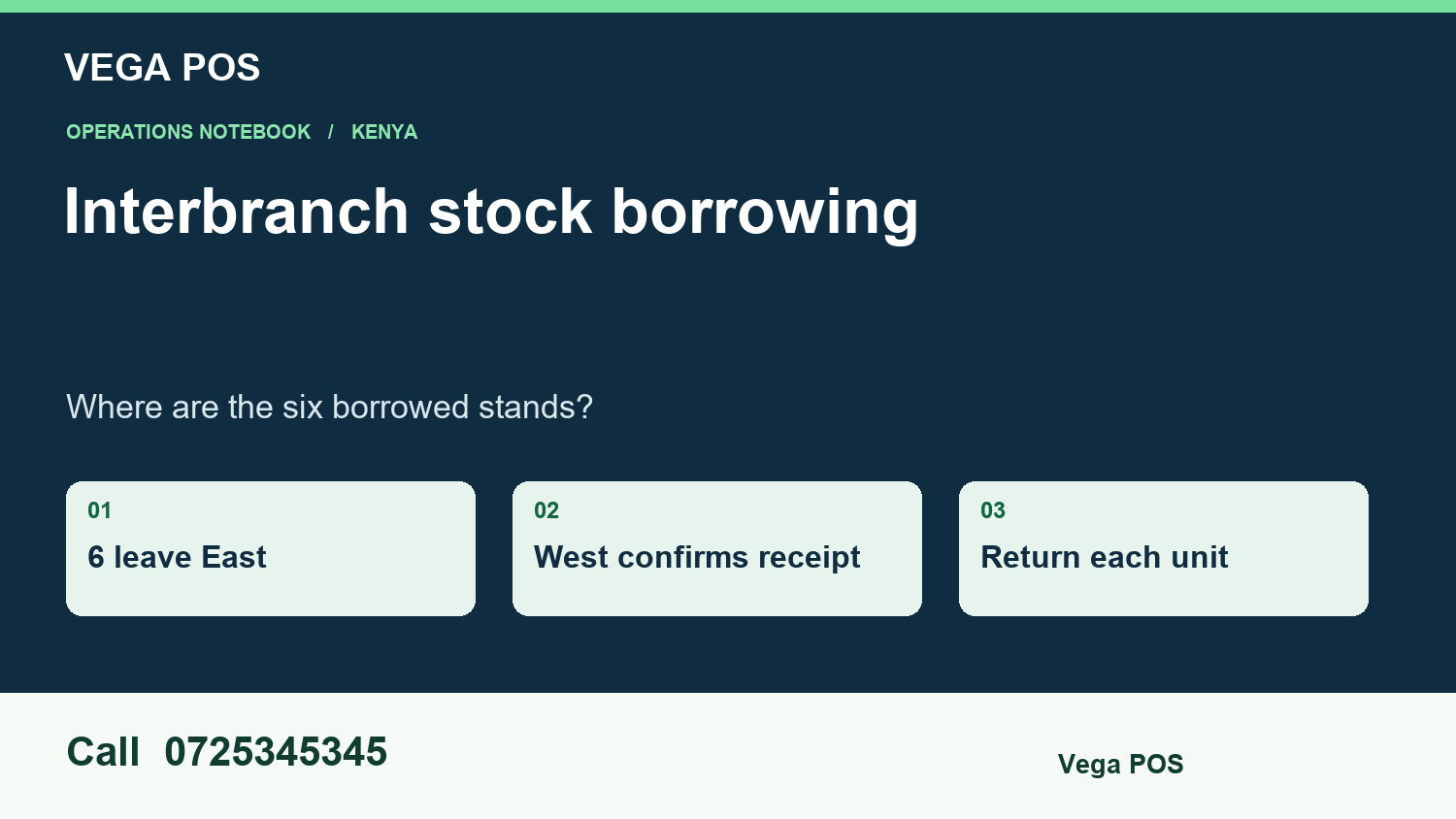
Interbranch stock borrowing in four decisions
Use the four decisions below as a tabletop exercise. The case is fictional. Each decision pairs a new scenario with field notes drawn from a linked guide in our library. Read the scenario aloud first, and ask the next person to explain the result before consulting the notes.
1. Define the movement before loading
Write six stands, the originating location, intended destination, purpose and agreed return date against B61. Distinguish a temporary display loan from stock sent for sale. If the receiving branch is permitted to sell any of the units, that changes the operational rule and should be documented before release.
Ask the sender and receiver to describe the expected end state independently. Interbranch stock borrowing should not rely on the word temporary alone: the agreement needs to explain what happens if a stand is still in use when the return date arrives. For interbranch stock borrowing, keep this starting assumption visible beside the result.
Field notes from our retail quotation review guide:
Confirm quantities and selling units together
An accurate quantity with the wrong unit can still produce a serious misunderstanding. Ten boxes, ten pieces and ten metres describe different commitments. Record the selling unit beside every quantity and check how the system handles a pack containing several individual units. Do not assume that a supplier’s packaging description matches the unit used at your counter.
Review prices without hiding their basis
Confirm which price list applies and whether the staff member is authorised to use it. A repeat customer may have an agreed arrangement, but a previous discount should not silently become permanent. Where the offer includes a negotiated price, preserve the approval reference and the reason. Make the applicable conditions understandable to the person completing the sale later.
Explain delivery and collection responsibilities
Specify whether the customer will collect, the shop will arrange delivery or another party will handle transport. Include the relevant location and any agreed delivery charge. Separate a preferred date from a confirmed commitment. Staff should know what must happen before the business can promise a collection time or dispatch slot.
Track open offers with useful next actions
An open quotation list should help someone decide what to do next. Useful statuses might distinguish waiting for clarification, waiting for customer approval and awaiting a stock check, according to your supported workflow. Assign an owner and a sensible follow-up date. A single pending label does not explain why progress stopped.
2. Reconcile dispatch and receipt
East dispatches six stands, but West initially records five. Keep the difference visible until the teams establish whether the sixth is in transit, left behind or simply missed during receipt. Do not force both records to six merely to close the movement.
East’s physical count becomes fourteen after six leave; West’s confirmed custody is five until the remaining unit is accounted for. The total owned across the business is a different question from each branch’s available quantity. Give the discrepancy an owner and a next check while evidence from loading and receiving is still available. This stage of interbranch stock borrowing tests a different question from the final total.
Field notes from our partial delivery tracking guide:
Count the physical delivery independently
Use the normal receiving checks for every arrival, even when the delivery note looks familiar. Compare physical goods with the document and the relevant order lines. Check product identity, unit and visible condition. A second delivery can contain a different mistake from the first, so it should not inherit approval automatically.
Assign ownership of supplier follow-up
Choose who will ask about outstanding goods and when they should do so. Include the order reference, affected lines and exact outstanding quantity in the question. A general request for an update may produce an answer that covers only part of the order.
Protect customers from unclear availability
Goods that are ordered, in transit, received or reserved are in different states. Confirm how the business represents each state before promising availability. Staff should know whether an outstanding supplier delivery has been allocated to a customer or simply replenishes the shelf.
Hand over open deliveries between shifts
Include the order, latest receipt, outstanding lines, expected next event and owner in the handover. Refer to the complete record for detail. A short structured note is more useful than a long conversation that the next receiving employee may never hear.
The retail handover log guide supports this routine. During partial delivery tracking, another shift should be able to recognise an expected second arrival without receiving the entire original order again. Make duplicate prevention part of the handover discussion.
3. Keep borrowed units identifiable
Mark the stands in a way staff can use without confusing them with ordinary saleable stock. Where references or serial identifiers are available, use them consistently in the handover. A generic note saying “six black stands” may be inadequate if West already has similar units of its own.
Test whether a colleague can select the correct items for return without the original organiser present. Interbranch stock borrowing also needs a rule for moving one stand onward to a third site; the first receiver should not become a dead end in the custody trail. Use interbranch stock borrowing to expose this exception before relying on the ordinary successful path.
Field notes from our barcode label checks guide:
Define the purpose of barcode label checks
Decide whether you are checking newly received goods, replacement labels or an entire shelf. Each situation needs a clear boundary. A receiving check asks whether the supplier’s product matches your record. A replacement check asks whether the printed label preserves the intended identity. A shelf review looks for mistakes that may already affect sales.
Confirm the selling unit before printing
Write down whether staff sell a piece, packet, pair, carton or another unit. Confirm how the supplier’s packaging relates to that unit. Do not copy a carton label onto individual items without checking what the resulting scan means in your system. A successful scan can still select a quantity that the cashier did not intend.
Record failures in a useful way
Separate a code that will not scan from a code that scans to the wrong product. Also distinguish a correct product with an unexpected unit or price. These failures may need different owners. A printer adjustment will not solve an incorrect product mapping, and changing a product description will not repair torn label material.
Review after the first trading period
Check the first day’s reported exceptions after introducing a label batch. Ask receiving staff whether application was straightforward and cashiers whether scanning produced consistent matches. Inspect a small sample on the shelf again. The goal is to discover practical problems that were not visible during printing.
4. Record the actual return outcome
At the end of the event, five stands are ready to return and one needs a condition review. Record the five dispatched back, the review location of the sixth and the person responsible for the remaining decision. Do not close B61 as six returned while one is still away.
When East acknowledges five, compare their identifiers and condition with the original handover. Interbranch stock borrowing closes after every unit has a supported destination or approved alternative outcome. A revised return date should remain visible rather than replacing the earlier commitment without explanation. The final interbranch stock borrowing record should explain the outcome to someone who was not present.
Field notes from our retail damaged stock guide:
Identify the affected product precisely
Confirm the internal product reference, description, unit and relevant batch information where available. Similar packaging can hide different sizes or variants. A note saying three damaged boxes may be unclear if one box contains multiple selling units. Record both the physical packaging and the quantity basis used in the stock record.
Distinguish the stage at which damage was found
Was the condition visible on arrival, discovered while unpacking, noticed on the shelf or reported after a customer transaction? Record the stage accurately. This helps the reviewer choose the appropriate documents and next contact. It does not automatically prove when the damage occurred or who is responsible.
Keep stock movements and decisions connected
If goods move to a holding area, record the movement using the supported process. If their available quantity changes, retain the reason and authorisation. Physical separation alone may not change what a cashier or buyer sees on screen. Confirm how your setup distinguishes held stock from stock ready for sale.
Record the authorised outcome
Possible outcomes depend on the goods and your procedures. The review may lead to a supplier return, an approved record correction or another documented decision. Use the applicable handling rules and qualified advice where the product requires it. This operational checklist does not decide whether damaged goods are suitable for use or resale.
Interbranch stock borrowing test sheet
Before running the example, cover the expected results and ask a colleague to predict them. Use the disagreements to decide which rule needs explaining. These are fictional test cases; use your own approved references for the real procedure.
| Test condition | Expected evidence |
|---|---|
| East releases six of twenty stands | Fourteen remain physically at East before other movements. |
| West initially acknowledges five | The sixth unit stays an open discrepancy until evidence explains its location. |
| One stand moves onward | The next receiving location and custodian remain linked to B61. |
| Five stands return, one remains under review | The temporary movement stays open for the unresolved unit. |
| Revised return date agreed | The new commitment is visible without erasing the original expectation. |
Interbranch stock borrowing: questions from the counter
Is temporary borrowing the same as selling stock to another branch?
Not automatically. The business must define the movement and use a supported process that reflects its purpose. A temporary display loan, ordinary transfer and sale can have different operational consequences. Record the agreed arrangement before dispatch rather than choosing whichever screen is easiest.
What if the return date changes?
Record the revised agreement, responsible person and reason while preserving the original commitment. The receiving branch should still know which units remain in its custody. A changed date should not erase an unresolved shortage or condition issue that requires a separate decision.
Why count each branch separately?
The business-wide total does not show where staff can physically find an item. A correct total can hide an incorrect branch balance or unacknowledged movement. Reconcile dispatch, receipt and return references so each location can explain its own position as well as the overall quantity.
Use interbranch stock borrowing in your next demonstration
For a discussion about interbranch stock borrowing, contact Vega POS on 0725345345. Bring one anonymised example, its starting position and the result your colleague expects. Ask for a demonstration using those details before assuming a particular feature or integration is available.
Other Kenyan business workflows
For a custom business portal, explore Zama Web Experts. If your team is working in another sector, these services provide different examples: Prim for salon bookings, sales and stock; TAS for chama records and contributions; Saseni for writing orders and delivery; JAAT for shop and product listings; Dereva for driver discovery. Use the service that fits your task; a link does not establish that the systems exchange data.