 Vega
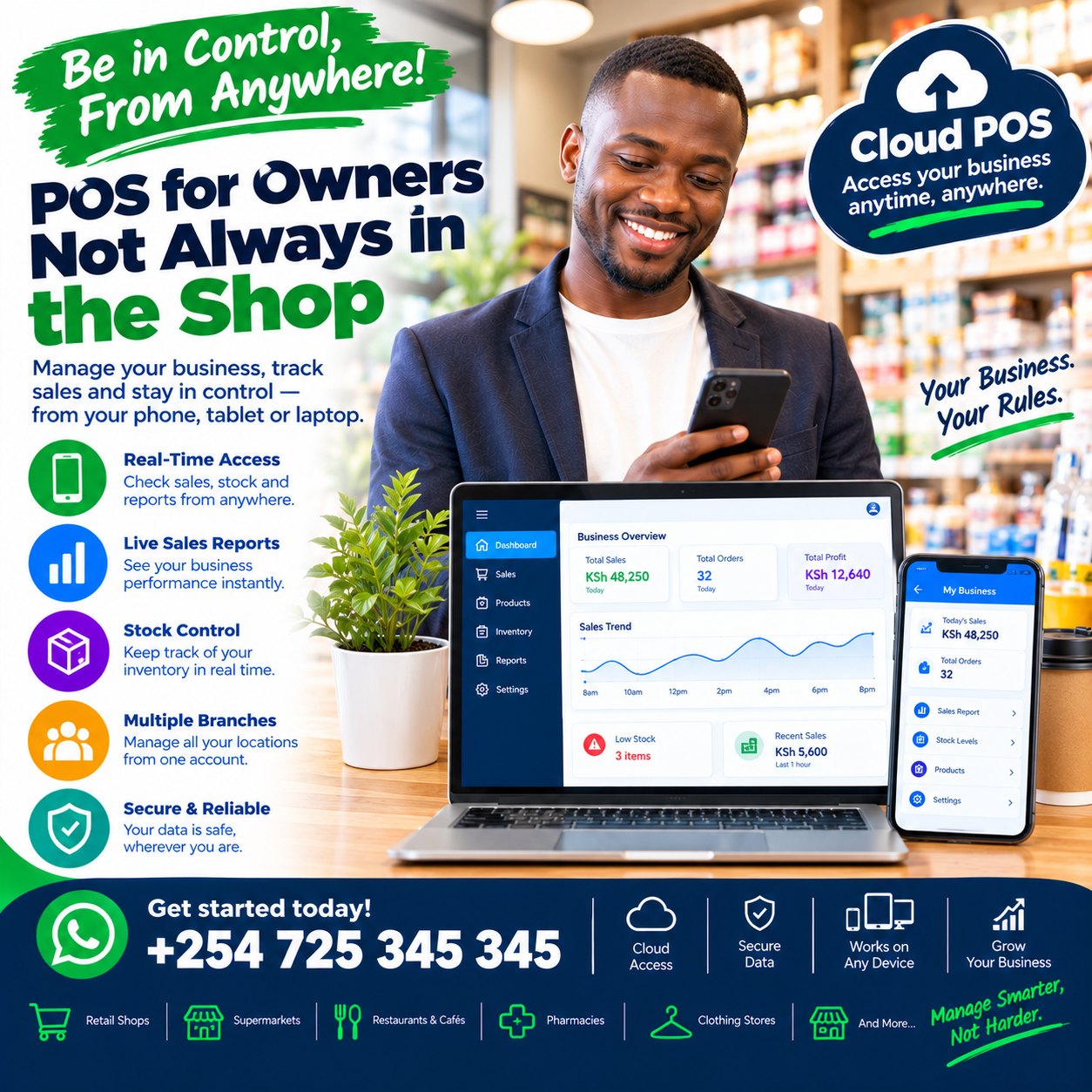
POS for owners not always in the shop is the technology that answers the question every growing owner eventually asks: what happens to my business on the days I am not standing behind the counter?
The first shop runs on presence. You are there for the open, the rush, the delivery, and the close — and the system of record is your own eyes.
Then life expands: a second shop, a supplier trip, a school event, a sick day, or simply the wish for one full weekend off — and presence stops being possible.
The shops that grow past their owner are not the ones with the most reliable staff.
They are the ones with the most reliable information — where the owner sees everything, the manager runs everything, and the difference between the two is a phone that updates every few seconds.
This article builds that capability end to end: what a genuine POS for owners not always in the shop delivers, the live dashboard that travels with you, the accountability that replaces supervision, the delegation that becomes safe, and the reports that decide your mornings.
Then the offline question, the demo test, the rollout, the mistakes, and the worth — because by the end, you will judge every system with one question: does my shop report to me, wherever I am, in time to act?
The Owner’s Real Problem: Distance, Not Absence
Let us name the problem precisely, because the industry usually mislabels it.
The issue is not that owners leave — every owner must leave, for banking, suppliers, family, rest, and the second shop that growth demands.
The issue is that in most shops, leaving means going blind: the records live at the counter, the truth lives in the staff’s discretion, and the owner’s questions can only be answered by returning.
The consequences arrive in a familiar sequence.
First, the WhatsApp management era: photos of notebook pages, voice notes of takings, and summaries that depend on whoever is reporting — the POS for owners not always in the shop replacement question that begins every owner’s search.
Second, the decision lag: problems discovered at the weekend post-mortem that were visible at Tuesday noon — losses compounding for days because the information travelled slower than the damage.
Third, the trust dilemma: the owner who cannot see must either micro-manage through messages or hand over blindly — and both erode the team.
Fourth, the growth ceiling: shops stop at the number of locations one owner’s physical presence can cover — a limit set by geography, not by market.
Each of these is survivable alone; together they are why most Kenyan shops stay exactly one shop.
A genuine POS for owners not always in the shop ends the sequence at its root — because the records stop living at the counter and start living where the owner is.
The distinction to hold: this is not surveillance software watching staff, and it is not a reports add-on bolted to a till.
It is a complete operating model — visibility, accountability, and delegation — where the owner’s absence changes nothing about what they know or can decide.
In shops we configure, owners describe the shift identically: the business stopped depending on their availability and started depending only on its machinery — which is the entire difference between owning a job and owning a business.
POS for Owners Not Always in the Shop: The Connection
Remote ownership is only possible where records are born centrally — and the till is where every fact of the shop is born.
Every sale, delivery, adjustment, and payment happens at the counter; the point-of-sale system is the only machine that captures those facts at their source, complete and timestamped.
That is why a genuine POS for owners not always in the shop is a property of the point-of-sale itself, not a camera in the corner or a WhatsApp group at closing: the machine that records the business is the machine that reports it.
In a proper POS for owners not always in the shop, every event files itself centrally as it happens — the sale appearing on the owner’s phone within seconds of the receipt printing.
Three properties define the real thing.
Live centralisation first: one source of truth for sales, stock, staff, and payments — updated at the moment of every transaction, not summarised at closing.
Access anywhere second: the owner’s phone, the manager’s login, the accountant’s browser — each seeing what their role allows, from wherever they actually are.
Accountability third: every action carries a name and a time, so the absence of eyes is replaced by the presence of evidence — the POS for owners not always in the shop structure that makes trust verifiable rather than hopeful.
A platform without all three produces owners who are away and uninformed — the worst of both worlds.
What it is not: a WhatsApp photo of the day’s page, and not a desktop till checked by driving to the shop — both are management by pilgrimage, and neither scales.
The distinction matters because the quality of the owner’s decisions is bounded by the freshness of their information: decisions made on yesterday’s summary are a day late, and a day late is often a day costly.
In shops we configure, owners describe the graduation the same way: the shop stopped being a place they had to be and became a business they could direct — the POS for owners not always in the shop difference that shows up as calmer mornings, quieter phones, and a second location that finally becomes possible.
The Live Dashboard: The Shop in Your Pocket
The dashboard is the centrepiece of the entire capability — and its quality decides whether remote ownership feels like control or like guessing.
A genuine POS for owners not always in the shop puts five numbers permanently on your phone.
Today’s takings, live: current sales against yesterday and last week — the figure that used to require a phone call now requiring a glance.
Sales by hour: the day’s rhythm as it unfolds — whether the morning carried, whether the lunch peak arrived, whether the evening is building as it should.
Top movers and alerts: what is selling, what has stalled, and the reorder warnings the system raised overnight — the stock picture without walking a shelf.
The exception list: unusual voids, discounts beyond policy, refunds without matching returns — the day’s departures from normal, flagged with names attached.
And the payment mix: cash in drawers, M-Pesa confirmed, card settled — the money’s location known without opening a single drawer.
The freshness test is the one that matters: ask every vendor what you can see at 2 p.m., and how current it is — because a genuine POS for owners not always in the shop answers in seconds, while a summary system answers tomorrow.
The 2 p.m. moment is the capability’s proof: at the bank, at the supplier, at a school event — you know how today is going without a single message to the shop, and the staff know you know, which quietly raises everyone’s game.
Depth behind the glance matters too: any figure on the dashboard drillable to its source — till, person, item, time — because a number you cannot interrogate is a number you must take on faith.
And the multi-shop view where it applies: every location side by side, live, with the laggard visible as opportunity rather than mystery — the POS for owners not always in the shop league table that replaces the evening phone-around across a portfolio.
Ask every vendor to demonstrate the dashboard live during evaluation: a sale made at the demo counter appearing on the phone in front of you — the freshness witnessed, not described.
The owner who has lived with that phone describes it the same way across every shop we configure: it is the first tool they check in the morning and the last they trust at night.
Accountability That Replaces Supervision
Visibility is only half the model — the other half is a counter that behaves well whether or not you are watching, and that behaviour is built from records rather than from fear.
The foundation is identity: every cashier, supervisor, and manager works under a personal login, and every sensitive action — voids, refunds, discounts, price overrides, stock edits — is stamped with the name, the till, and the time.
The exception report is the daily read: the departures from normal, five minutes each evening, patterns visible across weeks — the POS for owners not always in the shop evidence that replaces the supervision your absence removed.
Approvals travel with you: the refund that needs authorisation while you are across town arrives on your phone, and your decision returns in seconds — control retained without presence, the mechanism owners describe as transformative.
Shift discipline runs on the same rails: shifts opened under names, drawers reconciled against expectations, handovers recorded — the counter’s day structured by the system rather than by whoever is most senior in the room.
Stock movements gain the same attribution: deliveries scanned in, adjustments named, transfers recorded — the POS for owners not always in the shop audit trail that makes every figure explainable from a distance.
And the culture point deserves honesty: this structure is not surveillance — it is the mechanism that protects the honest staff first, because a record that clears them is worth as much as the one that flags the rest.
Teams introduced to it openly settle within a fortnight, and the pattern is consistent across every shop we configure: till arguments end, favouritism fades, and the best staff prefer being measured by numbers both sides can see.
The delegation test that proves it: give a trusted supervisor genuine authority — approvals, scheduling, ordering within limits — while your visibility holds them accountable.
That combination is the entire art of remote ownership: authority for the team, evidence for you, and the POS for owners not always in the shop architecture that makes both possible on the same screen.
Delegation Becomes Safe
The deepest change the capability makes is not technical — it is the change in what the owner dares to hand over.
The reason most owners micro-manage is not personality — it is the rational fear of blindness: hand over control without visibility, and you are trusting luck with your livelihood.
A genuine POS for owners not always in the shop dissolves that dilemma: the manager gets genuine authority to run the counter, because the owner has genuine visibility to hold them accountable.
The best managers prefer it this way — working for an owner who judges them by numbers both parties can see, rather than by presence, mood, or the accident of who was watching.
The permissions architecture makes the handover precise: the manager can approve refunds to a ceiling, reorder within limits, and schedule the team — while prices, users, and policy stay with you, changed centrally, applied everywhere.
The stock side delegates the same way: reorder points trigger the alerts, the manager approves the orders, and your dashboard shows what was bought, from whom, and at what margin — the POS for owners not always in the shop supply chain that runs on evidence rather than on trust and a phone call.
And the growth consequence is the headline: the second shop stops being a risk and becomes a configuration.
The branch inherits the same platform, the same logins, the same reporting — its manager delegated precisely as the first one was, its numbers flowing into the same dashboard.
That is how portfolios happen: not by the owner multiplying themselves, but by the architecture extending itself — each new location arriving pre-accountable, pre-visible, and pre-delegated.
In groups we configure, the owners who scaled all followed the same sequence: prove the visibility completely at shop one, delegate deliberately at shop two, and clone the model from there.
The POS for owners not always in the shop is not software they bought — it is the second-in-command they hired, one that works every location simultaneously.
Reports That Decide Your Mornings
Remote ownership succeeds or fails at the morning ritual — the moment the day’s plan is made, and the moment the dashboard either informs or disappoints.
The morning read takes five minutes and follows the same shape every day: yesterday’s close — clean or flagged — today’s opening position, and the exceptions raised overnight.
Then the decisions that matter: the reorder the system suggests, the price the margin report questions, the staff conversation the exceptions earned — the POS for owners not always in the shop agenda arriving before the first customer does.
The weekly review adds the strategic layer: margins per category, performance per person, slow stock per shelf — the half hour that feeds a week of decisions made from anywhere.
The monthly close completes the rhythm: the accountant’s file assembling itself from clean daily records — exports instead of shoeboxes, ready for tax, for the bank, and for the SACCO committee.
And the trend layer compounds: read quarterly, the history names the drifts — categories cooling, baskets shrinking, dayparts fading — early warnings that arrive while correction is still cheap.
The freshness rule governs all of it: reports drawn from live records rather than retyped summaries — because the POS for owners not always in the shop difference is not more reports, it is reports that were already true when you opened them.
Ask every vendor to demonstrate the morning ritual live: the dashboard opened, the overnight exceptions read, one decision traced from alert to action — in minutes.
The owner who has run this rhythm from another town describes it identically: the shop’s day starts on their screen before it starts at the counter — and that order of events is the whole capability in one sentence.
Offline: The Shop Trades, You Stay Informed
The remote model faces its hardest test when the shop’s internet fails — because an outage is exactly when the owner needs visibility most.
The answer is offline-first architecture: the counter keeps trading at full speed with the router dead, records everything locally, and syncs to your dashboard in order when the line returns.
The test is physical and takes two minutes: unplug the router mid-shift, complete sales, close the shift offline — then reconnect and watch the whole arc land on your phone.
Systems that go dark at the shop and at head office simultaneously fail this test — and they fail it on the busiest Saturday, because that is when networks choose to die.
The dashboard marks the outage honestly: the POS for owners not always in the shop shows which branch is offline, how long it has been, and what is pending sync — so a bad network day is an entry on your screen rather than a hole in your day.
Pending data stays honest: stock figures clearly mark the offline shop’s queued movements, and decisions account for what has not yet landed — nothing silently stale.
Power rides the same drill: a battery-backed tablet keeps the counter trading through the blackout that kills a desktop tower — because power and connectivity usually fail together.
Make offline behaviour a written acceptance item in your agreement, tested with a full shift before the final payment.
Ask each vendor one number: how long can the shop trade fully offline before anything is at risk — and what do you see at head office during that time?
The confident answer covers both: weeks of local trading, and an owner’s dashboard that never goes blind — the POS for owners not always in the shop design that treats connectivity as a courier, never as a lifeline.
Choosing a POS for Owners Not Always in the Shop: The Demo Test
Bring this script to every vendor; it converts claims into evidence in twenty-five minutes.
The live dashboard test. A sale made at the demo counter appearing on your phone within seconds — the POS for owners not always in the shop freshness test, witnessed rather than described.
The 2 p.m. question. What exactly can I see mid-trading, and how current is it — answered by demonstration, not by promise.
The drill-down test. Any dashboard figure traced to its source transaction — till, person, item, time — in seconds.
The approval test. A counter request arriving on the owner’s phone while the demo terminal waits — approved or declined remotely, both recorded.
The exception report. Populated with realistic events — voids, discounts, refunds — each carrying a name, not an empty screen.
The delegation test. A branch-scoped manager’s view set live: what they see, what they approve, what stays with you — the POS for owners not always in the shop boundary, demonstrated.
The two-shop test. Two locations on one dashboard — even simulated — because your future is the spec.
The offline test. The router unplugged, the shop trading, the dashboard marking the outage honestly — non-negotiable in this market.
Ask the month-thirteen question. What appears on the invoice later that is not on this quote today?
A vendor who welcomes this script has built for remote owners; a vendor who steers toward the counter screens is selling to the wrong person in the room.
Then ask for one reference from an owner who travels, and a single question: how many days were you away from the shop last month — and what did you miss?
The answer from someone running a real POS for owners not always in the shop — usually nothing missed, told with some pride — teaches you more than any demonstration.
Rolling Out Remote Ownership
The rollout has one psychological task beyond the usual setup: shifting the shop’s culture from presence-based to evidence-based — and the communication decides whether it lands as empowerment or as surveillance.
Announce it openly: the owner will see everything, the team gets genuine authority within clear limits, and the record protects the honest first — that sentence, kept, buys a team that works with the system instead of around it.
Configure the logins and permissions first: one per person, roles matched to duties, approval ceilings set deliberately — the POS for owners not always in the shop boundaries drawn before the first remote day.
Delegate deliberately: name the manager, hand them real authority — approvals, ordering within limits, scheduling — and resist the urge to keep decisions that now belong below you.
Install the owner’s ritual at the same time: the morning five minutes, the evening exceptions read, the weekly review — scheduled from week one, because visibility without routine is just another tab.
Train the team on what the record means for them: their performance visible fairly, their shifts filed accurately, their honesty provable — the reassurance that turns wariness into preference.
Run the first remote week deliberately: a full day away, then two, then a weekend — each time noting what you checked, what surprised you, and what the dashboard caught before it cost anything.
Book the month-one review: visibility confirmed, delegation working, the first problems caught at a distance — the POS for owners not always in the shop evidence that the model is real.
The first full week away — the shop trading, the exceptions read each evening from the sofa, and nothing waiting for your return — is the milestone owners describe as the day they became owners instead of attendants.
Mistakes Owners Make
Five patterns catch remote-bound owners first; learn them here without paying for them.
Buying a counter system and checking it remotely. The till that lives at the shop produces reports you must visit — a genuine POS for owners not always in the shop pushes the business to you; a visited one makes you the courier of your own information.
Delegating without boundaries. Handing over everything to avoid the hard conversation — or nothing to avoid the risk; the permission architecture exists to draw precise lines, and it works only when you actually draw them.
Using visibility as a weapon. Ambushes built on remote reports end teams and trust at once — data earns conversations, and conversations follow process, or the staff begin working around the very system that was meant to include them.
Ignoring the morning ritual. The dashboard installed, the routine never built — visibility without the daily five minutes is just another unused app; the POS for owners not always in the shop pays through the reading habit, not the purchase.
Testing only the good network. The evaluation run on perfect Wi-Fi, the outage met live in month three — the unplugged test belongs in the demo, on your hardware, before you sign.
A sixth worth naming: never actually going away — the system bought, the routine built, and the owner still standing behind the counter from habit; the capability is proven only by using it, and the first deliberately absent week is the real go-live.
Owners who avoid these five get what proper POS for owners not always in the shop capability promises and few deliver completely: a shop that runs without them, informs without being asked, and grows past the length of their arm.
What Remote Ownership Is Worth
Price the return honestly, in the currencies it pays.
The recovered freedom. The banking trips, the supplier visits, the family days, and the full weekends — returned without anxiety, because the POS for owners not always in the shop dashboard holds the shop steady while you are gone.
The caught problems. The drift, the leak, the lapsed regular, the mispriced line — each surfaced at Tuesday noon instead of the Sunday post-mortem, when correction is still cheap.
The enabled growth. The second shop, the third, the portfolio — each arriving as configuration rather than as cloning yourself, the ceiling raised by architecture instead of by exhaustion.
The safer delegation. Managers with real authority, measured by shared numbers — the team that performs better because the scoreboard is visible and the referee is fair.
The costs are modest: remote capability rides inside a normal mid-tier subscription — typically KES 3,000–7,000 monthly — with no separate product to buy.
Against that, a single problem caught at Tuesday noon instead of Sunday — or one week of full absence survived without a single call — usually covers a year of the subscription.
And the compounding line is the record itself: every month of remote-readable history makes the next month’s delegation broader, the next location easier, and the next absence calmer — the POS for owners not always in the shop capability that converts an owner’s presence into a business’s independence.
Frame it the way the best owners do: the shop was never supposed to need you standing in it — it was supposed to need you deciding, and the right system finally separates the two.
Different Owners, Different Distances
The capability flexes by situation; four quick portraits.
The owner with one shop and a busy life. Banking, family, and supplier runs — the POS for owners not always in the shop dashboard covering the hours away, with the manager delegated precisely.
The owner with two branches. The league table live, transfers recorded, managers scoped — the graduation the architecture was built for.
The wholesaler on the road. Route days and site visits — orders and collections landing on the same records, the counter and the van one business.
The semi-absentee investor. The shop run by a manager, owned from a distance — visibility as the entire investment thesis, verified daily from a phone.
The pattern generalises: name the longest stretch you need to be away, and make the vendor prove the shop runs — informed, accountable, and delegable — for exactly that stretch.
For every situation, the foundations hold: live dashboards, named accountability, remote approvals, and offline resilience — the four that no absent-owner setup should ever run without.
Frequently Asked Questions
Can I really run my shop without being there every day?
Yes — when the system delivers three things: a live dashboard that reaches you wherever you are, accountability that keeps the counter behaving without your eyes, and delegation with clear boundaries. Shops running a proper POS for owners not always in the shop handle full weeks away as routine — the owner deciding, the machinery operating.
Will I see sales in real time, or only at closing?
In real time, on a genuine system: sales appear on your phone within seconds of the receipt printing, with hourly rhythm, movers, and exceptions current throughout the day. Test the freshness live in the demo of any POS for owners not always in the shop — a sale made at the counter appearing on your phone is the proof.
How do I stop theft when I am not there?
Through structure rather than presence: named logins, approval-gated exceptions, shift reconciliation, and an exception report that surfaces patterns while they are small — visibility replacing supervision. The POS for owners not always in the shop protects the honest staff first, which is why teams settle into it rather than around it.
What happens when the shop’s internet goes down?
The counter keeps trading offline at full speed, records everything locally, and syncs to your dashboard in order when the line returns — with the dashboard marking the outage honestly so nothing is silently stale. Make the offline test a written acceptance item on any POS for owners not always in the shop before the final payment.
Can my manager approve things while I am away?
Yes — approvals route to your phone or to the manager by ceiling: the supervisor handles the routine, the manager the significant, and the exceptional reaches you wherever you are, decided in seconds. Test the remote approval live in the demo of any POS for owners not always in the shop — the flow that defines the whole capability.
Is this worth it for a shop I visit most days anyway?
Usually yes — even present owners gain the morning ritual, the fair records, and the freedom to be absent without anxiety; and the architecture you build now is what makes the second shop possible later. The first full week away on a POS for owners not always in the shop — nothing missed, nothing waiting — is typically when owners stop asking whether they needed it.