 Vega
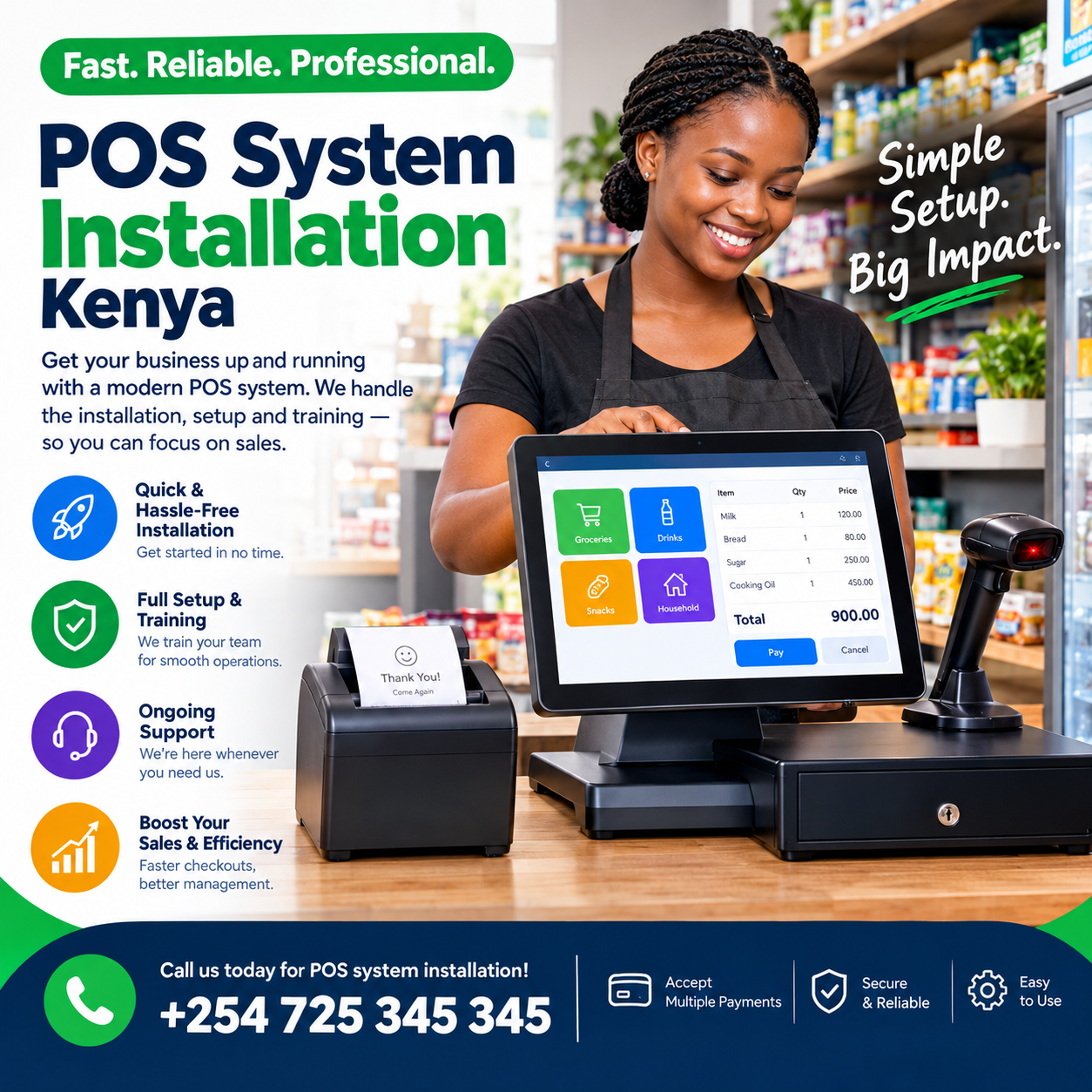
POS system installation Kenya is the stage where most systems are quietly won or lost — because the purchase only becomes a working till on the day someone installs it properly.
Two shops can buy identical systems and meet completely different fates: one opens the boxes, runs a clean weekend, and never looks back; the other fights glitches for months, drifts back to notebooks, and eventually tells everyone the software does not work.
The difference was never the software. It was the installation — who owned it, what it covered, and whether it happened on purpose.
This article walks through that stage end to end: what a professional POS system installation Kenya actually includes, how long it takes, what it costs, where DIY makes sense, and how to choose the team that installs.
By the end, you will know exactly what to demand from installation day — and what it costs you when it is skipped.
POS System Installation Kenya: The Connection Between the Boxes and the Business
A POS system becomes a business tool in three stages: bought, installed, and used. Stage three is where the money is — and stage two is the gate to it.
A proper POS system installation Kenya is therefore not a technical errand; it is the moment your purchase becomes a business. Three properties define a professional installation.
Preparation first: the catalogue, the stock count, and the configuration happen before the counter ever sees the new system. Correctness second: hardware placed and tested, payments run live, and every flow verified with your own products.
Ownership third: a named person responsible for the launch, the training, and the week-one review. A POS system installation Kenya without all three delivers boxes with a login — the most common shape of a failed purchase in this market.
What it is not: plugging in the scanner and handing over credentials, and not a video call and a prayer. The distinction matters because installation quality compounds: every day of clean data, every habit formed correctly in week one, and every payment flow tested properly pays back for the life of the system.
In shops we configure, the correlation is absolute: systems installed with structure run; systems installed ad hoc drift. That is why this article treats installation as a discipline — and why the next section starts with the stage where most installations quietly fail.
Preparation: The Installation That Starts Before Installation Day
The counter is the visible half of any POS system installation Kenya; the invisible half happens days earlier, and it is where the outcome is decided.
The catalogue comes first. Products, units, pack sizes, categories, and cost prices loaded and cleaned before installation day — the single most labour-intensive step, and the one amateurs skip.
A professional POS system installation Kenya treats dirty data as the enemy, because every later report inherits whatever the catalogue carried in.
The opening stock count follows. Counted with the system live, section by section, fast movers first — never estimated, never transcribed from paper after the fact.
Configuration is decided, not improvised. Tax settings, payment channels, user roles, receipt templates, and discount policies — decided by the owner, entered by the installer, and tested before launch.
The launch window is chosen deliberately. A weekday morning, never a Friday, never month-end, never peak season — the POS system installation Kenya scheduling that separates professionals from optimists.
Prepared this way, installation day becomes a confirmation rather than a creation: the counter is switched on, and everything behind it is already true. Unprepared, the same day becomes a scramble — prices missing, stock unknown, the team trained on nothing — and the system starts life with a backlog of errors it may never recover from.
Ask every provider how installation day works, then ask what happens before it: the answer — and the detail behind it — tells you which kind you are buying. The prepared half is also where DIY owners should focus their own effort: the installation team cannot count your stock or clean your catalogue for you if you bring them neither.
Hardware Installation: The Physical Half
Hardware setup looks trivial from the outside and hides a dozen small decisions that shape daily speed.
Placement comes first. Counter height, queue flow, scanner reach, and power access — the POS system installation Kenya ergonomics that decide whether the counter flows or fumbles.
Every peripheral is tested with your products. The scanner reads your crushed cartons and shiny wrappers — not the vendor’s pristine demo box; the printer aligns; the drawer pops on completed sales.
A professional POS system installation Kenya finishes hardware only when a stranger could walk up and sell.
The network is configured, not assumed. The terminal on the strongest connection, the printer connected directly — never through cloud services — and a small UPS keeping the router alive through short power cuts.
Power resilience is part of the install. A battery-backed tablet keeps selling through the blackout that kills a desktop tower — configured on installation day, not improvised after the first outage.
Cables are dressed and secured. The small professional touch that keeps the counter surviving busy Saturdays without anything working loose.
Payment hardware closes the session. M-Pesa flows tested with real transactions, card readers paired and verified, a split payment run end to end — with witnesses.
Ask every installer what their hardware checklist contains: the answer separates teams who install for the counter from teams who install for the photo.
The hardware half of a POS system installation Kenya is also the easiest to verify — you can see it, touch it, and rehearse it before the installer leaves. Never accept a handover that ends before a full test basket has been run: scanned, paid, printed, and reconciled in front of you.
Software Configuration: The Invisible Half
Software configuration is where the system learns your business — and it is the half most DIY installations get wrong.
User roles come first. One login per person, permissions matched to duties, approvals configured — the POS system installation Kenya accountability layer that must exist from the first sale, never after the first incident.
Payment channels are wired and tested. M-Pesa integrated with live triggers, card readers certified, and every payment path verified with real money before the counter opens.
Tax and receipt settings are entered correctly. Business details, tax rates, and receipt templates — the compliance half that a professional POS system installation Kenya gets right the first time.
Pricing policies are encoded. Who may discount, how much, and what always needs the owner — decided in ten minutes now, saving a month of exceptions later.
Offline behaviour is verified. The router unplugged mid-basket, the sale completed, the sync watched — because an installation that skips this test is rehearsing your first outage in front of real customers.
Reports are tuned to what you will read. The daily summary, the exceptions list, the reorder alerts — configured so the POS system installation Kenya delivers the numbers you asked for, not the defaults nobody reads.
Configuration done this way takes an afternoon and pays for years. Done carelessly, it becomes the quiet source of every later complaint — the discount that should have needed approval, the tax line that was wrong for three months, the report that answers a question nobody asked.
Ask every provider to show their configuration checklist: the itemised list is the difference between an installation and an installation story. And never accept default everything: your business is not the template, and a POS system installation Kenya that leaves defaults untouched has not finished its work.
Training: The Step That Decides Everything
Most software failures are training failures wearing a disguise — the till gets blamed for a team that was never taught. Effective training happens on-site, on your hardware, with your products, during a quiet trading window — and it includes everyone who will ever touch the till.
That last part is where installations fail quietly: the part-timer who covers Saturdays, the relative who helps during holidays — untrained, they become the exception that corrupts the data.
A thorough POS system installation Kenya trains for the awkward cases deliberately: refunds without receipts, split payments, discounts needing approval, and the router deliberately unplugged. That last drill matters more than any other — a cashier whose first outage was their tenth rehearsal greets the real one with a shrug.
The champion model multiplies everything: identify the team member who took to it fastest, and let them coach the rest with the trainer’s backing. Measure readiness instead of assuming it: a new hire should complete a three-item sale with M-Pesa payment in under thirty seconds by the end of week one.
Providers of a serious POS system installation Kenya include a refresher session in the second week, because the real questions only surface once real trading begins. Book that refresher at the same time as the installation — teams that schedule it always use it, and teams that leave it open never quite get around to it.
And train the owner too: the owner who cannot read the reports, pull the audit trail, or approve a refund has bought the staff a very expensive calculator. Training is not a cost centre inside the installation — it is the installation, with everything else merely making it possible.
Go-Live Day: Managed, Not Survived
Launch day should be ordinary by design — chosen, rehearsed, and supported rather than endured. A guided POS system installation Kenya launch puts support on call — or on site — for the first trading day, absorbing friction before it becomes folklore.
The morning checklist runs short and deliberate: logins working, printer aligned, scanner reading every barcode category, a test M-Pesa transaction done and reversed, backup receipt rolls in the drawer.
The first real sale is watched, not hoped for: scanned, paid, printed, and reconciled — the loop that proves the whole installation. Close the day deliberately: the first end-of-day reconciliation is the defining moment of the entire project.
When takings match the drawer, stock matches the movements, and the report prints complete, trust is born — and trust is what makes the system stick. If the numbers do not reconcile on day one, resolve it that evening with support, and never let it slide to someday.
Shops that launch with a managed first day consistently report the same thing: by Friday, the till felt like it had always been there. That feeling is the actual product of a POS system installation Kenya — not the cables, but the calm. And the calm compounds: a clean launch week sets the habits, and the habits set the years.
How Long a POS System Installation Kenya Takes
Honest timelines for a typical single shop look like this. Preparation: catalogue build and cleanup, three to seven days, mostly in the background while you keep trading.
Hardware installation and software configuration: half a day to one day on site. Training: half a day with the full team, plus a scheduled refresher in week two. Then a guided first day, with a parallel comparison against the old process for two or three days before full cutover.
All in, a professional POS system installation Kenya typically runs one to two weeks from booking to confident, independent trading. Larger catalogues, multiple counters, or heavy migration stretch that honestly to three or four weeks — not because the work is mysterious, but because it is more of the same careful work.
Treat both extremes with suspicion: a same-day full installation is a login and a prayer, while an open-ended project with no dated plan is a subscription with no destination.
A structured POS system installation Kenya provider gives you a dated plan at booking — preparation day, installation day, training day, launch day, review day — in writing. Dates you can hold someone to are worth more than any promise about quality, because schedules are where intent becomes visible.
Multi-branch installations follow the same shape per branch: pilot the first location fully, then roll the remaining ones in waves — one a week or a fortnight — with the pilot’s team coaching each wave. That sequencing keeps every branch trading while the POS system installation Kenya project advances — the difference between a rollout and a shutdown.
What POS System Installation Kenya Costs
Pricing varies with scope, so let us name the drivers honestly instead of pretending there is one number. Catalogue size is the biggest driver: installing two hundred products and four thousand products are different projects wearing the same word. Number of counters multiplies almost everything, and migration from an old system adds real hours.
Depth of training, whether the stock count is included, and how long go-live support lasts fill out the rest. In this market, many providers include a basic installation — hardware setup, configuration, and one training session — when you buy their hardware and subscription together.
Full professional scope — catalogue build, supervised stock count, configuration, whole-team training, and guided launch — typically runs KES 10,000–50,000, itemised separately. When collecting quotes, insist on an itemised POS system installation Kenya quotation: exactly what is included, what is extra, and what happens when something is not on the list.
Then price the alternative honestly: a system sitting in boxes costs its full price every month while returning nothing. The comparison is never the installation fee versus zero — it is the fee versus the true cost of not installing, paid monthly, indefinitely.
Framed that way, most owners find the professional route is the cheaper one the moment it saves even a single month of idle hardware. A transparent POS system installation Kenya provider will run this arithmetic with you without being asked.
Choosing an Installation Team: The Vetting Test
Bring this script to every provider; it converts promises into evidence in fifteen minutes.
Ask for the dated plan. Preparation, installation, training, launch, and review dates — in writing, before you pay anything; a serious POS system installation Kenya team produces one without being pressed twice.
Ask who does the work. The vendor’s own trained team or a subcontractor — and whether the people who configure the system also train it.
Demand the test basket. A full sale on your products — scanned, paid by M-Pesa, printed, reconciled — completed before the installer leaves.
Ask about the stock count. Is it included, supervised, and performed with the system live — or estimated and left to you?
Probe the offline drill. Will the router be unplugged during training, deliberately — because a POS system installation Kenya that skips this rehearses your first outage in front of real customers.
Confirm the week-one review. A scheduled reconciliation and coaching session, booked together with the installation itself.
Ask for one reference. A business installed in the last six months — and ask that owner a single question: what surprised you?
Red flags are consistent: setup defined as credentials and a video link, training offered as an optional extra, no named person responsible, no dated plan. A confident POS system installation Kenya team names the people, the dates, and the review point — because they have done it enough times to be boring about it. Boring, in this trade, is the highest compliment available.
DIY vs Professional Installation
Let us be fair to doing it yourself, because it genuinely suits some owners.
If your catalogue is small, you are comfortable with technology, you have a quiet week, and you run one location with one or two staff — you can absolutely install it yourself.
The honest middle path suits even more people: the provider handles the catalogue, configuration, and training, while you handle the stock count and daily running.
DIY fails predictably in the opposite conditions: peak season approaching, a thousand products, several staff, and no quiet week anywhere in sight.
The true cost of DIY is your own hours at their real value, plus the error risk on data you have no experience cleaning.
Three lost weekends at an owner’s hourly worth frequently exceed the professional fee — before counting the first error that survives undetected.
Run both columns honestly, and the POS system installation Kenya decision usually makes itself.
There is also a hybrid worth naming: start with a guided professional installation, then take over confidently once the foundation is true.
Most owners who attempt full DIY after a struggle end up paying for the installation anyway — plus the months of bad data in between.
Paying once, in the right order, is the whole trick — and a professional POS system installation Kenya is simply the trick, sold as a service.
After the Installer Leaves
The handover is a beginning, and the first week has its own rhythm.
Days one and two: everyone uses the system, you stay close to the counter, and small questions go to support rather than to improvisation.
A POS system installation Kenya engagement includes exactly this window — use it freely, because questions asked now cost minutes while questions deferred cost days.
Day three: run your first real stock receiving with a live supplier delivery, scanned in against the invoice — the habit that forms on a real document lasts forever.
End of week one: the scheduled review — reconcile takings, compare one shelf against the system, and correct the small drifts while they are still small.
At month one, audit three things: stock accuracy on a random shelf, the exception report for the month, and counter speed during a rush.
Owners who ran a structured POS system installation Kenya launch find this audit a confirmation rather than a discovery.
Then let the system compound: reorder from data, price from margins, promote from evidence — the returns the whole installation was for.
And when something odd surfaces in month three, call support while it is small — the POS system installation Kenya relationship you paid for includes exactly these moments.
The shops that thrive are rarely the ones with the best hardware — they are the ones whose first month was handled properly.
Mistakes That Turn Installations Into Struggles
Five patterns catch owners first; learn them here without paying for them.
Installing during peak season. Training a distracted team in December is training nobody — schedule the POS system installation Kenya launch for a shoulder month and thank yourself later.
Importing a messy catalogue as-is. Duplicates and inconsistent names become permanent residents — clean first, install once, and let the counts mean something from day one.
Creating one shared login. Accountability dies the moment actions have no name — the POS system installation Kenya exception report becomes decorative on day one.
Skipping the parallel run. Two or three days of comparing the new system against the old process catches the one pricing rule that translated wrong.
Treating owner training as optional. If only the staff know the system, you cannot audit it — and an audited system is most of its value.
A sixth worth naming: launching everything at once across branches — the shop that cuts over all locations in one weekend discovers every flaw simultaneously at maximum volume; pilots and waves exist precisely to prevent that.
Owners who avoid these five get what a proper POS system installation Kenya promises and few deliver completely: a launch that feels routine, data that starts true, and a team confident by Friday.
Frequently Asked Questions
What does a professional POS system installation Kenya include?
The full scope covers catalogue build, supervised opening stock count, hardware placement and testing, software configuration, payment setup with live tests, whole-team on-site training, a guided launch day, and a week-one review.
Insist on an itemised POS system installation Kenya quotation so you can see which parts are included and which cost extra.
How long does installation take?
One to two weeks for a typical single shop — background preparation, half a day of installation, half a day of training, and a short guided launch — with bigger catalogues or branches stretching honestly to three or four weeks.
A structured POS system installation Kenya provider puts every date in writing at booking.
Can I install the POS myself?
You can — it suits small catalogues, confident owners, and quiet schedules — but know the real price: your hours at their true value, plus unclean data surviving undetected.
Many owners land on the hybrid: professional POS system installation Kenya scope for the catalogue, configuration, and training, with the stock count and daily running kept in-house.
Does installation include M-Pesa and payment testing?
It must — with real transactions processed and reversed in front of you before the installer leaves: cash, M-Pesa, card, and a split payment.
Any POS system installation Kenya handover that skips live payment testing is handing you your biggest daily risk untested.
What happens if something goes wrong in the first week?
With a professional installation, week one is covered by defined support: a reachable person, a scheduled review, and defects fixed at no charge.
Confirm that window in writing before signing your POS system installation Kenya agreement — it is the difference between a launch partner and an invoice.
Is installation worth paying for separately?
Almost always — the installation is what converts your purchase into a working system, and skipped installations are the most common reason POS purchases fail in this market.
The first clean month after a proper POS system installation Kenya — every figure agreeing, every habit formed right — is typically when owners stop asking whether the fee was necessary.