 Vega
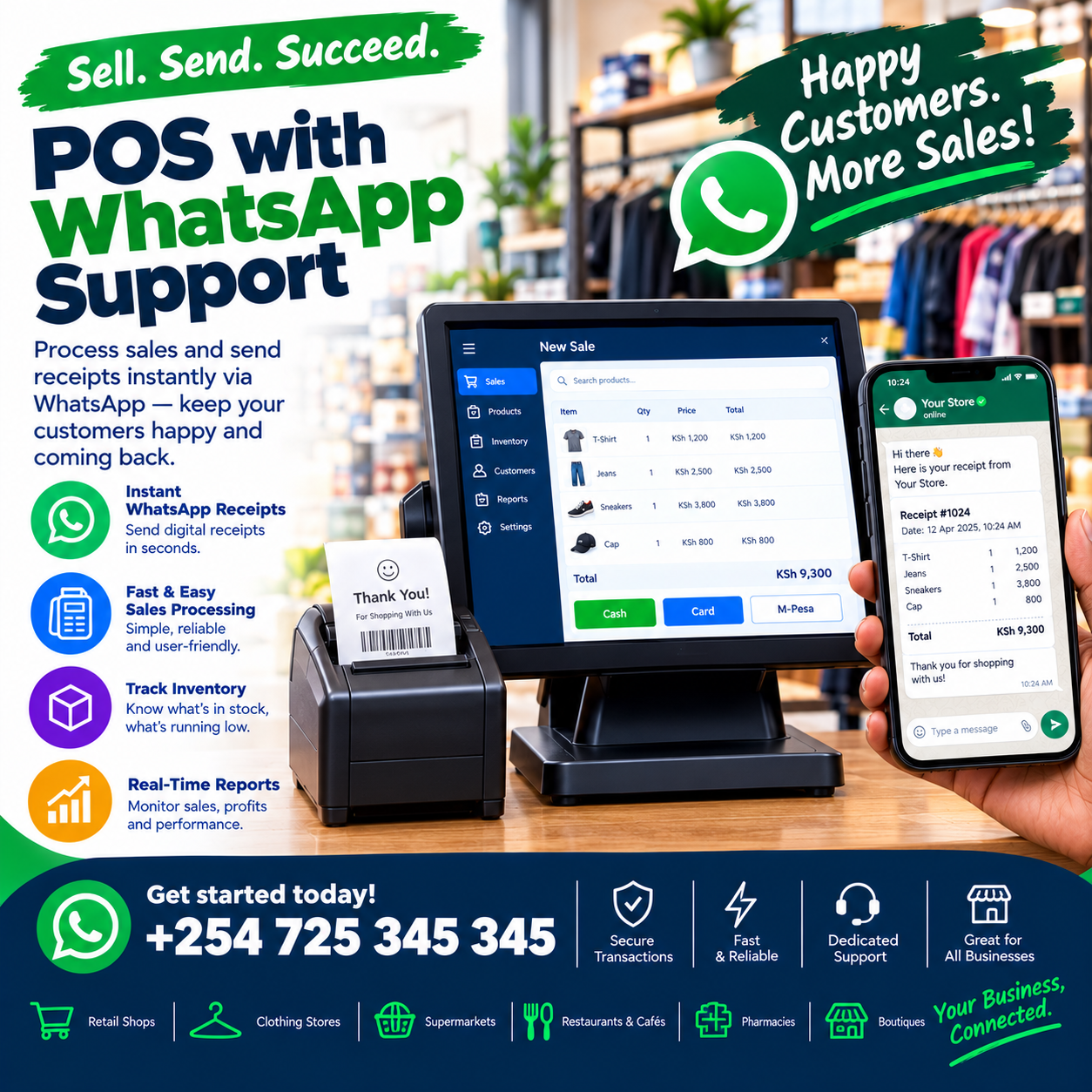
POS with WhatsApp support is the difference between owning a till and owning a team behind it — because the day your system misbehaves at 11 a.m. on a Saturday, the only feature that matters is who answers.
Every POS will fail you eventually: a printer jams, a price refuses to change, a receipt misaligns, a login stops working, a report will not open.
The question is never whether the moment arrives — it is what happens in the first ten minutes after it does.
On a call-centre system, it becomes a queue, a reference number, and a callback tomorrow.
On email support, it becomes a ticket answered after close of business.
On a genuine POS with WhatsApp support, it becomes a message, a reply in minutes, and often a fix before the next customer steps forward.
This article explains what WhatsApp support actually means when it is done properly — the response standards, the named humans, the things resolvable by message versus things needing a visit, and the support lifecycle from onboarding to year three.
Then the red flags, the demo test, the rollout, and the worth.
By the end, you will judge every provider with one question: will they answer on the day I actually need them?
POS with WhatsApp Support: The POS Connection
Support is not an accessory to a POS — it is half the product.
The software and the hardware are what you buy; the support is what you live with, and you live with it every trading day.
That is why a genuine POS with WhatsApp support treats the support channel as part of the architecture: designed, staffed, measured, and improved like any other feature.
Three properties define the real thing.
Reachability first: a named channel that answers during trading hours — including the weekends and holidays when shops actually trade and systems actually misbehave.
Speed second: response times measured in minutes, not business days — because a counter with a queue cannot wait for a ticket queue.
Capability third: the person replying can actually fix things — guide a fix, push an update, adjust a setting, or dispatch help — not just log a complaint.
A POS with WhatsApp support without all three is a reassurance, not a service.
What it is not: a generic WhatsApp number shared with sales, a bot that loops you back to email, and not the owner’s personal phone that goes quiet whenever they travel.
The distinction matters because support failures compound: the printer that sat broken for three days trained your staff to stop trusting the till — and distrust, once seeded, is expensive to reverse.
The costs of bad support are also quiet, which is why they are underestimated.
A question deferred is a habit improvised: staff work around the fault, the workaround corrupts the data, and the report inherits the noise.
A report nobody trusts gets ignored, and a report nobody ignored is a shop running blind — all traced back to one unanswered message.
In shops we configure, owners consistently name support as the real difference between systems they stayed with and systems they abandoned — the POS with WhatsApp support factor that outlasts every feature on the comparison sheet.
The feature list decides what the system can do.
The support decides what it actually does, every day, in your shop.
That is why this article spends its length on the channel — because the channel is where your purchase succeeds or quietly dies.
Why WhatsApp Support Wins in This Market
The channel matters as much as the reply — and in Kenya, WhatsApp is not one option among many; it is the way business actually communicates.
Your staff already live on it. Your suppliers already trade on it. Your customers already buy on it.
A support channel that lives where your team already is removes every barrier that kills traditional support: no call credit anxiety, no hold music, no formal email nobody checks.
A genuine POS with WhatsApp support meets the counter where the counter already is.
Messages carry context that calls cannot. A photo of the error on the till screen, a short video of the printer misbehaving, a screenshot of the report that will not load — the POS with WhatsApp support conversation starts with the evidence attached, not with five minutes of describing it.
Voice notes bridge literacy and language. A cashier who struggles to type the problem can hold a button and explain it — and the support person hears exactly what happened, in the words the floor actually uses.
The thread is the record. Every fix, every instruction, every exchange stays searchable in one place — so the same fault recurring in June is answered by scrolling to March, the POS with WhatsApp support history that no phone call ever leaves behind.
Asynchronous by design. The question is sent the moment it arises; the answer arrives while the sender keeps working — no hold music holding the queue hostage.
Group threads serve teams. The owner, the champion, and support in one conversation: questions answered once, visible to everyone who needs them — the POS with WhatsApp support transparency that spreads knowledge through the shop instead of parking it in one head.
Compare that honestly with the alternatives: call centres that open tickets and close shops, email answered after hours, and in-person visits scheduled for next week.
None of them match the speed, the evidence-richness, or the permanence of a message thread.
And the deeper point: support that is easy to reach gets used early, and early questions are cheap questions — the problems caught on WhatsApp on Tuesday never become the crises of Saturday.
The adoption effect deserves its own line: counters whose staff message freely build cleaner data, cleaner reports, and cleaner books — because the small confusions get corrected before they harden into wrong habits.
That is why the best POS with WhatsApp support providers made the channel primary rather than an afterthought — and why the ones who did not are finding their clients drifting away.
What Good WhatsApp Support Looks Like
Not all WhatsApp support is equal — the market sells everything from a bot to a full helpdesk under the same label.
Here is the anatomy of the genuine version, component by component.
A named human, not a bot. You know the person who answers — or at least the team — and they know your shop, your setup, and your history: the POS with WhatsApp support relationship that turns every query into a conversation instead of an interrogation.
Response times stated and kept. Minutes during trading hours, not business days — with weekend and holiday cover stated in writing, because a POS with WhatsApp support promise that excludes Saturdays excludes the day you will need it most.
Fix capability, not ticket-taking. The person replying can walk a fix step by step, push a setting change, resend a configuration, or escalate internally with context — the POS with WhatsApp support depth that resolves most issues without a visit.
Rich media troubleshooting. Photos, videos, screen recordings, and voice notes flowing both directions — the support person recording a thirty-second clip of the exact fix, which your cashier watches and copies.
Trading-hours alignment. Support that lives in your hours: early mornings before opening, evenings past close, and the Sunday before a Monday promotion — a POS with WhatsApp support schedule built around retail, not around office hours.
Escalation with memory. When an issue needs engineering, it escalates with the whole thread attached — no starting over, no re-explaining, no context lost between levels.
Proactive messages. The best providers message you before you message them: maintenance windows, update notes, and a check-in after any outage in your area — the POS with WhatsApp support posture that treats you as a client rather than a ticket number.
Follow-up discipline. The thread that solved a fault gets a check the next day: is it still behaving? — the POS with WhatsApp support habit that separates teams who close issues from teams who close conversations.
Ask every provider to describe their support in exactly these terms — then verify each claim in the demo test later in this article.
The honest summary: good WhatsApp support feels less like a helpdesk and more like a technically strong friend who happens to run the same software in a hundred shops like yours.
That feeling is buildable — and it is the standard worth holding every POS with WhatsApp support candidate to.
The Team Behind the Channel
The thread is only as good as the people answering it — and who sits behind the number is the question most owners never ask.
A genuine POS with WhatsApp support team is built deliberately, and the build shows in every reply.
Retail-experienced responders. The people answering have stood behind counters, run stock counts, and closed shifts — they speak the floor’s language, not a manual’s: the POS with WhatsApp support fluency that turns a vague complaint into a precise fix.
Engineers within reach. The first line escalates to the people who build the product — with the thread attached and the context intact — so the hard questions reach real answers the same day.
Continuity of knowledge. The same team supports you in month one and month eighteen: your setup, your history, your quirks — the POS with WhatsApp support memory that makes every year faster than the last.
Training culture inside the team. Support staff rehearse the product daily, read every thread, and learn from each other’s fixes — the discipline behind the POS with WhatsApp support replies that arrive already knowing.
Accountability at the top. When a response time slips, someone senior notices — because support metrics are reviewed like sales metrics, not treated as a cost centre.
Ask every provider who exactly answers their number: job roles, experience, and how long the team has been in place.
The answers — fluent or fumbling — tell you whether you are meeting a helpdesk or a rotating stranger.
And ask the retention question: how long has your longest-serving support person been answering?
A team that stays is a team that knows its clients — and the POS with WhatsApp support relationship you actually want is one that compounds rather than resets.
The deepest version of this is cultural: providers whose founders still read support threads build channels that never decay. That is the standard beneath the standard — and it is visible in the very first message you send.
What Resolves on WhatsApp — and What Needs a Visit
Honest support knows its limits: most issues die in the thread, some need hands, and pretending otherwise is how trust breaks.
Resolvable by message — the majority. Configuration changes, price and tax corrections, user additions, permission adjustments, receipt template edits, report questions, sync issues, and most printer or scanner behaviour — a capable POS with WhatsApp support resolves these in minutes, guided step by step or fixed remotely.
Resolvable with rich media. The fault you cannot describe but can film: the misaligned receipt, the stuck drawer, the error screen — a short video to support, a short video back showing the fix, done.
Resolvable remotely. Platform-side settings, account corrections, data fixes, and software updates pushed overnight — the POS with WhatsApp support issues that never needed anyone to travel at all.
Needing an on-site visit — the minority. Failed hardware, network rewiring, new counter installations, and physical replacements — which is why the provider’s proximity and spare-parts stock matter alongside the channel.
The split that matters is the ratio: on well-run systems, the overwhelming majority of support events close inside the thread — and the on-site visits are planned, not panicked.
Ask every provider what percentage of their support closes by message — the confident POS with WhatsApp support answer is high, specific, and backed by examples.
And ask the follow-up: when a visit is needed, how fast — and from where?
A provider with engineers in your town answers in hours; one coordinating from another region answers in days — and the difference is measured in trading.
The thread also serves the visit: the technician arrives already knowing the history, the attempts made, and the evidence collected — the POS with WhatsApp support efficiency that turns site visits from diagnostics into solutions.
One boundary deserves honesty: sensitive actions — data corrections, password resets, ownership changes — should carry identity verification inside the thread, because a support channel that moves money-adjacent settings must also be a secure one.
A capable POS with WhatsApp support team has that discipline built in, and will describe it without being asked.
WhatsApp Support vs the Call Centre
The two models deserve a direct comparison, because most providers still offer the call centre and call it support.
The call-centre evening. You call, a voice collects your details, a ticket is opened, and a promise to call back is made — the callback arrives tomorrow, after the trading day it was needed for is already lost.
The WhatsApp evening. You message with a photo attached, a reply lands in minutes, the fix is walked through live, and the thread records the whole exchange — the POS with WhatsApp support version of the same fault, ending before the queue notices.
The differences are structural, not stylistic.
Evidence: a call carries only words, while a thread carries photos, videos, and screenshots — the POS with WhatsApp support channel that starts half-solved.
Memory: calls vanish into notes, while threads persist — the fix from March is still readable in June.
Queue theory: a call centre rations attention through hold music, while a messaging team absorbs questions asynchronously — three shops can ask at once, and none of them waits on a line.
Cost to the asker: a call costs airtime and the cashier’s full attention; a message costs a thumb and keeps the counter moving.
And the recovery difference: when the first reply does not solve it, the thread continues from where it stopped — while a call back restarts from the beginning, with a stranger.
None of this makes calls useless — for urgent, complex, or emotionally hot moments, a live voice has real value.
The strongest POS with WhatsApp support providers offer both: WhatsApp as the default rail, and a call path for the moments that deserve one.
Ask every provider how the two fit together in their service — the answer that describes a designed system, not a compromise, is the one built for years.
Support Metrics That Matter
Quality support is measured, not promised — and the numbers worth knowing apply to both sides of the thread.
Response time. How long from your message to their first reply — the POS with WhatsApp support metric that matters most, because the first reply tells you someone has picked up the problem.
Resolution time. How long from first reply to the issue actually solved — faster to reply is good; faster to resolve is the real score.
First-contact resolution. The share of issues fixed in the thread without escalation or repetition — the POS with WhatsApp support figure that separates knowing teams from forwarding ones.
Recurrence rate. How often the same fault returns — a fix that sticks is a fix; a fix that fades is a deferment wearing a solution’s clothes.
Coverage consistency. Response times on Saturday compared to Tuesday — the POS with WhatsApp support gap between the two is where most providers hide their weakness.
Keep your own light log from day one: dates, issues, response times, outcomes — thirty days of it gives you your provider’s real profile, not their brochure’s.
Then use it: renewal conversations, upgrade decisions, and reference requests all sharpen when your experience has numbers attached.
Ask every provider which metrics they track internally — a serious POS with WhatsApp support team answers with the same list above, reviewed weekly.
The ones who measure are the ones who improve; the ones who do not are the ones you will be describing to their replacement provider.
Metrics turn support from a feeling into a fact — and facts are what long relationships are built on.
WhatsApp Support Through the System’s Life
Support is not one service — it is four, wearing the same channel, across the life of your system.
Onboarding support. The setup weeks: catalogue questions, configuration choices, and the small confusions of a new system — answered in minutes, so the foundation is built right, with a POS with WhatsApp support team walking beside you rather than after you.
Launch-week support. The most delicate days: the first close, the first delivery, the first rush — questions asked now cost minutes while questions deferred cost days, and the responsive channel is what makes asking easy.
The steady state. Daily trading: the odd question, the quarterly retune, the report you cannot quite read — the POS with WhatsApp support relationship that keeps the system aligned with the shop as both evolve.
The growth phases. The second counter, the new branch, the online channel — each expansion surfaces fresh questions, and the thread that already knows your setup answers them without a history lesson.
The crisis moments. The outage, the failure, the Saturday panic — measured by minutes-to-first-response and the quality of the first reply, which is when you finally learn what you bought.
Each phase tests the channel differently: onboarding tests patience, launch tests speed, the steady state tests knowledge, growth tests flexibility, and the crisis tests everything at once.
Ask every provider how their support changes across these phases — a serious POS with WhatsApp support team describes distinct coverage for each, because they have lived all five.
And ask for the crisis story: the worst failure a client had, and how the thread handled it.
The answer — fluent, specific, and slightly proud — is the single most revealing support question in this market.
Because the provider you choose is really the teammate you will message for years — and the POS with WhatsApp support channel is where that partnership either proves itself or quietly disappears.
The Red Flags: Support That Only Looks Like Support
The market’s pretenders signal themselves early — learn the tells here for free.
Red flag one: the number belongs to a salesperson. Fast replies before the sale, silence after it — the POS with WhatsApp support channel that was really a closing tool all along.
Red flag two: a bot answers, always. Menu options, auto-replies, and a loop back to email — automation has its place, but a channel with no human behind it is not support.
Red flag three: response times measured in days. The reply that arrives tomorrow helps nobody whose counter froze today — a POS with WhatsApp support promise worth having states minutes, in writing.
Red flag four: no weekend cover. Shops trade hardest on weekends and systems fail accordingly — support that keeps office hours has declared your Saturday someone else’s problem.
Red flag five: every answer is come for training. Real questions deserve real answers in the thread; deflection to paid sessions or visits is the POS with WhatsApp support version of not knowing.
Red flag six: the thread resets with every question. No history, no memory, no continuity — you re-explain your setup to a stranger weekly, which means nobody is actually keeping score.
Red flag seven: blame-shifting in the replies. The printer is the maker’s fault, the network is your fault, the settings are the staff’s fault — a POS with WhatsApp support channel that owns nothing solves nothing.
Read these seven tells and most of the market’s pretenders remove themselves in a single week of questions — which is exactly what the demo test in the next section formalises.
In shops we configure, owners who arrived after a bad support experience all describe the same regret: the tells were visible before they signed — they just did not know to look.
That looking costs one message and one day — and it is the highest-yield POS with WhatsApp support test an owner can run.
Choosing a POS with WhatsApp Support: The Demo Test
Bring this script to every provider; it converts promises into evidence in one week — without paying anything.
Message the support line during demo week. Before you have paid anything, with a real question about the product — the response time you experience is the response time you bought, and it is the single most predictive test of any POS with WhatsApp support.
Ask a technical question, not a sales one. How a report works, how a setting behaves, what happens offline — the quality and speed of that answer reveals whether engineers or salespeople sit behind the number.
Send a photo and a voice note. Ask something easiest shown than typed — and watch whether the POS with WhatsApp support reply matches your format, because rich-media fluency is a trained habit, not an accident.
Ask for the response-time commitment in writing. Trading hours, weekend cover, holiday cover — the POS with WhatsApp support terms that decide year two, confirmed before signing rather than discovered in a crisis.
Ask who replies. A name, a role, a team — and whether the same people support you after go-live, or disappear the moment the invoice clears.
Request one crisis story. The worst failure a client has had, and how the thread handled it — the POS with WhatsApp support answer that separates providers who have carried shops through bad days from providers who have never been tested.
Ask the split. What percentage of issues closes in the thread, and how fast does a visit arrive when one is needed — the POS with WhatsApp support numbers that describe the whole service in two figures.
A provider who welcomes this script has built support as a product; a provider who steers toward the demo is selling one.
Then weigh the silent signal: how fast did they answer before you were a customer?
That number is their best behaviour — and their worst will be slower, which makes the POS with WhatsApp support decision simpler than any feature comparison.
Rolling Out With Your Support Team
The support relationship starts before go-live — and the rollout is where it either forms or fails.
Save the support number as a named contact on the shop phone and the owner’s phone from day one: a POS with WhatsApp support channel nobody can find is a channel nobody uses.
Introduce the champion to the support team by name during training week — the peer who will ask most of the questions, and knowing who answers them changes everything.
Set the questions culture deliberately: ask early, ask small, ask anything — the teams that message freely in week one build systems that run cleanly in month twelve.
Agree the escalation path together: what you handle in the thread, what becomes a visit, and who decides — the POS with WhatsApp support boundary that keeps small issues small and big issues fast.
Keep the thread disciplined: one issue per conversation, screenshots attached, outcomes noted — the hygiene that makes the history searchable when it matters.
And keep your own log lightly: recurring faults, slow responses, patterns — the POS with WhatsApp support notes that turn your experience into leverage at renewal time.
Book the week-one review with support included: reconciliation, drift correction, and the questions that real trading always surfaces — scheduled together with the installation.
A structured rollout with a live support channel typically runs one to two weeks to confident independent trading — and the support thread from those weeks becomes the shop’s first operations manual, written in its own words.
That document — your questions, their answers, your history — is worth more than any generic guide: it is the POS with WhatsApp support relationship made visible, one message at a time.
Mistakes Owners Make
Five patterns catch owners first; learn them here without paying for them.
Testing support after signing instead of before. The free question during demo week is the cheapest insurance in this market — a POS with WhatsApp support promise verified before payment, discovered after, or regretted forever.
Saving the support number nowhere. The crisis at 11 a.m. is the wrong moment to search for the contact — named, saved, and visible on every device from day one.
Bottling questions at the counter. Staff who improvise instead of asking corrupt the data quietly — a team encouraged to message the POS with WhatsApp support channel freely builds cleaner systems and cleaner books.
Accepting bot-only channels. Automation that triages is fine; automation that replaces humans is a wall — insist on a named person behind every POS with WhatsApp support number you are asked to trust.
Not keeping the thread history. The conversation that solved March’s printer is the answer to September’s — delete it and you pay for the same lesson twice.
A sixth worth naming: judging support by the salesperson’s speed — the pre-sale replies are always fast; the test that matters is the technical question sent after the demo, before the deposit.
And a seventh: treating support as an emergency service only — the shops that thrive message about small things early, which is precisely why they never have big things to message about.
Owners who avoid these five get what a genuine POS with WhatsApp support relationship promises and few deliver completely: answers in minutes, fixes without visits, and a teammate who knows their shop by name.
What WhatsApp Support Is Worth
Price the return honestly, because support is measured in avoided disasters and recovered hours.
The recovered trading. The printer fixed in ten minutes instead of three days, the price corrected before the promotion, the outage navigated with guidance — every POS with WhatsApp support intervention is a trading day that did not die.
The prevented crises. Questions asked early are problems solved small — the thread culture that catches the loose habit in week two, before it becomes the corrupted report in month six.
The retained confidence. Staff who trust the till because help actually arrives — the POS with WhatsApp support adoption effect that keeps the system used and the data clean.
The compounding relationship. A support team that knows your shop, your setup, and your history answers faster every year — the POS with WhatsApp support advantage that grows instead of depreciating.
The costs are modest: quality support rides inside the normal subscription — typically KES 3,000–7,000 monthly for mid-tier platforms — with no separate product to buy.
Against that, a single prevented dead Saturday usually covers a year of the subscription — before counting the daily confidence of knowing help is one message away.
The compounding line is the archive itself: years of threads become your shop’s private manual — every fault, every fix, every answer — the POS with WhatsApp support asset that makes each year easier than the last.
Frame it the way the best owners do: you are not buying software with support — you are buying a partner with software, and the WhatsApp thread is where that partnership lives daily.
Frequently Asked Questions
What is a POS with WhatsApp support?
It is a point-of-sale system whose provider answers, troubleshoots, and resolves issues through WhatsApp — with named humans, stated response times, trading-hours and weekend cover, and the capability to fix most problems inside the thread. A genuine POS with WhatsApp support service is verified before you sign: message the line during demo week and time the reply.
How fast should a provider reply on WhatsApp?
Minutes during trading hours is the standard worth demanding — with weekend and holiday cover stated in writing, because retail fails on the days offices close. Test the actual response time yourself before signing any POS with WhatsApp support agreement.
What kinds of problems can be fixed over WhatsApp?
Most of them: configuration changes, pricing and tax corrections, user and permission adjustments, report questions, sync issues, and most printer or scanner behaviour — guided step by step or fixed remotely. Hardware failures and installations are the minority that need visits — ask each POS with WhatsApp support provider what their split looks like.
How is this different from a normal helpdesk?
Speed, evidence, and memory: photos, videos, and voice notes carry the problem instantly; replies arrive in minutes; and the thread keeps every fix searchable forever. A call centre opens tickets; a genuine POS with WhatsApp support service closes problems.
Should support be free or paid per message?
Included in the subscription is the standard worth holding — support billed per incident inverts every incentive, and one teething month can erase a year of savings. Confirm that the POS with WhatsApp support channel rides inside the plan, in writing, before you sign.
Is WhatsApp support enough without in-person visits?
For the overwhelming majority of issues, yes — and the provider’s proximity matters only for the hardware failures and installations that genuinely need hands. Choose a POS with WhatsApp support provider who is strong in the thread and near enough to visit — the two together are the complete service.