 Vega
Consignment stock reconciliation starts with a shelf that looks ordinary. A supplier leaves forty handmade notebooks at a bookshop. Staff also have fifteen similar notebooks bought outright. A customer cannot tell who owns the goods by looking at the shelf, but the buyer must be able to tell before reporting sales or sending a settlement statement.
Give the two groups separate references in a fictional demonstration. Ask the supplier and shop to agree how receipts, returns, damage and settlement will be evidenced. Their agreement determines the rules; a POS label cannot create them. Test the physical count and ownership record independently before asking anyone to calculate what is payable.
Consignment stock reconciliation in four decisions
Use the four decisions below as a tabletop exercise. The case is fictional. Each decision pairs a new scenario with field notes drawn from a linked guide in our library. Read the scenario aloud first, and ask the next person to explain the result before consulting the notes.
1. Receive custody without guessing ownership
The delivery note says forty consigned notebooks. Count the actual goods, identify their owner and record the agreed receiving location. A delivery of thirty-eight against a note for forty needs a discrepancy record, not an invented receipt for two missing units.
Ask the receiver to show where a purchased notebook of the same colour would be recorded. If the system cannot distinguish ownership in a useful report, discuss separate product references, bins or an agreed supporting register before selling the mixed stock. A tick beside “delivered” answers a different question from “whose stock is this?” Consignment stock reconciliation begins at receipt, while the owner and physical quantity are still independently verifiable.
Field notes from our partial delivery tracking guide:
Count the physical delivery independently
Use the normal receiving checks for every arrival, even when the delivery note looks familiar. Compare physical goods with the document and the relevant order lines. Check product identity, unit and visible condition. A second delivery can contain a different mistake from the first, so it should not inherit approval automatically.
Use consistent units in partial delivery tracking
Choose a clear quantity basis for comparisons. If the order uses cartons and the shelf record uses individual units, confirm the relationship and record it consistently. Packaging changes may alter the relationship, so do not assume that every carton contains the same quantity across suppliers or dates.
Give each receipt its own evidence
Keep a distinct receiving reference for each arrival. Record the date, related order, accepted lines, quantities and any exception. Link the supplier’s delivery document where appropriate. This allows the team to reconstruct the sequence without treating the latest document as a replacement for everything that happened earlier.
Hand over open deliveries between shifts
Include the order, latest receipt, outstanding lines, expected next event and owner in the handover. Refer to the complete record for detail. A short structured note is more useful than a long conversation that the next receiving employee may never hear.
2. Identify the unit that was sold
Sell seven consigned notebooks using the test reference. Then sell two purchased notebooks. The till should show nine units sold across both groups, but only seven belong in the supplier’s consignment sales statement.
Scan a sample from each group and compare the receipt line with the underlying ownership record. If both select a generic blue notebook, no amount of arithmetic at month end can tell you which units were consumed. Decide how staff will identify the correct stock at checkout and how the supervisor will detect a mistaken selection while the physical evidence remains available. The ownership reference matters to consignment stock reconciliation even when two notebooks retail for the same price.
Field notes from our barcode label checks guide:
Separate product labels from shelf information
A product barcode identifies an item or unit within the agreed process. A shelf label may also show a price, location or promotional message. Treat those functions separately during barcode label checks. An accurate shelf description does not prove that the product sticker underneath it belongs to the same record.
Test scans at the actual counter
Use the scanner and counter position that staff normally use. Try the label on the real package, not only as a flat sheet held close to the device. Curved packaging, shiny surfaces and awkward placement can make a label harder to read during normal handling.
Place labels where people can use them
Agree a sensible label position for each packaging type. Staff should find it without covering important product information or opening the package. Avoid folds, seams and places likely to rub against shelves. If a supplier code remains visible beside your own label, demonstrate which code staff should scan and why.
Train the exception routine
Show cashiers what to do when scanning fails during a queue. They need a supported search method and a clear way to confirm the selected item. Picking the first similar description may complete the sale quickly while creating a stock error that appears much later.
3. Account for returns and damage separately
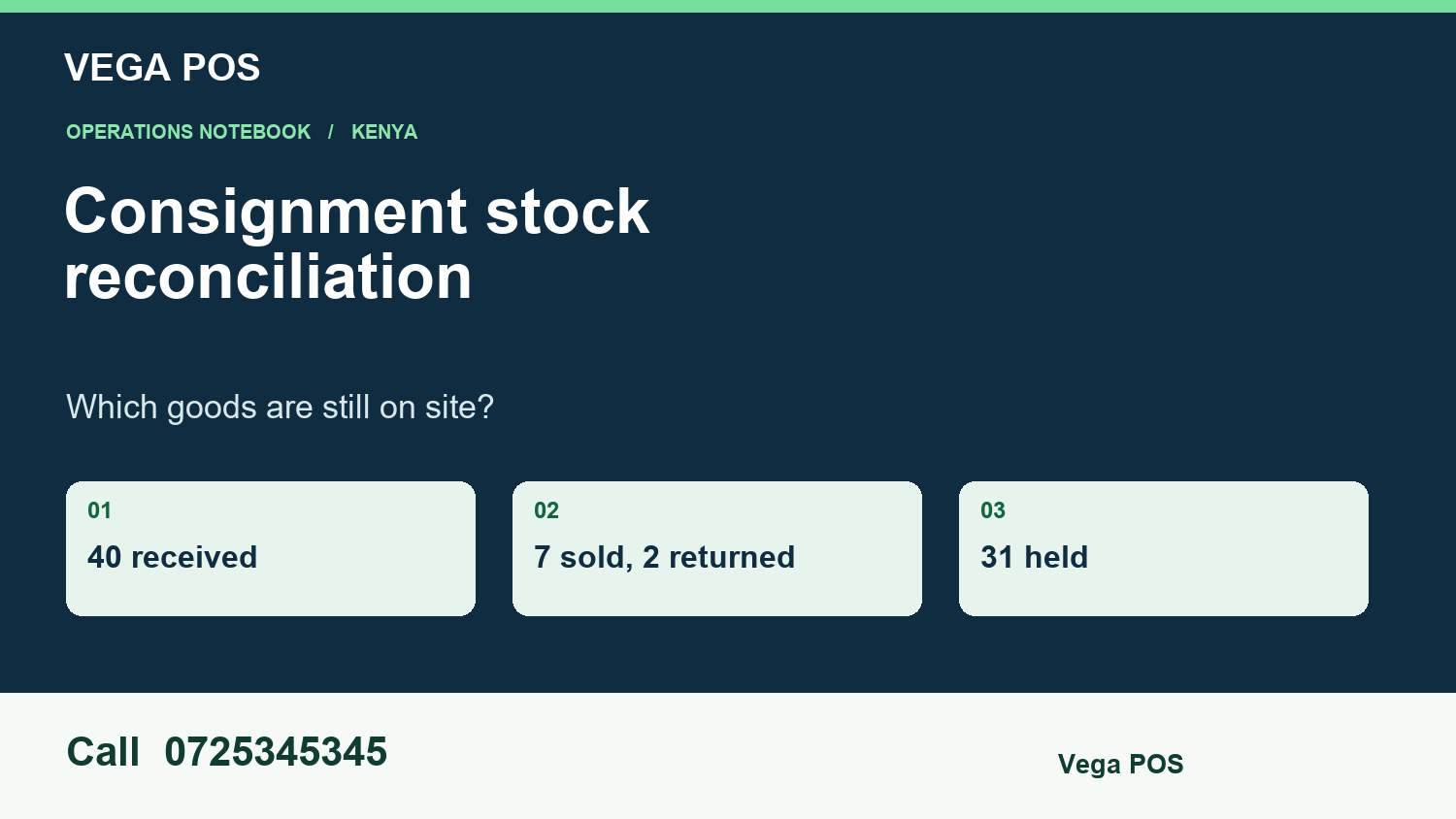
After the seven sales, two unsold notebooks are returned to the supplier and one is found wet. From forty accepted units, thirty-one remain physically at the shop: forty less seven sold and two returned. Of those thirty-one, thirty are currently fit to sell if the wet one is isolated.
Damage does not by itself prove who bears the cost or whether the supplier has accepted a claim. Keep the physical movement, condition decision and any settlement decision separate. If someone subtracts the wet notebook twice, the bookshop will appear to owe a unit that is still in its possession. During consignment stock reconciliation, distinguish unsaleable units still on site from units physically returned to the supplier.
Field notes from our retail damaged stock guide:
Identify the affected product precisely
Confirm the internal product reference, description, unit and relevant batch information where available. Similar packaging can hide different sizes or variants. A note saying three damaged boxes may be unclear if one box contains multiple selling units. Record both the physical packaging and the quantity basis used in the stock record.
Compare the item with your catalogue before entering a change. The supplier catalogue cleanup guide helps with confusing supplier descriptions and product mappings. Retail damaged stock should remain connected to the correct product identity throughout review, return or another authorised outcome.
Give the review a named owner
Assign someone who can investigate or route the case to the right decision maker. Include a review date and a practical next action, such as checking the delivery record or asking the supplier about its returns procedure. A case described only as pending tends to remain pending because nobody knows what should happen next.
Learn from repeated retail damaged stock cases
Review recurring patterns by product, handling stage and location. Repeated torn packaging near one shelf may suggest a storage problem. Repeated incoming issues may require a supplier discussion. Treat these as questions to investigate, not proof of a cause based on a small number of observations.
4. Explain the supplier statement
Prepare a statement for this one supplier, reference and period. Show forty accepted, seven sold, two returned, thirty-one physically held and one of the remaining units under condition review. Ask the supplier to identify which entries require agreement and which merely report quantities. A selling price printed on a customer’s receipt may not equal the amount due under the agreement.
Apply the agreed settlement basis separately and retain its reference. The shop should be able to amend an incorrect sale classification without erasing the evidence that supported the first statement. Keep differences visible until both sides can explain them. A useful consignment stock reconciliation ends with a statement both parties can read without relying on the cashier’s memory.
Field notes from our supplier lead time review guide:
Define the event that ends the period
Goods arriving at a gate, being counted and becoming available for sale are not always the same event. Choose the endpoint that answers your business question and state it clearly. A buyer planning stock availability may need to understand receiving and inspection time as well as the physical delivery date.
Where several endpoints are useful, record them separately. Do not change the definition from order to order because one date is easier to find. Supplier lead time review should allow another employee to reproduce the comparison and explain what the resulting duration includes and excludes.
Treat split deliveries explicitly
An order may arrive in several parts. Decide whether you are measuring the first usable receipt, complete fulfilment or both. Those measures answer different questions. The first receipt may allow some sales to continue, while the missing balance may still prevent an important customer order from being completed.
Compare similar purchasing situations
Routine replenishment, specially sourced goods and urgent orders may have different expectations. Group records sensibly before comparing performance. A supplier handling an unusual product should not be judged against an ordinary stocked item without explaining the difference. The goal is a useful planning reference, not a ranking that hides important context.
Consignment stock reconciliation count sheet
Before running the example, cover the expected results and ask a colleague to predict them. Use the disagreements to decide which rule needs explaining. These are fictional test cases; use your own approved references for the real procedure.
| Test condition | Expected evidence |
|---|---|
| Accept forty consigned notebooks | Supplier reference, ownership and receiving location are identifiable before sale. |
| Sell seven consigned and two purchased notebooks | The supplier’s statement includes seven sales, while the total shop sales report includes nine. |
| Return two unsold units and isolate one wet unit | Thirty-one consigned units remain on site. Thirty are immediately saleable in this example. |
| Count an extra notebook under the wrong owner | Investigate its receipt and product identity. Do not use a matching combined total to approve both owner balances. |
Consignment stock reconciliation: questions from the counter
What if the supplier and shop count different quantities?
First compare the reporting cut-off, location and unit. A notebook dispatched back to the supplier but not yet acknowledged may appear in transit rather than on either party’s shelf. Agree where that movement is recorded and identify who follows up. Do not force agreement by recording a sale that nobody can tie to a customer receipt.
Can an ordinary sales report settle consignment stock reconciliation?
It can supply part of the evidence, but it may include purchased goods or exclude unsold goods returned to the supplier. Use a supplier-specific movement record and a physical count as well. A settlement also depends on the parties’ actual agreement, not a price inferred from the till.
Which mistake is easiest to miss during a demonstration?
Offsetting errors. Selling one purchased notebook under the supplier’s reference and one supplier notebook under the shop’s reference leaves the combined shelf count unchanged. Pick two receipts with different ownership references and trace each back to a physical sample. A correct total can conceal both mistakes.
Use consignment stock reconciliation in your next demonstration
For a discussion about consignment stock reconciliation, contact Vega POS on 0725345345. Bring one anonymised example, its starting position and the result your colleague expects. Ask for a demonstration using those details before assuming a particular feature or integration is available.
Other Kenyan business workflows
For a custom business portal, explore Zama Web Experts. If your team is working in another sector, these services provide different examples: Prim for salon bookings, sales and stock; TAS for chama records and contributions; Saseni for writing orders and delivery; JAAT for shop and product listings; Dereva for driver discovery. Use the service that fits your task; a link does not establish that the systems exchange data.
To compare the outcome of consignment stock reconciliation with a related case, try our retail stock master cleanup exercise. Use the same fictional reference throughout, then explain what the second exercise checks that the first one did not.