 Vega
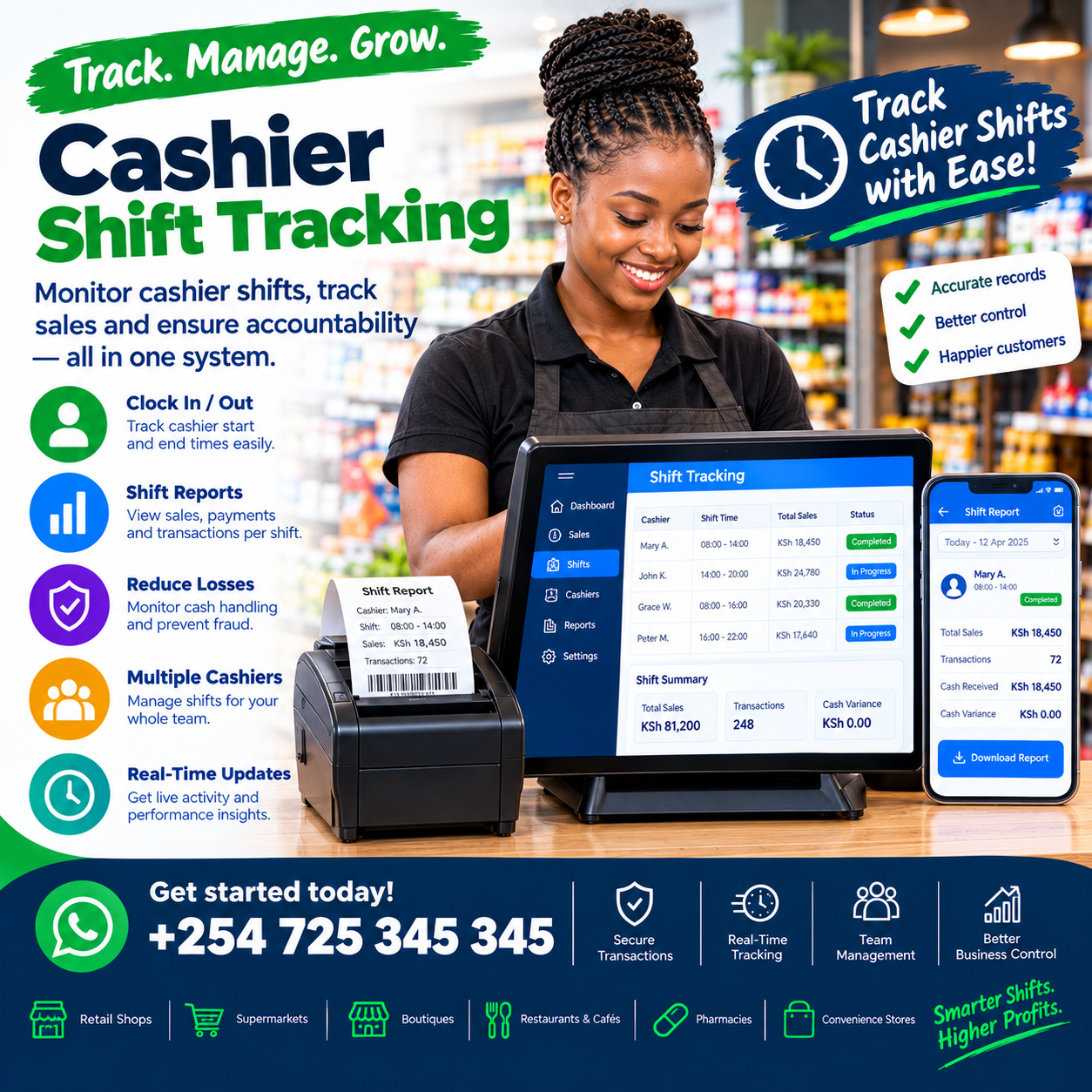
Cashier shift tracking is the quiet discipline that separates a counter you can audit from a counter you can only hope about — because every shop with more than one cashier, or more than one shift, lives or dies on knowing exactly who held the drawer, when, and how it closed.
The problem it solves is as old as retail itself: the drawer comes up short, the discount was given to nobody anyone remembers, and the only witnesses are people whose memories conveniently disagree.
Fragmented counters answer with blame, suspicion, and blanket accusations that poison the team while finding nothing.
A genuine cashier shift tracking structure answers with evidence: every shift opened under a name, every sale stamped to that shift, every drawer reconciled against a system expectation, and every variance named rather than absorbed.
This article builds that structure end to end: what shift tracking actually means, the opening ritual that starts it, the live expectations that run through the day, the handover that closes each shift in thirty seconds, the variance reports that follow, and the attendance and scheduling layers that ride on the same logins.
Then the offline question, the demo test, the rollout, the mistakes, and the worth — because by the end, you will judge every system with one question: can it tell me, for any shift in any month, exactly who held the till and how it added up?
Cashier Shift Tracking: The Connection
A shift is the natural unit of counter accountability — the window between one person opening the till and the next person taking it over.
Everything that goes wrong at a counter happens inside a shift: the shortfall, the suspicious discount, the refund without a return — and everything that goes right deserves the same attribution.
That is why genuine cashier shift tracking belongs inside the point-of-sale: the machine recording the sales is the only machine that knows which hands were on it, hour by hour.
In a proper cashier shift tracking setup, every transaction lands complete with its shift attached: the cashier’s login, the till, the timestamp, and the running expectation the system maintains for that drawer.
Three properties define the real thing.
Named shifts first: no transaction exists without an author — the login is personal, and the shift inherits every action taken under it.
Live expectations second: the system knows what each drawer should hold at any moment, updated sale by sale — so reconciliation is a comparison, not a reconstruction.
Closed loops third: the shift opens with a counted float, trades under continuous tracking, and closes with a counted drawer — the whole arc recorded, searchable, and defensible.
A system without all three produces shifts that are memories, and memories are where counters lose money.
What it is not: a shared login that changes hands at noon, and not an attendance sheet kept by the door — both describe who was present, and neither says what happened at the till.
The distinction matters because presence is not accountability: two cashiers can share a counter all day, and only the system knows whose hands moved on which transaction.
In shops we configure, owners describe the change the same way: shift tracking did not catch anyone — it simply made the questions answerable, which is the everyday promise of a cashier shift tracking setup.
What Shift Tracking Actually Means
Strip away the terminology and the capability is four mechanisms working as one, from the first minute of a shift to the last.
The named open. The shift begins when a cashier logs in under their own credentials and declares their float — the counted cash in the drawer, entered into the system as the opening expectation, the cashier shift tracking baseline every later comparison stands on.
The live ledger. Through the shift, every sale, payout, and top-up updates the system’s running figure for that drawer — the exact amount it should hold at any moment, tracked transaction by transaction without anyone writing anything down.
The counted close. The shift ends with the drawer counted against the expectation: the difference computed automatically, and any variance named, recorded, and attached to the shift that produced it.
The searchable history. Every shift — open, closed, variance, and all — files itself into a permanent record: searchable by person, by till, by date, and by amount, the cashier shift tracking archive that settles questions months later in seconds.
Together the four mechanisms turn the counter from a shared blur into a sequence of accountable, bounded windows — each one owned, measured, and filed.
What the capability is not: a sign-in sheet, a rota on the wall, and not the owner’s memory of who was working last Tuesday — all three describe attendance, and none of them tracks the drawer.
The distinction matters because accountability needs both halves: who was present, and what the till did while they were. Shift tracking joins them into one record, which is what makes every later question answerable.
In shops we configure, the completeness is what owners notice first: for the first time, any day in any month can be replayed shift by shift — the cashier shift tracking depth that no notebook and no shared login ever provided.
The Shift Open: Thirty Seconds That Anchor the Day
Every tracked shift begins with a small ritual, and the discipline of that ritual is what the whole system stands on.
The cashier logs in personally — no shared PINs, no inherited sessions, no “I’ll just use yours” — and the cashier shift tracking record opens under their name, timestamped to the second.
Then the float: the drawer counted, the figure entered, and the system accepting it as the opening expectation — thirty seconds of counting that every later reconciliation depends on.
Shops that skip the float discover the cost weeks later: without a known starting point, no end-of-day figure can ever prove anything — the variance might be today’s trade, or last night’s, or nobody’s.
The float ritual also assigns responsibility cleanly: from the moment the count is accepted, the drawer’s expectation belongs to this shift, this cashier, this login — the cashier shift tracking boundary that ends the “it was already short” argument permanently.
Printers, receipt rolls, and the till screen get a thirty-second check in the same breath: aligned, loaded, and ready — because a shift that opens prepared is a shift that closes clean.
Multi-till shops repeat the ritual per drawer: each till tracked separately, each with its own float, its own expectation, and its own named owner — the cashier shift tracking structure that keeps two counters from blurring into one shared mystery.
And the opening record files itself automatically: who opened, when, with what float — the first entry in a shift’s permanent story, written before the first customer arrives.
Ask every vendor to demonstrate the open live in the evaluation: a login, a float entered, the expectation set — and then a shift opened without a float to see whether the system allows the omission.
A serious system insists on the baseline; one that permits an unanchored shift is inviting every dispute the ritual was designed to prevent.
The Live Shift: Expectations in Real Time
Between the open and the close runs the part most owners never see — the system quietly maintaining a running answer to the oldest question in retail: how much should be in that drawer right now?
Every cash sale increments the expectation automatically, calculated to the shilling on screen — no mental arithmetic, no manual tally, no “roughly” — the cashier shift tracking precision that manual counters never achieve for longer than an hour.
Every payout decrements it: money leaving the drawer for expenses, refunds, or deliveries routes through approval and updates the figure — because unrecorded payouts are the classic hole through which cash discipline dies.
Every top-up and every float adjustment lands the same way: recorded, attributed, and folded into the running expectation — so the drawer’s story has no unexplained chapters.
Mid-shift checks become possible and painless: a supervisor can compare the drawer against the expectation at any moment, catching a drifting till hours before close — the cashier shift tracking early warning that manual shops only get at 9 p.m., when it is too late to matter.
The M-Pesa side rides in parallel: digital payments bind to their sales automatically, so the shift’s takings split cleanly into cash expected in the drawer and digital confirmed on the platform — both reconciled at close, neither reconstructed.
And the whole live picture is visible on the dashboard: shifts in progress, drawers against expectations, and any till that has gone quiet mid-morning — the cashier shift tracking oversight that replaces walking the floor with reading a screen.
Ask every vendor to demonstrate the live expectation in the demo: three cash sales, a payout, and a mid-shift check — the comparison should be instant and exact.
The system that maintains that figure faithfully is the one that makes every close of day boring — which is precisely what a well-run counter should be.
The Handover: Thirty Seconds Between Shifts
The moment one cashier leaves and another takes over is where accountability historically dissolved — and it is where a tracked counter shows its sharpest advantage.
The closing ritual is short and absolute: the outgoing cashier counts the drawer against the system’s expectation, the difference — if any — is computed and recorded, and the shift closes under their name.
Then the incoming cashier logs in, counts their float, and opens their own shift — the cashier shift tracking handover that takes thirty seconds and ends the era of blurred boundaries forever.
Before tracking, the handover was the shop’s most dangerous moment: one drawer passed between two names, both responsible for nothing, both blameless for everything — and every shortfall in the month traced back to a moment nobody could pin.
After tracking, the same moment is two clean records: one shift closed and filed, another opened and anchored — with no window in between where responsibility went dark.
The variance conversation, when one exists, happens in the handover’s thirty seconds: the outgoing cashier sees the difference immediately, explains or corrects it on the spot, and the record keeps whatever was said — the cashier shift tracking immediacy that turns disputes into clarifications.
Shift notes belong in the same ritual: anything the next shift needs to know — a broken item, a waiting customer, an unusual payout — recorded against the shift rather than carried in memory.
And the handover report files itself: close time, float in, takings, variance, notes — the cashier shift tracking document that used to take a page of handwriting and now takes none at all.
In shops we configure, owners name the handover as the moment the change became visible: the arguments between shifts simply stopped, because the boundaries finally had edges.
Variances: Naming the Shift, Not the Mystery
Every counter produces variances eventually — the discipline is whether they arrive as named, small, explainable events or as month-end mysteries with no address.
On a tracked counter, the variance is born at the close: the counted drawer against the expectation, the difference computed to the shilling, and the result attached to the shift that produced it — the cashier shift tracking specificity that manual shops never achieve.
Small variances are normal: rounding, miscounts, and the honest accidents of a busy day — and the report exists to show them as small, so the owner stops treating every shilling like a scandal.
Patterns are the signal: one variance is noise; one cashier with weekly shorts, one till that drifts every Friday, or one shift-time that misses consistently — those are conversations, and the cashier shift tracking report exists to surface them early while the trail is warm.
The variance report reads in five minutes: every shift of the week, its expectation, its count, its difference — ranked by size, filterable by person and by day.
Act through process, never ambush: a pattern earns a conversation, a review of the exception report, or a quiet check of the footage — because data used as a weapon destroys the trust the tracking was built to create.
And the clean weeks count too: months of small or zero variances are evidence your counter is tight — proof for your insurer, your accountant, and your own sleep, the cashier shift tracking quiet that means the structure is working.
The honest framing for the team: tracking protects the honest first, because a named, reconciled shift is a shift nobody can hang a loss on — and that reassurance is worth more to your best cashier than to you.
Ask every vendor to plant a variance in the demo: a drawer counted with a deliberate difference — the system should name the shift, the till, and the time in seconds, and file it into the report without anyone writing anything.
Attendance and Hours: The Same Logins, Twice the Value
The logins that anchor shift tracking carry a second gift at no extra cost: they become your attendance record, built as a by-product of trading.
Every shift open is a clock-in; every close is a clock-out — the hours worked, per person, per day, accumulating automatically into the cashier shift tracking record that payroll has always needed and never had.
No timesheets to fudge, no memory to argue with at month-end, and no separate attendance system to buy, feed, or ignore — the clock lives in the till the staff already use.
Late starts surface as patterns, not accusations: the shift that begins twelve minutes late three Fridays running is a conversation with evidence attached, and the cashier shift tracking data makes it fair on both sides.
Overtime, leave, and shift swaps gain the same clarity: every change recorded, approved, and payable without a reconstruction session at the end of the month.
For teams paid hourly, this alone justifies the structure: attendance disputes are among the most expensive conversations in retail, and tracked hours end them before they start.
And the attendance data feeds scheduling: real coverage compared against real traffic — the mismatch between your busiest hour and your actual staffing, invisible until the two records sit side by side.
Ask every vendor how attendance connects to payroll: the confident answer is a clean export the accountant confirms in minutes, flowing from the same cashier shift tracking logins the counter already runs on.
The rule that keeps the record honest: staff sign in at the till they will actually work — an attendance record tied to the counter is the one nobody argues with.
Scheduling Against the Real Rush
Once shifts are tracked and hours are logged, a quieter advantage emerges: your roster can finally follow your shop’s true rhythm instead of its remembered one.
Hourly sales data, per shift and per till, shows when the counter actually peaks — and the cashier shift tracking history reveals the gap between the rush you assume and the rush that pays.
Shops that align rosters to the measured curve report the same two results: faster queues at rush hour, and a payroll that stops paying for empty hours — both from one scheduling correction.
Peak-to-quiet comparisons expose the drift: if transactions slow when the shop is fullest, staffing is inverted — and the tracked data names the exact hours to fix.
Month-end peaks, pay-week surges, and holiday patterns repeat, and your tracked history makes them plannable instead of surprising — the cashier shift tracking calendar written by the shop’s own customers.
Performance joins the same picture: sales per cashier per shift, baskets by hour, speed at peak — the fair comparisons that only work when every shift feeds the same system.
Promotion and correction both stand on evidence instead of affection — and in groups we have watched, the staffing decisions that followed the first months of tracked data were the highest-value personnel moves those owners had ever made.
Ask every vendor to show the shift-performance view live: cashiers ranked by shift, hours by day, peaks against coverage — the cashier shift tracking reporting that turns the rota from a habit into a decision.
The scheduling payoff compounds quietly: better coverage at the true peak, fewer paid empty hours, and a team measured fairly — all flowing from the same logins that anchored the drawer.
The Exception Report: The Shift-Watcher’s Daily Read
Beneath the floats and the closes runs the layer that catches what the arithmetic alone cannot: the exception report, read daily, tuned to speak only when something departs from normal.
It lists the departures: unusual voids, discounts beyond policy, refunds without matching returns, price overrides, and tills that went silent mid-shift — the cashier shift tracking early warning that replaces supervision with evidence.
Every entry carries its attribution: the name, the till, the shift, and the time — so the follow-up is a conversation with the facts attached, never an ambush built on a feeling.
Read it in five minutes each evening with three questions: is there a pattern, is there a person, is there a time? One odd refund is noise; one cashier’s cluster of voids is a conversation.
The report protects the honest most of all: weeks of clean lists are evidence the counter is tight, and a named clean shift is a shift nobody can implicate — the cashier shift tracking reassurance that keeps good staff working with the system rather than around it.
Set the thresholds thoughtfully at the start: alerts too sensitive become noise, and noisy alerts get muted — tuning matters in week one and every quarter after.
And never let the list pile up unread: an exception report ignored for a month is a notebook with better graphics — the same blindness, wearing a screen.
Ask every vendor to populate the exception view in the demo with realistic events — an empty alert screen is a checkbox, not a feature.
The five minutes is the entire cost of the early warning: the highest-yield reading habit in the whole structure, and the one that every cashier shift tracking owner either builds or regrets.
Offline: The Shift Survives the Router
Shifts happen through power cuts and fibre cuts in this market — and the tracking cannot pause just because the network did.
A genuine cashier shift tracking system must therefore be offline-first: the login, the float, the running expectation, and the close all work locally at full speed, and everything syncs in order when the line returns.
The test is physical and takes two minutes: unplug the router mid-shift, ring cash sales, process a payout, close the shift offline — then reconnect and watch the whole arc land intact.
Systems that freeze, lose the shift context, or fail to record the close offline fail this test — and they fail it on the busiest Saturday, when networks choose to die and accountability matters most.
Attribution continues offline too: the sales recorded during the outage still carry the shift and the name, because a disconnected counter is precisely when discipline matters most.
Power rides the same drill: a battery-backed tablet keeps the shift alive through the blackout that kills a desktop tower — because power and connectivity usually fail together.
Make offline behaviour a written acceptance item in your agreement, tested with a full shift before the final payment on any cashier shift tracking system you are considering.
Ask each vendor one number: how long can shifts trade and close fully offline before anything is at risk?
The confident answer is measured in weeks, not hours — and it separates a system built for this market from one adapted to it.
Choosing a Cashier Shift Tracking Setup: The Demo Test
Bring this script to every vendor; it converts claims into evidence in twenty minutes.
Open a shift live. A personal login, a float entered, the expectation anchored — then confirm the shift appears on the dashboard under the right name.
Run the live check. Three cash sales and a payout, then a mid-shift comparison — the drawer expectation must be exact, to the shilling.
Break a handover. Close the shift with a planted variance, and watch the system name the shift, the till, and the time — then open the next shift and confirm the boundary is clean.
Test the attendance link. Check that hours, late starts, and shift history flow from the same logins — and that the cashier shift tracking data exports cleanly for payroll.
Read the variance report. A week of shifts with realistic variances — ranked, filterable, and readable in five minutes, not an empty screen.
Attempt a shared login. Two users on one credential, or an action without a login — a serious system blocks both, because attribution is the product.
Unplug the router mid-shift. Trade and close offline, reconnect, and watch the arc land intact — non-negotiable in this market.
Ask the month-thirteen question. What appears on the invoice later that is not on this quote today?
A vendor who welcomes this script has built the structure; a vendor who steers toward a rota feature is selling attendance wearing a till’s clothes.
Then ask for one reference from a business your size and a single question: when did you last have a till argument between shifts?
The answer from an owner running real cashier shift tracking — usually a pause, then a date from months ago — teaches you more than any demonstration.
Rolling Out Shift Tracking
The rollout has one sensitive task: introducing structure to a counter that may have run on trust for years — and the communication matters as much as the configuration.
Announce it openly as protection for the shop and the people in it: a record that clears the honest is worth as much as the one that flags the rest, and that sentence, kept, buys a team that works with the structure.
Configure the logins first: one per person, no shared PINs anywhere including yours — the foundation laid before the first tracked shift opens.
Define the shift pattern next: opening floats, handover times, and who closes what — decided once, encoded in the system, applied everywhere.
Train every person who will ever touch the till: the open, the live flow, the close, and the handover — rehearsed on real hardware until the ritual survives a busy Saturday.
Nominate a champion by name; counters learn fastest from the peer who has already made the mistakes.
Run parallel deliberately: the old habit and the tracked shifts side by side for two or three days — then retire the old way formally, on an ordinary trading day.
Do not retrofit suspicion: do not re-examine last year’s drawer through the new lens, because the point of the rollout is that the guessing era ends at go-live, not that it gets rewritten backwards.
Book the week-one review at the same time as the setup: reconcile the first closes, tune the thresholds, and read the first variance report together with the team.
A structured cashier shift tracking rollout typically runs days, not weeks — because the architecture rides inside the till you already run.
The first month of clean closes — every shift filed, every variance explained, every argument that never happened — is the milestone owners describe as the day the counter grew up.
Mistakes Owners Make
Five patterns catch owners first; learn them here without paying for them.
Keeping one shared login. The most common and most costly habit — one shared PIN erases the name from every action, and every shift downstream goes slack. A cashier shift tracking cannot defend what it cannot attribute.
Skipping the float ritual. The shift that opens without a counted baseline is a shift whose close proves nothing — thirty seconds at open, or a month of unanswerable questions at the end.
Using tracking as a weapon. Ambushes built on variance reports end teams and trust at once — data earns conversations, and conversations follow process, or the cashier shift tracking structure gets quietly sabotaged by the people it watches.
Never reading the reports. Shifts filed, variances computed, exceptions flagged — and nobody opens any of it: the most common failure in the category, and the difference between tracking and wallpaper.
Ignoring the attendance link. Hours flowing to payroll by memory and argument while the tracked data sits unused — the cashier shift tracking bonus left on the table every month.
A sixth worth naming: forgetting the leavers — an ex-employee whose login nobody remembered to remove is the quietest hole in the structure; deactivate the same day, everywhere, always.
Owners who avoid these five get what proper cashier shift tracking promises and few deliver completely: shifts that reconcile, handovers with edges, and a team that knows the record protects them first.
What Shift Tracking Is Worth
Price the return honestly, in the currencies it pays.
Ended till arguments. The disputes between shifts, the blame that had no address, the suspicion that poisoned quiet afternoons — ended by records that answer before voices rise, the cashier shift tracking dividend owners mention first.
Recovered leakage. Variances named while small, payouts gated, discounts attributed — the counter losses that were invisible in shared-login shops becoming specific, manageable events.
Cleaner payroll. Hours from the same logins, attendance without arguments, overtime recorded — the cashier shift tracking data that ends the month-end negotiation permanently.
Fairer team, better retention. Best performers visible, comparisons fair, and the honest protected — the cultural return that keeps good cashiers longer than any pay rise alone.
The costs are modest: shift tracking rides inside a normal mid-tier subscription — typically KES 3,000–7,000 monthly — with no separate product to buy.
Against that, a single resolved dispute or one recovered variance pattern usually covers a year of the subscription — before counting the daily calm the structure provides.
And the compounding line is the archive itself: a year of named, reconciled shifts is the most defensible account of your counter that exists — the foundation for insurance, audits, and every future hire’s training, built one clean cashier shift tracking shift at a time.
Frame it the way the best owners do: the shift is the natural unit of counter trust — and tracking is simply what makes the unit countable.
Different Trades, Same Structure
The tracking flexes by trade; four quick portraits.
Groceries and mini-marts. Volume and multi-shift days — handovers three or four times daily, each one a thirty-second ritual instead of a blurred boundary.
Restaurants and takeaways. Split shifts and peak-driven rosters — the cashier shift tracking data aligning coverage to the dinner rush, with tips and payouts gated per shift.
Pharmacies. Regulated counters and controlled dispensing — shift-level attribution deep enough for auditors, with permissions that hold through every handover.
Boutiques and phone shops. High-value items and small teams — even two staff benefit from named shifts, and the cashier shift tracking record becomes the shop’s first defence on its most valuable stock.
The pattern generalises: name the shift boundaries your counter actually runs on, and make the vendor prove the tracking follows them — floats, closes, handovers, and variances, demonstrated live.
For every trade, the foundations hold: named opens, live expectations, counted closes, and attributed exceptions — the four that no counter should ever run without.
Frequently Asked Questions
What does cashier shift tracking actually do?
It gives every shift a name and a number: the cashier logs in personally, declares their float, trades under a live drawer expectation, and closes with a counted reconciliation — every step timestamped and filed into a searchable history.
A genuine cashier shift tracking setup turns every dispute between shifts into a lookup that takes seconds.
How does the handover between shifts work?
The outgoing cashier counts the drawer against the system’s expectation, the difference — if any — is computed and recorded, and the shift closes under their name; the incoming cashier logs in, counts their float, and opens fresh.
The whole ritual takes thirty seconds, and the cashier shift tracking record means no boundary is ever blurred again.
Will it catch who caused a shortfall?
It will attribute it: the variance names the shift, the till, and the time — and patterns across weeks surface the conversations worth having.
A cashier shift tracking report does not accuse anyone; it simply makes every answer available, which changes behaviour before anyone is ever asked.
Does it also track attendance and hours?
Yes — the same logins become the clock: every shift open is a clock-in, every close a clock-out, and the hours flow to payroll without a separate attendance system.
Confirm the payroll export during the demo of any cashier shift tracking setup you evaluate.
Does it work when the internet is down?
A properly engineered one does: logins, floats, sales, and closes all work offline at full speed, and the whole shift syncs in order when the connection returns.
Make the unplugged shift test a written acceptance item on any cashier shift tracking before the final payment.
Is this worth it for a shop with only two cashiers?
Usually yes — even two people create handovers, shared-drawer risks, and month-end questions, and the tracking rides inside a normal subscription rather than costing extra.
The first clean month on a cashier shift tracking setup — no arguments, clean handovers, hours flowing to payroll — is typically when small-shop owners stop asking whether two cashiers needed it.