 Vega
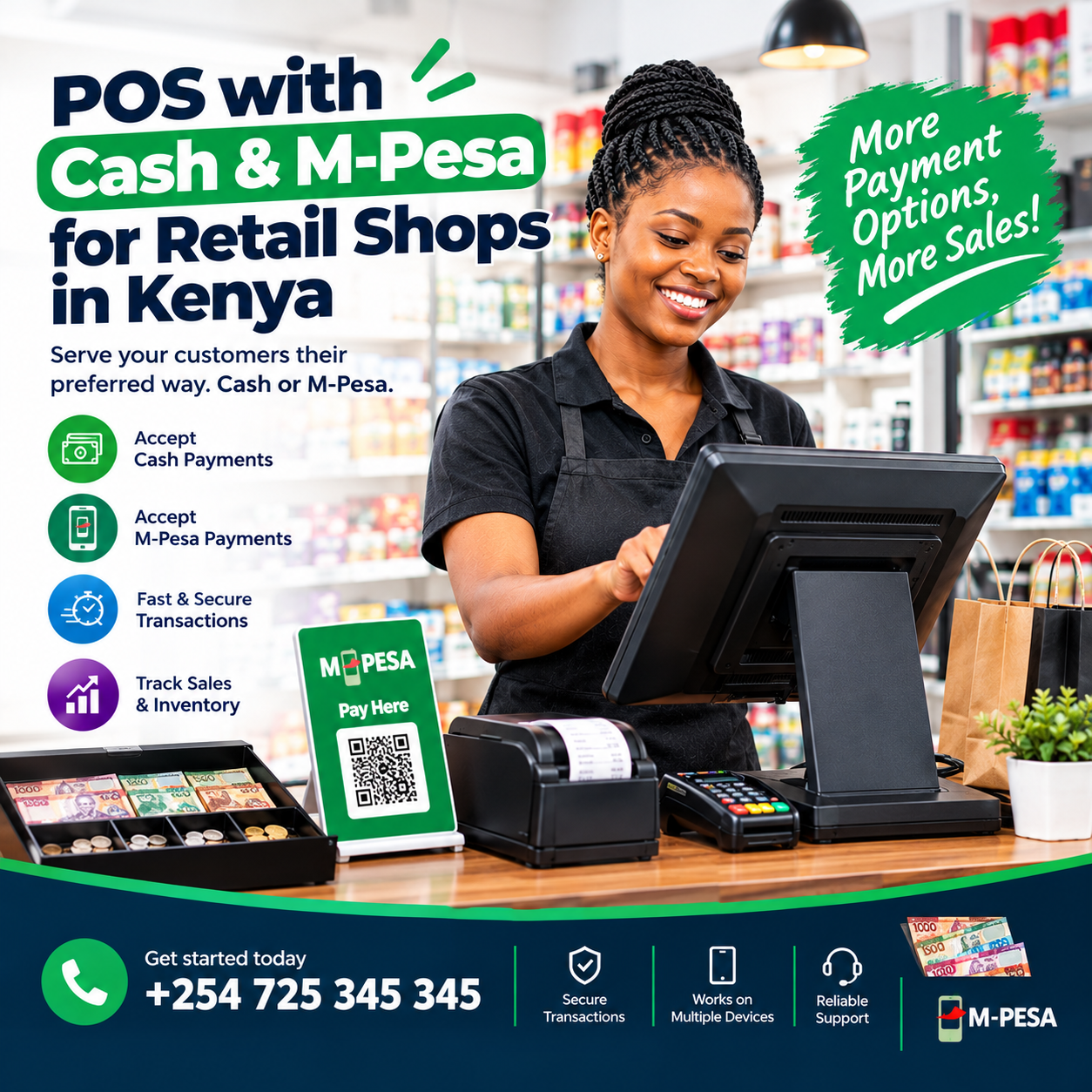
POS with cash and M-Pesa describes the counter every Kenyan shop actually runs: a till that takes notes and coins in one hand and a mobile money confirmation in the other, often in the same basket.
Cash still carries most of daily trade, and M-Pesa carries the rest — and a counter that treats one properly while improvising the other loses money in both.
The cash side leaks through uncounted drawers and unnamed actions.
The M-Pesa side leaks through the evening matching ritual, where messages and receipts are reconciled by eye and the odd unexplained payment is absorbed.
A genuine POS with cash and M-Pesa ends both leaks with one structure: cash disciplined by floats and shift counts, M-Pesa recorded against sales automatically, and both channels reconciled into one evening report.
This article builds that structure piece by piece: how cash handling works inside a modern till, how M-Pesa integration actually connects, how split payments and repayments fit, and how the end-of-day ritual closes both channels to the shilling.
Then the offline test, the demo script, the costs, and the mistakes.
By the end, you will judge every system with one question: does every shilling — paper or digital — land on one reconciled record?
POS with Cash and M-Pesa: The POS Connection
Payments and sales are the same event — and the till is where they must meet.
When a sale is rung and a payment taken, the point-of-sale system is the only machine positioned to bind the two: the items, the amount, the method, and the moment, on one record.
That is why a genuine POS with cash and M-Pesa is a property of the point-of-sale system, not two tools sitting side by side.
In a proper POS with cash and M-Pesa, every payment — notes counted or prompt confirmed — lands against its sale automatically, stamped with the method and the reference.
Three properties define the real thing.
Dual-channel first: cash and M-Pesa treated as equal first-class paths on the same payment screen — no workarounds, no parallel records.
Automatic recording second: M-Pesa confirmations attach to their sales by themselves, and cash expectations are calculated by the system, not remembered.
Reconciliation third: at close of day, takings split by channel — cash against the drawer, M-Pesa against the phone — each line agreeing to the shilling. A POS with cash and M-Pesa without all three produces two half-records that argue every evening.
What it is not: a cash register with an M-Pesa till number written beside it, and not a till that records cash while M-Pesa lives in the shop phone’s inbox.
The distinction matters because the two channels leak differently: cash leaks through the drawer, M-Pesa leaks through the matching gap — and only a system that binds both to their sales closes either.
In shops we configure, the moment both channels integrate is the moment the evening ritual ends: the POS with cash and M-Pesa difference owners describe as getting their evenings back.
Cash Discipline: The Drawer Half of a POS with Cash and M-Pesa
Cash is the oldest payment rail and the leakiest — and the till disciplines it the way no notebook ever could.
The discipline starts with the float: the shift opens with a counted drawer, entered into the system as the opening expectation — the POS with cash and M-Pesa baseline every later comparison stands on.
During the shift, every cash sale adds to the system’s running expectation: the exact figure the drawer should hold, updated transaction by transaction.
The drawer pops on completed sales, change is calculated on screen, and large-note exchanges are recorded — the small mechanics that keep hands and records aligned all day.
At shift close, the ritual takes thirty seconds: the drawer counted against the expectation, the difference — if any — named and recorded before the next cashier begins.
That thirty-second count is the whole difference between shops that catch variances and shops that absorb them: a POS with cash and M-Pesa turns the drawer from a trust exercise into a reconciled account.
Per-shift attribution completes the discipline: every cash sale, every drawer top-up, every payout carries the cashier’s name — so a short drawer names a shift, not a mystery.
Cash payouts deserve their own gate: money leaving the drawer for expenses, refunds, or deliveries routes through approval and lands on the record — because unrecorded payouts are the classic hole in cash discipline.
And the cash report closes the loop: takings by shift, variances by drawer, patterns by person — readable in five minutes each evening.
In shops we configure, owners running this discipline report the same quiet outcome: cash variances shrink to zero or near it within the first quarter — not through suspicion, but through structure.
That is the drawer half of a POS with cash and M-Pesa done properly: cash treated as data, not as a drawer that is mostly right.
M-Pesa Integration: The Digital Half of a POS with Cash and M-Pesa
M-Pesa is the digital half of the counter — and integration depth decides whether it reconciles itself or becomes the evening’s puzzle.
The integration levels are worth naming precisely, because the market sells all of them under one label.
Level one is the sticker: the till records cash, and M-Pesa payments are noted separately — on paper, in the phone’s inbox, in a manager’s memory.
Level two is the manual record: the cashier types that an M-Pesa payment was received against the sale, code and all — better, but mistyped, skipped, and unverifiable in practice.
Level three is the live link: the POS with cash and M-Pesa triggers the payment prompt from the sale screen, the customer confirms, and the sale marks itself paid with the reference stamped — automatically, every time.
Only level three deserves the name — and it changes the counter’s rhythm visibly.
The payment prompt arrives on the customer’s phone within seconds: no numbers dictated across the counter, no typos in the till number, no paying the wrong shop.
The confirmation returns to the sale screen while the customer is still standing there: paid, receipt printing, next customer.
Wrong amounts and wrong recipients largely stop existing — the error moment is removed, not caught.
And the record stays whole: the payment lives on the sale it belongs to, searchable months later — the POS with cash and M-Pesa audit trail that paper matching never produced.
Direct transfers sent outside the flow — a customer paying the till number from home the night before — get received and matched too: a receive-and-match flow keeps records whole however money actually arrives.
Ask every vendor which level they sell, then verify it live: a real prompt triggered from the sale screen, confirmed on a real phone, the sale turning paid with the reference visible.
A POS with cash and M-Pesa that demonstrates level three in one minute has passed the digital half’s defining test.
Split Payments: Where Cash and M-Pesa Meet
Real baskets rarely respect one payment method — and the meeting point is where weak systems show their seams.
The everyday scene: a 5,300-shilling basket, 3,000 in cash, the balance by M-Pesa.
On a paper counter, that becomes two half-records and a small evening argument.
On a proper POS with cash and M-Pesa, it is one sale with two payment lines: cash entered, the M-Pesa prompt triggered for the balance, the receipt showing both, the record complete.
Split payments should take seconds, because the queue behind the customer is measuring them.
The same flow covers deposits and part-payments: half today for goods collected Friday — the order held, the balance visible, no note under the till.
Group baskets fit the pattern: several customers splitting one bill across methods and wallets — each contribution recorded, the total closing cleanly.
And the reverse direction matters equally: a refund on a split payment returns through both channels, attached to its original — no cash conversations, no missing money.
Test splits explicitly in every demo: part cash, part M-Pesa on one basket, timed — the POS with cash and M-Pesa flow customers create daily, proven in seconds.
The counter rule worth adopting: any payment combination a customer can describe in one sentence, the till should complete in one transaction.
A system that passes that rule all day has made payment methods the customer’s choice — and choice is what customers reward with return visits.
The End-of-Day Reconciliation Ritual
Close of day is where a POS with cash and M-Pesa either delivers its promise or reveals its absence — so let us walk both evenings.
The integrated evening. The day closes at the till: takings split by channel — cash against the drawer count, M-Pesa against the system’s recorded confirmations — each line reconciled to the shilling.
Exceptions appear on a short list, not hidden inside totals: one payment awaiting confirmation, one refund flagged, one till variance named.
Five minutes, one screen, the day done.
The manual evening. The receipt roll matched against the phone’s inbox, line by line: scrolling, squinting at timestamps, guessing which 8:40 a.m. message belongs to which sale.
Personal transfers tangled in the same inbox. One payment of 2,350 that matches nothing. Forty minutes later, one mystery absorbed.
The difference between the two evenings is the entire commercial argument for a POS with cash and M-Pesa: twenty-plus hours a month returned, discrepancies ended at the source, and books that close themselves.
The ritual requirements deserve honesty: automation still needs the ritual — close the day deliberately, count the drawer, read the exceptions — five minutes that keep the numbers trustworthy.
Shops that keep the ritual get the full value of their POS with cash and M-Pesa; shops that skip it slowly rebuild the darkness they paid to remove.
And the payoff compounds: when every day reconciles cleanly, month-end becomes a quiet review of thirty already-agreed days — and the accountant receives exports instead of archaeology.
That is the promise worth holding every vendor to: end-of-day in five minutes, both channels, every day.
Preventing Leakage Across Both Channels
Every counter carries two leak profiles — cash leakage and digital leakage — and a proper POS with cash and M-Pesa closes both with the same few controls.
The cash leaks. Under-ringing, drawer skimming, unrecorded payouts, and the discount to nobody — each depends on no record existing.
Personal logins close the door: every cash sale, payout, and discount stamped with a name — the POS with cash and M-Pesa attribution that changes behaviour before anyone is accused.
The digital leaks. The M-Pesa payment taken but the sale rung smaller, the confirmation deleted, the personal number quietly collecting shop money.
Integration closes these structurally: when every M-Pesa confirmation must find its sale, the gap between payments and records has nowhere to hide — a POS with cash and M-Pesa makes pocketing the difference visible by design.
The exception report watches both. Unusual voids, discounts beyond policy, cash variances by shift, M-Pesa payments without matching sales — the daily five-minute read that replaces worry.
Patterns are the signal: one odd refund is noise; one cashier’s twelve voids, or one till’s weekly shorts, are conversations.
Approvals guard the exceptions. Refunds, voids, and discounts beyond policy route to a supervisor or your PIN — the two-person event that ends most counter abuse structurally.
Honest staff gain the most: a record that clears them is worth as much as the one that flags the rest — and teams settle into the structure within a fortnight.
In shops we configure, owners describe the same sequence: first the variances fade, then the arguments end, then nobody mentions the till at all — the POS with cash and M-Pesa quiet that means the structure is working.
Offline Mode: When Both Channels Survive
The rule of Kenyan trading: the busiest hours and the network failures share a calendar — and the counter must survive both channels failing differently.
Cash needs nothing: notes and coins work through any outage, as they always have.
M-Pesa rides the mobile networks, not your shop’s broadband — so during a fibre cut, your customer’s phone still sends the payment perfectly well.
The question a genuine POS with cash and M-Pesa must answer: can the till record both channels while its own internet is down?
Well-built systems handle it cleanly: the catalogue and prices live on the terminal, cash sales complete at full speed, M-Pesa payments are recorded locally against their sales, and everything syncs in order when the line returns.
The worst systems fall back to the notebook at exactly the moment the shop is busiest — the failure this technology exists to end.
The test is physical and takes two minutes: unplug the router mid-basket, complete a cash sale, record an M-Pesa payment against a second sale, print both receipts, reconnect, and watch the clean sync.
Systems that freeze, degrade, or lose the queued records fail this test — and they fail it on your busiest Saturday.
Power rides the same drill: a battery-backed tablet keeps both channels alive through the blackout that kills a desktop tower.
Make offline behaviour a written acceptance item before the final payment on any POS with cash and M-Pesa you are considering.
Ask each vendor one number: how long can the shop trade both channels fully offline before anything is at risk?
The confident answer is measured in weeks, not hours — and it separates a system built for this market from one adapted to it.
Reports: Reading Both Channels
The reconciled record unlocks the reports that paper counters never produced — and they change decisions weekly.
Takings by channel. Cash, M-Pesa, and any card — daily, weekly, monthly, each reconciled — the POS with cash and M-Pesa view that tells you instantly how much of today’s money is in the drawer and how much is already digital.
Cash variances by shift. Every drawer against its expectation, every difference named — the report that makes cash discipline visible instead of hoped for.
M-Pesa patterns. Digital share rising, peak confirmation hours, unmatched payment trends — the POS with cash and M-Pesa intelligence that informs float sizes, banking rhythms, and staffing.
Settlement timing. Money that lands instantly versus money that arrives tomorrow — working capital made a schedule instead of a surprise.
The exception list. Both channels’ anomalies in one place: till shorts, unmatched payments, voids, and discounts — five minutes of reading that replaces an evening of wondering.
Reports should arrive on your phone without export buttons — the shop visible from the bank queue or the supplier’s yard.
Ask every vendor to demonstrate the channel reports on realistic numbers — and to drill any figure to its source: sale, payment, cashier, time.
A POS with cash and M-Pesa report that cannot survive a follow-up question is a summary, not a tool.
Choosing a POS with Cash and M-Pesa: The Demo Test
Bring this script to every vendor; it converts claims into evidence in twenty minutes.
Trigger a real M-Pesa payment. From the sale screen, to a real phone: prompt, confirmation, sale turning paid with the reference stamped — the POS with cash and M-Pesa level-three test, timed.
Run a split payment. Part cash, part M-Pesa on one basket — two payment lines, one receipt, seconds on the clock.
Break the cash discipline. Count a drawer against the system’s expectation, plant a variance, and watch it name the shift — then read the cash report.
Attempt a leak. Ring a sale smaller than the M-Pesa payment received — the mismatch should surface immediately, not at month-end.
Read the exception report. Populated with realistic events — voids, variances, unmatched payments — not an empty screen.
Unplug the router mid-basket. Complete a cash sale, record an M-Pesa payment offline, reconnect — non-negotiable in this market.
Ask the month-thirteen question. What appears on the invoice later that is not on this quote today?
A vendor who welcomes this script has built both channels; a vendor who steers toward one is selling half a counter.
Then ask for one reference from a business your size and a single question: what does your close of day look like now?
The answer from an owner running a real POS with cash and M-Pesa — usually five minutes, told with some relief — teaches you more than any demonstration.
Rolling Out Both Channels
Dual-channel rollout is gentle when sequenced — and the shop never closes.
Configure cash first: floats defined, shift-close expectations set, payout approvals configured — the POS with cash and M-Pesa drawer discipline decided before the first sale.
Then M-Pesa: the integration tested with live prompts and confirmations before training day — real transactions, not simulations.
Set the banking rhythm deliberately: cash banked on a schedule, M-Pesa settlement timing understood, accounts separated — the three-way story that keeps records lender-ready.
Train the whole team on both channels: the cash sale, the prompt flow, the split payment, the offline drill, and the shift close — rehearsed until the fastest and most hesitant cashier move alike.
Nominate a champion by name; counters learn fastest from the peer who has already made the mistakes.
Run parallel for two or three days — new system and old process side by side — comparing takings by channel each evening before cutting over fully.
Book the week-one review at the same time as the setup: reconcile, correct small drifts, and tune the screen layout against what the counter actually taught you.
A structured POS with cash and M-Pesa rollout typically runs one to two weeks from booking to confident independent trading — with the doors open every day.
The first reconciled Friday — both channels closed in five minutes, no mysteries left in the drawer or the inbox — is the milestone owners describe as the day the counter finally grew up.
Mistakes Owners Make
Five patterns catch owners first; learn them here without paying for them.
Buying the sticker level. A till that records cash while M-Pesa lives in the phone’s inbox is the old ritual with new paper — confirm level three live on any POS with cash and M-Pesa before you sign.
Skipping the float discipline. The drawer counted at open, reconciled at close — the thirty seconds that separate caught variances from absorbed ones.
Letting the shop money mix with personal. The M-Pesa line receiving customer payments and family transfers tells the record nothing — a dedicated till number and separated accounts are free fixes with disproportionate effect.
Never reading the exceptions. Voids, variances, and unmatched payments flagged and ignored — a POS with cash and M-Pesa earns its keep through the daily five-minute read.
Testing only the happy path. One clean cash sale proves nothing — the split payment, the failed prompt, the offline recording, and the planted variance are where truth lives.
A sixth worth naming: keeping the paper habit in parallel forever — the notebook and the till both running re-create the very disagreement the switch existed to end.
Owners who avoid these five get what a proper POS with cash and M-Pesa promises and few deliver completely: every shilling recorded, every evening reconciled, and both channels working as one.
What a POS with Cash and M-Pesa Is Worth
Price the return honestly, in the currencies it pays.
Recovered evenings. The forty-minute matching ritual compressed into five minutes of reading — twenty-plus hours a month returned, the POS with cash and M-Pesa dividend owners mention first.
Ended discrepancies. The unexplained payments and monthly mysteries stop at the source — every payment bound to its sale, every drawer to its expectation.
Closed leaks. Cash variances named by shift, digital gaps made visible by design — the POS with cash and M-Pesa structure that turns losses into conversations instead of absorptions.
Bankable records. Clean channel splits and reconciled days — the file that lenders, accountants, and SACCO committees actually want to see.
The costs are modest: dual-channel capability rides inside a normal mid-tier subscription — typically KES 3,000–7,000 monthly — with hardware bundles from KES 50,000–80,000 where needed.
Against that, the recovered evenings alone usually cover the subscription several times over — before counting a single prevented leak.
And the compounding line is the record itself: a year of reconciled days is the most honest account of your business that exists — the foundation for borrowing, insuring, and expanding, built one clean POS with cash and M-Pesa evening at a time.
Frame it the way the best owners do: cash and M-Pesa are just two languages for the same money — and a proper till is the translator that keeps the books true in both.
Frequently Asked Questions
What does a POS with cash and M-Pesa actually do?
It records both payment channels against every sale on one record: cash counted against system expectations by shift, and M-Pesa payments confirmed automatically with references stamped — then reconciles both into one end-of-day report. A genuine POS with cash and M-Pesa closes the evening in five minutes with no mysteries left in either channel.
How does the M-Pesa integration work?
At the level worth buying, the till triggers the payment prompt from the sale screen, the customer confirms on their phone, and the sale marks itself paid with the reference attached — automatically. Verify the live flow in the demo of any POS with cash and M-Pesa you evaluate: real prompt, real confirmation, timed.
Can customers pay part cash and part M-Pesa?
Yes, and it must be effortless: one basket, two payment lines, one receipt, completed in seconds. Test the split live in the demo of any POS with cash and M-Pesa before you sign — it is the flow your customers create daily.
Will both channels work when the internet is down?
Cash works through any outage, and M-Pesa rides the mobile networks rather than your broadband — a properly engineered till records both locally and syncs in order when the line returns. Make the unplugged dual-channel test a written acceptance item on any POS with cash and M-Pesa before the final payment.
How does it prevent cash going missing?
Through structure: counted floats, per-shift expectations, named logins, payout approvals, and a variance report that names the shift rather than the mystery. The POS with cash and M-Pesa drawer discipline changes behaviour before anyone is accused — and protects the honest staff first.
Is this worth it for a small shop?
Usually yes — small shops feel every lost evening and every unexplained payment hardest, and the dual-channel features ride inside a normal subscription rather than costing extra. The first reconciled month on a POS with cash and M-Pesa — evenings free, books boring, every shilling accounted for — is typically when small-shop owners stop asking whether they needed it.